How to Train a Service Dog: A Complete Behavior & Task-Training Guide
Learn how to train a service dog with step-by-step behavior protocols, task-training techniques, timeline expectations, and expert tips for success.

What Qualifies as Service Dog Behavior? Defining the Standard
Service Dog Behavior Threshold: A dog qualifies as a service animal under the Americans with Disabilities Act (ADA) when it is individually trained to perform work or tasks directly related to a person's disability. The behavioral bar is exceptionally high: the dog must remain calm, focused, and non-disruptive in any public environment — hospitals, airports, restaurants, and crowded streets — without soliciting attention, showing aggression, or becoming distracted from its handler.
Unlike therapy dogs or emotional support animals, service dogs must demonstrate what trainers call "public access behavior." This includes:
- Neutral environmental response: Ignoring dropped food, other animals, loud noises, and strangers attempting to pet them
- Settle-on-command: Lying quietly under a table or beside a chair for 60-90 minutes without fidgeting or vocalizing
- Loose-leash walking: Maintaining a consistent position (typically left-side heel) without pulling, sniffing, or marking
- Task execution under distraction: Performing trained tasks (retrieving items, alerting to sounds, providing deep pressure) even in high-stimulation environments
- No elimination indoors: Reliable house training with the ability to hold for 8+ hours during long outings
If you're searching for how to train a service dog, understand that the process is closer to training a working professional than teaching household obedience. According to Assistance Dogs International (ADI), professional programs invest 1,500-2,500 hours over 18-24 months per dog, with an average program cost of $25,000-$50,000. Owner-training is a viable path, but it demands the same rigor.
Why Does My Dog Struggle With Service Dog Behaviors? Root Cause Analysis
Diagnostic Framework: Identifying Why Your Dog Can't Focus or Settle
- Fear/Anxiety: Dog freezes, tucks tail, pants excessively, or attempts to flee in public spaces. Common in under-socialized dogs or those with single-event trauma (e.g., attacked by another dog, startled by machinery). Threshold: if your dog cannot accept a treat from you in the environment, fear is likely the primary blocker.
- Under-stimulation/Boredom: Dog creates its own entertainment — sniffing, pulling, scavenging, barking. Common in sporting and herding breeds (Labradors, Golden Retrievers, Border Collies) that need 90+ minutes of structured mental and physical work daily before they can settle.
- Over-arousal/Impulse Control Deficit: Dog can perform skills in quiet settings but falls apart with distractions. Not fear — the dog is excited and unable to regulate. Threshold: dog can take treats but grabs them frantically, jumps, or whines.
- Medical/Neurological: Sudden behavior regression, inability to maintain position (possible joint pain), excessive panting unrelated to temperature (possible cardiac or respiratory issue), or compulsive behaviors (possible neurological condition).
- Incomplete Foundation Training: Dog was rushed into public access work before mastering basic skills to fluency. The dog isn't being defiant — it literally doesn't understand what's expected at this difficulty level.
Before launching into advanced service dog training, honestly assess which root cause(s) apply. Training protocols differ significantly depending on the underlying issue. A fearful dog needs desensitization; a bored dog needs more exercise; an over-aroused dog needs impulse control games.
Medical Rule-Out: When to See Your Vet Before Training
Pre-Training Veterinary Clearance Checklist
Consult your veterinarian to rule out these conditions before beginning intensive behavior modification or service dog training:
- ☐ Orthopedic pain: Hip dysplasia, elbow dysplasia, IVDD (intervertebral disc disease), or arthritis can make "settle" and "under-table" positions physically painful. Dogs in pain will fidget, stand up repeatedly, or resist lying down. Request a full orthopedic exam; for dogs over 2 years, ask about PennHIP or OFA screening.
- ☐ Thyroid dysfunction: Hypothyroidism (common in Golden Retrievers, Dobermans, Cocker Spaniels) can cause anxiety, irritability, and difficulty concentrating. A full thyroid panel (T4, free T4, T3, free T3, TgAA) costs $80-$150 and is essential if behavior changed suddenly.
- ☐ Vision/hearing deficits: A dog that startles easily may have partial deafness or progressive retinal atrophy (PRA). BAER testing for hearing ($150-$300) and a veterinary ophthalmology exam ($100-$250) are warranted if your dog seems unaware of environmental cues.
- ☐ Gastrointestinal discomfort: Chronic GI issues (food sensitivities, IBD, pancreatitis) cause restlessness. A dog with an upset stomach cannot focus on tasks. Discuss diet trials and fecal panels with your vet.
- ☐ Neurological conditions: Compulsive tail-chasing, flank-sucking, or fly-snapping may indicate seizure disorders or canine compulsive disorder (CCD). These require veterinary neurology referral and possibly medication (fluoxetine, clomipramine) alongside behavior modification.
Cost range for full pre-training veterinary workup: $300-$800 depending on tests required.
Immediate Management: Preventing Rehearsal of Unwanted Behaviors
Every time your dog rehearses an unwanted behavior — barking at strangers in public, pulling on leash, breaking a down-stay — that neural pathway strengthens. Management means structuring the environment so the dog cannot practice the problem behavior while you build the correct one.
Management strategies for common service dog training challenges:
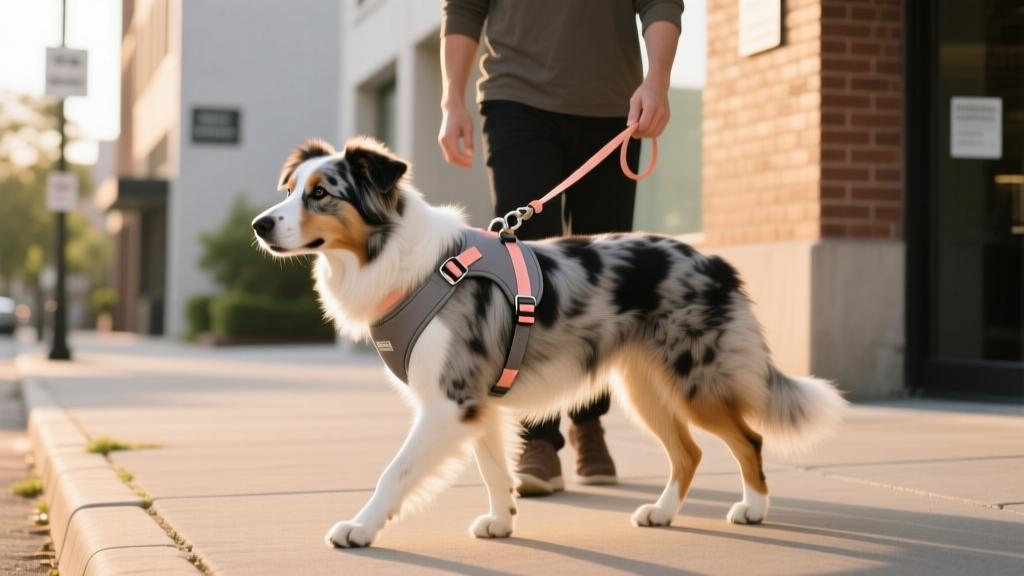
- Leash pulling: Switch to a front-clip harness (e.g., Ruffwear Front Range, $40-$50 or 2 Hounds Design No-Pull, $35-$45) during training. Walk only in low-distraction areas until loose-leash walking is fluent at home. Use a 4-foot leash — never retractable leashes, which teach pulling.
- Jumping on people: Keep the dog on a leash or behind a baby gate when guests arrive. Teach an incompatible behavior (sit or go-to-mat) and reward that. Do not allow rehearsal by letting the dog greet people while jumping.
- Inability to settle in public: Start with 5-minute "settle" sessions in your car (parked, engine off), then progress to 10 minutes outside a quiet store. Use a familiar mat or bed as a contextual cue. If the dog cannot settle for 5 minutes, the environment is too stimulating — increase distance from the trigger.
- Scavenging/food-stealing: Use a basket muzzle (Baskerville Ultra, $20-$30) during early public access training. This is a management tool, not a punishment — pair it with treats so the dog has a positive association.
- Reactivity to other dogs: Maintain a minimum 30-foot distance from other dogs during training. Use visual barriers (parked cars, fences) to create "safe zones." Gradually decrease distance only when the dog can offer eye contact to you at the current distance.
Step-by-Step Service Dog Training Protocol
Phase 1: Foundation Skills (Months 1-4)
Goal: Fluent obedience in low-distraction environments (home, yard, quiet street).
- Eye contact/attention: Hold a treat near your eye. When the dog makes eye contact, mark (clicker or "yes") and reward. Build to 3-second sustained eye contact. Practice 3 sessions/day, 5 minutes each.
- Loose-leash walking: Reward the dog every 2-3 steps when the leash has slack ("J-shape" between your hand and the collar). If the leash tightens, stop immediately. Wait for the dog to release tension, then resume. Expect 4-6 weeks for fluency in low-distraction areas.
- Settle on mat: Lure the dog onto a specific mat, reward lying down. Gradually extend duration: 5 seconds → 30 seconds → 2 minutes → 5 minutes → 15 minutes. Use a Kong or lick mat to make the mat rewarding. Practice daily.
- Sit-stay and down-stay: Build duration first (up to 5 minutes), then distance (up to 20 feet), then distraction (adding one variable at a time). Never increase more than one criterion at once.
- Recall: Use a long line (15-30 feet) for safety. Reward with high-value treats (freeze-dried liver, boiled chicken). Never punish a dog that comes to you, even if it took multiple calls.
Phase 2: Public Access Skills (Months 4-10)
Goal: All foundation skills performed fluently in progressively challenging public environments.
- Environmental desensitization: Visit 3-5 new locations per week. Start at the periphery (parking lots, outdoor seating areas) and gradually move inside. Reward calm behavior. If the dog shows stress signals (lip-licking, yawning, whale eye), increase distance from the trigger and lower your criteria.
- Counter-conditioning for specific triggers: If the dog fears automatic doors, stand 40 feet away and feed treats every time the door opens. Gradually move 5 feet closer each session. The dog should be under threshold (able to take treats gently, body relaxed) at every stage.
- Ignore-training: Practice in environments with deliberate distractions — a person drops food, another dog walks past, a child runs by. Reward the dog for maintaining focus on you. Use the "Look at That" (LAT) game: the dog looks at the distraction, then looks back at you for a treat.
- Duration settle in public: Bring your settle mat to a café or library. Start with 10-minute sessions. Gradually build to 60-90 minutes. Bring a chew or frozen Kong for the dog. If the dog breaks the settle, calmly reset without punishment.
Phase 3: Task Training (Months 8-18)
Goal: Train specific disability-mitigating tasks to reliability.
- Identify required tasks: Work with your healthcare provider to identify 2-3 tasks that directly mitigate your disability. Examples: retrieving dropped items, opening doors, alerting to sounds (doorbell, alarm, name being called), providing deep pressure therapy (DPT), guiding during dissociative episodes.
- Task shaping with positive reinforcement: Break each task into micro-steps. For "retrieve dropped keys": (a) dog touches keys with nose → reward, (b) dog picks up keys → reward, (c) dog holds keys for 3 seconds → reward, (d) dog carries keys to your hand → reward, (e) dog picks up keys from the floor → reward. Each step may take 3-7 days of daily 5-minute sessions.
- Task generalization: Once a task is fluent at home, practice in 5+ different locations. A dog that retrieves keys in the kitchen may not understand the same command in a grocery store until it's been practiced there.
- Task under distraction: Add distractions gradually. Have someone talk loudly while you give the task cue. Practice in a busy parking lot. The task must be reliable in at least 8 out of 10 trials in a high-distraction environment before it's considered trained.
Phase 4: Public Access Test Preparation (Months 16-24)
Goal: Demonstrate that the dog meets public access standards.
- Practice the ADI Public Access Test criteria: no sniffing merchandise, no soliciting attention, walking calmly on leash, settling under a table for 30+ minutes, ignoring food on the floor, remaining calm around other dogs, and performing trained tasks on cue in public.
- Video-record practice sessions to self-assess. Look for stress signals you might miss in real time.
- Consider hiring a certified service dog trainer for an evaluation. Many offer public access test prep for $75-$150/session.
Tools That Help vs. Tools to Avoid
| Tool | Category | Purpose | Price Range (2026) | Recommendation |
|---|---|---|---|---|
| Clicker (e.g., i-Click by Karen Pryor) | Marker | Precise timing for marking desired behaviors | $3-$8 | ✅ Strongly recommended |
| Front-clip harness (Ruffwear Front Range) | Walking equipment | Reduces pulling without pain or pressure | $40-$50 | ✅ Recommended for training phase |
| Treat pouch (e.g., Ruffwear Treat Trader) | Reward delivery | Quick access to high-value treats during sessions | $25-$40 | ✅ Essential |
| Settle mat (e.g., Mutt Matt or folded blanket) | Contextual cue | Signals "relax here" — portable across environments | $15-$60 | ✅ Essential for public access |
| Puzzle feeders (Kong Classic, West Paw Toppl) | Mental enrichment | Builds focus, reduces boredom, extends settle duration | $12-$25 | ✅ Highly recommended |
| Calming aids (Adaptil pheromone collar, ThunderEase) | Anxiety support | May reduce baseline anxiety during early exposure work | $20-$40 | ⚠️ Adjunct only — not a substitute for training |
| Basket muzzle (Baskerville Ultra) | Management | Prevents scavenging during early public access training | $20-$30 | ✅ Recommended as temporary management tool |
| Long line (15-30 ft, biothane or cotton) | Safety | Allows recall practice with a safety net | $15-$40 | ✅ Essential for off-leash reliability training |
| Shock/e-collar (any brand) | Aversive | Delivers electric shock to suppress behavior | $50-$300 | 🚫 Never — causes fear, damages handler bond, and is incompatible with service dog welfare standards |
| Prong/pinch collar | Aversive | Delivers pain to the neck to suppress pulling | $15-$40 | 🚫 Never — creates negative associations with walking and public environments |
| Alpha roll / physical domination | Aversive technique | Forcing dog onto its back to "submit" | N/A | 🚫 Never — debunked by modern behavioral science; increases aggression risk (AVSAB Position Statement) |
Realistic Timeline: How Long Does It Take to Train a Service Dog?
Service Dog Training Timeline — Owner-Trained Dog
| Phase | Timeframe | Milestones | Common Setbacks |
|---|---|---|---|
| Foundation obedience | Months 1-4 | Fluent sit, down, stay, recall, loose-leash walking at home | Inconsistency in daily practice; rushing to public settings too early |
| Public access basics | Months 4-10 | Calm behavior in stores, restaurants, transit; settle for 30+ minutes | Environmental fear periods (common at 8-11 months); adolescent regression |
| Task training | Months 8-18 | 2-3 disability-specific tasks performed reliably in public | Task generalization failures; dog performs task at home but not in public |
| Proofing & test prep | Months 16-24 | Passes ADI-style public access test; works reliably 6+ days/week | |
| Maintenance | Ongoing | Weekly practice sessions; annual skill assessments | Handler health changes requiring new tasks; dog aging out (typically 8-10 years of service) |
Note: Professional programs report a 50-70% success rate for dogs entering training. Owner-trainers should expect a similar washout rate. Not every dog is temperamentally suited to service work, and recognizing this early saves time, money, and heartache.
Prevention: Setting Puppies and Newly Adopted Dogs Up for Success
If you're starting with a puppy (8-16 weeks) or a newly adopted adult dog, prevention is far more effective than rehabilitation.
For puppies (8-16 weeks):
- Socialization window: The critical socialization period closes around 12-14 weeks (AVSAB Puppy Socialization Position Statement). Expose the puppy to 100+ novel stimuli (surfaces, sounds, people of different ages/ethnicities/abilities, other vaccinated dogs) before 16 weeks. Keep all exposures positive — pair with treats and play.
- Handling exercises: Daily touch the puppy's paws, ears, mouth, and tail. Pair with treats. Service dogs must tolerate grooming, veterinary exams, and being touched by strangers without flinching.
- Crate training and alone-time practice: Service dogs must be comfortable resting quietly for extended periods. Start with 5-minute crate sessions with a stuffed Kong, building to 2+ hours by 6 months.
- Impulse control games: "Wait" at doors, "leave it" with food on the floor, and "settle" on a mat should begin by 10-12 weeks.
For adopted adult dogs:
- 2-week decompression period: Allow the dog to settle into your home before beginning formal training. Limit outings to quiet walks and yard time. This reduces stress and gives you a clearer picture of the dog's true temperament.
- Temperament assessment: Evaluate noise sensitivity (drop a metal pan 10 feet away — does the dog startle and recover, or shut down?), prey drive (toss a toy — does the dog chase obsessively or show moderate interest?), and human-directed sociability (does the dog seek interaction or avoid it?). Dogs that recover quickly from startles, show moderate drive, and actively seek human engagement are the best service dog candidates.
- Health screening: Complete the veterinary checklist above before committing to a 2-year training investment. A dog with undiagnosed hip dysplasia may not be physically capable of mobility assistance tasks.
When to Hire a Professional: Trainer vs. Behaviorist
Hire a Certified Service Dog Trainer when:
- You need help designing a task-training protocol for your specific disability
- Your dog is progressing but you want an objective public access evaluation
- You need guidance on legal requirements and documentation (note: the ADA does not require certification, but having a trainer's evaluation letter can help in access disputes)
Look for: CPDT-KA (Certified Professional Dog Trainer – Knowledge Assessed) or CTDI (Certified Trick Dog Instructor) credentials, plus specific service dog training experience. Expect to pay $75-$150/hour for private sessions or $2,000-$6,000 for a comprehensive program.
Hire a Veterinary Behaviorist or Certified Applied Animal Behaviorist (CAAB) when:
- Your dog shows fear, anxiety, or aggression that hasn't improved after 4-6 weeks of positive reinforcement training
- You suspect a medical component to the behavior
- Your dog has bitten or shown intent to bite in public settings
- You're considering medication (SSRIs, TCAs) to support behavior modification
Look for: DACVB (Diplomate of the American College of Veterinary Behaviorists) or CAAB certification. Veterinary behaviorist consultations typically cost $300-$600 for the initial appointment, with follow-ups at $150-$300. A CAAB may charge $150-$350/hour.
A dog that shows aggression in public settings should not continue service dog training until evaluated by a behaviorist. This protects the public, your dog, and the reputation of legitimate service dog teams.
Frequently Asked Questions
Why does my dog lose focus in public even though they're perfect at home?
This is a generalization problem, not a disobedience problem. Dogs are context-specific learners — a "sit" trained in your kitchen is not automatically a "sit" in a grocery store parking lot. The solution is systematic proofing: practice each skill in at least 10 different locations, starting with low-distraction environments and gradually increasing difficulty. Expect to lower your criteria (shorter duration, closer distance) each time you add a new environment, then build back up.
How do I stop my dog from sniffing and scavenging during public access work?
Management first: use a basket muzzle during early training to prevent rehearsal of scavenging. Then train an incompatible behavior — "watch me" (sustained eye contact) or "find it" (sniffing on cue in designated areas only). Reward heavily for ignoring food on the ground. Practice by deliberately dropping treats on the floor and rewarding the dog for looking at you instead of eating them. This takes 6-12 weeks of daily practice for reliability.
Is it normal for my dog to regress during adolescence?
Yes. Adolescent regression (typically 6-14 months) is extremely common in service dog candidates. Hormonal changes, fear periods (secondary fear period peaks around 8-11 months), and increased independence can make a previously fluent dog seem like a beginner. This is not failure — it's a developmental stage. Maintain your criteria, increase reinforcement rate, and be patient. Most dogs emerge from adolescence with stronger skills if you stay consistent.
How long will it take to fully train my service dog?
Realistically, 18-24 months of consistent daily training (30-60 minutes/day, broken into 3-5 short sessions). Professional programs invest 1,500-2,500 hours. Owner-trainers who practice 30 minutes/day will accumulate approximately 365 hours/year. There are no shortcuts. Any program promising a fully trained service dog in weeks should be viewed with skepticism.
Should I use punishment or correction to fix problem behaviors quickly?
No. Aversive methods (shock collars, prong collars, physical corrections, alpha rolls) are contraindicated for service dog training for multiple reasons: they create negative associations with public environments, suppress warning signals (making aggression less predictable), damage the handler-dog bond, and are incompatible with the calm, confident demeanor a service dog requires. The American Veterinary Society of Animal Behavior (AVSAB) recommends only positive reinforcement-based methods. If a behavior isn't improving with positive methods after 4-6 weeks, consult a veterinary behaviorist rather than escalating to punishment.
When do I need a professional behaviorist instead of a trainer?
Seek a veterinary behaviorist (DACVB) or CAAB if your dog displays: aggression toward people or other dogs in public, fear that doesn't improve after 4-6 weeks of desensitization, compulsive behaviors (spinning, tail-chasing, flank-sucking), or anxiety severe enough to cause physical symptoms (chronic diarrhea, self-mutilation, inability to eat in public). Trainers handle skill-building; behaviorists handle underlying emotional and neurological issues. The two often work together.
Can any breed become a service dog?
Legally, any breed can be a service dog under the ADA. Practically, breeds selected for generations to work cooperatively with humans (Labrador Retrievers, Golden Retrievers, Standard Poodles, and their crosses) have the highest success rates. Brachycephalic breeds (Bulldogs, Pugs) often lack the physical stamina for mobility work. High-drive herding breeds (Belgian Malinois, Border Collies) can excel but require significantly more exercise and mental stimulation to prevent frustration-based behaviors. Mixed breeds can be excellent service dogs if temperamentally suited.
What does it cost to owner-train a service dog?
Budget for the following over 2 years:
- Puppy/adult dog acquisition: $500-$3,000 (from a responsible breeder with health-tested parents) or $50-$500 (rescue adoption)
- Veterinary care (including pre-training workup, vaccinations, spay/neuter): $1,500-$3,000
- Professional training support (private sessions, group classes): $2,000-$8,000
- Equipment (harnesses, treat pouches, crate, mats, puzzle toys): $300-$800
- Public access training expenses (parking, meals at restaurants for practice, transit fares): $500-$1,500
- Ongoing food, supplies, veterinary care: $1,500-$3,000/year
Total estimated 2-year cost: $6,300-$19,300 — significantly less than a program-trained dog ($25,000-$50,000) but still a major investment.
Marcus Aldridge
All our authors care for dogs every day — read more of their work on the authors page.