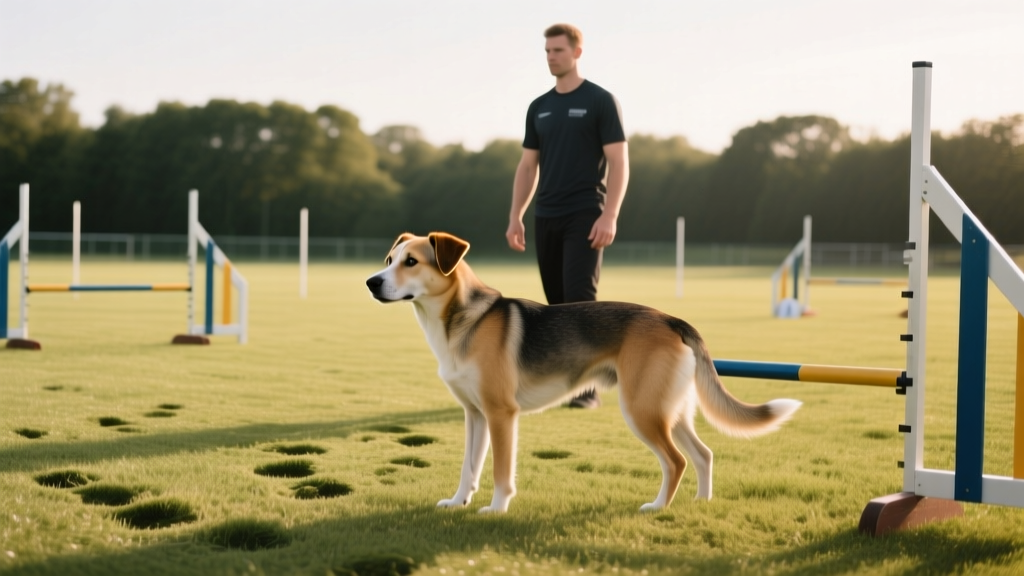
How to Make Your Dog Stop Barking: A Science-Based Training Guide
Learn how to make your dog stop barking using positive reinforcement, root cause analysis, and step-by-step desensitization protocols from certified behaviorists.

What Qualifies as Problem Barking?
Barking is normal canine communication. It becomes a behavior problem when it meets one or more of these thresholds:
- Frequency: More than 10–15 sustained barking episodes per day in a home setting
- Duration: Continuous barking lasting longer than 5 minutes without interruption
- Context mismatch: Barking triggered by non-threatening, routine stimuli (doorbell on TV, neighbors walking by at normal volume, family members moving between rooms)
- Failure to settle: Dog cannot stop barking within 60 seconds of owner giving a calm cue or the trigger being removed
- Impact: Barking disrupts sleep, causes neighbor complaints, or creates household stress
If your dog barks 3–4 times when someone knocks and then stops, that's alert barking — a normal, functional behavior. If your dog barks for 20 minutes every time the mail carrier arrives and escalates to lunging at the window, that's a problem worth addressing.
Before you start any training protocol, it's critical to understand why your dog is barking. Barking is a symptom, not the disease. The approach that works for a bored dog will fail completely for a fearful one.
Why Does My Dog Bark So Much? Root Cause Analysis
Step 1: Identify the trigger pattern. Keep a 7-day bark log noting time, trigger, duration, and what happened before/after. Then match to the most likely cause below:
| Root Cause | Typical Triggers | Body Language Signs | When It Peaks |
|---|---|---|---|
| Alert/Territorial | Doorbell, knock, people/dogs passing house, delivery drivers | Ears forward, stiff posture, tail up, standing at window/door | Morning and evening (high foot traffic times) |
| Attention-Seeking | Owner on phone, working at desk, ignoring dog, meal prep | Pawing, nudging, barking directly at owner, stopping when acknowledged | When owner is occupied or pre-mealtime |
| Separation Distress | Owner leaving, being in separate room, pre-departure cues (keys, shoes) | Pacing, drooling, destructive behavior near exits, barking starts after owner leaves | First 30 minutes after departure (often visible on camera) |
| Fear/Anxiety | Thunder, fireworks, unfamiliar people, new environments, vet visits | Tucked tail, flattened ears, trembling, hiding, whale eye, lip licking | During or anticipating the feared event |
| Boredom/Understimulation | Left alone in yard, crated for long periods, lack of exercise | Monotonous repetitive barking, pacing, digging, chewing inappropriate items | Midday or after extended inactivity |
Many dogs have overlapping causes. A dog who barks at the doorbell may start with territorial barking, then shift to attention-seeking barking when the owner yells "quiet!" (which the dog interprets as the owner joining in). Identifying the primary driver is what makes your training protocol effective.
Medical Rule-Out: When to See Your Vet First
Before starting behavior modification, rule out medical causes. Sudden-onset barking in a previously quiet dog — or a significant increase in vocalization — warrants a veterinary exam. According to the Merck Veterinary Manual, excessive vocalization can signal:
- Pain or discomfort: Arthritis, dental disease, ear infections, or GI distress can lower a dog's threshold for reactivity. A dog in pain barks at things they previously tolerated.
- Cognitive Dysfunction Syndrome (CDS): In dogs over 8–10 years, nighttime barking, disorientation, and apparent barking at "nothing" may indicate canine cognitive decline. Prevalence estimates suggest 28% of dogs aged 11–12 show at least one CDS sign.
- Hypothyroidism: Can cause irritability and behavioral changes including increased reactivity and vocalization.
- Hearing loss: Dogs losing their hearing may bark more loudly because they cannot self-regulate volume, or bark at things they sense but cannot fully identify.
- Neurological conditions: Focal seizures or brain lesions can manifest as sudden, unexplained vocalization episodes.
Red flags requiring a vet visit before training:
- Barking started suddenly in a dog older than 5 with no environmental changes
- Barking accompanied by pacing, confusion, or house-soiling in a previously trained dog
- Vocalization that sounds different (hoarse, higher pitch, strained)
- Barking paired with physical symptoms: limping, head shaking, appetite changes, lethargy
A standard veterinary exam for behavior-related vocalization typically costs $80–$200 depending on your region. If bloodwork is needed (thyroid panel, senior panel), add $100–$250. This investment prevents you from spending months on training that won't work because the root cause is medical.
Immediate Management: Stop the Rehearsal Loop
Every time your dog practices a barking behavior, the neural pathway gets stronger. This is called behavioral rehearsal, and it's why the problem seems to get worse over time even without any change in your environment. Your first priority isn't training — it's management. You need to prevent rehearsal while you build new habits.
Environmental modifications you can implement today:
- Visual barriers: Apply frosted window film ($8–$15 per roll on Amazon) to the bottom 24–36 inches of windows where your dog watches passersby. This is the single most effective management tool for territorial barkers. Brands like Artscape or Rabbitgoo work well and are removable.
- White noise or ambient sound: A white noise machine ($25–$50) or a fan placed near the front door or window masks outdoor sounds that trigger alert barking. The LectroFan Classic is a reliable, low-cost option.
- Doorbell desensitization audio: Change your physical doorbell chime to a different sound, or disconnect it temporarily and ask visitors to text instead. This breaks the conditioned bark response while you train.
- Enrichment before triggers: Give your dog a frozen Kong stuffed with peanut butter and kibble 15 minutes before predictable trigger times (mail delivery, school bus, neighbor's return). Licking and chewing are self-soothing behaviors that reduce arousal.
- Safe space training: Teach your dog to go to a mat or bed in a room away from the front door. This becomes their "default place" during high-trigger times.
Management alone won't fix the behavior long-term, but it buys you the time and reduced arousal levels needed for training to work. Think of it as turning down the volume before trying to change the channel.
Step-by-Step Training Protocol to Stop Barking
The following protocol uses desensitization (gradually exposing your dog to triggers at sub-threshold intensity) and counter-conditioning (changing the emotional response to the trigger) combined with differential reinforcement of an incompatible behavior (DRI — rewarding a behavior that physically cannot happen at the same time as barking).
Phase 1: Teach the "Quiet" Cue (Weeks 1–2)
- Wait for your dog to bark naturally. If they don't bark on their own, use a mild trigger — a soft knock on the table, for instance.
- After 2–3 barks, present a high-value treat (real chicken, cheese, hot dog) at nose level. The dog will stop barking to sniff/eat. Mark this silence with a clicker or the word "yes."
- Give the treat. Repeat 10–15 times per session, 2–3 sessions per day.
- Add the verbal cue "quiet" just before presenting the treat, once your dog reliably stops barking when they see the treat in your hand.
- Gradually increase the duration of silence before the treat: 2 seconds, then 3, then 5, then 10.
- Phase out the treat lure: Say "quiet" without showing the treat first. If the dog stops barking, reward from your pocket or a treat pouch. If they don't respond, go back one step.
Phase 2: Desensitization to the Trigger (Weeks 2–6)
- Identify your dog's threshold distance/intensity. This is the point at which your dog notices the trigger but does NOT bark. For a dog reactive to passersby, this might be seeing someone at 50 feet. For a doorbell-reactive dog, it might be a recording of a doorbell played at volume level 1 out of 10.
- Present the trigger at sub-threshold intensity. Use recorded sounds at low volume, have a helper stand far away, or use video on a phone. The key: your dog notices but stays under threshold.
- Pair with high-value rewards. Trigger appears → treat. Trigger disappears → treats stop. This builds a classical conditioning association: "doorbell = chicken."
- Increase intensity in tiny increments. Raise volume by 1 level, move helper 5 feet closer, or increase duration by 2 seconds. Only advance when your dog is relaxed and taking treats softly (not snatching).
- If your dog barks, you've moved too fast. Increase distance/decrease intensity and return to the last successful step. Do NOT punish the bark — just manage the environment better.
Phase 3: Differential Reinforcement of Incompatible Behavior (Weeks 4–8)
- Choose an incompatible behavior: "Go to mat" or "grab your toy" are ideal because a dog holding a toy or lying on a mat is less likely to bark intensely.
- Train this behavior independently first until it's fluent with no distractions (see Phase 1-style shaping).
- Pair with the trigger at low intensity: Doorbell plays softly → cue "go to mat" → reward heavily on the mat.
- Gradually increase trigger intensity while maintaining the incompatible behavior as the default response.
- Eventually, the trigger itself becomes the cue: Doorbell rings → dog goes to mat automatically without being asked. This is the goal.
This protocol is adapted from techniques recommended by the American Veterinary Society of Animal Behavior (AVSAB), which advocates for positive reinforcement-based methods as the standard of care for behavior modification in dogs.
Training Tools That Help vs. Tools to Avoid
| Category | Recommended Tools | Price Range | How They Help |
|---|---|---|---|
| Enrichment feeders | Kong Classic, West Paw Toppl, Outward Hound Slow Feeder | $8–$25 | Provide licking/chewing outlet that reduces arousal; use before predictable trigger times |
| Calming aids | Adaptil DAP diffuser, ThunderShirt, VetriScience Composure chews | $15–$60 | Pheromone diffusers and pressure wraps may lower baseline anxiety; evidence is mixed but low-risk as adjuncts |
| Sound masking | LectroFan white noise machine, Calm Radio app | $0–$50 | Reduce trigger audibility from outdoor sounds |
| Training equipment | Front-clip harness (Ruffwear Front Range), treat pouch (Dog Gone Smart), clicker (i-Click) | $5–$45 | Front-clip harness reduces pulling during outdoor reactivity walks; clicker marks desired behavior precisely |
| Visual barriers | Frosted window film, baby gates, curtain sheers | $8–$30 | Block visual access to triggers for territorial/alert barkers |
| Tools to Avoid | Why They're Harmful |
|---|---|
| Shock/bark collars (static correction) | Suppress barking without addressing cause; increase fear and anxiety; can escalate to aggression. The AVSAB explicitly advises against aversive methods. Studies published in the Journal of Veterinary Behavior show dogs trained with shock collars display significantly more stress behaviors. |
| Citronella spray collars | Punish the symptom (barking) without treating the cause; the unpleasant spray can create negative associations with whatever the dog was looking at, worsening fear-based barking. |
| Ultrasonic bark deterrents | Unreliable effectiveness; can cause anxiety in noise-sensitive dogs; some dogs simply habituate within days. |
| Alpha rolls or physical corrections | Dominance-based methods are debunked by modern canine science; increase fear and damage the human-dog bond without improving behavior. |
| Yelling "QUIET!" | Dogs interpret this as you barking along with them, which can reinforce the behavior. It also increases overall household arousal. |
Realistic Timeline: How Long Will It Take?
Behavior modification is not a weekend project. Here are realistic milestones based on typical cases. Individual dogs vary based on age, duration of the behavior, breed tendencies, and consistency of implementation.
| Timeframe | Expected Progress | What You'll Notice |
|---|---|---|
| Week 1–2 | Management in place, "quiet" cue introduced | Overall barking frequency drops 20–40% due to environmental changes alone. Dog begins to understand the quiet cue in low-distraction settings. |
| Week 3–4 | Desensitization underway at sub-threshold levels | Dog shows less intense reactions to recorded triggers. May begin offering silence before the treat is presented. Setbacks are normal here. |
| Week 5–8 | Counter-conditioning taking hold, DRI behavior fluent | Dog begins to look at you instead of barking at mild triggers. "Go to mat" response becomes automatic at moderate trigger levels. Barking episodes shorten from minutes to seconds. |
| Month 3–4 | Generalization to real-world scenarios | Dog responds to the quiet cue during actual doorbell rings and real passersby. Occasional breakthrough barking still occurs but settles within 5–10 seconds with a cue. |
| Month 5–6 | Maintenance and reliability | Barking is functional (brief alert) rather than prolonged. Dog self-settles after alerting. Continued management (window film, white noise) remains in place as a support. |
Factors that extend the timeline:
- Behavior has been rehearsed for years (a 7-year-old dog who has barked at the mail carrier for 5 years will take longer than a 1-year-old who started 3 months ago)
- Inconsistent implementation by household members
- Underlying anxiety disorder requiring medication (adds 4–8 weeks for medication titration)
- Multiple overlapping triggers that each need individual desensitization
When to Hire a Professional Behaviorist vs. a Trainer
Not all barking problems require professional help. But certain situations warrant bringing in an expert. Here's how to decide:
Work with a certified dog trainer (CPDT-KA, KPA-CTP) when:
- The barking is primarily attention-seeking or alert-based
- Your dog has no bite history and no signs of severe fear or aggression
- You need help with training mechanics — timing, criteria, rate of reinforcement
- Cost: $75–$150 per session, or $400–$800 for a 6-session package
Work with a veterinary behaviorist (DACVB) or certified applied animal behaviorist (CAAB/ACAAB) when:
- Barking is paired with aggression (lunging, snapping, biting)
- Suspected separation anxiety (barking combined with destruction, self-injury, house-soiling only when alone)
- Medication may be needed to lower anxiety enough for training to work
- Previous work with a trainer hasn't produced results after 6–8 sessions
- Cost: $250–$500 for initial consultation (1.5–2 hours), $150–$300 per follow-up. Veterinary behaviorists can prescribe medication; CAABs cannot.
How to verify credentials:
- DACVB: Directory at dacvb.org — these are veterinarians with 3+ years of residency training in behavior
- CAAB/ACAAB: Certified through the Animal Behavior Society — requires PhD or Master's in animal behavior plus supervised experience
- CPDT-KA: Certified Professional Dog Trainer through the Certification Council for Professional Dog Trainers — requires 300+ training hours and passing an exam
Avoid anyone who calls themselves a "behaviorist" without verifiable credentials, or who guarantees results within a specific timeframe. Legitimate professionals will tell you that progress depends on multiple factors they cannot fully control.
Preventing Problem Barking in Puppies and Newly Adopted Dogs
Prevention is dramatically easier than rehabilitation. If you have a puppy or recently adopted dog, implement these practices from day one:
- Teach "quiet" proactively. Puppies bark naturally during play. Use those moments to teach the cue before barking becomes a habit. Start as early as 8–10 weeks.
- Build a settlement mat routine. Feed meals on a specific mat or bed. This builds a positive association with calm, settled behavior in a designated spot.
- Socialize broadly during the critical window (8–14 weeks). Expose your puppy to doorbells, vacuums, delivery trucks, people in hats, dogs of all sizes — all paired with treats. The AKC recommends structured socialization to prevent fear-based reactivity later.
- Meet exercise and enrichment needs. A physically exercised and mentally stimulated dog has a higher arousal threshold. Plan for breed-appropriate daily activity: 30–60 minutes for most breeds, 60–120 minutes for high-drive working and sporting breeds.
- Practice alone-time training. Start with 1-minute departures and gradually build up. Pair your departure with a long-lasting chew or frozen Kong so being alone predicts good things.
- Don't accidentally reinforce demand barking. If your puppy barks at you during meal prep and you give them food to quiet them, you've just taught them that barking produces food. Instead, wait for 3 seconds of silence, then reward.
- Desensitize to departure cues. Pick up your keys, then sit back down. Put on your shoes, then take them off. Break the association between these cues and your departure.
For adopted adult dogs with unknown histories, give them a 2–3 week decompression period before assessing barking as a "problem." Many dogs bark excessively in the first weeks of a new home due to stress and uncertainty, and the behavior resolves on its own as they settle. Follow the "3-3-3 rule" popularized by rescue organizations: 3 days to decompress, 3 weeks to learn your routine, 3 months to feel truly at home.
Frequently Asked Questions
Is barking normal for dogs?
Yes. Barking is a natural form of canine communication, just as meowing is for cats. All dogs bark to some degree. It becomes a problem only when it's excessive in frequency, duration, or context — meaning it occurs at levels that disrupt your household or your neighbors. Some breeds are genetically predisposed to vocalize more: Beagles, Yorkshire Terriers, Miniature Schnauzers, and many terrier and spitz breeds tend to bark more than breeds like Greyhounds or Basenjis. Understanding your dog's breed tendencies helps set realistic expectations.
Should I use punishment to stop my dog from barking?
No. Punishment-based methods — including shock collars, citronella collars, yelling, or physical corrections — suppress the outward behavior without addressing the underlying cause. A dog barking from fear who is then shocked for barking learns that the scary thing also causes pain, which deepens the fear and can escalate to aggression. The American Veterinary Society of Animal Behavior (AVSAB) states that reward-based methods should be the first-line approach for all canine behavior problems. Positive reinforcement teaches your dog what TO do instead of barking, which produces lasting change.
How long will it take to stop my dog's barking?
With consistent daily practice, most owners see meaningful reduction in 4–8 weeks, with reliable results by 3–6 months. Dogs who have been barking at the same trigger for years will take longer than dogs with recently developed habits. Separation distress barking often requires the longest timeline (3–6+ months) and may benefit from veterinary-prescribed anti-anxiety medication. There is no honest "fix your dog's barking in 7 days" solution — anyone promising that is selling something that relies on suppression, not genuine behavior change.
My dog barks when I leave the house. Is that separation anxiety?
Not necessarily. Barking when alone can stem from separation anxiety, boredom, territorial behavior (watching out the window), or simply an under-exercised dog. True separation anxiety typically includes a cluster of behaviors: barking/howling that begins within minutes of departure, destructive behavior focused on exit points (doors, windows), house-soiling in a previously trained dog, excessive drooling, and self-injury (broken teeth from chewing crates). If you suspect separation anxiety, set up a camera (a Wyze Cam or similar, around $25–$40) to record your dog's first 30 minutes alone and share the footage with your vet or a behaviorist for accurate assessment.
My neighbor's dog barks all day. What can I do?
Start with a polite, direct conversation with your neighbor — many people are unaware their dog barks when they're not home. If that doesn't resolve it, document the barking with timestamps and audio recordings over several days. Most municipalities have noise ordinances that address animal noise, and your local animal control or code enforcement office can advise on the complaint process. Avoid ultrasonic "bark deterrents" aimed at neighboring yards — they are unreliable and may affect your own pets.
Can medication help with excessive barking?
In some cases, yes. For dogs with underlying anxiety disorders (separation anxiety, noise phobia, generalized anxiety), veterinary-prescribed medications like fluoxetine (Prozac), sertraline, or trazodone can lower the dog's baseline arousal enough for behavior modification to work. Medication is not a standalone solution — it's a tool that makes training more effective. A veterinary behaviorist (DACVB) is the most qualified professional to evaluate whether medication is appropriate. Expect to pay $200–$400 for a behavior consultation plus $20–$80/month for medication depending on your dog's size and the drug prescribed.
This article provides educational guidance on canine behavior modification. If your dog's barking is accompanied by aggression, self-injury, or signs of severe distress, consult your veterinarian or a certified veterinary behaviorist before starting any training program. Individual dogs respond differently, and professional assessment ensures the safest, most effective approach for your specific situation.
Dr. Hannah Wickes
All our authors care for dogs every day — read more of their work on the authors page.