My Dog Ate Chewing Gum Off the Floor: Xylitol Danger & Scavenging Fix
My dog ate chewing gum off the floor — learn the xylitol toxicity risks, emergency steps, and a force-free training protocol to stop floor scavenging for good.
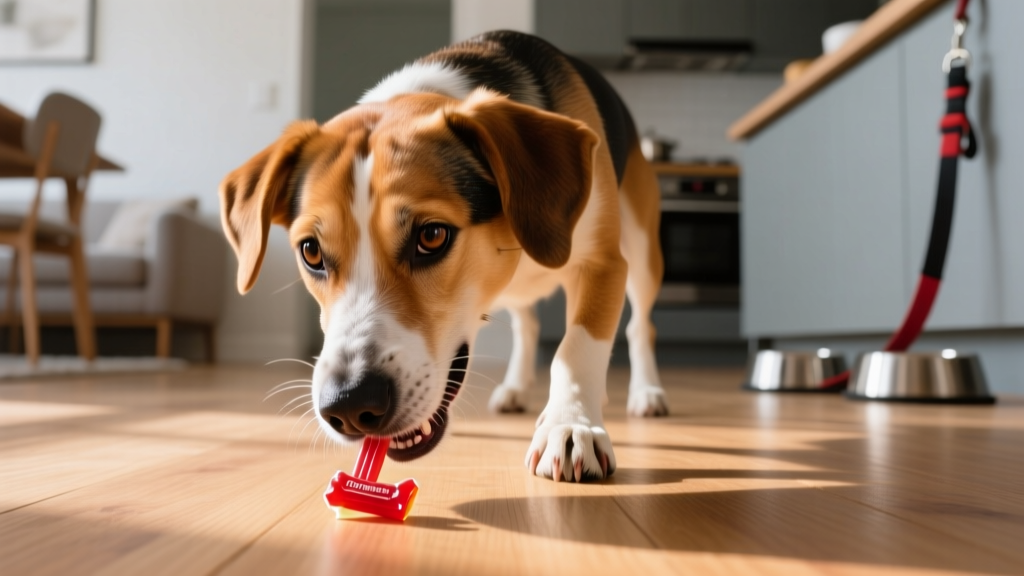
You turned your back for three seconds, and it happened: your dog snatched a piece of discarded chewing gum off the floor and swallowed it before you could react. If you're reading this right now, your heart is probably racing — and for good reason. Chewing gum can contain xylitol, a sugar substitute that is acutely toxic to dogs, and floor scavenging is a behavior that puts your dog at risk every single day.
This guide covers both the immediate medical emergency you may be facing right now and the behavioral root causes that led to this moment — plus a step-by-step force-free training protocol to stop your dog from eating things off the floor permanently.
If the gum contained xylitol (check the package for ingredients like xylitol, birch sugar, or sugar alcohol), this is a veterinary emergency. Toxicity can begin within 15-30 minutes.
- ASPCA Animal Poison Control: (888) 426-4435 (24/7, consultation fee applies)
- Pet Poison Helpline: (855) 764-7661
- Call your nearest emergency vet clinic immediately — bring the gum packaging if you have it
Xylitol triggers rapid insulin release in dogs, causing life-threatening hypoglycemia. As little as 0.05 grams per pound of body weight (0.1 g/kg) can be toxic. A single piece of sugar-free gum can contain 0.2-1.0 grams of xylitol.
What Qualifies as Floor Scavenging? The Behavior Definition
Floor scavenging is the behavior of seeking out, picking up, and consuming items found on ground surfaces — including food scraps, wrappers, medications, household objects, and discarded gum. It becomes a clinical behavior problem when:
- Your dog actively scans floors and surfaces during walks or at home (head-down, sniffing pattern)
- The behavior occurs more than 3-5 times per day in a typical household setting
- Your dog consumes non-food items (pica behavior) or potentially toxic substances
- Standard verbal cues like "leave it" or "drop it" fail to interrupt the behavior reliably
- The dog shows resource guarding when you attempt to retrieve the item
Floor scavenging exists on a spectrum. A dog who occasionally sniffs a crumb and moves on is displaying normal foraging curiosity. A dog who inhales every scrap of debris on a city sidewalk, swallows items before you can intervene, or guards stolen objects is exhibiting scavenging behavior that requires active management and training.
When your dog ate chewing gum off the floor, it likely wasn't a one-time accident — it was the predictable result of an established scavenging pattern meeting an opportunity. Understanding why this happened is the first step to preventing it from happening again.
Why Does My Dog Eat Everything Off the Floor? Root Cause Analysis
Dogs don't eat chewing gum off the floor out of spite or defiance. There are identifiable, addressable reasons driving this behavior. According to the Merck Veterinary Manual, persistent scavenging and pica (eating non-food items) can stem from behavioral, environmental, or medical origins.
- Nutritional Deficiency or Hunger
- Dog on calorie-restricted diet? → May be genuinely hungry
- Dog fed low-quality, high-filler kibble? → May lack satiety
- Parasites or malabsorption? → Nutrients not being utilized (medical)
- Boredom and Under-Stimulation
- Less than 30-60 minutes of structured activity per day?
- No puzzle feeders, chew toys, or enrichment available?
- Long hours alone with nothing to do?
- Learned Reinforcement History
- Has your dog successfully eaten floor items many times before?
- Each successful "catch" reinforces the scanning-and-grabbing pattern
- The behavior is self-rewarding — the dog doesn't need you to participate
- Anxiety or Stress-Related Coping
- Dogs with separation anxiety or generalized anxiety may mouth and eat objects as a displacement behavior
- Multi-dog household competition can trigger rapid food scavenging ("eat it before they do")
- Medical Conditions
- Diabetes, Cushing's disease, exocrine pancreatic insufficiency (EPI), hyperthyroidism (rare), and certain medications (prednisone) can cause polyphagia — excessive hunger
- Gastrointestinal disorders can create nausea-driven pica
Most dogs who snatch gum off the floor fall into causes #2 and #3: they're under-stimulated and have a long history of the behavior being self-reinforcing. Every time they successfully grab and swallow something, the neural pathway strengthens. This is why the behavior gets worse over time if left unaddressed.
Is Floor Scavenging Normal?
Partially. Dogs are natural scavengers — their ancestors survived by eating whatever they could find. The American Kennel Club notes that picking things up off the ground is a normal canine instinct. However, "normal" doesn't mean "safe" or "acceptable in a domestic setting." When your dog's scavenging puts them at risk of xylitol poisoning, intestinal blockage, or toxic ingestion, it crosses from normal instinct into a behavior problem that requires active intervention.
Medical Rule-Out: See Your Vet Before Starting Behavior Modification
Before you invest weeks in training, you need to rule out medical causes. This step is non-negotiable — no amount of counter-conditioning will fix scavenging driven by a metabolic disorder.
Ask your veterinarian to evaluate for these conditions if your dog shows sudden-onset or intense scavenging:
| Condition | Key Signs Beyond Scavenging | Diagnostic Test | Estimated Cost |
|---|---|---|---|
| Diabetes Mellitus | Increased thirst, urination, weight loss despite eating more | Blood glucose, fructosamine | $80-$200 |
| Cushing's Disease (Hyperadrenocorticism) | Pot-bellied appearance, hair loss, panting, increased thirst | ACTH stimulation test, LDDST | $150-$350 |
| Exocrine Pancreatic Insufficiency (EPI) | Chronic diarrhea, weight loss, coprophagia (eating feces) | TLI (trypsin-like immunoreactivity) | $100-$200 |
| Intestinal Parasites | Pot-belly in puppies, diarrhea, visible worms, scooting | Fecal flotation, Giardia antigen | $35-$80 |
| Medication Side Effects | Currently on prednisone, phenobarbital, or other appetite-stimulating drugs | Medication history review | Included in exam ($50-$90) |
Red flags requiring immediate veterinary evaluation: sudden-onset ravenous hunger in a previously moderate eater, weight loss despite increased food intake, vomiting, or diarrhea alongside scavenging behavior. Always consult your veterinarian to rule out underlying medical causes before assuming the problem is purely behavioral.
Xylitol Toxicity: What Happens When a Dog Eats Sugar-Free Gum
Before we get to the training protocol, you need to understand the medical stakes. Xylitol is the single greatest danger when your dog eats chewing gum off the floor, and understanding the toxicity timeline could save your dog's life.
Xylitol Toxicity Timeline in Dogs
| Time After Ingestion | What's Happening | Symptoms |
|---|---|---|
| 15-30 minutes | Rapid insulin release triggered; blood glucose begins dropping | Vomiting, lethargy, weakness |
| 30-60 minutes | Severe hypoglycemia develops | Ataxia (stumbling), tremors, collapse, seizures |
| 12-72 hours | Hepatic necrosis (liver failure) may develop, especially at doses above 0.5 g/kg | Jaundice, coagulopathy (bleeding disorders), black tarry stools |
Toxic dose thresholds:
- Hypoglycemia: 0.075-0.1 g xylitol per kg of body weight
- Liver failure: >0.5 g xylitol per kg of body weight
- Example: A 20 lb (9 kg) dog needs only 0.7-0.9 grams of xylitol for hypoglycemia — roughly 1-3 pieces of sugar-free gum depending on the brand
Not all chewing gum contains xylitol. Brands like Wrigley's Spearmint (original sugar version) and Hubba Bubba are sugar-sweetened and pose less acute risk (though large amounts can still cause gastrointestinal upset). However, most sugar-free gums — including Trident, Ice Breakers, Orbit Sugar-Free, and many "natural" brands — use xylitol as a primary sweetener. If you cannot confirm the gum was xylitol-free, treat the situation as an emergency.
Even if the gum was xylitol-free, swallowing a large wad can pose a choking hazard or contribute to a gastrointestinal blockage, particularly in small dogs under 20 lb (9 kg). Monitor for vomiting, abdominal pain, loss of appetite, or constipation in the 24-72 hours following ingestion.
Immediate Management: Stop the Behavior While You Train
Training takes weeks. Management starts today. The single most important principle in behavior modification is preventing rehearsal — every time your dog successfully eats something off the floor, the behavior gets stronger. You need to make the behavior impossible while you build new habits.
Management Strategies by Environment
| Environment | Management Strategy | Cost Range |
|---|---|---|
| At Home | Sweep/vacuum daily; use lidded trash cans; keep purses and bags off the floor; baby gate high-risk rooms; do a "floor sweep" before releasing your dog into a room | $0-$40 (baby gates, trash cans) |
| On Walks | Use a basket muzzle (Baskerville Ultra or BUMAS) during the training period; keep leash short in high-debris areas; scan 10 feet ahead continuously | $25-$50 (basket muzzle) |
| Guests/Parties | Crate or confine dog during events where food and wrappers drop; brief guests not to drop food | $0 (if crate owned) |
| Yard/Parks | Walk the area before releasing the dog; use a long line (15-30 ft) for control in unfenced areas; muzzle for high-risk dogs | $15-$35 (long line) |
A basket muzzle is not a punishment tool — it's a safety device. A properly fitted basket muzzle allows your dog to pant, drink water, and take treats through the openings while physically preventing them from picking up and swallowing objects. The Baskerville Ultra ($25-$35) and the BUMAS basket muzzle ($40-$55) are well-regarded options that allow normal breathing and treat delivery during training. Introduce the muzzle gradually with positive reinforcement over 3-5 days before using it on walks.
Step-by-Step Training Protocol: Teaching "Leave It" and "Drop It"
This protocol uses positive reinforcement, counter-conditioning, and desensitization — all force-free methods aligned with the Least Intrusive, Minimally Aversive (LIMA) framework. No shock collars, prong collars, or physical corrections are used or recommended.
Prerequisites: Your dog knows their name, will sit for a treat, and you have high-value treats (freeze-dried liver, chicken, cheese) cut into pea-sized pieces. Training sessions should be 5-10 minutes, 2-3 times daily.
PHASE 1: Foundation "Leave It" (Weeks 1-2)
- Closed fist exercise: Place a low-value treat in your closed fist. Present your fist to your dog. They will sniff, lick, and paw — wait silently. The instant they pull their nose away (even for 1 second), mark with a clicker or the word "yes" and reward from your OTHER hand with a higher-value treat. Repeat 10-15 times per session.
- Open palm progression: Once your dog consistently backs off the closed fist within 3 seconds, open your palm flat with the treat visible. If they dive for it, close your fist immediately. Wait for them to back off, mark, and reward from the other hand. Goal: dog looks at the open-palm treat and then looks at you.
- Add the cue: Once the open-palm behavior is reliable (8 out of 10 trials), add the verbal cue "leave it" just before presenting your hand. Your dog should now associate the cue with the behavior of looking away.
PHASE 2: Floor Generalization (Weeks 2-4)
- Treat on floor, covered: Place a treat on the floor and cover it with your foot. Give the "leave it" cue. When your dog looks at you instead of your foot, mark and reward with a better treat from your hand.
- Treat on floor, uncovered: Place a treat on the floor without covering it. Use a leash to prevent your dog from reaching it if they break position. Give "leave it." Mark and reward compliance. If they go for the treat, calmly block with your body (no verbal correction) and reset.
- Increasing distance and distraction: Drop treats from standing height. Walk past treats on the floor with your dog on leash. Practice in different rooms, then in the yard, then on quiet sidewalks.
PHASE 3: Real-World Proofing (Weeks 4-8)
- Planted scavenging scenarios: Set up controlled "traps" — place safe items (a piece of kibble, a dog-safe cracker) in spots your dog normally scavenges. Walk them past on leash, cue "leave it," reward generously for compliance. Gradually increase the realism: use gum wrappers (empty), crumpled paper, etc.
- Off-leash reliability: Only remove the leash or muzzle in controlled areas after your dog has demonstrated 90%+ compliance on-leash across at least 20 sessions in varied environments.
- "Drop It" as backup: Train "drop it" separately by offering a high-value trade — present a piece of chicken near your dog's mouth when they have a toy, mark when they release the toy, and reward. This is your emergency backup for when "leave it" fails.
Counter-Conditioning the Emotional Response
Many scavenging dogs have developed an emotional association: things on the floor = mine, must grab fast before it's taken away. Counter-conditioning changes this emotional response. The goal is to teach your dog: things on the floor = I should look at my human because something even better is coming.
Every time your dog notices something on the floor and voluntarily looks at you instead of grabbing it, that's a jackpot moment. Reward with 3-5 high-value treats in a row (a "jackpot") plus enthusiastic praise. You're building a new neural pathway that competes with the old scavenging habit.
Tools That Help vs. Tools to Avoid
- Basket muzzle (Baskerville Ultra, $25-$35) — prevents ingestion while allowing panting and treat delivery
- Puzzle feeders (Kong Classic $15, Outward Hound Nina Ottosson $15-$30, snuffle mats $15-$25) — satisfy foraging drive constructively
- Front-clip harness (Ruffwear Front Range $40, Freedom No-Pull $30) — better control on walks without neck pressure
- Treat pouch (Ruffwear Treat Trader $25) — keeps high-value rewards accessible for real-time reinforcement
- Clicker (i-Click $5-$8) — precise marker for the exact moment of desired behavior
- Long line (15-30 ft, $15-$35) — allows distance training with safety
- Calming aids (Adaptil DAP diffuser $25-$40, Zesty Paws Calming Bites $25-$30) — may help anxiety-driven scavenging
- Shock collars (e-collars) — suppress behavior without addressing root cause; increase anxiety and can create fear-based aggression around food/objects
- Prong/pinch collars — pain-based correction that damages the human-dog bond and risks tracheal injury
- Alpha rolls — debunked dominance theory; increases fear and defensive aggression
- Spray bottles or citronella — startle-based punishment that doesn't teach an alternative behavior
- Yelling or physical corrections — teaches the dog to eat items faster before you can intervene ("grab and gulp" response)
- Flat cloth muzzles — restrict panting and should only be used for very short vet visits, never for training or walks
The American Veterinary Society of Animal Behavior (AVSAB) explicitly recommends against the use of aversive training methods, noting that punishment-based approaches carry risks of increased aggression, anxiety, and suppressed warning signals — making dogs more dangerous, not less.
How Long Will It Take? Realistic Progress Timeline
There is no "fix it in 7 days" promise here. Scavenging is a self-reinforcing behavior with deep evolutionary roots, and the timeline depends on your dog's history, your consistency, and the underlying cause.
| Timeframe | Expected Milestone | What You're Doing |
|---|---|---|
| Days 1-3 | Management fully in place; muzzle conditioning started; zero unsupervised scavenging opportunities | Environmental control, muzzle training with treats, beginning Phase 1 "leave it" |
| Week 1-2 | Dog reliably backs off closed fist and open palm; beginning to generalize to floor treats in low-distraction settings | 2-3 daily training sessions (5-10 min each); muzzle on all walks; puzzle feeders for meals |
| Week 3-4 | Dog responds to "leave it" for floor treats indoors with moderate distractions; may still break on walks | Phase 2 training; beginning outdoor generalization; still using muzzle outside |
| Week 5-8 | Reliable "leave it" on walks with known items; dog begins voluntarily checking in with you when spotting floor items | Phase 3 proofing; planted scenarios; beginning to test without muzzle in low-risk areas |
| Month 3-6 | Strong default "check with human" behavior; occasional lapses still possible with novel high-value items | Maintenance training 2-3x/week; periodic "surprise" tests; continued vigilance |
| Ongoing | Behavior is managed, not "cured" — lifelong environmental awareness needed | Refresh training monthly; never fully trust the dog unsupervised with accessible toxic items |
Key insight: Dogs with 2+ years of established scavenging habits will take longer (closer to 4-6 months for reliable responses) than puppies or recently adopted dogs with less reinforcement history (closer to 6-8 weeks). Setbacks are normal — a single successful scavenging event can set progress back 1-2 weeks.
When to Hire a Professional: Behaviorist vs. Trainer
Seek professional help if:
- Your dog resource guards stolen items (growling, snapping, or biting when you try to take things away)
- The scavenging includes pica — eating non-food items like rocks, fabric, plastic, or feces
- Your dog has already required veterinary treatment for foreign body ingestion or toxic exposure
- You've followed this protocol consistently for 4+ weeks with no measurable improvement
- The behavior is accompanied by other anxiety signs: pacing, panting, destructive behavior, or compulsive licking
| Professional Type | Credentials to Look For | When to Choose | Typical Cost |
|---|---|---|---|
| Certified Dog Behavior Consultant (CDBC) | IAABC certification; 500+ hours of behavior consulting | Resource guarding, anxiety-driven scavenging, multi-dog household issues | $125-$250/session; 4-8 session packages ($500-$1,800) |
| Veterinary Behaviorist (DACVB) | DVM + DACVB board certification | Suspected medical component, medication may be needed, severe anxiety or compulsive behavior | $250-$500 initial consult; $150-$300 follow-ups |
| Certified Professional Dog Trainer (CPDT-KA) | CCPDT certification; force-free methods (look for "KA" — knowledge assessed) | Basic "leave it" and "drop it" training, puppy prevention, general manners | $60-$150/session; group classes $150-$300 for 6-week course |
Avoid any professional who recommends dominance theory, "being the alpha," or aversive tools. The AVSAB position statement on humane training provides a framework you can reference when vetting professionals.
Prevention for Puppies and Newly Adopted Dogs
The most effective approach to floor scavenging is preventing it from becoming an established habit in the first place. This is especially relevant for puppies (8-16 weeks) and newly adopted dogs in their first 30 days — the period when environmental patterns are being encoded.
Puppy Prevention Protocol (8-16 Weeks)
- Feed from puzzle toys exclusively — Kong Wobbler ($15), snuffle mats, and scatter feeding satisfy the foraging drive without teaching floor-scanning for human food
- Practice "trade up" from day one — whenever your puppy has something in their mouth, offer something better. This builds a lifelong association that giving things up leads to good things
- Puppy-proof at floor level — crawl around your home at puppy eye height and identify every small object, food item, and potential hazard. This is the single most effective prevention step
- Supervise or confine — puppies should never be unsupervised in un-proofed areas. Use a playpen ($40-$80), exercise pen, or crate when you cannot actively watch them
Adopted Dog Decompression Protocol (First 30 Days)
- Assume the dog will scavenge — shelter dogs often have a history of food scarcity and competition. Default to management (muzzle on walks, swept floors) from day one
- Establish a feeding routine — predictable meals at set times (2x daily) reduce anxiety-driven scavenging. Measure portions with a standard measuring cup rather than estimating
- Build engagement before freedom — spend the first 2-4 weeks building a reinforcement history with you (training, play, structured walks) before testing off-leash reliability or removing management tools
- Introduce "leave it" in week 2 — after the dog has settled and you've established a positive relationship, begin the Phase 1 protocol above
Frequently Asked Questions
Should I use punishment to correct my dog for eating things off the floor?
No. Punishment-based corrections (yelling, leash jerks, shock collars) for scavenging typically produce one of two outcomes: the dog learns to eat items faster when you're not looking (suppression, not elimination), or the dog develops resource guarding — growling or biting when you approach them while they have something. Force-free methods using positive reinforcement and management are more effective long-term and don't carry these risks. The AVSAB's position statement on punishment explicitly warns against aversive methods for behavior modification.
My dog only eats gum and candy wrappers — why are they so selective?
Dogs have an extraordinarily sensitive sense of smell (up to 300 million olfactory receptors compared to our 6 million). Sweet-smelling items like gum, candy wrappers, and baked goods have a high scent signature that's extremely reinforcing. Your dog isn't being "picky" — they've learned through repeated experience that these specific scent profiles predict high-value caloric rewards. This makes training harder because the reinforcement value of the scavenged item is very high. You'll need to use equally high-value training treats (real meat, freeze-dried liver, cheese) to compete.
How do I stop my dog from eating things off the floor on walks specifically?
Walk-specific scavenging requires a layered approach: (1) basket muzzle during the training period for safety, (2) practice "leave it" in your yard first with planted items before moving to the sidewalk, (3) walk with your dog on a 4-6 foot leash in high-debris areas so you can physically prevent access, (4) carry high-value treats and reward every time your dog looks at a floor item and then looks at you, and (5) choose cleaner walking routes during the training period to reduce temptation density.
Is it ever okay to let my dog eat things off the floor?
In controlled training contexts, yes — deliberately placing safe, known items (a piece of your dog's kibble) on the floor and rewarding your dog for leaving them is part of the training protocol. In real-world scenarios, the risk of toxic ingestion (xylitol, grapes, onions, medications, rodenticide) makes it unwise to allow casual floor eating. Even in your own home, a dropped grape, a piece of chocolate, or a pill that fell from a counter can be dangerous. The safest policy is a consistent "nothing off the floor" rule.
What if my dog ate chewing gum off the floor and I don't know if it had xylitol?
Call the ASPCA Animal Poison Control at (888) 426-4435 or the Pet Poison Helpline at (855) 764-7661 immediately. If you can identify the brand and type, check the ingredient list online. If you cannot confirm the gum was xylitol-free, proceed to an emergency veterinary clinic. Your vet may induce vomiting (if within 1-2 hours of ingestion), administer activated charcoal, and monitor blood glucose levels for 12-24 hours. Treatment costs for xylitol toxicity typically range from $500-$3,000 depending on severity, which makes prevention through behavior training a cost-effective investment.
How long will it take to fix my dog's scavenging behavior?
Realistic timelines range from 6-8 weeks for puppies and dogs with minimal scavenging history to 3-6 months for dogs with years of established habit. Some level of management (environmental control, vigilance on walks) will likely be a lifelong practice. Dogs don't reach a point of being "100% cured" — they reach a point of having a strong default behavior of checking with you, but the underlying scavenging drive remains. This is normal and expected for a species evolved to be opportunistic feeders.
Priya Sutaria
All our authors care for dogs every day — read more of their work on the authors page.