Bug Bites on Dogs: Why They Scratch, Lick & Chew and How to Stop It
Bug bites on dogs cause obsessive scratching, licking, and chewing. Learn root causes, medical rule-outs, and step-by-step behavior modification protocols.
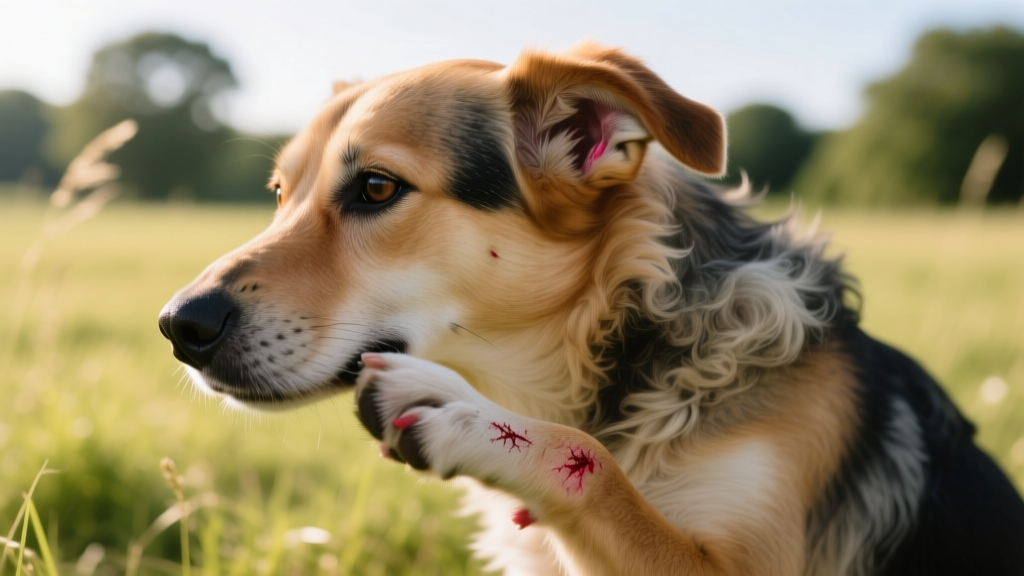
Behavior Definition: When Bug Bite Reactions Become a Problem
Every dog gets bitten by insects — mosquitoes, fleas, ticks, midges, and flies are routine nuisances. A normal response is a few minutes of scratching, a brief glance at the area, or a single lick. The behavior crosses into a problem threshold when any of the following occur:
- Duration: Focused scratching, licking, or chewing at a bite site lasting more than 10–15 minutes per episode, or recurring more than 5–6 times per hour.
- Tissue damage: The dog breaks skin, creates hot spots (acute moist dermatitis), or pulls out hair around the bite area.
- Displacement: The dog interrupts meals, play, sleep, or walks to obsessively attend to the bite.
- Escalation over time: What started as a single bite response generalizes — the dog begins chewing at multiple body regions or continues the behavior days after the bite has healed.
- Secondary infection signs: Redness spreading beyond the bite, oozing, foul odor, or warmth at the site — indicating the self-trauma has created a bacterial or yeast infection.
If your dog meets two or more of these thresholds, you are dealing with a behavior pattern that needs active management, not just a topical anti-itch cream.
Why Does My Dog Obsess Over Bug Bites?
Understanding the root cause is the foundation of any behavior modification plan. Bug bites on dogs trigger a cascade of physical sensation and learned response that can spiral into compulsive grooming. Here are the five most common drivers:
Root Cause Diagnostic Tree
- Allergic Hypersensitivity (Most Common — ~60% of cases)
- Flea allergy dermatitis (FAD): Even a single flea bite triggers a systemic allergic response in sensitized dogs. One bite can cause whole-body itching for 5–7 days.
- Mosquito bite hypersensitivity: Some dogs develop exaggerated wheal-and-flare reactions, particularly on the bridge of the nose, ear tips, and groin.
- Culicoides (biting midge/no-see-um) allergy: Causes intense ventral abdomen and inner thigh pruritus, especially in late spring through early fall.
- Anxiety-Driven Compulsive Grooming (~20% of cases)
- The bite provides an initial itch sensation, but the dog continues licking or chewing as a self-soothing displacement behavior.
- Common in dogs with separation anxiety, noise phobias, or generalized anxiety disorders.
- The repetitive licking releases endorphins, reinforcing the behavior even after the original itch subsides.
- Boredom / Under-Stimulation (~10% of cases)
- Dogs with insufficient physical exercise or mental enrichment fixate on minor sensations they would otherwise ignore.
- Particularly common in working and herding breeds (Border Collies, Australian Shepherds, Belgian Malinois) kept in low-activity households.
- Pain Referral or Neuropathic Itch (~5% of cases)
- A bite near an area of underlying joint pain, nerve damage, or spinal disease can cause the dog to focus on the surface skin when the actual discomfort is deeper.
- Syringomyelia (common in Cavalier King Charles Spaniels) can cause phantom scratching — the dog scratches at the neck/shoulder without making contact, or scratches in response to light touch that wouldn't bother a normal dog.
- Learned Attention-Seeking (~5% of cases)
- If owners consistently respond to bite-scratching with attention, treats, or belly rubs, the dog learns that scratching produces a rewarding social interaction.
- This is not "manipulation" in the human sense — it is straightforward operant conditioning.
Medical Rule-Out: When to See Your Vet Before Starting Behavior Training
Before you invest weeks in counter-conditioning and environmental management, you must eliminate medical causes. Attempting behavior modification on a dog with untreated allergic dermatitis, a secondary skin infection, or neuropathic pain is like trying to train someone to stop coughing while they have pneumonia — the underlying driver will override your protocol every time.
Veterinary Rule-Out Checklist
Schedule a vet appointment if your dog shows any of the following:
| Sign | Possible Underlying Condition | Diagnostic Tests Your Vet May Run |
|---|---|---|
| Generalized itching beyond bite sites | Flea allergy dermatitis, atopic dermatitis, food allergy | Skin scrape, flea comb, intradermal allergy testing, IgE blood panel ($250–$600) |
| Hot spots or oozing lesions | Secondary bacterial pyoderma, Malassezia yeast overgrowth | Cytology tape prep, bacterial culture ($80–$200) |
| Air-scratching or phantom scratching | Syringomyelia, cervical disc disease, neuropathic itch | Neurological exam, MRI ($1,500–$3,500) |
| Hair loss without broken skin | Demodectic mange, ringworm (dermatophytosis), hypothyroidism | Deep skin scrape, fungal culture, thyroid panel ($120–$350) |
| Seasonal pattern with ear involvement | Environmental atopy (pollen, mold, dust mite allergy) | Otoscopic exam, ear cytology, allergen-specific immunotherapy workup |
| Excessive drinking + itching + pot-bellied appearance | Cushing's disease (hyperadrenocorticism) | ACTH stimulation test, low-dose dexamethasone suppression test ($200–$500) |
Bottom line: Always consult your veterinarian before beginning a behavior modification protocol for bite-related scratching. Medical and behavioral causes frequently coexist, and treating one without the other will produce incomplete results.
Immediate Management: Stop the Rehearsal Cycle
Every time your dog licks, chews, or scratches at a bug bite, the neural pathway reinforcing that behavior gets stronger. This is called behavioral rehearsal, and it is the single biggest obstacle to modification. Your first priority is not teaching a new behavior — it is preventing the old one from being practiced while you build your long-term plan.
Physical Barriers (Use Immediately)
- Elizabethan collar (E-collar): The classic plastic cone remains the gold standard for preventing face-reaching. The KONG Cloud Collar ($18–$30) or Comfy Cone ($15–$25) offer softer alternatives that dogs tolerate better for extended wear.
- Recovery suit or bodysuit: For torso and limb bites, a fitted recovery suit (e.g., Medical Pet Shirt, $25–$45) blocks access while allowing normal movement. This is preferable to bandaging, which can trap moisture and worsen skin infections.
- Bitter Apple or bitter cherry spray: Apply to bandage edges or recovery suit fabric (never directly on open wounds). Effectiveness varies — approximately 60% of dogs find the taste aversive enough to stop chewing.
Environmental Management
- Reduce insect exposure: Apply veterinarian-approved monthly flea/tick prevention (e.g., Simparica Trio, NexGard, or Bravecto — $45–$75 per dose). Use pet-safe yard treatments like Wondercide Flea & Tick Yard Spray ($25–$35) on outdoor areas.
- Limit outdoor time during peak insect activity: Mosquitoes and midges are most active at dawn and dusk. Schedule walks for mid-morning or early afternoon during summer months.
- Wipe down after outdoor exposure: Use a damp microfiber cloth or pet-safe wipe (e.g., Earthbath Grooming Wipes, $10–$15 per pack) to remove insect residue, pollen, and debris from the coat. This reduces both new bites and allergic trigger load.
Itch Relief (Bridge Until Behavior Protocol Takes Hold)
- Cold compress: Apply a clean cloth soaked in cool water to the bite site for 3–5 minutes. This provides immediate vasoconstriction and reduces histamine-driven swelling.
- Colloidal oatmeal bath: Products like Aveeno Skin Relief Oat Bath (unscented, $8–$12) or veterinary-formulated Douxo S3 Calm Shampoo ($22–$30) soothe inflamed skin. Bathe in lukewarm (not warm) water — heat increases pruritus.
- Veterinary-prescribed anti-itch medications: Apoquel (oclacitinib) at 0.4–0.6 mg/kg twice daily for 14 days, then once daily, or Cytopoint (lokivetmab) injections every 4–8 weeks. These are prescription-only and require veterinary oversight. Typical costs: Apoquel $70–$150/month; Cytopoint $65–$120/injection.
Step-by-Step Training Protocol: Counter-Conditioning the Scratch Response
12-Week Desensitization & Counter-Conditioning Plan
Core principle: You are teaching your dog that the sensation of itch/touch near a healing bite predicts something wonderful (high-value food), rather than predicting self-scratching. Over time, the conditioned emotional response shifts from "itch → scratch" to "itch → look at my human for treats."
Phase 1: Foundation (Weeks 1–3)
Goal: Build a strong "look at me" / eye-contact default behavior that you can deploy when your dog notices an itch.
- With no distractions present, hold a high-value treat (boiled chicken, freeze-dried liver, or cheese — something your dog rates 9/10 or higher) at your eye level.
- Mark the instant your dog makes eye contact with a clicker or the word "Yes!" and deliver the treat.
- Repeat 10–15 times per session, 2–3 sessions per day.
- Add a verbal cue: "Watch me" or "Look." Only add the cue once the dog is reliably offering eye contact without the prompt.
- Criterion: Dog offers eye contact within 1–2 seconds of hearing the cue, in a low-distraction indoor environment.
Phase 2: Introduce Mild Tactile Stimulus (Weeks 4–6)
Goal: Pair gentle touch near the old bite area with the "watch me" behavior and high-value rewards.
- Choose a time when your dog is calm and the bite site is fully healed (no open skin, no active inflammation).
- Lightly touch the fur approximately 2 inches away from the healed bite site. Immediately say "Watch me."
- When your dog looks at you, mark and reward with 3–5 small treats delivered in rapid succession (this is called a "jackpot" reward and strengthens the association).
- Repeat 5 times, then end the session. Total session time: 2–3 minutes.
- Gradually decrease the distance between your touch point and the old bite site over multiple sessions — 2 inches, 1 inch, then directly adjacent.
- If your dog begins to scratch or lick at any point, you have moved too fast. Return to the previous distance and proceed more slowly.
Phase 3: Add Real-World Triggers (Weeks 7–9)
Goal: Generalize the "itch → look at human" response to outdoor settings and actual insect encounters.
- Practice the protocol on-leash in your yard during low-insect-activity hours (mid-morning).
- Carry a treat pouch loaded with high-value rewards. When you observe your dog notice an itch sensation (ear flick, head turn toward body, brief pause in walking), immediately cue "Watch me."
- Reward generously. The timing matters enormously — you must mark and reward before the dog begins scratching, not after.
- Gradually increase practice sessions to higher-insect-activity times (late afternoon) as your dog's response reliability improves.
- Begin fading treat frequency: shift from continuous reinforcement (every time) to variable reinforcement (every 2nd or 3rd time), then to occasional jackpot rewards.
Phase 4: Maintenance and Proofing (Weeks 10–12+)
Goal: Solidify the new default behavior so it persists without constant management.
- Continue random "Watch me" practice in everyday contexts — not just around bug bites.
- Keep high-value treats accessible (pocket, treat jar near the door) for at least 6 months post-protocol to reinforce spontaneous good choices.
- If a new bug bite occurs, return to Phase 2 temporarily (closer proximity, higher reward rate) until the new site heals.
- Monitor for regression: if your dog returns to obsessive scratching, reassess for new medical causes before assuming the training failed.
Tools That Help vs. Tools to Avoid
| Tool | Type | How It Helps | Cost Range |
|---|---|---|---|
| KONG Classic or KONG Wobbler | Puzzle feeder / enrichment | Redirects licking/chewing drive into productive food-extraction activity. Frozen KONG stuffed with plain yogurt and pumpkin occupies dogs for 20–40 minutes. | $12–$22 |
| Snuffle mat or lick mat | Calming enrichment | Licking is inherently self-soothing for dogs. A Hyper Pet LickiMat ($8–$15) spread with peanut butter (xylitol-free) provides a constructive licking outlet. | $8–$20 |
| Adaptil Calm Diffuser or Collar | Pheromone-based calming aid | Synthetic dog-appeasing pheromone (DAP) reduces baseline anxiety in ~60% of dogs, making behavior modification more effective. Diffuser covers ~700 sq ft. | $25–$50 (diffuser); $20–$35 (collar) |
| Clicker (e.g., Karen Pryor i-Click) | Training marker tool | Precise event marker for counter-conditioning. Superior timing compared to verbal markers for most handlers. | $5–$10 |
| Treat pouch (e.g., Ruffwear Treat Trader) | Reward delivery system | Keeps high-value treats immediately accessible during outdoor walks for real-time counter-conditioning. | $15–$35 |
⚠ Tools to Avoid — These Will Make the Problem Worse
- Shock collars (e-collar / remote trainers): Punishing scratching with electric shock increases anxiety, which increases compulsive grooming. Research published in the Journal of Veterinary Behavior shows dogs trained with shock collars display significantly more stress behaviors than dogs trained with positive reinforcement alone.
- Prong/pinch collars: Same anxiety-escalation problem. Additionally, the neck pressure can cause localized pain that the dog may redirect into scratching.
- Alpha rolls / physical dominance techniques: These increase fear and erode trust. A dog who fears its handler is more likely to develop displacement behaviors — including obsessive licking and scratching.
- Bitter sprays applied to open wounds: Alcohol-based deterrent sprays cause stinging pain on broken skin, increasing distress and potentially worsening the wound through increased agitation.
- Scolding or yelling when the dog scratches: This adds social stress to physical discomfort. The dog does not understand what it is being punished for — it simply learns that scratching in your presence is dangerous, which may lead to hiding and unsupervised wound reopening.
Realistic Timeline: How Long Will It Take to Fix This?
There is no universal fix-it-in-7-days promise for behavior modification, and anyone offering one is selling something. Bug bite obsession sits at the intersection of physical sensation and learned behavior, which means your timeline depends on multiple variables:
Expected Progress Milestones
| Timeframe | What to Expect | Your Role |
|---|---|---|
| Days 1–3 | Immediate management in place. Scratching frequency drops due to physical barriers and itch-relief medication. | Consistent barrier use, vet appointment if not already done. |
| Weeks 1–3 | "Watch me" behavior established in low-distraction settings. Dog reliably offers eye contact for treats indoors. | 2–3 short training sessions daily. High consistency with rewards. |
| Weeks 4–6 | Dog begins to voluntarily look at you when it feels an itch, rather than immediately scratching. You will see this first in controlled settings. | Introduce tactile stimulus protocol. Maintain barriers as needed. |
| Weeks 7–9 | New default response generalizes to outdoor settings with mild insect activity. Occasional setbacks when a fresh bite occurs. | Real-world practice on walks. Carry treats at all times outdoors. |
| Weeks 10–12 | Scratching episodes become brief and self-interrupting. Dog may start a scratch, stop, and look at you. This is the target behavior. | Begin variable reinforcement schedule. Phase down barriers if skin is healthy. |
| Months 4–6+ | Maintenance phase. Occasional "booster" sessions needed, especially during peak bug season. The behavior is managed, not "cured" — expect lifelong vigilance during high-exposure periods. | Keep treats accessible. Revisit Phase 2 if new bites trigger regression. |
Factors that extend the timeline: severe allergic disease requiring ongoing medical management, pre-existing anxiety disorder, multi-dog household where one dog's scratching triggers the other, inconsistent handler follow-through.
Is Obsessive Bug-Bite Scratching Normal?
Brief, occasional scratching after a bug bite is completely normal canine behavior. Dogs, like humans, itch when bitten, and scratching is the natural response. The question is one of degree.
Normal bug bite responses include: a few scratches, a lick or two, perhaps a brief period of rubbing against furniture, all resolving within minutes. The bite site may be slightly raised or red, and it heals on its own within 24–72 hours.
What is not normal — and warrants both veterinary and behavioral intervention — is scratching to the point of self-injury, licking that continues for hours, or behavior that persists long after the physical bite has healed. These patterns suggest either an underlying allergic condition amplifying the itch signal, a compulsive behavioral disorder, or both. According to the Merck Veterinary Manual, chronic pruritus that leads to self-trauma should always be approached as a medical- behavioral comorbidity rather than purely one or the other.
Should I Use Punishment to Correct Bug-Bite Scratching?
No. Punishment is counterproductive for itch-driven behavior for three specific reasons:
- The behavior is self-reinforcing at a neurological level. Scratching an itch produces immediate relief via pain-gating mechanisms in the spinal cord — the mild pain of scratching temporarily overrides the itch signal. This relief is an automatic physiological reward that no amount of external punishment can outweigh. Your dog is not choosing to scratch "despite" your correction — the scratch itself is the reward.
- Punishment increases anxiety, and anxiety amplifies pruritus. Studies on psychogenic pruritus in dogs show that stress hormones (cortisol, norepinephrine) increase inflammatory mediator release in the skin, making the itch objectively worse. A punished dog itches more, not less.
- Punishment suppresses visible behavior without addressing the underlying drive. A dog who is shocked or scolded for scratching may stop scratching in your presence — but will resume (often more intensely) when alone. This is the classic "suppression vs. resolution" problem in behavior science.
The alternative — counter-conditioning with positive reinforcement — works by giving the dog a competing behavior that is also rewarding. When "looking at my human" predicts chicken, and chicken is more motivating than the temporary relief of scratching, the dog makes the rational choice to look instead of scratch. This is not permissiveness. It is strategic reinforcement.
Prevention: Building Resilience in Puppies and Newly Adopted Dogs
If you are starting with a puppy or a newly adopted adult dog, you have a prevention window that makes future behavior modification far easier. Here is a proactive framework:
For Puppies (8–16 Weeks)
- Begin flea/tick prevention at the weight-appropriate age (most products are approved from 8 weeks and 2–4 lb body weight — check your specific product label). Prevention is vastly cheaper than treating flea allergy dermatitis: annual preventive costs $150–$300, while treating FAD with secondary infection can cost $400–$1,200 per episode.
- Handle paws, ears, and body daily from a young age. Pair handling with treats so that future touch near sensitive areas does not trigger a startle or defensive response. This is critical for the counter-conditioning protocol described above — dogs already comfortable with handling progress 2–3x faster.
- Build a default "check in with human" behavior through regular name-response training. A puppy who automatically looks at you when uncertain is a puppy who will look at you instead of scratching when it feels an itch at 3 years old.
- Provide ample enrichment: Food puzzles, snuffle mats, frozen KONGs, and scent work. A puppy with a full enrichment diet is less likely to fixate on minor bodily sensations out of boredom.
For Newly Adopted Adult Dogs
- Assume unknown allergy history. Start monthly flea/tick prevention immediately, even if the dog shows no current symptoms. FAD can develop after a single sensitizing bite.
- Observe for 2–4 weeks before drawing conclusions. Shelter stress suppresses some behaviors. A dog who seems calm in the shelter may develop obsessive grooming once settled into a home environment — this is not the shelter's fault, it is the decompression process.
- Establish your training relationship early. Spend the first two weeks building "Watch me" and engagement behaviors before you need them. It is far easier to deploy a trained response than to build one during an active bug-bite crisis.
When to Hire a Professional Behaviorist
Decision Framework: Do You Need a Professional?
| Situation | Recommendation |
|---|---|
| Scratching is mild, dog responds to management barriers, and you can commit to daily 10-minute training sessions | DIY protocol — follow the 12-week plan above |
| Dog has created multiple hot spots, required veterinary treatment for self-inflicted wounds, or continues scratching through physical barriers | Hire a certified professional — the self-trauma level indicates the behavior is deeply established |
| Scratching is accompanied by other anxiety signs (pacing, panting, destructiveness, vocalization when left alone) | Consult a veterinary behaviorist (DACVB) — this suggests an underlying anxiety disorder that may benefit from medication (e.g., fluoxetine, clomipramine) alongside behavior modification |
| You have followed the protocol for 6+ weeks with no measurable progress | Hire a Certified Applied Animal Behaviorist (CAAB) or a Certified Professional Dog Trainer (CPDT-KA) — the protocol may need individualized adjustment |
| Dog shows aggression when you attempt to interrupt scratching or handle the affected area | Immediate professional referral — pain-triggered aggression requires safety planning and professional handling. Do not attempt to manage alone. |
Who to Hire — Credentials Matter
- Veterinary Behaviorist (DACVB): A veterinarian who has completed a residency in behavior medicine and passed board certification. Can prescribe medication and design behavior modification plans. There are approximately 100 DACVB diplomates in the US. Find one through the American College of Veterinary Behaviorists directory. Cost: $250–$500 for initial consultation.
- Certified Applied Animal Behaviorist (CAAB/ACAAB): Holds a PhD or master's degree in animal behavior and is certified by the Animal Behavior Society. Cannot prescribe medication but designs sophisticated behavior modification plans. Cost: $150–$350 for initial consultation.
- Certified Professional Dog Trainer (CPDT-KA or CPDT-KSA): Has logged 300+ hours of training experience and passed a standardized exam. Best for implementation support — they can coach you through the protocol hands-on. Cost: $75–$150 per session.
Avoid: Anyone who advertises as a "dog behaviorist" without verifiable credentials, anyone who recommends dominance-based methods, or anyone who guarantees a specific timeline.
Frequently Asked Questions
What are the most common bug bites on dogs?
The most frequent culprits are fleas (by far the most common, accounting for the majority of insect-related dermatitis cases), mosquitoes, ticks, biting midges (Culicoides), black flies, and horseflies. Flea bites cluster around the tail base, hindquarters, and inner thighs. Mosquito bites appear on the nose bridge, ear tips, and sparsely-haired belly. Tick attachment sites are most common around the ears, neck, between toes, and in the armpits. Spider bites are rare but can cause localized necrosis — brown recluse bites produce a characteristic "bullseye" lesion that worsens over 48–72 hours and requires immediate veterinary attention.
Can bug bites on dogs cause behavioral changes beyond scratching?
Yes. Chronic itch from repeated bug bites can lead to irritability, restlessness, sleep disruption, and decreased tolerance for handling. Dogs with untreated flea allergy dermatitis are more likely to develop resource guarding around resting areas and may become reactive when touched near sensitive body regions. In severe cases, the constant discomfort can manifest as apparent "aggression" that is actually pain-driven defensiveness. Addressing the underlying itch often resolves these secondary behavioral changes within 2–4 weeks.
Are some breeds more prone to bug bite reactions?
Breeds with known atopic predisposition — including West Highland White Terriers, French Bulldogs, Golden Retrievers, Labrador Retrievers, German Shepherds, and Shar-Peis — are more likely to develop exaggerated allergic responses to bug bites. Short-coated and hairless breeds (Chinese Crested, Xoloitzcuintli, American Hairless Terrier) have more exposed skin surface and receive more bites. Brachycephalic breeds (French Bulldogs, Pugs, Bulldogs) often have skin folds that trap moisture and insect debris, creating secondary infection risk. However, any breed can develop flea allergy dermatitis — it is an immune-mediated response not limited by breed genetics.
How do I know if it is a bug bite or something else?
Bug bites typically present as small, raised, red bumps (papules) or wheals, often in clusters. Flea bites appear as groups of 2–3 small red dots, commonly with a central puncture mark. Mosquito bites are larger, softer swellings. Tick attachment sites show a firm nodule with the tick still embedded (if not yet removed). However, many skin conditions mimic bug bites: bacterial folliculitis, ringworm lesions, demodectic mange patches, and contact dermatitis can all look similar. If you cannot identify the cause within 24–48 hours, or if the lesions are multiplying, consult your veterinarian for a skin scrape and cytology.
My dog only scratches bug bites when I am watching. Is it for attention?
While it can appear that way, the more likely explanation is that your presence has become a conditioned predictor of the scratching episode stopping — not because you scold, but because you may have historically intervened (moving the dog, applying a remedy, offering a distraction). The dog has learned that scratching in your presence leads to interaction. This is not spite or manipulation — it is straightforward learning history. The counter-conditioning protocol above addresses this by making the "look at human" response more rewarding than the scratching itself.
Can I use human anti-itch creams on my dog's bug bites?
Some human products are safe with caveats; others are toxic. Hydrocortisone 1% cream can be applied sparingly to intact skin (never open wounds) for 2–3 days maximum — prolonged use thins the skin. Calamine lotion contains zinc oxide, which is toxic if ingested — do not use on areas your dog can lick. Benadryl (diphenhydramine) cream is generally safe topically but oral Benadryl dosing should be confirmed with your veterinarian (typical dose: 1 mg per pound of body weight, every 8–12 hours). Never use products containing lidocaine, benzocaine, or pramoxine without veterinary guidance, as these can cause methemoglobinemia in dogs if ingested through licking. If your dog has already licked a potentially toxic topical product, contact the ASPCA Animal Poison Control Center at (888) 426-4435 (24/7, consultation fee applies) or the Pet Poison Helpline at (855) 764-7661.
Key Takeaway: Bug bites on dogs are inevitable, but obsessive scratching, licking, and chewing are not. By combining immediate veterinary care for allergic and infectious components with a structured counter-conditioning protocol, you can shift your dog's default response from destructive self-trauma to a constructive "check in with my human" behavior. Start with the medical rule-out, manage the environment to prevent rehearsal, and commit to consistent daily training sessions. Progress is measured in weeks, not days — but the investment pays dividends across your dog's entire life, not just the current bug season.
Anouk Beaumont
All our authors care for dogs every day — read more of their work on the authors page.