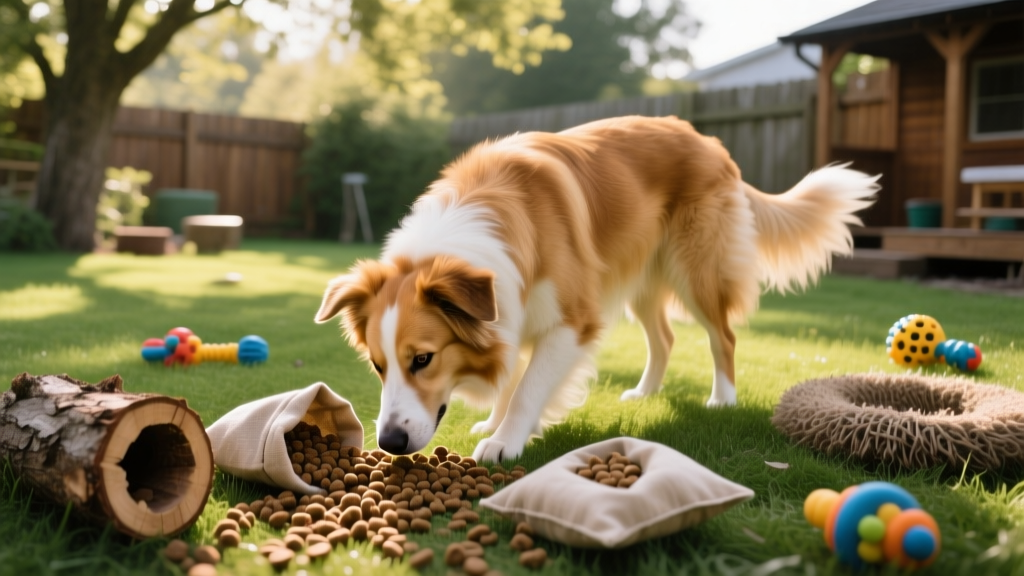
Ant Bites on Dogs
Ant bites on dogs happen when dogs investigate or dig at ant colonies.

Understanding the Problem: Ant Bites on Dogs and the Behaviors Behind Them
Every spring and summer, veterinary clinics see a predictable surge in dogs with painful, swollen paws and muzzles — the aftermath of encounters with ant colonies. Ant bites on dogs aren't just a nuisance; fire ant stings can trigger severe allergic reactions, and even common pavement ant bites cause significant discomfort. But the real question for dog owners isn't just how to treat the bites — it's why dogs seek out ants in the first place and how to stop the behavior before it becomes a repeated problem.
What Qualifies as Ant-Seeking Behavior?
Not every accidental ant encounter is a behavioral concern. Ant-seeking behavior becomes a problem requiring intervention when your dog meets any of these thresholds:
- Frequency: Actively sniffing, pawing, or digging at ant trails or mounds 3+ times per week during outdoor time
- Intensity: Cannot be redirected or called away from an ant colony once engaged; ignores recall commands completely
- Consequence: Has received ant bites or stings on two or more separate occasions
- Fixation: Returns to the same ant hill location repeatedly, even after being bitten previously
- Escalation: Behavior has expanded from sniffing to active digging, rolling, or face-rubbing on ant colonies
If your dog hit an ant mound once by accident while playing fetch and learned to avoid it afterward, that's normal canine learning. The dogs we're addressing here are the ones who keep going back — often despite obvious pain.
Why Does My Dog Go After Ants? Root Cause Analysis
Understanding why your dog targets ant colonies is the foundation of any effective intervention. After years of working with owners whose dogs repeatedly get bitten, I've identified five primary drivers. Most dogs have a combination of two or three.
Root Cause Diagnostic Tree
| Root Cause | Behavioral Signs | Common in Breeds | Prevalence |
|---|---|---|---|
| Prey Drive / Predatory Drift | Intense staring at ground, rapid pawing, snapping at moving ants, high arousal when insects are spotted | Terriers, Hounds, Herding breeds | ~40% of cases |
| Sensory Stimulation / Novelty Seeking | Sniffing intensely, licking the ground near ants, rolling on ant trails, appears fascinated rather than aggressive | Spaniels, Retrievers, young dogs of all breeds | ~25% of cases |
| Boredom / Under-stimulation | Targets ants primarily when left alone in yard, engages more during unstructured outdoor time, has other destructive behaviors | Working breeds, high-energy dogs, adolescents (8-18 months) | ~15% of cases |
| Compulsive Behavior | Ritualistic approach to ant hills, appears unable to stop even when stung, may also shadow-chase or tail-chase, glazed expression during episodes | Doberman Pinschers, Bull Terriers, German Shepherds | ~10% of cases |
| Pain or Medical Discomfort | New onset in older dog, pawing at ground may target area near painful joint, other signs of discomfort present | Senior dogs, large breeds with joint issues | ~10% of cases |
Prey Drive: The Most Common Culprit
Dogs with high prey drive are hardwired to notice small, fast-moving things. Ants scurrying across soil trigger the same predatory sequence — orient, stalk, chase, grab — that a squirrel would trigger, just at ground level. Terriers were literally bred to hunt small burrowing creatures, so a Jack Russell digging into an ant hill is doing exactly what generations of selective breeding programmed it to do. This doesn't make the behavior acceptable, but it does mean you're working with genetics, not against a random habit.
Sensory Stimulation and Curiosity
Some dogs are simply fascinated by the movement, texture, and scent of ant colonies. The pheromones ants release when disturbed create a strong chemical signal that dogs find intensely interesting. Young dogs, especially those under 2 years old, are in a developmental window where novelty-seeking is at its peak. A puppy who discovers that disturbing an ant hill produces thousands of fascinating moving specks has found a self-rewarding activity.
Boredom and Environmental Under-Stimulation
A dog who spends hours alone in a yard with nothing to do will manufacture its own entertainment. Ant hills become a reliable source of activity — there's always something happening. If your dog primarily targets ants during unstructured yard time and also digs holes, chews fences, or barks excessively when bored, the ant-seeking is a symptom of a larger enrichment deficit.
Medical Rule-Out: When to See Your Vet First
Before starting any behavior modification protocol, you need to rule out medical causes — both for the ant-seeking behavior itself and for any injuries from previous bites. According to the Merck Veterinary Manual, insect bites and stings can cause reactions ranging from mild local swelling to life-threatening anaphylaxis.
Pre-Training Veterinary Checklist
Schedule a vet visit before beginning behavior modification if your dog shows any of the following:
- New-onset ant-seeking in a dog over 7 years old — may indicate cognitive decline, vision loss (dog notices ground-level movement more), or pain-related displacement behavior
- Compulsive patterns — dog cannot be interrupted, shows glazed eyes, also engages in other repetitive behaviors (flank sucking, tail chasing, shadow fixation). This may require veterinary behaviorist evaluation and potentially medication such as fluoxetine or clomipramine.
- Allergic reaction history — previous ant stings caused facial swelling, hives, vomiting, difficulty breathing, or collapse. Your dog may need a prescribed epinephrine auto-injector and an emergency action plan.
- Secondary infection at bite sites — redness, pus, heat, or your dog excessively licking a bite wound beyond 48 hours
- Thyroid dysfunction — hypothyroidism can increase irritability and reduce impulse control; ask your vet for a full thyroid panel (T4, free T4, TSH) if behavior changes coincided with weight gain, lethargy, or coat changes
- Neurological signs — head pressing, disorientation, sudden behavioral changes with no environmental trigger warrant neurological evaluation
⚠️ Fire Ant Emergency Protocol
Fire ants (Solenopsis species) inject venom called solenopsin, which causes pustules and intense pain. Multiple stings can be fatal, especially in small dogs under 20 lb (9 kg).
Call your vet immediately or go to emergency veterinary care if:
- Your dog was stung more than 10-15 times
- Facial or throat swelling is present
- Your dog is vomiting, has diarrhea, or seems disoriented
- Your dog collapses or has difficulty breathing
- Your dog weighs under 20 lb (9 kg) and received any fire ant stings
ASPCA Animal Poison Control: (888) 426-4435 (24/7, consultation fee applies)
Pet Poison Helpline: (855) 764-7661
Immediate Management: Preventing Rehearsal While You Train
Every time your dog successfully engages with an ant colony and gets that rush of stimulation, the behavior gets stronger. This is called rehearsal, and it's the number one reason behavior modification fails. Your first job is to manage the environment so the behavior cannot happen while you implement your training plan.
Yard and Environment Management
1. Locate and treat ant colonies. Walk your yard in the early morning or after rain when ants are most active. Mark every mound and trail with a garden flag. Treat colonies using pet-safe ant baits (such as Terro T300B liquid ant bait stations, ~$6 for a 6-pack) placed where dogs cannot access them, or hire a pest control service that offers pet-safe treatment options. Expect to spend $80-$200 for professional yard treatment depending on property size.
2. Create physical barriers. For dogs who target specific areas, use garden fencing or chicken wire laid flat on the ground (covered with mulch) over known ant hill locations. Dogs dislike the texture of wire underfoot, and this blocks access while training is underway.
3. Supervise all outdoor time. During the initial management phase (typically 2-4 weeks), your dog should not be in the yard unsupervised. If you cannot watch them, they should be inside. Use a long line (15-30 ft / 4.5-9 m) during potty breaks to maintain physical control and prevent the dog from running to a known ant area.
4. Redirect to structured activities. Replace unstructured yard time with purposeful activity: flirt pole sessions (10-15 minutes), structured sniffaris with scattered treats in ant-free zones, or training games. A mentally tired dog has less drive to seek out stimulation from ant colonies.
Tools That Help vs. Tools to Avoid
| Tool | Purpose | Estimated Cost | Recommendation |
|---|---|---|---|
| Long line (15-30 ft / 4.5-9 m) | Maintains recall reliability and prevents rehearsal during outdoor time | $15-$35 | ✅ Essential during training phase |
| Puzzle feeders (Kong Classic, Outward Hound Nina Ottosson) | Provides mental stimulation to reduce boredom-driven ant-seeking | $12-$35 each | ✅ Highly recommended — use 2-3 daily |
| Snuffle mat or lick mat | Redirects ground-sniffing behavior to appropriate outlet | $15-$30 | ✅ Good for sensory-seeking dogs |
| Calming supplements (Zesty Paws Calming Bites, Solliquin) | Reduces overall arousal and impulsivity in high-drive dogs | $25-$45/month | ✅ Helpful as adjunct; not a standalone solution |
| Basket muzzle (Baskerville Ultra) | Prevents face contact with ants during walks in high-risk areas | $20-$40 | ✅ Situational use for trail walks in ant-heavy areas |
| GPS collar (Fi Series 3, Whistle Go) | Tracks yard movement patterns to identify hotspot locations | $100-$150 + subscription | ⚠️ Useful for data gathering, not a training tool |
| Shock collar / e-collar | Aversive punishment for approaching ants | $40-$200 | ❌ Do NOT use — increases anxiety, damages trust, can create fear of the yard itself |
| Prong collar | Physical correction for pulling toward ant hills | $15-$35 | ❌ Do NOT use — pain-based, risks neck injury |
| Alpha roll / physical domination | "Showing dominance" after ant encounters | N/A | ❌ Do NOT use — debunked methodology, increases aggression risk |
| Citronella spray or bitter spray on ant hills | Deterrent to make area unpleasant | $8-$15 | ⚠️ May work temporarily but does not address root cause; often ineffective outdoors |
Step-by-Step Training Protocol: Ant Avoidance Program
This protocol uses desensitization (gradually reducing the emotional response to ants), counter-conditioning (replacing the "ants are exciting" association with "ants mean I look at my human for something better"), and positive reinforcement (rewarding the alternative behavior you want).
Phase 1: Foundation Skills (Weeks 1-2)
Goal: Build a rock-solid "leave it" and "look at me" cue in low-distraction environments before adding ant-related triggers.
- Teach "Leave It" with treats. Place a low-value treat on the floor, cover it with your hand. When your dog stops nosing your hand and pulls back even slightly, mark (click or "yes!") and reward from your OTHER hand with a higher-value treat. Progress to uncovered treats, then treats tossed on the ground. Target: dog reliably leaves any food item on the ground when cued, 9 out of 10 trials. Practice 5-minute sessions, 2-3 times daily.
- Teach "Watch Me" (eye contact cue). Hold a treat at your eye level. When your dog makes eye contact, mark and reward. Add the verbal cue "watch me" once the behavior is consistent. Progress to eye contact without the lure, then in increasingly distracting environments. Target: dog makes eye contact within 2 seconds of cue in your yard. Practice in 3-minute sessions, 3-4 times daily.
- Build engagement on walks. On leash walks, randomly call your dog's name and reward heavily (3-5 treats in a row) when they orient to you. This builds a habit of checking in with you rather than scanning the ground.
Phase 2: Controlled Desensitization (Weeks 3-5)
Goal: Introduce ant-related stimuli at a distance where your dog notices but does not react intensely. This is called working "sub-threshold."
- Identify your dog's threshold distance. On leash, walk toward a known ant trail at a slow pace. Watch for the first sign of interest — ears forward, sniffing intensifies, pace changes, pulling toward the area. Note that distance. For most dogs, this is 10-20 feet (3-6 meters) from the colony.
- Work at threshold + 5 feet. At a distance where your dog notices ants but can still respond to cues, ask for "watch me." Mark and reward generously (chicken, cheese, hot dog pieces — whatever your dog values most). Do 10 repetitions per session, 1 session per day.
- Decrease distance by 2 feet every 3-4 sessions — but ONLY if your dog is responding to cues quickly and showing relaxed body language (loose wagging, soft eyes, no whining or straining). If your dog fails to respond at a closer distance, move back 5 feet and work there for several more sessions before trying again.
- Add "leave it" at ant trails. Once your dog can maintain engagement at 5 feet (1.5 m) from an ant trail, walk parallel to the trail and cue "leave it" as your dog glances at it. Reward heavily for compliance. Never force your dog to walk directly over an ant trail during training.
Phase 3: Counter-Conditioning and Real-World Application (Weeks 5-8+)
Goal: Your dog sees ants and automatically looks at you, because ants predict great things from their human.
- "Ants = Chicken" game. On walks where you expect to encounter ants, the moment your dog notices ants (looks at them, sniffs toward them), immediately say "yes!" and deliver 3-5 high-value treats. You are not asking for a behavior — you are creating a classical conditioning association: ants predict chicken. Over time, your dog will look at ants and then immediately look at you.
- Add an incompatible behavior. Once the "ants = look at human" association is established, ask for a sit or a "touch" (nose to hand) when ants are spotted. This gives your dog a specific job to do instead of investigating.
- Gradually reduce treat frequency. Move from continuous reinforcement (treat every time) to variable reinforcement (treat 7 out of 10 times, then 5 out of 10). Always reward heavily if your dog was previously stung at a particular location — that spot carries stronger emotional weight.
- Practice emergency recall. Teach a special recall cue (different from your regular "come") that always predicts an exceptional reward — a jackpot of treats, a favorite toy, or a game of chase. Practice this cue weekly in various locations so that if your dog does break toward an ant hill, you have a reliable emergency brake.
Is Ant-Seeking Behavior Normal? Understanding What You're Working With
Short answer: investigating insects is normal canine behavior. Repeatedly engaging with ant colonies despite negative consequences (being bitten) is not.
Most dogs will sniff an ant trail once or twice and move on. The dogs who keep returning, who dig into mounds, who seem unable to stop even while being stung — these dogs are displaying behavior that has moved beyond normal curiosity into the territory of fixation or compulsion.
According to veterinary behaviorists, this pattern shares characteristics with canine compulsive disorder (CCD), which affects an estimated 2-8% of the general dog population but is significantly higher in certain breeds. A study published in the Journal of Veterinary Behavior found that compulsive behaviors in dogs often emerge between 6 months and 2 years of age and are more likely to persist if they are inadvertently reinforced by the environment — which is exactly what happens when a dog finds a self-rewarding activity like disturbing ant colonies.
If your dog falls into the compulsive category (cannot be interrupted, glazed expression, engages in the behavior to the point of injury), consult your veterinarian about whether medication such as an SSRI (selective serotonin reuptake inhibitor) might be appropriate alongside behavior modification. Medication is not a failure — it's a tool that can lower arousal enough for training to take hold.
Timeline Expectations: How Long Will It Take to Fix Ant-Seeking?
Be realistic. You're asking your dog to override instinct, and that takes time. Here's what typical progress looks like based on behavior modification cases I've followed:
| Timeframe | Expected Milestones | Notes |
|---|---|---|
| Weeks 1-2 | Foundation cues (leave it, watch me) reliable indoors and in low-distraction yard areas. Management protocols in place. No new ant encounters. | Focus on management and skill-building. Do not test near ant colonies yet. |
| Weeks 3-4 | Dog can maintain focus on handler at 10-15 feet from ant trails. Responds to "leave it" when ants are visible at a distance. | Progress may be non-linear. Some sessions will be better than others. |
| Weeks 5-8 | Dog begins to voluntarily check in with handler when ants are spotted. Can walk past ant trails at 5 feet without pulling. Counter-conditioning association forming. | This is where most owners see the first "aha" moment — the dog looks at ants and then looks at you. |
| Weeks 8-12 | Dog reliably avoids ant colonies on walks. Emergency recall effective if dog does orient toward ants. Reduced intensity of interest in ants overall. | Continue variable reinforcement. Do not stop rewarding entirely. |
| Months 3-6+ | Ant-avoidance is the default behavior. Occasional refresher sessions needed. Dog may always notice ants but no longer acts on the impulse. | High-prey-drive dogs may always require management in novel environments with heavy ant activity. |
Factors that extend the timeline: dogs with very high prey drive, dogs with previous severe sting experiences (the adrenaline memory makes the trigger more potent), dogs in environments with constant ant exposure (rural properties, warm climates), and dogs where the behavior has been rehearsed for months or years before intervention began.
Factors that shorten the timeline: early intervention (first sting, immediate management), high-value food motivation, consistent daily practice, and lower baseline prey drive.
Prevention for Puppies and Newly Adopted Dogs
The best time to prevent ant-seeking behavior is before it starts. Whether you have a new puppy or a recently adopted adult dog, these steps build ant-avoidance into your dog's behavioral foundation:
- Early exposure with positive associations (puppies 8-16 weeks): On leash, let your puppy notice an ant trail from a safe distance. When they look at it, mark and treat. You're teaching: "Ants are boring; my human is interesting." Do not let puppies physically interact with ant colonies.
- Teach "leave it" as a top-5 priority cue — alongside sit, come, down, and name recognition. A dog with a solid "leave it" has a built-in safety net for all environmental hazards, not just ants.
- Supervise yard time for the first 3-6 months. New dogs are exploring and mapping their environment. Unsupervised exploration during this period is when self-rewarding behaviors like ant-hill digging get established.
- Provide abundant enrichment from day one. Puzzle feeders, snuffle mats, chew toys, training sessions, and structured walks reduce the likelihood that your dog will seek stimulation from ant colonies out of boredom.
- Treat ant colonies proactively in your yard before your new dog has a chance to discover them. Pet-safe pest control is a worthwhile investment when bringing a new dog home.
Should I Use Punishment to Correct Ant-Seeking?
No. Punishment-based methods — shock collars, prong collars, physical corrections, yelling, or alpha rolls — are counterproductive for ant-seeking behavior for several specific reasons:
First, punishment suppresses the visible behavior without addressing the underlying motivation. Your dog still wants to investigate the ants; they're just afraid to do it in front of you. This means the behavior will happen when you're not watching, which is when your dog is most at risk of being bitten without anyone available to intervene.
Second, punishment creates negative associations with the environment itself. A dog who is shocked near an ant hill may develop fear of the yard, fear of being outdoors, or fear of the handler. This can manifest as leash reactivity, refusal to go outside, or redirected aggression — problems far more difficult to treat than the original ant-seeking.
Third, for dogs driven by compulsion or anxiety, adding an aversive stimulus increases their overall stress level, which typically worsens compulsive behaviors. The veterinary behavior consensus, as outlined by the American Veterinary Society of Animal Behavior (AVSAB), is that punishment-based training increases the risk of fear, anxiety, and aggression while being less effective than positive reinforcement methods.
The alternative — teaching your dog that choosing to ignore ants leads to better rewards than investigating them — creates a dog who makes good decisions even when you're not actively managing them.
When Do I Need a Professional Behaviorist?
Seek Professional Help If:
- Your dog has been stung by fire ants and received emergency veterinary treatment but continues to seek out ants after recovery
- The behavior has a compulsive quality — your dog cannot be interrupted, shows a glazed or "absent" expression during episodes, or engages in the behavior to the point of injury
- You've followed the training protocol above for 6-8 weeks with consistent daily practice and seen no measurable improvement
- Your dog also displays other concerning behaviors: resource guarding, aggression toward people or other dogs, separation anxiety, or other compulsive patterns
- You're unsure whether the behavior is medical, behavioral, or a combination
Who to Hire:
| Professional | Credentials to Look For | When to Choose | Typical Cost (2026) |
|---|---|---|---|
| Veterinary Behaviorist | DACVB (Diplomate, American College of Veterinary Behaviorists) | Compulsive behavior, medication may be needed, complex cases with comorbidities | $250-$500 initial consultation; $100-$200 follow-ups |
| Certified Applied Animal Behaviorist | CAAB or ACAAB (Animal Behavior Society certification) | Behavior is clearly environmental/learned, no medication needed, structured behavior modification plan | $150-$350 initial assessment; $80-$150 per session |
| Certified Professional Dog Trainer | CPDT-KA or CPDT-KSA (Certification Council for Professional Dog Trainers) | Foundational training skills, management guidance, accountability for daily practice | $75-$150 per private session; $25-$50 for group classes |
| Fear Free Certified Trainer | FFCP (Fear Free Certified Professional) | Dog has anxiety component, you want to ensure all methods are force-free | $80-$160 per session |
Always verify credentials directly through the certifying organization's website. The dog training industry is unregulated in most US states, and anyone can call themselves a "behaviorist" without formal qualifications.
Frequently Asked Questions About Ant Bites on Dogs
How do I stop my dog from digging at ant hills?
Combine environmental management with positive reinforcement training. Immediately manage the environment by treating ant colonies with pet-safe products and supervising all outdoor time. Then implement the desensitization and counter-conditioning protocol outlined above, teaching your dog that noticing ants predicts rewards from you rather than the excitement of investigating. A solid "leave it" cue is your most important training tool. Expect 8-12 weeks of consistent practice for reliable results.
What should I do if my dog gets ant bites?
For minor bites from non-fire ants: remove your dog from the area, brush off any remaining ants, apply a cool compress to swollen areas, and monitor for 24 hours. You can give an oral antihistamine like diphenhydramine (Benadryl) at 1 mg per pound of body weight — but always consult your veterinarian before administering any medication, as some formulations contain xylitol or other ingredients toxic to dogs. For fire ant stings, multiple bites, or any signs of allergic reaction (facial swelling, vomiting, difficulty breathing), seek emergency veterinary care immediately.
Are fire ant bites dangerous for dogs?
Yes. Fire ant venom (solenopsin) causes painful pustules and can trigger anaphylaxis in sensitized dogs. Small dogs under 20 lb (9 kg) are at higher risk of systemic reactions from even a moderate number of stings. Dogs who have been stung before may have heightened sensitivity, meaning subsequent encounters carry greater risk. If you live in fire ant territory (primarily the southeastern and south-central United States), proactive yard treatment and avoidance training are critical safety measures.
My dog was stung once and now avoids ants — is that enough?
Some dogs learn from a single negative experience and self-regulate. If your dog was stung, recovered, and now gives ant hills a wide berth, that's a successful natural learning event. However, monitor for overcorrection: some dogs generalize the fear and become anxious about all ground-level stimuli, which can manifest as reluctance to walk on grass, fear of dark patches on the ground, or generalized outdoor anxiety. If you notice this, consult a certified behaviorist.
Can I use diatomaceous earth around my yard to deter ants safely?
Food-grade diatomaceous earth (DE) is generally considered safe for use around dogs when applied correctly — it kills ants by damaging their exoskeletons through physical rather than chemical action. However, avoid letting your dog inhale DE dust, as it can irritate respiratory passages. Apply in calm weather, let it settle, and keep dogs away from the area during application. Reapply after rain. It costs approximately $15-$25 for a 4 lb bag. Note that DE is non-selective and will also harm beneficial insects like bees if they come into direct contact with it.
How long will it take to fix my dog's ant-seeking behavior?
With consistent daily training, most dogs show meaningful improvement within 5-8 weeks, with reliable ant avoidance established by 3-4 months. Dogs with very high prey drive, compulsive tendencies, or years of rehearsed behavior may require 6+ months of ongoing management and periodic refresher training. There is no quick fix — any program promising results in days is relying on suppression through punishment, which carries significant behavioral side effects.
Always consult your veterinarian before starting any new supplement, medication, or behavior modification program, especially if your dog has existing health conditions or is currently taking medication. The information in this article is for educational purposes and does not replace professional veterinary or behavioral advice.
Dr. Hannah Wickes
All our authors care for dogs every day — read more of their work on the authors page.