Best Rated Dog Crates for 2026: A Vet Tech's Buying Guide
Compare the best rated dog crates across 6 top models. Includes sizing charts, safety tips, crate training steps, and real pricing for every budget.

Why the Right Crate Matters More Than You Think
A crate isn't just a metal box you stick in the corner. When chosen and used correctly, it becomes your dog's den — a predictable, safe space that reduces anxiety, prevents destructive behavior, and supports house training. The American Kennel Club recommends crate training as a foundational tool for puppies and adult dogs alike, and most veterinary behaviorists agree that a properly sized crate can significantly ease separation distress when paired with positive reinforcement training.
But pick the wrong crate — too large, too flimsy, poor ventilation — and you're looking at escaped dogs, injured paws, or a stressed-out pup who associates the crate with punishment. After years of helping dog owners troubleshoot crate issues in clinical and home settings, I've tested dozens of models across breeds from 5-pound Chihuahuas to 140-pound Great Danes. This guide breaks down what actually matters.
How to Measure Your Dog for a Crate
Before browsing models, grab a tape measure. Here's exactly what you need:
- Height: Measure from the floor to the top of your dog's head (or ears if erect) while standing naturally. Add 2-4 inches.
- Length: Measure from the tip of the nose to the base of the tail (not the tail tip). Add 2-4 inches.
- Width: Most standard crates accommodate width if height and length are correct, but brachycephalic breeds (Bulldogs, Pugs) and barrel-chested breeds (Greyhounds) may need wider models.
| Crate Size | Interior Dimensions (L×W×H) | Dog Weight Range | Example Breeds |
|---|---|---|---|
| Small (24") | 24" × 18" × 19" | 11-25 lb / 5-11 kg | French Bulldog, Cavalier King Charles Spaniel, Miniature Schnauzer |
| Medium (30") | 30" × 19" × 21" | 26-40 lb / 12-18 kg | Beagle, Cocker Spaniel, Border Terrier |
| Intermediate (36") | 36" × 23" × 25" | 41-70 lb / 19-32 kg | Border Collie, Australian Shepherd, Basset Hound |
| Large (42") | 42" × 28" × 30" | 71-90 lb / 32-41 kg | Labrador Retriever, Golden Retriever, Boxer |
| Extra-Large (48") | 48" × 30" × 33" | 91-120+ lb / 41-54+ kg | German Shepherd, Rottweiler, Great Dane (may need 54") |
Top 6 Best Rated Dog Crates Compared
These picks span wire, plastic, soft-sided, heavy-duty, and furniture-style categories. Prices reflect typical retail as of early 2026.
1. MidWest Homes for Pets iCrate (Double Door)
Category: Wire Crate | Price: $45-$85 depending on size | Sizes: 18" to 48"
The iCrate has been a veterinary clinic and shelter staple for over a decade. It's not flashy, but the dual slide-bolt latches, rounded corners, and included divider panel make it a reliable all-rounder. The composite plastic pan slides out for cleaning without unlatching the door. In my experience, this crate holds up well for dogs under 80 lb who aren't aggressive chewers or escape artists.
- Divider panel included at no extra cost
- Folds flat without tools
- ABS plastic pan is durable and dishwasher-safe (small sizes)
- Widely available — easy to replace parts
- Wire gauge (9-gauge) can bend under determined large dogs
- Single-latch system is escapable by clever breeds (Huskies, Hounds)
- Heavier than competitors in the 42"+ range
2. Frisco Ultimate Heavy Duty Steel Crate
Category: Heavy-Duty Wire | Price: $120-$220 | Sizes: 38" and 42"
Built with 22-gauge steel tubing and dual-locking slide bolts, this crate is designed for dogs who treat standard wire crates like a puzzle toy. The hammer-tone powder coat resists scratching and rust. I've recommended this for foster dogs with severe confinement anxiety who've bent or broken out of standard MidWest models. It's also the crate I'd point you toward for large, powerful breeds like Malamutes or livestock guardian dogs.
- Significantly stronger than standard wire crates
- Dual-locking mechanism prevents nose-and-paw escapes
- Removable wheels for easy repositioning
- 5-year limited warranty
- Heavy — the 42" model weighs approximately 65 lb
- Only two size options
- No divider panel included
- Premium price point
3. Petmate Sky Kennel (Airline-Style Plastic)
Category: Plastic/Hard-Sided | Price: $35-$130 | Sizes: 21" to 48" (6 sizes)
If you fly with your dog or want a den-like feel that many anxious dogs prefer, the Sky Kennel meets most IATA cargo requirements (always confirm with your specific airline before booking). The vault-style door with squeeze latches is more secure than basic wire door clips, and the four-way ventilation keeps airflow consistent. Plastic crates also block visual stimuli on two sides, which reduces reactivity for dogs who bark at movement.
- Airline-compatible design (verify with carrier)
- Enclosed sides reduce visual overstimulation
- Easy to wipe down and sanitize
- Lightweight relative to wire crates of same size
- Not foldable — takes up full footprint in storage
- Limited size adjustment (no divider panels available)
- Some dogs chew through the ventilation slots
- Plastic can retain odors over time
4. EliteField 3-Door Folding Soft Crate
Category: Soft-Sided | Price: $45-$80 | Sizes: 21" to 42"
Soft crates are not for puppies, chewers, or untrained dogs — let me be direct about that. But for a fully crate-trained adult dog who travels to agility trials, camping trips, or hotel stays, the EliteField is the soft crate I've seen most often in competition holding areas. The steel tube frame gives it structure without the weight of a wire crate, and the three mesh doors provide ventilation and access options.
- Weighs under 10 lb even at 36" size
- Folds completely flat in seconds
- Machine-washable cover
- Includes carrying bag with shoulder strap
- Zero chew resistance — a determined dog exits in seconds
- Not suitable for unsupervised confinement
- Mesh panels can snag on claws
- No hard floor pan — needs a separate mat
5. Revol Dog Crate by Diggs
Category: Premium Wire/Hybrid | Price: $195-$325 | Sizes: Small (25"), Medium (31"), Large (37"), XL (42")
The Revol borrows from baby-gate engineering with a diamond-shaped wire mesh that reduces paw-snagging injuries — a real concern documented in veterinary emergency rooms. The single-hand collapsibility is genuinely useful, and the built-in divider and ceiling hatch (for top-loading anxious puppies) are thoughtful touches. This is the crate I recommend to first-time puppy owners who want a single crate that lasts from 8 weeks to adulthood.
- Diamond mesh reduces paw and snout injuries
- Collapses with one hand in under 5 seconds
- Divider panel and ceiling hatch included
- Modern aesthetic — doesn't look like a typical wire crate
- Premium pricing
- Replacement parts only available through manufacturer
- Heavier than standard wire crates at same size
- Limited color options
6. Casper Dog Crate (Furniture-Style)
Category: Furniture/Wood-Wire Hybrid | Price: $350-$500 | Sizes: Small, Medium, Large
For owners who want a crate that doubles as a side table or nightstand, the Casper Dog Crate uses a powder-coated steel frame with acacia wood panels. The mattress-grade cushion is removable and machine-washable. It's not the most practical choice for multi-dog households or travel, but for a single, fully trained dog in a design-conscious home, it eliminates the "cage in the living room" problem entirely.
- Functions as actual furniture
- High-quality cushion included
- Sturdy construction — supports items on top
- Quiet door mechanism
- Most expensive option on this list
- Not portable or collapsible
- Wood panels can be chewed by destructive dogs
- Limited size range — no option for dogs over ~90 lb
Side-by-Side Comparison Table
| Feature | MidWest iCrate | Frisco Heavy Duty | Petmate Sky Kennel | EliteField Soft | Diggs Revol | Casper Dog Crate |
|---|---|---|---|---|---|---|
| Price Range | $45-$85 | $120-$220 | $35-$130 | $45-$80 | $195-$325 | $350-$500 |
| Material | Electro-coated wire | 22-gauge steel | Molded plastic | 600D fabric + steel frame | Diamond wire mesh | Steel + acacia wood |
| Divider Panel | Yes (included) | No | No | No | Yes (included) | No |
| Collapsible | Yes (fold-flat) | Partial | No | Yes | Yes (one-hand) | No |
| Chew Resistance | Moderate | High | Moderate | Very Low | High | Low (wood) |
| Best For | Budget all-rounder | Escape artists / large breeds | Travel / anxious dogs | Trained dogs on the go | Puppies growing to adult | Design-conscious homes |
Crate Safety: What Can Go Wrong
Safety Red Flags
- Collar and tag entanglement: Remove collars (especially martingale and choke-chain styles) before crating. Tags can snag on wire mesh and cause strangulation. Use a breakaway collar or go collar-free inside the crate.
- Paw injuries: Wire crate floors without trays can trap toenails. Always use the included plastic pan or a fitted crate mat. The Merck Veterinary Manual notes that torn nails are among the most common paw injuries in confined dogs.
- Heat stress: Never place a crate in direct sunlight or near heating vents. Brachycephalic breeds (French Bulldogs, Pugs, Boston Terriers) are at elevated risk of overheating in enclosed plastic crates without adequate airflow.
- Confinement duration: Adult dogs should not be crated for more than 6-8 hours during the day. Puppies under 6 months should not exceed 3-4 hours (general rule: age in months + 1 = max hours). Prolonged crating leads to musculoskeletal stiffness, urinary tract issues, and behavioral deterioration.
- Chewing crate materials: Dogs who ingest plastic tray fragments, fabric, or wire coatings risk intestinal obstruction. If your dog chews the crate itself, switch to a heavy-duty steel model and consult a certified behaviorist about underlying anxiety.
How to Crate Train Your Dog: Step-by-Step
Crate training should always use positive reinforcement methods. Never use the crate as punishment — this creates a negative association that undermines every benefit crating can offer.
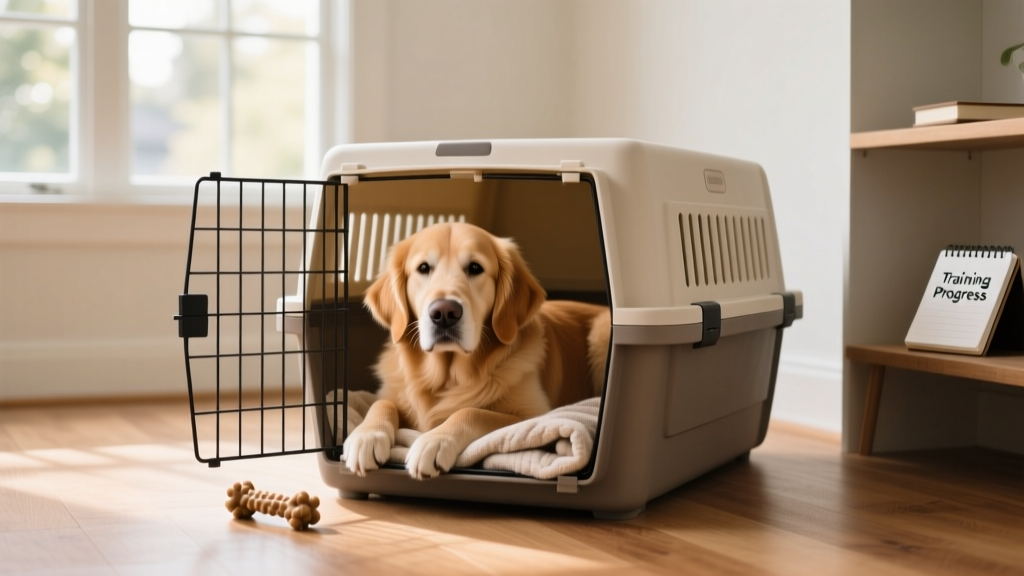
- Place the crate in a high-traffic area with the door open. Add a soft blanket and a safe chew toy (Kong stuffed with peanut butter works well). Let your dog investigate freely without any pressure to enter.
- Feed meals near the crate for the first 2-3 days, then move the bowl just inside the doorway, then fully inside. Your dog should walk in voluntarily to eat.
- Begin closing the door for short intervals (30 seconds to 2 minutes) while you sit nearby. Toss high-value treats through the bars. Gradually extend to 5, then 10, then 20 minutes over the course of a week.
- Leave the room briefly once your dog is comfortable with 20-30 minutes of closed-door time. Start with 1 minute absences and build up. Avoid dramatic departures or reunions — keep arrivals calm.
- Begin overnight crating once your dog handles 1-2 hour daytime sessions calmly. Place the crate in your bedroom initially so your dog can hear and smell you. You can gradually move it to a preferred location over 1-2 weeks.
- For puppies, expect overnight potty breaks. Set an alarm for 3-4 hours after bedtime. Carry (don't walk) the puppy outside, wait for elimination, then immediately return to the crate. This reinforces the crate-as-sleeping-space association.
When to Skip the Crate and See a Vet or Behaviorist
Crating is a tool, not a cure-all. Certain situations require professional intervention before or instead of crate use:
- Severe separation anxiety: If your dog panics, injures themselves, or exhibits extreme distress (prolonged howling, self-mutilation, destruction of the crate) within minutes of confinement, crating can worsen the condition. A veterinary behaviorist may recommend anti-anxiety medication (such as fluoxetine or clomipramine) combined with a structured desensitization protocol. Consult your veterinarian before attempting crate training with a dog showing these signs.
- Medical conditions: Dogs with untreated urinary incontinence, Cushing's disease, diabetes, or mobility issues (severe hip dysplasia, IVDD recovery) should not be confined for standard durations. Frequent access to a potty area and padded flooring may be necessary.
- Post-surgical recovery: While crate rest is often prescribed after orthopedic surgery, the crate must be appropriately sized with non-slip padding. Your surgeon will specify confinement duration — typically 6-12 weeks for TPLO or femoral head ostectomy procedures.
- Resource guarding: If your dog guards the crate aggressively (growling, snapping when approached), this is a behavioral concern that requires a certified professional dog trainer or veterinary behaviorist — not a different crate.
Alternatives to Traditional Crates
Not every dog or household needs a traditional crate. Here are legitimate alternatives depending on your situation:
- Exercise pens (x-pens): Metal or fabric playpens give puppies more room to move while still providing confinement. Ideal for whelping areas or short-term puppy containment when you're home but can't directly supervise. Brands like MidWest and IRIS offer 8-panel setups for $40-$80.
- Baby gates and dog-proofed rooms: For fully house-trained dogs with mild confinement needs, gating off a kitchen or laundry room with non-slip flooring removes the "cage" element entirely. Pair with a camera (Wyze, Furbo) to monitor remotely.
- Tether training: A short leash attached to a sturdy furniture leg or eye hook, paired with a bed, teaches settle behavior without full enclosure. Only appropriate for supervised sessions — never leave a tethered dog unattended.
- Daycare or pet sitters: For dogs who cannot tolerate any form of confinement and whose owners work long hours, doggy daycare ($25-$50/day depending on region) or a midday dog walker may be more humane than extended crating.
Frequently Asked Questions
What is the best rated dog crate for most dogs?
For the average dog owner with a medium-to-large dog who needs a reliable, affordable wire crate, the MidWest iCrate Double Door is the most widely recommended model by veterinary clinics and shelters. For growing puppies where you want a single long-term investment, the Diggs Revol offers better engineering and a built-in divider at a higher price point.
How much does a good dog crate cost?
Expect to spend $45-$85 for a standard wire crate, $120-$220 for heavy-duty models, $35-$130 for airline-style plastic crates, and $195-$500 for premium or furniture-style crates. A quality crate should last 5-10 years, making even the premium options cost-effective on a per-year basis.
Is it cruel to crate a dog while at work?
Crating an adult dog for up to 6-8 hours during the workday is generally acceptable if the dog receives adequate exercise, mental stimulation, and social interaction before and after. Puppies under 6 months cannot physically hold their bladder that long and need a midday break. Dogs with separation anxiety may suffer more in a crate than in a dog-proofed room — consult your veterinarian if you're unsure.
How do I clean a dog crate properly?
Remove the plastic tray and wash with warm soapy water or a veterinary-grade disinfectant (accelerated hydrogen peroxide solutions like Rescue™ are effective and pet-safe once dry). Wipe down wire bars with a damp cloth weekly. Machine-wash any fabric bedding on hot (at least 140°F / 60°C) to kill bacteria and parasites. Avoid bleach-based cleaners on plastic trays as they can degrade the material over time.
Should I put a blanket over my dog's crate at night?
Many dogs sleep more soundly with a breathable cover over the top and sides of a wire crate, as it mimics the enclosed den environment. Use a lightweight, breathable fabric — never plastic or heavy quilts that restrict airflow. Leave at least one full side uncovered for ventilation. If your dog seems restless or pants heavily with the cover on, remove it.
Can I use a crate for two dogs together?
Generally, no. Each dog should have their own crate. Sharing a confined space can trigger resource guarding, and if one dog becomes ill or agitated, the other has no escape route. The exception is bonded littermates or pairs that have been raised together and show no signs of conflict — but even then, separate crates give you flexibility if one dog needs individual confinement for medical or behavioral reasons.
Where to Buy and Final Recommendations
Most crates on this list are available through Chewy, Amazon, and directly from manufacturer websites. Buying direct (Diggs, Casper) often gives you better warranty support and access to replacement parts. Chewy frequently runs 10-15% off autoship discounts on MidWest and Frisco models, and Petco carries the Petmate Sky Kennel in-store if you want to see it before purchasing.
If I had to narrow this to two recommendations: for budget-conscious owners, the MidWest iCrate remains the best value-to-durability ratio available. For those willing to invest in a single crate from puppyhood through adulthood, the Diggs Revol is the best-engineered option I've used. Either way, measure your dog first, train with patience and treats, and remember — the crate is a tool to help your dog feel secure, not a substitute for exercise, training, and time together.
Aaron Whyte
All our authors care for dogs every day — read more of their work on the authors page.