Yorkshire Terrier Puppy Guide: Milestones, Feeding,
Complete Yorkshire Terrier puppy guide covering age-specific milestones, feeding schedules, potty training timelines, vaccinations, socialization, and

Bringing home a Yorkshire Terrier puppy means welcoming a confident, affectionate companion who will likely weigh no more than 7 pounds at maturity — but whose care requirements in the first 12 months are anything but small. Yorkies have unique developmental needs tied to their tiny frame: hypoglycemia risk in early weeks, a notoriously challenging potty training curve due to small bladders, and a critical socialization window that closes faster than many owners realize.
This guide walks you through every stage of your Yorkshire Terrier puppy's first year with specific timelines, exact feeding portions, and realistic expectations based on veterinary science and breed-specific data from the American Kennel Club and the Merck Veterinary Manual.
When Should You Bring Your Yorkshire Terrier Puppy Home?
Responsible Yorkie breeders typically release puppies between 10 and 12 weeks of age, not the 8-week standard common with larger breeds. This extended time with the litter is critical for toy breeds. Yorkshire Terriers are prone to stress-induced hypoglycemia (dangerously low blood sugar) during transitions, and those extra weeks with the mother and littermates build metabolic stability and bite inhibition skills that directly affect your experience at home.
A Yorkie puppy brought home at 8 weeks often shows heightened separation anxiety, weaker immune response to initial vaccines, and more difficulty with house training compared to one that transitions at 12 weeks. If a breeder offers you a Yorkie at 7 or 8 weeks without medical justification, consider it a red flag about their practices.
Yorkshire Terrier Puppy Milestones: Week by Week
Understanding what's developmentally appropriate at each stage prevents both unnecessary worry and missed intervention windows. Here's what to expect from your Yorkie puppy across the first year.
| Age Range | Physical Development | Behavioral Expectations | Owner Action Items |
|---|---|---|---|
| Weeks 4–8 (with breeder) | Deciduous teeth erupting; weight gain of ~1 oz/day; coat begins transitioning from puppy fuzz to silkier texture; eyes fully functional | Littermate play teaches bite inhibition; startle response to loud sounds; beginning to explore beyond whelping box | Verify breeder has started deworming (typically at 2, 4, 6 weeks); confirm first DHPP vaccine given at 6–8 weeks |
| Weeks 8–12 (home transition) | Weight typically 1.5–3 lb (0.7–1.4 kg); sleeping 18–20 hours/day; rapid skeletal growth; bladder capacity ~30–45 minutes | Peak fear imprint period (weeks 8–11); strong startle responses; bonding intensely with primary caregiver; may show resource guarding of food or toys | Schedule first vet visit within 72 hours of homecoming; begin crate training; establish feeding routine; limit exposure to unknown dogs until vaccine series complete |
| Weeks 12–16 | Weight typically 2.5–4.5 lb (1.1–2.0 kg); coordination improving; adult coat starting to show characteristic steel-and-tan coloring on new growth | Fear period often ending; confidence increasing; testing boundaries with nipping and jumping; attention span extending to 5–10 minutes for training sessions | Enroll in positive-reinforcement puppy class (post second vaccine series); begin structured name-recognition and sit training; increase socialization outings |
| Weeks 16–24 | Weight approaching 4–6 lb (1.8–2.7 kg); teething begins around 16 weeks; deciduous teeth falling out; adult teeth emerging; coat lengthening noticeably | Chewing intensity peaks; may regress on potty training during teething stress; adolescent independence emerging; may become selectively deaf to known commands | Provide appropriate chew outlets; reinforce potty training consistency; practice recall in low-distraction environments; begin short grooming habituation sessions |
| Months 6–12 | Reaching adult weight of 4–7 lb (1.8–3.2 kg); adult coat fully growing in; sexual maturity (spay/neuter typically recommended at 6–9 months for Yorkies) | Energy stabilizing; personality solidifying; potential for small-dog syndrome if boundaries not maintained; territorial barking may emerge | Discuss spay/neuter timing with veterinarian; transition to adult food around 10–12 months; establish regular grooming schedule (baths every 2–3 weeks for long-coat Yorkies) |
Yorkshire Terrier Puppy Feeding Schedule and Portions
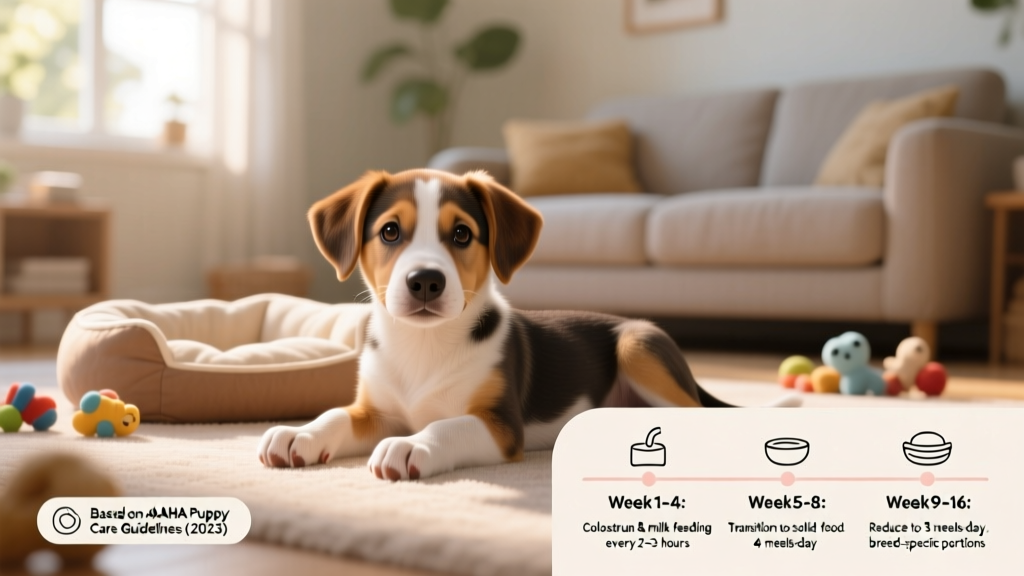
Toy breed puppies have proportionally higher metabolic rates than large breeds — a Yorkie puppy burns calories faster per pound of body weight and is at genuine risk of hypoglycemia if meals are skipped or spaced too far apart. The Merck Veterinary Manual recommends feeding toy breed puppies three to four times daily through at least 6 months of age.
Choose a kibble specifically formulated for small or toy breed puppies — these formulas have smaller kibble size and higher caloric density per cup. Look for an AAFCO statement confirming the food is "complete and balanced for growth" or "for all life stages."
| Age | Estimated Weight | Meals Per Day | Daily Kibble Total (approx.) | Notes |
|---|---|---|---|---|
| 8–12 weeks | 1.5–3 lb (0.7–1.4 kg) | 4 meals | ¼ – ⅓ cup | Never skip a meal — hypoglycemia risk is real. Keep Nutri-Cal gel on hand for emergencies. |
| 12–16 weeks | 2.5–4.5 lb (1.1–2.0 kg) | 3–4 meals | ⅓ – ½ cup | Can reduce to 3 meals if puppy consistently eats well and maintains energy. |
| 4–6 months | 3.5–5.5 lb (1.6–2.5 kg) | 3 meals | ½ – ⅔ cup | Monitor body condition score (BCS); adjust portions if ribs become difficult to feel. |
| 6–9 months | 4–6.5 lb (1.8–2.9 kg) | 2–3 meals | ½ – ¾ cup | Transition to 2 meals around 8 months if maintaining healthy weight. |
| 9–12 months | 4–7 lb (1.8–3.2 kg) | 2 meals | ½ – ¾ cup | Begin transitioning to adult small-breed formula around 10–12 months over 7–10 days. |
How Often Should I Feed My Yorkie Puppy?
Feed four meals daily from 8–12 weeks, three meals from 12 weeks to 6 months, and transition to two meals between 6–9 months. Free-feeding (leaving kibble out all day) is generally not recommended for Yorkies because it makes potty training significantly harder — you can't predict bathroom timing when you don't know when they ate.
Potty Training Your Yorkshire Terrier Puppy: Realistic Timeline
Here's the honest truth that many breed guides gloss over: Yorkshire Terriers are among the most challenging breeds to potty train, and it's not a reflection of intelligence. It's anatomy. A 3-pound puppy has a bladder roughly the size of a tablespoon, and they physically cannot hold it for the same duration as a Labrador puppy of the same age.
Most Yorkie puppies achieve reliable daytime house training between 5 and 7 months, with full overnight reliability often taking until 8–10 months. Some individuals, particularly males, may take up to 12 months for complete reliability. This is normal and expected for the breed.
Potty Training Schedule and Strategies
| Age | Maximum Hold Time (awake) | Take-Out Frequency | Overnight Expectation |
|---|---|---|---|
| 8–10 weeks | 20–30 minutes | Every 20–30 minutes when awake; immediately after eating, waking, and playing | Expect 2–3 overnight wake-ups; set alarms |
| 10–14 weeks | 30–45 minutes | Every 30–45 minutes; after every meal and nap | 1–2 overnight trips; may sleep 3–4 hour stretches |
| 14–20 weeks | 1–1.5 hours | Every 60–90 minutes during active periods | 4–5 hour stretches becoming possible |
| 5–7 months | 2–3 hours | Every 2–3 hours; learning to signal at door | 6–8 hours overnight for many puppies |
| 8–12 months | 4–5 hours | 3–4 times daily with consistent schedule | Full overnight hold for most individuals |
Key troubleshooting tips for Yorkie potty training:
- Use an enzymatic cleaner (Nature's Miracle or Rocco & Roxie) for every accident — standard household cleaners don't break down uric acid crystals, and your Yorkie will re-soil the same spot if they can smell residual urine.
- Consider a potty bell system hung on the door handle. Yorkies are smart enough to learn bell-ringing by 4–5 months, which solves the "I didn't know they needed to go out" problem.
- Indoor grass pads (like Fresh Patch or DoggieLawn) are legitimate tools for apartment-dwelling Yorkie owners, especially during winter months or before the vaccine series is complete. Introduce them as a supplement to outdoor training, not a replacement.
- Never punish accidents. Rubbing a puppy's nose in urine or yelling creates fear of eliminating in front of you, which leads to hiding behind furniture to potty — a far harder problem to fix. Simply interrupt calmly, carry them outside, and reward heavily when they finish outdoors.
Socialization Window: Weeks 3–14 (Don't Miss This)
Canine behavioral research published in the AVMA's literature consistently identifies weeks 3 through 14 as the primary socialization period — the developmental window during which puppies form lasting impressions about what is safe and normal in their environment. For a Yorkshire Terrier, who can naturally default to wariness and territorial barking if under-socialized, this window is the single most important investment you can make in your dog's lifelong temperament.
The challenge: your puppy's vaccine series isn't complete until around 16 weeks, which overlaps with the closing of this window. The AVMA and the American Veterinary Society of Animal Behavior (AVSAB) recommend that puppies do begin controlled socialization after their first DHPP vaccine (typically given at 6–8 weeks), rather than waiting for the full series. The risk of behavioral problems from under-socialization outweighs the disease risk when exposures are managed carefully.
Yorkie Puppy Socialization Checklist
Yorkshire Terrier Puppy Vaccination Schedule
Your veterinarian will tailor the exact protocol to your puppy's health status and local disease prevalence, but the core vaccine timeline for Yorkshire Terrier puppies follows established AVMA guidelines. Toy breeds occasionally show stronger post-vaccine reactions (lethargy, mild fever, soreness at injection site) than larger dogs — discuss this with your vet, who may recommend spacing vaccines or pre-treating with an antihistamine.
| Age | Vaccine | What It Protects Against | Notes |
|---|---|---|---|
| 6–8 weeks | DHPP (Distemper, Hepatitis/Adenovirus, Parainfluenza, Parvovirus) — Dose 1 | Core diseases; parvovirus is particularly lethal in toy breed puppies | Often administered by breeder before pickup; request documentation |
| 10–12 weeks | DHPP — Dose 2; Bordetella (optional) | Booster for core immunity; Bordetella protects against kennel cough | Bordetella recommended if attending puppy classes or visiting groomers |
| 14–16 weeks | DHPP — Dose 3; Rabies (required by law in most US states) | Final core booster; rabies is zoonotic (transmissible to humans) and uniformly fatal | Rabies vaccine timing varies by state law — your vet will advise on local requirements |
| 12–16 months | DHPP booster; Rabies booster | Maintains immunity into adulthood | After this, DHPP boosters are typically given every 3 years; rabies intervals vary by jurisdiction |
When can my puppy go outside and meet other dogs? After the first DHPP vaccine (6–8 weeks), your puppy can have controlled outdoor exposure — carried in your arms, placed on clean surfaces, and introduced to known-vaccinated dogs in private yards. Avoid high-traffic dog areas (dog parks, pet store floors, public sidewalks with heavy dog traffic) until at least 7 days after the final DHPP dose at 14–16 weeks. Parvovirus can survive in soil for over a year and is a genuine threat to unvaccinated toy breed puppies.
Teething Timeline and Relief Strategies (3–6 Months)
Yorkshire Terrier puppies begin losing their 28 deciduous (baby) teeth around 14–16 weeks, with the full set of 42 adult teeth typically erupted by 6–7 months. Toy breeds are particularly prone to retained deciduous teeth — where baby teeth fail to fall out as adult teeth emerge — creating crowded, overlapping teeth that trap food and accelerate dental disease. Your vet should check for retained teeth at every puppy visit and may recommend extraction during the spay/neuter procedure.
Safe Chew Recommendations by Teething Stage
- 14–20 weeks (active eruption, high discomfort): Frozen, wet washcloths twisted into a rope shape; KONG Puppy teething sticks; chilled (not frozen solid) rubber toys like the KONG Puppy Classic filled with plain yogurt and frozen.
- 20–28 weeks (incisors and canines replacing): Benebone Puppy Wishbone (sized for dogs under 15 lb); Nylabone Puppy Chew in chicken flavor; bully sticks (supervised only — remove when small enough to swallow).
- Avoid entirely: Rawhide (choking and intestinal blockage risk), ice cubes (can fracture emerging teeth), hard nylon bones designed for adult dogs (too hard for puppy enamel), and any chew toy harder than a fingernail (the "thumbnail test" — if you can't dent it with your thumbnail, it's too hard).
Crate Training Progression for Yorkie Puppies
Crate training is especially valuable for Yorkshire Terriers because it provides the structure their potty training depends on and creates a safe retreat that reduces the separation anxiety this breed is genetically predisposed to. Choose a crate sized for your puppy's adult dimensions (approximately 24" x 18" x 19" for most Yorkies) with a divider panel to reduce the interior space while they're small — too much room allows them to eliminate in one corner and sleep in another.
| Puppy Age | Maximum Continuous Crate Time | Overnight Expectation |
|---|---|---|
| 8–10 weeks | 30–45 minutes (daytime) | 2–3 hours before needing a potty break |
| 10–14 weeks | 1–1.5 hours | 3–4 hours between overnight breaks |
| 14–20 weeks | 2–3 hours | 4–5 hours; may begin sleeping through |
| 5–7 months | 3–4 hours | 6–8 hours for most puppies |
| 8+ months | 4–5 hours (daytime maximum) | 8–10 hours overnight |
Important: A crate is not a babysitter. Exceeding these time limits teaches your puppy that they have no choice but to soil their sleeping area, which destroys the den-instinct that makes crate training effective for potty training. If your work schedule requires longer absences, use a puppy-proofed exercise pen with a potty pad station at one end and the crate (door open) at the other.
Common Yorkshire Terrier Puppy Problems and Solutions
Puppy Biting and Nipping
Yorkie puppies are mouthy — a trait that surprises owners who expected a "lap dog." This breed was originally developed to hunt rats in textile mills, and that terrier drive shows in their play style. Puppy biting typically peaks between 12–20 weeks and intensifies during teething.
What works:
- Redirect to a toy: When teeth touch skin, say "oops" in a neutral tone, stand up and withdraw attention for 10–15 seconds, then return with a chew toy. This mimics how littermates teach bite inhibition — they stop playing when bites are too hard.
- Structured play sessions: Keep play to 10–15 minutes, then transition to a calm activity. Overstimulated puppies bite harder and more frequently.
- Teach "gentle": Hold a treat in a closed fist. When your puppy licks or noses your hand instead of biting, mark with "yes" and open your hand to release the treat.
What doesn't work (and causes harm): Holding the mouth shut, alpha rolls, tapping the nose, or any aversive technique. These methods increase fear-based biting and damage the trust your puppy needs to develop with you.
Excessive Whining and Crying
The first 1–2 weeks home, expect significant whining, especially at night. This is a normal stress response to separation from littermates. Strategies that help: a Snuggle Puppy toy with a simulated heartbeat, a warm (not hot) water bottle wrapped in a towel, and keeping the crate in your bedroom for the first few weeks so your presence is reassuring. Gradually move the crate to its permanent location over several days once your puppy is settling well.
Destructive Chewing
Between 4–7 months, your Yorkie puppy will chew everything within reach. This is driven by teething discomfort and natural exploration. Puppy-proof by removing access to shoes, electrical cords, and houseplants (many common houseplants — including pothos, philodendron, and peace lilies — are toxic to dogs; if ingestion is suspected, call ASPCA Animal Poison Control at (888) 426-4435, a consultation fee applies). Provide a rotation of 5–7 approved chew toys, swapping them every few days to maintain novelty.
First-Year Cost Breakdown for a Yorkshire Terrier Puppy
Budgeting accurately for a Yorkie puppy prevents the financial stress that leads to delayed veterinary care. Below are realistic 2026 cost ranges based on national averages. Costs skew higher in major metropolitan areas (New York, San Francisco, Los Angeles) and lower in rural regions.
| Category | Items | Cost Range (USD) |
|---|---|---|
| Puppy purchase/adoption | Responsible breeder: health-tested parents, AKC registration, early socialization, take-back clause | $1,500 – $4,000 (adoption from breed rescue: $300 – $600) |
| Veterinary care | Initial exam, 3 DHPP doses, rabies vaccine, Bordetella, fecal tests, deworming, heartworm prevention (12 months), spay/neuter | $800 – $1,800 |
| Food and treats | High-quality small-breed puppy kibble, training treats, dental chews | $250 – $500 |
| Supplies | Crate, exercise pen, bed, leash/harness (Yorkies need harnesses, not collars, due to tracheal collapse risk), bowls, grooming tools, potty supplies, enzymatic cleaner | $300 – $600 |
| Grooming | Professional grooming every 6–8 weeks for coat maintenance (8–10 sessions/year), plus at-home brush/comb maintenance supplies | $500 – $1,000 |
| Training | Puppy socialization class, basic obedience course (positive reinforcement methods) | $150 – $400 |
| Pet insurance | Comprehensive accident/illness policy (enrolled before pre-existing conditions develop) | $350 – $600/year |
| Emergency fund | Recommended reserve for unexpected illness, injury, or foreign body ingestion | $500 – $2,000 (set aside, not necessarily spent) |
Total estimated first-year cost (excluding puppy purchase): $2,850 – $6,900
Total estimated first-year cost (including puppy from a breeder): $4,350 – $10,900
Yorkies have above-average grooming costs compared to short-coated breeds, and their predisposition to dental disease means you should budget for professional dental cleanings under anesthesia starting around age 2–3 (typically $500–$1,200 per cleaning). Starting daily toothbrushing as a puppy significantly delays or reduces the need for these procedures.
Frequently Asked Questions
When should I bring my Yorkshire Terrier puppy home?
Between 10 and 12 weeks of age. This is later than many breeds because Yorkies need extra time with their litter for metabolic stability, bite inhibition development, and immune system maturation. A responsible breeder will not release a Yorkie puppy before 10 weeks without a compelling medical reason.
How often should I feed my Yorkie puppy at each age?
Four meals daily from 8–12 weeks, three meals from 12 weeks to 6 months, and two meals from 6 months onward. Toy breed puppies should never go more than 4–5 hours without eating during their first 4 months due to hypoglycemia risk. Portion sizes range from ¼ cup to ¾ cup total daily, depending on age and weight (see the feeding table above).
When will my Yorkshire Terrier puppy be fully potty trained?
Realistically, expect reliable daytime house training between 5 and 7 months, with overnight reliability by 8–10 months. Some Yorkies take up to 12 months for complete reliability. This is a breed-typical timeline driven by their small bladder capacity, not a training failure. Consistency, frequent outdoor trips, and enzymatic cleaners for accidents are your most effective tools.
What vaccines does my Yorkie puppy need and when?
The core schedule includes DHPP at 6–8 weeks (dose 1), 10–12 weeks (dose 2), and 14–16 weeks (dose 3), plus a rabies vaccine at 14–16 weeks. Bordetella (kennel cough) is recommended if your puppy will attend classes or visit groomers. Always consult your veterinarian for a protocol tailored to your puppy's health status and local disease risk.
How do I stop my Yorkie puppy from biting and nipping?
Redirect every bite to an appropriate chew toy and withdraw attention for 10–15 seconds when teeth contact skin. Keep play sessions short (10–15 minutes) to prevent overstimulation. Teach a "gentle" cue using closed-fist treat exercises. Biting typically peaks at 12–20 weeks and subsides as adult teeth fully erupt around 6–7 months. Never use aversive methods like mouth-holding or nose-tapping.
When can my Yorkie puppy go outside and meet other dogs?
After the first DHPP vaccine (6–8 weeks), controlled outdoor exposure is appropriate — carrying your puppy, visiting private yards with known-vaccinated dogs, and attending structured puppy classes that require proof of vaccination. Avoid dog parks, pet stores, and high-traffic public areas until 7 days after the final DHPP dose at 14–16 weeks. The socialization window closes around 14 weeks, so managed exposure during this period is critical for long-term temperament.
Dr. Hannah Wickes
All our authors care for dogs every day — read more of their work on the authors page.