Yorkie Puppy Breeders: Your First 6 Months Care & Milestone Guide
Brought home a Yorkie from reputable breeders? This milestone-by-milestone guide covers feeding, potty training, vaccines, and costs for your Yorkshire Terrier puppy.

So you've found reputable yorkie puppy breeders and you're preparing to bring home a 2-to-4-pound bundle of silk-coated energy. Yorkshire Terriers are one of the most popular toy breeds in the US for good reason — they're bold, affectionate, and surprisingly athletic for their size. But their tiny stature creates unique puppy-care challenges that generic guides often miss.
This guide walks you through every critical milestone from week 4 through month 12, with exact feeding portions, vaccine schedules, and potty training timelines calibrated specifically for Yorkie physiology. Yorkies are prone to hypoglycemia as puppies, have notoriously small bladders, and hit developmental windows on a slightly compressed timeline compared to larger breeds. Getting these details right from day one prevents expensive vet visits and behavioral headaches down the road.
Bringing Your Yorkie Puppy Home: Timing and the First 48 Hours
When should you bring your puppy home? Reputable yorkie puppy breeders will not release a puppy before 10 to 12 weeks of age — and many responsible breeders of toy breeds insist on 12 to 16 weeks. This is not arbitrary. Yorkshire Terriers are particularly vulnerable to hypoglycemia (dangerously low blood sugar) in the first weeks of life, and the extra time with the mother and littermates builds critical stress resilience and bite inhibition.
A Yorkie puppy sent home at 8 weeks weighs roughly 1.5 to 2.5 pounds. At that size, even a missed meal or an episode of stress-induced diarrhea can trigger a hypoglycemic crisis. By 12 weeks, most Yorkies have better metabolic stability and immune function.
Your First 48-Hour Checklist
- Set up a confined space — a playpen with a crate inside, not free-roaming access to the house. Yorkie puppies can squeeze behind furniture and get trapped.
- Karō syrup or Nutri-Cal on hand — rub a pea-sized amount on the puppy's gums if they seem lethargic, wobbly, or refuse food. This is an emergency bridge, not a treatment. Call your vet immediately.
- Same food the breeder used — request at least a week's supply of the exact kibble or wet food. Sudden diet changes cause GI upset in toy breeds faster than in larger dogs.
- Limit visitors — one or two calm introductions per day maximum. Overstimulation stresses a tiny puppy's immune system during a vulnerable transition.
- Carry, don't let them jump — Yorkie puppies have delicate leg bones. A jump off a couch at 10 weeks can fracture a radius or ulna.
Yorkie Puppy Milestones: Week-by-Week Development Timeline
Yorkshire Terriers mature faster in some areas and slower in others compared to medium and large breeds. Their socialization window is the same (3–14 weeks), but their bladder control develops more slowly due to sheer physical size. Here's what to expect at each stage:
| Age Range | Weight (approx.) | Key Milestones | What to Expect |
|---|---|---|---|
| Weeks 4–8 | 0.7–1.8 lb / 0.3–0.8 kg | Eyes fully functional, baby teeth erupting, first socialization with littermates, weaning onto solid food | Puppy should still be with the breeder. They learn bite inhibition from siblings. Breeder begins handling exercises and introduces varied surfaces. |
| Weeks 8–12 | 1.5–3.0 lb / 0.7–1.4 kg | Primary socialization window peaks, first DHPP vaccine, fear imprinting period begins (~8–10 weeks), crate training starts | Bring puppy home (ideally at 10–12 weeks from responsible breeders). Nighttime whining is normal. Potty accidents every 30–60 minutes. Begin name recognition and gentle handling. |
| Weeks 12–16 | 2.5–4.5 lb / 1.1–2.0 kg | Second and third DHPP boosters, rabies vaccine (12–16 weeks), socialization window closing, basic cue training begins | Puppy gains confidence. Bladder control extends to 1.5–2 hours. Short training sessions (3–5 minutes) for sit, come, and leash introduction. Puppy may test boundaries with nipping. |
| Weeks 16–24 | 3.5–6.0 lb / 1.6–2.7 kg | Teething begins (baby teeth shed), adult coat starts replacing puppy coat, vaccination series complete, fear period #2 (~6–8 months) | Chewing intensifies — provide appropriate outlets. Puppy can now go to public spaces safely. Begin structured socialization with unfamiliar dogs. Coat may look patchy during transition. |
| Months 6–12 | 4.0–7.0 lb / 1.8–3.2 kg | All adult teeth in by 7 months, spay/neuter window (discuss with vet), sexual maturity, adolescent energy surge | Training regression is normal — stay consistent. Yorkie should be reliably potty trained by 8–9 months. Switch to adult food at 10–12 months. Full adult coat grows in. |
Yorkie Puppy Feeding Schedule: Exact Portions by Age and Weight
How often should you feed your puppy at each age? Yorkie puppies have extremely fast metabolisms and tiny stomachs. They cannot store glycogen the way larger breeds can, which is why feeding frequency matters as much as portion size. According to the American Kennel Club, toy breed puppies need more frequent meals than their larger counterparts.
Use a high-quality small-breed puppy formula with an AAFCO statement confirming it meets nutritional requirements for growth. Look for minimum 22% protein and 8% fat on the guaranteed analysis. Kibble size matters — choose formulas with extra-small kibble designed for toy breeds (brands like Royal Canin Yorkshire Terrier Puppy, Hill's Science Diet Small Paws Puppy, or Purina Pro Plan Toy Breed Puppy).
| Age | Meals Per Day | Daily Kibble (dry) | Notes |
|---|---|---|---|
| 8–12 weeks (1.5–3 lb) | 4 meals/day (every 4 hours while awake) | ¼ to ⅓ cup/day total (split across meals) | Free-choice feeding acceptable at this stage — leave kibble available. Monitor intake to ensure they're eating. Supplement with wet food if appetite is low. |
| 12–16 weeks (2.5–4.5 lb) | 3 to 4 meals/day | ⅓ to ½ cup/day total | Transition to scheduled meals. Remove food after 15–20 minutes to establish routine. Fresh water always available. |
| 4–6 months (3.5–5.5 lb) | 3 meals/day | ⅓ to ½ cup/day total | Growth rate slows. Adjust portions based on body condition score — you should feel ribs easily but not see them prominently. |
| 6–12 months (4–7 lb) | 2 meals/day | ⅓ to ¾ cup/day (depending on adult size) | Transition to adult small-breed formula at 10–12 months. A 4 lb Yorkie needs roughly 150 calories/day; a 7 lb Yorkie needs roughly 225 calories/day. |
Vaccination Schedule for Your Yorkshire Terrier Puppy
What vaccines does your puppy need and when? Your Yorkie puppy's vaccination schedule follows the American Veterinary Medical Association core vaccine guidelines, but toy breeds sometimes experience stronger post-vaccine reactions. Your vet may recommend splitting vaccine appointments (giving one or two vaccines per visit rather than all at once) to reduce risk of adverse reactions.
| Age | Vaccine(s) | What It Protects Against | Notes |
|---|---|---|---|
| 6–8 weeks | DHPP (1st dose) | Distemper, Hepatitis (Adenovirus), Parainfluenza, Parvovirus | Usually administered by the breeder. Ask for records. Some vets add Bordetella at this stage if puppy will be in group settings. |
| 10–12 weeks | DHPP (2nd dose), Bordetella (optional), Leptospirosis (1st dose, risk-dependent) | Booster for core diseases; kennel cough; leptospirosis (if in endemic area) | Critical booster — the first DHPP alone does not provide full immunity. Maternal antibodies may interfere with the first dose. |
| 14–16 weeks | DHPP (3rd dose), Rabies, Leptospirosis (2nd dose if started) | Final core booster; rabies (legally required in all US states) | After this appointment, your puppy is considered fully vaccinated in approximately 1–2 weeks. Rabies vaccine is required by law — keep the certificate. |
When can your puppy go outside or meet other dogs? Until your Yorkie has completed the full DHPP series (approximately 1 week after the 14–16 week booster), avoid public dog areas — parks, pet stores, sidewalks where unknown dogs walk. You can carry your puppy in a sling or carrier for socialization exposure (seeing new sights, hearing traffic, meeting calm vaccinated dogs in controlled settings) before vaccinations are complete. The socialization window closes around 14 weeks, so waiting until 16 weeks to expose your puppy to the world creates lasting fear and reactivity issues.
Socialization Window: The Critical Weeks 3–14 Exposure Checklist
The AKC recommends structured socialization during the 3-to-14-week window — this is when your Yorkie's brain is most receptive to new experiences without forming fear associations. After 14 weeks, unfamiliar things trigger caution or fear by default. Missing this window is the single biggest predictor of adult dog reactivity and anxiety.
Because your puppy won't be fully vaccinated during much of this window, focus on controlled, low-risk exposures — carry your puppy, invite vaccinated dogs to your home, and avoid high-traffic dog areas.
Your Yorkie Socialization Checklist (Weeks 8–14)
People (aim for 15–20 unique individuals):
- Children of different ages (supervised, calm interactions)
- Men with beards, hats, sunglasses
- People using wheelchairs, crutches, or walkers
- Delivery workers in uniform
- People of different ethnicities and heights
Surfaces and environments:
- Grass, gravel, sand, wet pavement
- Metal grates, wooden decks, tile floors
- Elevator rides, car rides (start with 5-minute trips)
- Automatic doors, revolving doors
Sounds (play recordings at low volume, pair with treats):
- Thunderstorms, fireworks, vacuum cleaners
- Doorbells, alarms, construction noise
- Other dogs barking (at a distance)
Handling exercises (daily, 2–3 minutes):
- Touch paws, ears, mouth, tail base — pair with treats
- Gentle restraint (simulate vet exam holds)
- Nail trimming introduction (touch clippers, don't cut yet)
- Tooth brushing introduction (finger, then brush)
Rule of thumb: Every new experience should end with your puppy feeling neutral or positive. If they show fear (tucked tail, flattened ears, freezing), increase distance or reduce intensity and try again with higher-value treats. Never force a frightened puppy into a situation — this creates lasting phobias.
Potty Training Your Yorkie: Realistic Timeline and Troubleshooting
When will your puppy be fully potty trained? Here's the honest answer most generic guides won't give you: Yorkshire Terriers typically take 4 to 8 months to become reliably house-trained, and some take up to 12 months. This is not a reflection of intelligence — it's a consequence of anatomy. A 3-pound puppy has a bladder roughly the size of a grape, and the neurological signals that tell them "hold it" mature more slowly in toy breeds.
Potty Training Timeline (Realistic Expectations)
- 8–12 weeks: Accidents every 30–60 minutes. Take puppy out every 30 minutes when awake, plus immediately after eating, playing, or waking from a nap.
- 12–16 weeks: Bladder control extends to 1–2 hours. Accidents still happen, but patterns emerge. Puppy may start going to the door.
- 4–6 months: Can hold 2–3 hours during the day. Nighttime control improves to 5–6 hours. Accidents become less frequent if you've been consistent.
- 6–9 months: Most Yorkies are reliably trained with rare accidents. Males may begin marking — neutering and consistent management help.
Potty Training Troubleshooting for Yorkies
Problem: Puppy pees on puppy pads but won't go outside.
Many Yorkie owners start with indoor pads because of the puppy's size and cold-weather sensitivity. If you want to transition to outdoor elimination, move the pad gradually toward the door over several days, then place it just outside, then remove it. Yorkies form strong substrate preferences — if they learn to pee on fabric, they'll seek out rugs and bathmats.
Problem: Puppy won't potty outside in cold or rainy weather.
This is extremely common with Yorkies. Solutions: use a covered patio area, put a lightweight dog sweater on them, and use a consistent verbal cue ("go potty") paired with a high-value treat immediately after they eliminate. Keep outdoor trips brief (3–5 minutes) in bad weather.
Problem: Puppy has accidents after being "trained."
Regression at 6–8 months is normal and usually coincides with the second fear period or hormonal changes. Return to more frequent outings, supervise more closely, and rule out urinary tract infections with your vet — UTIs are common in small breeds and cause sudden house-training setbacks.
Crate Training Progression and Time Limits by Age
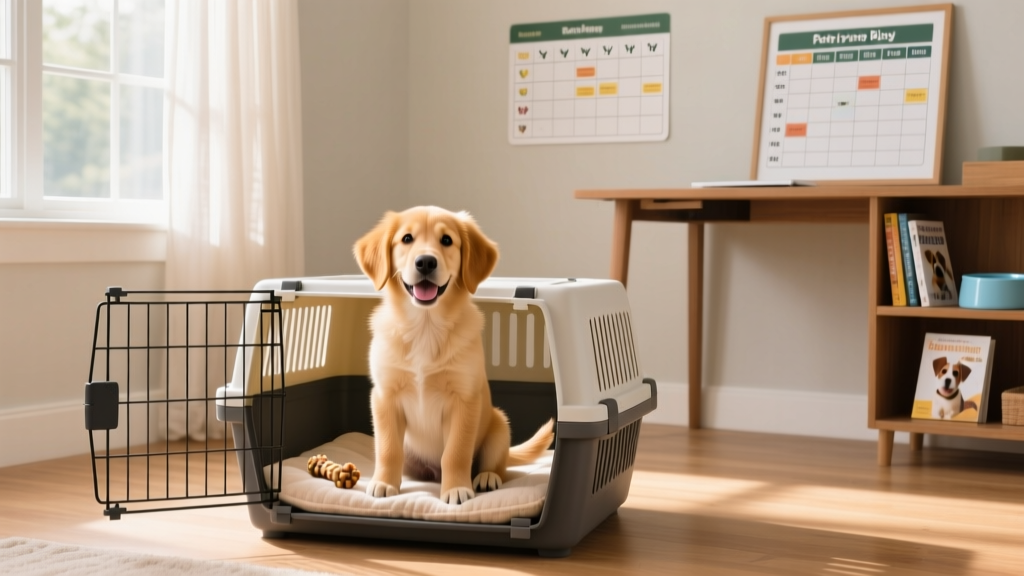
Crate training is essential for Yorkie puppies — it provides a safe den, aids potty training, and protects them from household hazards when unsupervised. But toy breed puppies have different time limits than larger breeds because of their metabolism and bladder capacity.
Maximum Crate Time by Age
- 8–10 weeks: 30–60 minutes maximum during the day (except overnight)
- 10–12 weeks: 1–2 hours maximum during the day
- 3–4 months: 2–3 hours maximum during the day
- 5–6 months: 3–4 hours maximum during the day
- Overnight (any age past 10 weeks): Place crate next to your bed initially. Expect 1–2 nighttime potty breaks at 8–12 weeks, decreasing to 0–1 by 4–5 months.
Use a crate sized for your Yorkie's expected adult size (typically a 22-inch or 24-inch crate) with a divider panel. The puppy should be able to stand up, turn around, and lie down — but not have enough room to eliminate in one corner and sleep in another. A wire crate with a divider (such as the MidWest iCrate 22-inch) works well for growing Yorkies.
Crate Training Steps
- Week 1: Leave crate door open, feed meals inside, toss treats in. Puppy enters voluntarily.
- Week 2: Close door for 1–2 minutes while you sit nearby. Open before puppy whines.
- Week 3: Close door for 5–15 minutes, step out of sight briefly. Return before distress.
- Week 4+: Gradually extend time. If puppy whines, wait for a 3-second pause in whining before opening — this prevents teaching "whine = freedom."
Teething Timeline and Relief Strategies (3–6 Months)
Yorkie puppies begin losing their 28 baby teeth around 12–16 weeks, with the process typically complete by 6–7 months when all 42 adult teeth have erupted. Toy breeds are especially prone to retained deciduous teeth — baby teeth that don't fall out on schedule, causing crowding and dental disease. Your vet should check for retained teeth at every puppy visit and may recommend extraction during spay/neuter surgery.
Teething Phases and Relief
- 3–4 months (incisors shed): Puppy may drool more, chew on fingers. Offer frozen washcloths (wet, twisted, frozen) and rubber teething toys like the KONG Puppy (XS size).
- 4–5 months (canines shed): Peak chewing intensity. Puppy may find baby teeth on the floor (most are swallowed — this is normal). Increase appropriate chew options.
- 5–7 months (premolars and molars): Chewing gradually decreases as adult teeth settle. Continue monitoring for retained baby canines — these are the most commonly retained teeth in Yorkies.
Safe chew recommendations for Yorkie puppies: KONG Puppy (XS or S, stuff with plain yogurt and freeze), Nylabone Puppy Chew (soy-based, gentle on developing teeth), Benebone Puppy (small size), frozen carrot sticks (supervised — remove small pieces). Avoid rawhide, antlers, hooves, and hard nylon bones — these can fracture puppy teeth.
Common Yorkie Puppy Problems and Solutions
How do you stop puppy biting and nipping? Yorkie puppies are mouthy — this is normal developmental behavior, not aggression. Their tiny teeth feel like needles but are actually teaching bite inhibition. Here's how to manage it using positive reinforcement methods:
- Redirect to a toy: When puppy mouths your hand, immediately offer an appropriate chew toy. Praise when they chew the toy instead.
- "Ouch" and withdraw: If a nip is too hard, say "ouch" in a calm tone and stop playing for 10–15 seconds. This mimics how littermates respond. Resume play when puppy is calm.
- Never punish physically: Alpha rolls, muzzle grabs, and finger-in-mouth techniques increase fear and can make biting worse. They also risk injuring a 2-pound puppy.
- Provide adequate chewing outlets: A puppy with nothing appropriate to chew will chew you. Rotate 4–5 different textured toys to maintain interest.
Nighttime whining in the crate: Most Yorkie puppies cry for the first 3–7 nights. Place the crate next to your bed, drape a blanket over it, and use a Snuggle Puppy (a plush toy with a heartbeat simulator and heat pack) to ease the transition. Set an alarm for one nighttime potty break at 2–3 AM for the first few weeks, then gradually phase it out.
Destructive chewing: Puppy-proof your home at Yorkie-height — electrical cords, small objects, shoes, and toxic plants (lilies, sago palm, poinsettia) must be out of reach. If your puppy chews something toxic, contact the ASPCA Animal Poison Control Center at (888) 426-4435 (24/7, consultation fee applies) immediately.
First-Year Cost Breakdown for a Yorkshire Terrier Puppy
Budgeting accurately prevents sticker shock. Here's what to expect in your Yorkie's first year, based on 2025–2026 US pricing data:
| Category | Low Estimate | Mid Estimate | High Estimate |
|---|---|---|---|
| Puppy purchase (from responsible yorkie puppy breeders with health testing) | $1,500 | $2,500 | $4,000+ |
| Veterinary care (vaccines, wellness exams, deworming, spay/neuter, fecal tests) | $600 | $1,000 | $1,800 |
| Food (premium small-breed puppy formula, treats) | $200 | $350 | $500 |
| Supplies (crate, bed, harness, leash, bowls, toys, grooming tools, puppy pads) | $200 | $400 | $700 |
| Grooming (professional grooming every 6–8 weeks for coated Yorkies) | $400 | $600 | $900 |
| Training (puppy kindergarten group class, optional private sessions) | $100 | $300 | $800 |
| Pet insurance (annual premium, accident + illness plan) | $300 | $500 | $720 |
| TOTAL FIRST YEAR (excluding puppy purchase) | $1,800 | $3,150 | $5,420 |
Yorkies are prone to dental disease, luxating patellas, tracheal collapse, and portosystemic shunts (liver shunts). Pet insurance enrolled during puppyhood (before any conditions are documented) can save thousands if a congenital issue surfaces. Companies like Trupanion, Healthy Paws, and Fetch offer plans starting around $25–60/month for toy breeds enrolled before 6 months of age.
Frequently Asked Questions About Yorkie Puppies
When should I bring my Yorkie puppy home from the breeder?
Ideally between 10 and 16 weeks. Responsible yorkie puppy breeders keep toy breed puppies longer than large-breed breeders because of hypoglycemia risk and the need for extra socialization within the litter. A breeder who sends a Yorkie home at 6–8 weeks is prioritizing convenience over the puppy's welfare.
How often should I feed my 10-week-old Yorkie puppy?
Four meals per day, spaced roughly every 4 hours during waking hours. At 10 weeks, your Yorkie weighs approximately 1.5–2.5 lb and needs about ¼ to ⅓ cup of high-quality small-breed puppy kibble daily, divided across those meals. Leave kibble available between meals if your puppy is a nibbler rather than a meal-eater — hypoglycemia risk outweighs overfeeding risk at this age.
When will my Yorkie puppy be fully potty trained?
Most Yorkies achieve reliable house training between 6 and 9 months, though some take up to 12 months. Consistency is the biggest variable — puppies taken outside on a predictable schedule with immediate rewards for outdoor elimination train faster. If your puppy is having frequent accidents past 6 months, consult your vet to rule out UTIs or anatomical issues like an ectopic ureter.
What vaccines does my Yorkie puppy need and when?
The core schedule is DHPP at 6–8 weeks, 10–12 weeks, and 14–16 weeks, plus a rabies vaccine at 12–16 weeks. Your vet may also recommend Bordetella (kennel cough) if your puppy will attend group classes, and Leptospirosis if you live in an area with wildlife exposure. Always discuss splitting vaccines across visits for toy breeds to minimize reaction risk.
How do I stop my Yorkie puppy from biting and nipping?
Redirect to an appropriate chew toy every time, say "ouch" calmly and pause play for 10–15 seconds if a nip is hard, and ensure your puppy has 4–5 different textured chew toys available. Puppy nipping peaks around 12–16 weeks and decreases as adult teeth come in by 6–7 months. Never use physical punishment — it damages trust and can increase fear-based biting.
When can my Yorkie puppy go outside and meet other dogs?
You can carry your puppy in a sling or carrier for socialization exposure immediately. For ground-level outdoor time and direct dog-to-dog contact, wait until approximately 1 week after the final DHPP booster at 14–16 weeks — so around 15–17 weeks of age. Only allow contact with dogs you know are fully vaccinated and temperamentally appropriate. Avoid dog parks until your puppy is at least 6 months old and has solid recall skills.
Robin Maitland
All our authors care for dogs every day — read more of their work on the authors page.