Whippet Puppies: The Complete Week-by-Week Growth & Care Guide
Everything you need to raise whippet puppies: feeding schedules, vaccination timelines, potty training, socialization windows, and first-year costs.

Whippet puppies are deceptively low-maintenance adults wrapped in high-energy, sensitive, and occasionally chaotic puppy packaging. If you've just committed to bringing one home—or you're preparing for a litter—you're probably wondering how this sleek sighthound breed develops from a wobbly 8-week-old into the couch-potato sprinter the breed is famous for.
This guide covers every developmental stage from weeks 4 through 12 months, with breed-specific feeding portions, vaccination timelines, potty training expectations, and the critical socialization window that shapes your whippet's temperament for life. Whippets have unique traits—thin skin, deep chests, high prey drive, and emotional sensitivity—that make their puppy care distinctly different from raising a Labrador or a French Bulldog.
When Should You Bring Your Whippet Puppy Home?
The ideal age to bring a whippet puppy home is 8 to 10 weeks. While some breeders hold puppies until 10–12 weeks to complete early socialization and first vaccinations, whippets are a socially dependent breed that bonds intensely with their humans. Bringing one home at 8 weeks gives you maximum overlap with the critical socialization window (weeks 3–14), which closes rapidly after week 12.
Whippet puppies younger than 8 weeks should remain with their littermates and dam. During weeks 4–7, they learn bite inhibition from siblings and begin the weaning process. Removing a puppy before this period ends increases the risk of poor impulse control and excessive mouthing later.
If your breeder recommends holding until 10–12 weeks—common with show-line whippets intended for conformation or coursing—ask for a detailed socialization log documenting exposures, handling exercises, and environmental experiences the puppy has already received.
Whippet Puppy Development: Age-Specific Milestones
Whippets mature at a moderate pace. They reach physical maturity around 12–14 months but may retain puppy energy and emotional reactivity until 18–24 months. Here's what to expect at each stage.
Weeks 4–8: The Litter Phase
- Weight: 2–5 lb (0.9–2.3 kg)
- Development: Baby teeth fully erupted, weaning from mother's milk to softened puppy food, littermate play teaches bite inhibition, startle responses develop
- Temperament: Curious, clumsy, beginning to show individual personality—bold puppies explore while cautious ones hang back
- What you can do: If you're the breeder or fostering, introduce novel textures (towels, cardboard, grass), gentle handling of paws/ears/mouth, and short separation periods from littermates (2–5 minutes)
Weeks 8–12: The Homecoming Window
- Weight: 5–10 lb (2.3–4.5 kg)
- Development: Rapid brain development, fear imprinting period peaks around weeks 8–10, coordination improves dramatically, first DHPP vaccine due
- Temperament: Eager to bond, may show separation distress (whining, following you room to room), prey drive begins emerging as chasing behavior toward moving objects
- What to expect: Sleep needs are 18–20 hours per day. Overtired whippet puppies become hyperactive and bitey—enforce nap schedules in a crate or pen
Weeks 12–16: Confidence Building
- Weight: 10–16 lb (4.5–7.3 kg)
- Development: Second and third DHPP vaccines, bladder control improves (can hold 2–3 hours), adult teeth begin pushing in around week 16, growth plates still wide open
- Temperament: Testing boundaries, may "forget" learned cues, increased independence and environmental awareness—whippets at this age will suddenly notice squirrels, cats, and blowing leaves with intense focus
- What to expect: Recall becomes unreliable as prey drive strengthens. Never allow off-leash access in unfenced areas—whippets can reach 35 mph by 6 months and will not stop chasing
Weeks 16–24: The Adolescent Sprinter
- Weight: 16–25 lb (7.3–11.3 kg)
- Development: Teething peaks (3–6 months), second fear period may emerge around 6 months, growth rate slows, lean muscle develops
- Temperament: High energy in short bursts followed by deep sleep, may become selectively reactive to unfamiliar dogs or environments, strong attachment to primary caregiver
- What to expect: Destructive chewing peaks during teething. Whippet puppies have surprisingly powerful jaws for their size and can destroy soft toys, wooden furniture legs, and shoes rapidly
Months 6–12: Approaching Maturity
- Weight: 25–35 lb / 11.3–15.9 kg (females typically 25–30 lb, males 28–35 lb per AKC breed standard)
- Development: Spay/neuter typically performed between 6–9 months (discuss timing with your vet—some sighthound specialists recommend waiting until 9–12 months for joint development), growth plates close around 10–12 months, adult coat texture establishes
- Temperament: Settling into adult patterns, still needs structured exercise but increasingly capable of relaxing indoors, recall may improve with consistent training but prey drive never fully disappears
- What to expect: This is when the famous "whippet switch" happens—explosive zoomies in the yard followed by instant couch collapse. Ensure your fencing is secure; whippets are accomplished climbers and diggers when motivated
Whippet Puppy Feeding Schedule: Portions by Age and Weight
Whippet puppies need a high-quality, AAFCO-certified puppy food formulated for medium breeds. Avoid large-breed puppy formulas—whippets max out at 25–40 lb and don't need the modified calcium-phosphorus ratios designed for dogs over 50 lb. Look for a food with a named animal protein as the first ingredient and minimum 22% protein / 8% fat for growth (per AAFCO nutrient profiles).
Because whippets are deep-chested dogs, never feed a single large meal. Divide daily portions across multiple feedings to reduce bloat risk, and avoid vigorous exercise for 30 minutes before and after eating.
| Age | Typical Weight | Meals Per Day | Total Daily Amount | Per Meal |
|---|---|---|---|---|
| 8–12 weeks | 5–10 lb (2.3–4.5 kg) | 4 | ¾–1 cup | 3–4 Tbsp |
| 3–4 months | 10–16 lb (4.5–7.3 kg) | 3 | 1–1¼ cups | ⅓–½ cup |
| 5–6 months | 16–25 lb (7.3–11.3 kg) | 3 | 1¼–1¾ cups | ½–⅔ cup |
| 7–9 months | 25–32 lb (11.3–14.5 kg) | 2 | 1½–2 cups | ¾–1 cup |
| 10–12 months | 28–35 lb (12.7–15.9 kg) | 2 | 1½–2 cups | ¾–1 cup |
Note: These are starting estimates. Individual caloric needs vary based on activity level, metabolism, and specific food caloric density. Monitor your puppy's body condition score (BCS) weekly—you should feel ribs easily without pressing, but not see them prominently. Whippets are naturally lean, but growing puppies should carry a slight fat layer over the ribs. Adjust portions up or down by 10–15% based on condition.
Vaccination Schedule for Whippet Puppies
Whippet puppies follow the standard core vaccination protocol recommended by the American Animal Hospital Association (AAHA). Sighthounds, including whippets, have been studied for vaccine reaction risk—the data shows small-breed and sighthound dogs have a slightly higher rate of mild adverse reactions (lethargy, soreness, facial swelling) compared to large breeds, but serious reactions remain rare (approximately 13 per 10,000 doses across all breeds per a study published in the Journal of the American Veterinary Medical Association).
| Age | Vaccine | Type | Notes |
|---|---|---|---|
| 6–8 weeks | DHPP (1st dose) | Core | Distemper, Hepatitis (Adenovirus), Parainfluenza, Parvovirus. Often given by breeder before pickup. |
| 8–10 weeks | Bordetella | Non-core (lifestyle) | Recommended if attending puppy classes, boarding, or visiting dog parks. Intranasal form provides faster immunity. |
| 10–12 weeks | DHPP (2nd dose) | Core | Booster to ensure adequate antibody response as maternal antibodies wane. |
| 12–14 weeks | Leptospirosis (1st dose) | Non-core (lifestyle) | Recommended if you live in areas with wildlife exposure, standing water access, or urban rodent populations. Zoonotic—transmissible to humans. |
| 14–16 weeks | DHPP (3rd dose) | Core | Final puppy booster. After this, puppy is considered protected 1–2 weeks post-injection. |
| 14–16 weeks | Leptospirosis (2nd dose) | Non-core | Booster, 2–4 weeks after first dose. |
| 12–16 weeks | Rabies | Core (legal requirement) | Timing varies by state law. Typically given at 12–16 weeks. Required for licensing. |
| 12 months | DHPP booster + Rabies booster | Core | First annual boosters. After this, DHPP may transition to 3-year intervals per AAHA guidelines. |
When Can My Whippet Puppy Go Outside and Meet Other Dogs?
Your whippet puppy can explore your own yard (assuming no unvaccinated dogs have been there recently) immediately after coming home. However, avoid public areas—dog parks, pet stores, sidewalks with heavy dog traffic—until 1–2 weeks after the final DHPP booster at 14–16 weeks. Parvovirus survives in soil for months and is lethal to unvaccinated puppies.
That said, the socialization window closes around week 14. To balance disease risk with behavioral development, the AVMA and the American Veterinary Society of Animal Behavior (AVSAB) recommend controlled socialization in low-risk environments: carry your puppy to new places, arrange playdates with fully vaccinated adult dogs in private yards, and attend puppy classes that require proof of first vaccination and sanitize floors between sessions.
The Socialization Window: Weeks 3–14
This is the single most important developmental period in your whippet puppy's life. Between weeks 3 and 14, puppies form lasting associations with novel stimuli. Positive exposures during this window create a confident, adaptable adult. Missed exposures—or traumatic ones—can result in lifelong fear responses.
Whippets are naturally more sensitive and reserved than breeds like Golden Retrievers. They need extra positive exposure to build confidence, particularly around loud noises, unfamiliar handling, and fast-moving objects (which can trigger prey drive or fear simultaneously).
Golden rule: Every new experience must be paired with something positive—food, play, or praise. If your whippet puppy shows fear (tucked tail, flattened ears, trembling, refusal to take treats), increase distance from the stimulus and reduce intensity. Never force a frightened puppy closer to something scary. Force-free, positive reinforcement methods build confidence; flooding (forced exposure) creates lasting phobias.
Potty Training Your Whippet Puppy: Realistic Timeline
Whippet puppies are generally clean dogs and tend to learn potty training faster than some breeds—most are reliably house-trained by 4–6 months with consistent management. However, "reliable" means accidents are rare, not impossible. Stress, schedule changes, illness, and adolescence can cause temporary regressions.
Whippets have small bladders relative to their body size and thin coats that make them reluctant to go outside in cold or wet weather. This is the number one potty training obstacle for the breed. Investing in a well-fitting puppy raincoat and using high-value treats for outdoor elimination solves most weather-related resistance.
| Age | Bladder Hold Time | Outing Frequency | Accident Expectation |
|---|---|---|---|
| 8–10 weeks | 30–60 minutes | Every 30–60 min while awake; after every meal, nap, play session | Multiple per day—this is normal |
| 10–14 weeks | 1–2 hours | Every 60–90 min while awake | 1–2 per week with consistent schedule |
| 3–4 months | 2–3 hours | Every 2 hours; overnight stretch of 4–5 hours possible | Occasional—usually after schedule disruption |
| 4–6 months | 3–4 hours | Every 3–4 hours during the day | Rare—mostly weather-related resistance |
| 6–12 months | 5–8 hours | Every 4–6 hours; 2–3 outings per day | Should be minimal; regression possible during adolescence |
Protocol: Take your whippet puppy to the same outdoor spot on a leash. Use a consistent cue word ("go potty" or "do your business"). Reward immediately with a high-value treat (small piece of chicken, cheese, or training treat) the moment they finish—not when they come back inside. If an accident happens indoors, clean it with an enzymatic cleaner (Nature's Miracle or Rocco & Roxie) to eliminate odor markers. Never punish a puppy for accidents—this teaches them to hide elimination, not to go outside.
Crate Training Progression for Whippet Puppies
Whippets adapt well to crate training because they're naturally den-seeking dogs. A properly crate-trained whippet will voluntarily retreat to their crate for naps throughout their entire life. The key is gradual progression—never use the crate as punishment, and never exceed age-appropriate confinement times.
Choose a crate sized for an adult whippet (36-inch wire crate or equivalent soft-sided travel crate) with a divider panel to reduce space while the puppy is small. Too much room allows the puppy to eliminate in one corner and sleep in another, undermining potty training.
Crate Time Limits by Age
- 8–10 weeks: 30–60 minutes max during the day; crate next to your bed at night
- 10–14 weeks: 1–2 hours max during the day; overnight 4–5 hours (set one alarm for a potty break)
- 3–4 months: 2–3 hours during the day; overnight 5–6 hours
- 4–6 months: 3–4 hours during the day; overnight 7–8 hours
- 6+ months: 4–5 hours during the day; overnight 8 hours
No dog of any age should be crated for more than 5 hours during waking hours without a break. For longer absences, use an exercise pen attached to the crate with a potty pad area, or arrange for a midday dog walker.
Teething Timeline and Relief Strategies (3–6 Months)
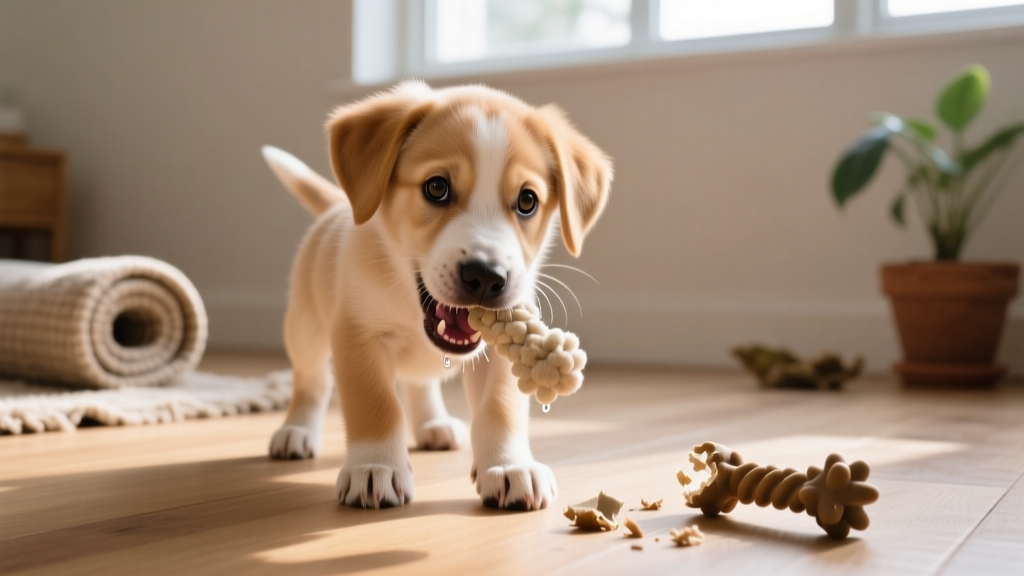
Whippet puppies begin losing baby teeth around 12–16 weeks, with the process completing by 6–7 months. The 4–5 month mark is peak discomfort. You'll find tiny teeth in toys, bedding, or on the floor—sometimes your puppy will swallow them, which is harmless.
During teething, whippet puppies chew everything. Their thin muzzles and scissor bite make them efficient at stripping bark from furniture legs and shredding fabric. Redirect to appropriate chews immediately and manage the environment by puppy-proofing rooms.
Safe chew options for teething whippet puppies:
- Frozen Kong Classic (puppy size): Fill with wet puppy food or plain yogurt and freeze for 4+ hours. The cold numbs gums and the rubber is gentle on developing teeth.
- Benebone Puppy Wishbone: Nylon chew designed for puppies under 30 lb. Replace when worn down significantly.
- Frozen carrot sticks: Whole carrots, frozen. Supervise—remove when small enough to swallow whole.
- Wet washcloth twist: Soak a clean washcloth in water, twist into a rope shape, freeze. Supervise and discard if threads come loose.
Avoid: Rawhide (choking and intestinal blockage risk), antlers and weight-bearing bones from large animals (tooth fracture risk—whippet teeth are more delicate than mastiff-type breeds), and any chew small enough to fit entirely inside the puppy's mouth.
Common Whippet Puppy Problems and Solutions
Every breed has puppy-stage challenges shaped by their genetics. Whippets are sighthounds—wired to chase, sensitive to correction, and physically fragile compared to stockier breeds of similar weight. Here are the most common issues and breed-specific solutions.
Problem: Puppy Biting and Nipping
Whippet puppies mouth and nip, particularly during play and when overtired. Their thin skin means littermate scratches and puppy teeth leave visible marks easily, and they need extra bite inhibition practice.
Solution: When teeth touch skin, say "oops" calmly and redirect to a toy. If biting continues, end the play session by stepping away for 10–15 seconds (negative punishment—removing attention). Ensure your puppy is getting 18–20 hours of sleep; overtired whippet puppies become land sharks. Never hold the mouth shut, tap the nose, or use physical correction—whippets are emotionally sensitive and physical punishment damages trust and can create fear-based biting.
Problem: Whining and Crying in the Crate
Whippets are velcro dogs that bond intensely and often vocalize when separated from their person, especially during the first 2–3 weeks home.
Solution: Place the crate in your bedroom for the first month so the puppy can hear and smell you. Use a Snuggle Puppy (a plush toy with a heartbeat simulator and heat pack) to ease the transition from littermates. Wait for a brief pause in whining before opening the crate—even 3 seconds of silence—so you're rewarding quiet, not crying. Gradually move the crate to your desired permanent location over 2–3 weeks.
Problem: Chasing Everything That Moves
This isn't misbehavior—it's genetics. Whippets were bred to chase and catch prey by sight. Puppyhood is when this instinct activates, and you'll see your whippet fixate on squirrels, cats, bicycles, blowing bags, and running children.
Solution: Teach "look at me" (eye contact on cue) using high-value treats. Practice in low-distraction environments first, then gradually increase difficulty. Use a long-line leash (15–30 feet) for outdoor training so your puppy can explore safely while you practice recall. Never allow off-leash access in unfenced areas—the instinct to chase overrides training in most whippets, even well-trained adults. Invest in secure fencing (minimum 5 feet, with no gaps) for your yard.
Problem: Sensitivity to Cold Weather
Whippet puppies have virtually no body fat and single coats. They get cold rapidly in temperatures below 50°F (10°C), which affects potty training, exercise, and general comfort.
Solution: Fit your puppy for a fleece-lined dog coat for outdoor outings in cool weather. Limit cold-weather potty breaks to 3–5 minutes. Indoor potty pad stations can serve as backup during extreme cold. As adults, most whippets need coats for any outdoor time below 40°F (4°C).
First-Year Cost Breakdown for a Whippet Puppy
Budgeting accurately prevents surprises. Here's a realistic first-year cost range based on 2026 pricing for a whippet puppy in the United States.
| Category | Low Estimate | High Estimate | Details |
|---|---|---|---|
| Purchase / Adoption | $300 | $2,500 | Rescue adoption fee ($300–$600) or responsible breeder ($1,200–$2,500). Avoid puppies under $800—often from puppy mills. |
| Veterinary (wellness) | $500 | $900 | 3–4 puppy exams, full vaccine series, deworming (2–3 rounds), fecal tests, heartworm prevention start, spay/neuter ($300–$600). |
| Food | $250 | $450 | Quality puppy kibble ($50–$80/bag, 25 lb bag lasts 6–8 weeks for a whippet). Whippets eat less than most breeds their size. |
| Supplies | $300 | $600 | Crate ($60–$120), harness ($25–$50), leash ($15–$30), coat ($35–$70), bed ($40–$80), bowls, toys, enzymatic cleaner, puppy gate. |
| Training | $150 | $500 | Group puppy class ($150–$250 for 6-week session). Private trainer for specific issues ($75–$150/session). Whippets respond well to group classes. |
| Pet Insurance | $350 | $600 | Monthly premium $30–$50 for a whippet puppy (accident + illness). Enrolling young locks in lower rates and avoids pre-existing condition exclusions. |
| Emergency Fund | $0 | $1,500 | Not every puppy needs emergency care, but budget for it. Common puppy emergencies: foreign body ingestion ($1,500–$4,000 surgery), parvo treatment ($2,000–$5,000), broken leg ($1,500–$3,000). |
| TOTAL (excluding purchase) | $1,550 | $4,550 |
Whippets are relatively inexpensive to maintain compared to larger breeds—food costs are low, grooming is minimal (short coat, occasional bath), and the breed is generally healthy. The biggest financial risks are emergency veterinary care (puppies eat things they shouldn't) and the purchase price from a responsible breeder who performs health testing on parent dogs (cardiac evaluation, ophthalmologist exam, and BAER hearing test per AKC-recommended health tests).
Frequently Asked Questions About Whippet Puppies
How often should I feed my whippet puppy at 10 weeks old?
Four meals per day, spaced roughly 4 hours apart during waking hours (e.g., 7 AM, 11 AM, 3 PM, 7 PM). Each meal should be approximately 3–4 tablespoons of high-quality puppy kibble, adjusted based on the food's caloric density and your puppy's body condition. Remove uneaten food after 15–20 minutes to establish a feeding routine.
When will my whippet puppy be fully potty trained?
Most whippet puppies are reliably house-trained by 4–6 months with consistent management. "Fully" trained—meaning you can trust them unsupervised for several hours—typically happens around 8–10 months. Whippets are fastidious dogs and generally dislike soiling their sleeping area, which works in your favor with crate training. Weather-related resistance is the most common delay factor.
How do I stop my whippet puppy from biting and nipping?
Use redirection and negative punishment (removing attention). When teeth touch skin, say a calm marker word like "oops," offer a toy, and if biting continues, step away for 10–15 seconds. Ensure adequate sleep (18–20 hours/day), as overtired puppies bite more. This phase peaks around 12–16 weeks during teething and gradually diminishes by 6–7 months with consistent responses. Never use physical punishment—whippets are emotionally sensitive and physical correction creates fear responses.
What vaccines does my whippet puppy need and when?
Core vaccines: DHPP series at 6–8 weeks, 10–12 weeks, and 14–16 weeks, plus rabies at 12–16 weeks. Lifestyle-dependent vaccines: Bordetella at 8–10 weeks (for puppy classes and social settings), Leptospirosis starting at 12–14 weeks (2-dose series). Your veterinarian will tailor the protocol based on your location and lifestyle. See the vaccination table above for the full timeline.
When can my whippet puppy meet other dogs?
Controlled introductions with fully vaccinated, temperament-tested adult dogs can begin immediately after your puppy comes home, ideally in private yards or homes. Avoid dog parks, pet stores, and high-traffic public areas until 1–2 weeks after the final DHPP booster (around 16–18 weeks of age). Puppy socialization classes that require proof of first vaccination are an excellent option for safe dog-to-dog interaction during the critical socialization window.
Are whippet puppies good with children?
Whippet puppies can be wonderful with respectful, calm children aged 8 and up. However, whippet puppies are physically fragile—thin bones and skin that tears easily—making them poor matches for toddlers or roughhousing children. Teach children to sit on the floor for interactions, never pick up the puppy, and leave the puppy alone when sleeping or eating. Always supervise all interactions between puppies and children.
Do whippet puppies need special veterinary care?
Whippets are generally healthy, but they have breed-specific considerations your veterinarian should know about. They are sensitive to barbiturate-based anesthetics (thiopental) due to low body fat—ensure your vet is experienced with sighthound anesthesia protocols. They're prone to minor skin lacerations from play (thin skin), and some lines carry genetic risks for cardiac conditions and eye disorders. Ask your breeder for documentation of parent health testing.
Raising a whippet puppy is one of the most rewarding experiences in dog ownership. They're intelligent, deeply affectionate, and endlessly entertaining as they rocket around the yard at full speed before collapsing into your lap. The work you put in during these early months—consistent socialization, positive training, proper nutrition, and preventive veterinary care—builds the foundation for a confident, healthy adult dog who will be your companion for 12–15 years.
Priya Sutaria
All our authors care for dogs every day — read more of their work on the authors page.