When Is Your Puppy Vaccinated?: Immunization Guide
Learn exactly when your puppy is vaccinated at each developmental stage. Includes age-specific milestones, feeding, potty training, and first-year costs.
The Critical Weeks: When Your Puppy Gets Vaccinated and Why It Matters
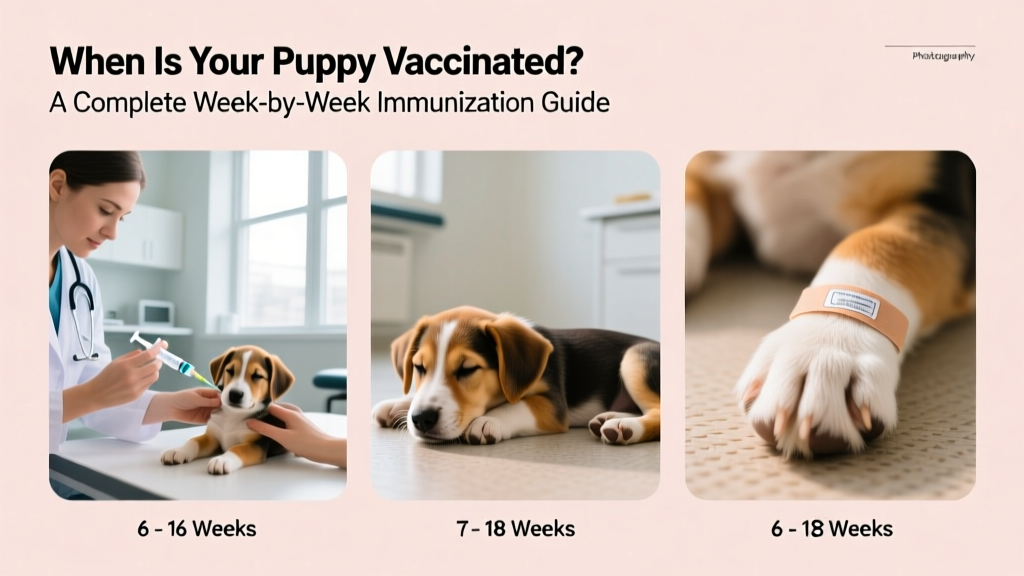
Bringing home a new puppy means navigating a maze of veterinary appointments, and understanding exactly when your puppy is vaccinated at each stage is one of the most important things you can do for their long-term health. Puppies receive a series of core vaccines starting around 6 weeks of age, with boosters continuing through approximately 16 weeks. This staggered approach isn't arbitrary — maternal antibodies from the mother's colostrum gradually wane during this period, and vaccines must be timed to catch the immune system when it's ready to respond effectively.
According to the American Veterinary Medical Association (AVMA), puppies that complete their full vaccination series on schedule have significantly lower rates of parvovirus, distemper, and other life-threatening illnesses. Missing even one booster window can leave dangerous gaps in immunity.
This guide walks you through every major milestone from weeks 4 through 12 months — not just vaccinations, but feeding, potty training, socialization, teething, and the real costs of raising a healthy puppy in their first year.
Week-by-Week Puppy Milestone Timeline
Weeks 4–8: The Breeder or Foster Stage
- Weight: Typically 2–10 lb (0.9–4.5 kg) depending on breed
- Development: Eyes and ears fully open, beginning to explore environment, litter-mate play intensifies, bite inhibition learning starts with siblings
- Nutrition: Weaning from mother's milk to gruel (puppy kibble soaked in warm water or puppy-formula milk replacer) around week 4; fully on solid food by week 7
- Veterinary: First deworming at 2, 4, 6, and 8 weeks; some breeders administer first DHPP vaccine at 6 weeks
- Socialization: Handling by multiple humans daily, exposure to household sounds (vacuum, doorbell, TV), introduction to various floor textures
Weeks 8–12: Homecoming and Adjustment
- Weight: Gaining roughly 5–10% of body weight per week; small breeds 3–6 lb (1.4–2.7 kg), large breeds 10–25 lb (4.5–11.3 kg)
- Development: Peak fear imprint period (8–11 weeks) — negative experiences can create lasting phobias; crate training and name recognition begin
- Nutrition: 3–4 meals per day of AAFCO-approved puppy food; maintain the same food the breeder used for at least the first week to avoid GI upset
- Veterinary: DHPP vaccine at 8–10 weeks (or first visit within 48–72 hours of homecoming); fecal parasite screening; heartworm prevention started
- Training: Short 3–5 minute sessions focusing on sit, name recognition, and handling exercises; begin potty training immediately
Weeks 12–16: Building Confidence and Immunity
- Weight: Small breeds 5–10 lb (2.3–4.5 kg), large breeds 20–45 lb (9–20 kg)
- Development: Second fear period may begin around 12–14 weeks; teething discomfort starts; chewing behavior escalates dramatically
- Nutrition: Transition to 3 meals per day around week 12; increase portions as puppy gains weight (see feeding table below)
- Veterinary: DHPP booster at 12–14 weeks; rabies vaccine at 12–16 weeks (legally required in most US states); Bordetella if attending group classes
- Training: Leash introduction, recall games in low-distraction environments, impulse control exercises (wait for food, settle on mat)
Weeks 16–24: Adolescent Foundations
- Weight: Approaching 60–70% of adult weight for most breeds
- Development: Adult teeth erupting (deciduous teeth should all be lost by 6 months); independence-seeking behavior emerges; may test boundaries
- Nutrition: Transition to 2 meals per day around 16 weeks; large-breed puppies remain on large-breed-specific puppy formula to control growth rate
- Veterinary: Final DHPP booster at 14–16 weeks (some vets recommend a 4th at 18–20 weeks for high-risk areas); spay/neuter discussion typically at 5–6 month appointment
- Training: Formal group classes (now that fully vaccinated), advanced cue building, leash walking refinement
Months 6–12: The Teenage Phase
- Weight: Reaching 85–100% of adult weight by 12 months (giant breeds continue growing to 18–24 months)
- Development: Sexual maturity (if intact); possible regression in previously learned behaviors; energy peaks and requires structured outlets
- Nutrition: Transition to adult food between 9–12 months for small/medium breeds, 12–18 months for large/giant breeds; two meals per day continues
- Veterinary: 1-year wellness exam; titer testing option for future vaccine decisions; annual rabies or 3-year rabies depending on product used
- Training: Proofing behaviors in high-distraction environments, CGC (Canine Good Citizen) prep, sport or activity introduction
When Is Your Puppy Vaccinated? The Complete Schedule
Understanding when your puppy is vaccinated — and which vaccines are given at each visit — helps you plan appointments and protect your puppy during their most vulnerable window. The Merck Veterinary Manual outlines core and non-core vaccines based on disease risk, geographic location, and lifestyle.
| Age | Vaccine(s) Administered | Type | Notes |
|---|---|---|---|
| 6–8 weeks | DHPP (Distemper, Hepatitis, Parainfluenza, Parvovirus) — 1st dose | Core | Often given by breeder or rescue before homecoming; if not, schedule within 72 hours of pickup |
| 10–12 weeks | DHPP — 2nd dose; Bordetella (optional) | Core + Non-core | Bordetella recommended if attending puppy socialization classes or boarding |
| 14–16 weeks | DHPP — 3rd (final) dose; Rabies | Core | Rabies required by law in most states; final DHPP completes primary series |
| 12–16 months | DHPP booster; Rabies booster (1-year or 3-year) | Core | First annual booster; after this, DHPP may move to 3-year intervals depending on product |
Non-core vaccines your vet may recommend based on lifestyle:
- Leptospirosis: 2-dose series starting at 12 weeks; recommended for dogs with outdoor/wildlife exposure
- Lyme disease: 2-dose series starting at 12 weeks; recommended in tick-endemic regions (Northeast, Upper Midwest, Pacific Coast)
- Canine influenza (H3N2/H3N8): 2-dose series; recommended for dogs in boarding, daycare, or show environments
- Rattlesnake toxoid: For dogs in rattlesnake country with high outdoor exposure
⚠️ Red Flag — Vaccine Reactions: Mild lethargy and soreness at the injection site for 24 hours is normal. Contact your veterinarian immediately if your puppy develops facial swelling, hives, persistent vomiting, difficulty breathing, or collapse within hours of vaccination. These may indicate anaphylaxis, which is rare (estimated 1 in 10,000 vaccinations) but requires emergency treatment.
Feeding Your Puppy: Portions, Frequency, and Transitions
Puppies have small stomachs and high metabolic demands. Feeding frequency decreases as they grow, while portion sizes increase. The following table is based on an average-energy puppy eating a standard AAFCO-approved dry puppy food (approximately 400 kcal/cup). Always adjust based on your puppy's body condition score (BCS) — you should be able to feel but not prominently see their ribs.
| Age | Meals/Day | Small Breed (10–25 lb adult) | Medium Breed (26–55 lb adult) | Large Breed (56–100 lb adult) |
|---|---|---|---|---|
| 8–12 weeks | 4 | ¼–½ cup/day | ½–1 cup/day | 1–2 cups/day |
| 12–16 weeks | 3 | ⅓–¾ cup/day | ¾–1½ cups/day | 1½–3 cups/day |
| 16–24 weeks | 2–3 | ½–1 cup/day | 1–2 cups/day | 2–4 cups/day |
| 6–12 months | 2 | ½–1 cup/day | 1½–2½ cups/day | 3–5 cups/day |
Key feeding rules:
- Use a large-breed puppy formula for dogs expected to exceed 55 lb (25 kg) as adults — these formulas have controlled calcium and phosphorus ratios to prevent developmental orthopedic diseases like hip dysplasia and osteochondrosis
- Never free-feed (leave food out all day) — measured meals help monitor appetite changes, which are an early indicator of illness
- When transitioning foods, mix 25% new food with 75% old food for 3 days, then 50/50 for 3 days, then 75/25 for 3 days before switching fully
- Avoid feeding within 1 hour before or after vigorous exercise to reduce bloat risk in deep-chested breeds
Potty Training: Realistic Timelines and What Actually Works
Let's set expectations early: most puppies are not reliably house-trained until 4–6 months of age, and some small breeds take up to 8–10 months due to smaller bladder capacity. Anyone promising a fully potty-trained puppy in 3 days is selling something. Here's what the timeline actually looks like:
| Age | Bladder Capacity | Expected Frequency | Accident Expectation |
|---|---|---|---|
| 8–10 weeks | 30–45 minutes | Every 30–45 min while awake; immediately after eating, sleeping, playing | Frequent — 2–5 accidents/day is normal |
| 10–14 weeks | 1–2 hours | Every 1–2 hours; overnight stretch of 3–4 hours possible | 1–3 accidents/day; beginning to signal (sniffing, circling) |
| 14–20 weeks | 2–4 hours | Every 2–3 hours; overnight stretch of 5–6 hours | 0–1 accidents/day if schedule is consistent |
| 5–6 months | 4–6 hours | Every 3–4 hours; overnight stretch of 7–8 hours | Rare accidents; regression possible during stress or routine changes |
| 6–12 months | 6–8 hours | Every 4–6 hours; full overnight hold | Reliably trained for most puppies; intact males may begin marking |
The method that works: Take your puppy to the same outdoor spot on a leash every time. Use a consistent cue word ("go potty" or "do your business"). Reward immediately with a high-value treat the moment they finish — not when they come back inside. If an accident happens indoors, clean it with an enzymatic cleaner (Nature's Miracle or Rocco & Roxie) to eliminate odor markers. Never punish accidents — puppies don't connect punishment with the act after the fact, and it creates fear-based hiding behavior.
The Socialization Window (Weeks 3–14): Your Puppy's One-Time Opportunity
The primary socialization period for puppies closes around 12–14 weeks of age. After this window, unfamiliar stimuli are more likely to trigger fear responses rather than curiosity. According to the American Kennel Club (AKC), puppies that receive structured socialization during this period show significantly fewer behavioral problems throughout life.
This creates a tension with vaccination schedules — your puppy is not fully vaccinated until approximately 16 weeks. The AVMA and the American Veterinary Society of Animal Behavior (AVSAB) both recommend that the benefits of early socialization outweigh the disease risk when done safely. Here's how:
Ground rules before your puppy is fully vaccinated: Avoid dog parks, pet store floors, and any area with unknown dog traffic. Carry your puppy or use a sling for outings. Arrange playdates only with known, fully vaccinated, temperament-tested adult dogs in private yards.
Crate Training Progression and Time Limits
A crate is a management tool and a safe den — not a punishment space. The general guideline for maximum crate time during the day is: puppy's age in months plus one, expressed in hours. So a 3-month-old puppy can hold for approximately 4 hours maximum. Overnight, puppies can typically hold 1–2 hours longer due to reduced activity.
| Age | Daytime Maximum | Overnight Maximum | Notes |
|---|---|---|---|
| 8–10 weeks | 1–2 hours | 2–3 hours | Expect overnight potty breaks; place crate near your bed |
| 10–14 weeks | 2–3 hours | 3–4 hours | One overnight potty break still likely needed |
| 14–20 weeks | 3–4 hours | 5–6 hours | Most puppies sleep through the night by 16 weeks |
| 5–6 months | 4–5 hours | 7–8 hours | Transition crate to a quieter area if puppy is settled |
| 6–12 months | 5–6 hours | 8+ hours | Begin testing freedom with baby gate–confined room access |
Crate training steps: Leave the door open with meals served inside for the first week. Add a stuffed Kong or chew to build positive association. Close the door for 30 seconds, then 1 minute, then 5 minutes while you remain in the room. Gradually increase duration and distance. If your puppy whines, wait for 3–5 seconds of silence before opening the door — this prevents reinforcing whining as a door-opening mechanism.
Teething Timeline and Relief Strategies (3–6 Months)
Puppies have 28 deciduous (baby) teeth that begin erupting at 3–4 weeks and are fully in by 6–8 weeks. These start falling out around 12–16 weeks, replaced by 42 permanent teeth. The most intense chewing phase occurs between 3–6 months as adult teeth push through the gums.
What helps:
- Frozen washcloth: Wet a clean washcloth, twist into a rope, freeze for 2 hours, and offer under supervision. The cold numbs sore gums.
- Kong Classic (puppy rubber, pink/blue): Stuff with a mixture of plain yogurt and mashed banana, then freeze. The softer puppy rubber is gentler on developing teeth than the adult red Kong.
- Benebone Puppy Wishbone: Made with softer nylon designed for puppy teeth; bacon-flavored options increase engagement.
- Nylabone Puppy Chew Keys: Textured surface helps massage gums; replace when nubs are worn flat.
What to avoid: Ice cubes (can fracture teeth), hard antlers or hooves (too dense for puppy teeth), raw bones until adult teeth are fully set (around 7 months), and any rope toy left unsupervised (ingested fibers can cause intestinal blockage).
Common Puppy Problems and Breed-Specific Solutions
Puppy Biting and Nipping
Why it happens: Puppies explore the world with their mouths. Litter-mates teach bite inhibition through yelping feedback, but once separated, humans must continue this education.
Solution: When teeth touch skin, say "ouch" in a sharp, high-pitched tone and immediately withdraw attention for 10–15 seconds (stand up, turn away, or step behind a baby gate). Redirect to an appropriate chew toy. This mimics sibling behavior. Never hold the mouth shut, slap, or use alpha rolls — these create fear and can escalate to defensive biting. If biting intensifies, your puppy is likely overstimulated and needs a crate nap (puppies need 18–20 hours of sleep per day).
Excessive Whining and Crying
Why it happens: Separation from litter-mates, overstimulation, or unmet physical needs (hunger, potty, discomfort).
Solution: First, rule out physical needs. If the puppy is fed, has eliminated, and is safe in the crate, allow 5–10 minutes of fussing before intervening. Reward quiet with a calm "yes" and a treat delivered through the crate bars. Build alone-time tolerance gradually: start with 1 minute out of sight, return while puppy is quiet, and increase by 1–2 minutes per session.
Destructive Chewing
Why it happens: Teething discomfort, boredom, insufficient exercise, or lack of appropriate alternatives.
Solution: Puppy-proof by removing shoes, cords, and accessible items. Provide 4–5 approved chew options rotated every 2–3 days to maintain novelty. Ensure at least 30–60 minutes of structured exercise and 15–20 minutes of mental enrichment (snuffle mats, frozen Kongs, training sessions) daily.
Jumping on People
Why it happens: Greeting excitement reinforced by attention (even negative attention like pushing away).
Solution: Teach an incompatible behavior — "sit" for greetings. Have visitors ignore the puppy entirely (no eye contact, no talking, no touching) until all four paws are on the floor. Reward with calm petting at ground level. Consistency from every person who interacts with the puppy is essential.
First-Year Cost Breakdown: What to Budget
Raising a puppy costs more in year one than in any subsequent year due to the concentration of veterinary procedures, equipment purchases, and training investments. Here's a realistic breakdown based on 2026 US pricing data:
| Category | Low Estimate | Mid-Range | High Estimate |
|---|---|---|---|
| Veterinary (vaccines, deworming, wellness exams, fecal tests) | $400 | $650 | $900 |
| Spay/neuter surgery | $200 | $500 | $800 |
| Heartworm, flea, and tick prevention (12 months) | $200 | $350 | $500 |
| Food (puppy formula, 10–12 months) | $300 | $550 | $900 |
| Supplies (crate, bed, leash, harness, bowls, gates, toys, enzymatic cleaner) | $200 | $400 | $700 |
| Training (group puppy class + follow-up classes) | $150 | $350 | $800 |
| Microchip (if not done by breeder/rescue) | $25 | $50 | $75 |
| Pet insurance (annual premium, optional but recommended) | $400 | $600 | $900 |
| Total First Year | $1,875 | $3,450 | $5,575 |
These figures do not include the purchase or adoption fee for the puppy itself, which ranges from $50–$500 for shelter/rescue dogs to $1,500–$4,000+ for puppies from health-tested, AKC-registered breeders. Emergency veterinary care for unexpected illness or injury can add $500–$5,000+ to any year, which is why pet insurance or a dedicated emergency fund is strongly recommended.
Frequently Asked Questions
When should I bring my puppy home?
The ideal age to bring a puppy home is 8–10 weeks. Puppies separated from their mother and littermates before 8 weeks miss critical socialization learning (bite inhibition, canine communication signals). Some breeders of toy breeds prefer to keep puppies until 10–12 weeks due to their fragility and risk of hypoglycemia. Avoid bringing a puppy home during the same week as a major life change (moving, new baby, vacation).
How often should I feed my puppy at 10 weeks old?
At 10 weeks, feed 4 meals per day spaced roughly 4 hours apart during waking hours. For a medium-breed puppy (expected adult weight 30–50 lb), this means approximately ¼ cup of puppy kibble per meal, totaling about 1 cup per day. Adjust based on body condition — if ribs are visible, increase by 10%; if you cannot feel ribs under gentle pressure, decrease by 10%.
When will my puppy be fully potty trained?
Most puppies are reliably house-trained between 4–6 months of age, though small breeds (Chihuahuas, Yorkshire Terriers, Pomeranians) often take 8–10 months due to their tiny bladder capacity. "Fully trained" means fewer than 1–2 accidents per month under normal routine conditions. Setbacks are normal during illness, travel, or household changes.
What vaccines does my puppy need and when?
Core vaccines include DHPP (a combination protecting against distemper, hepatitis, parainfluenza, and parvovirus) given at 6–8 weeks, 10–12 weeks, and 14–16 weeks, plus rabies at 12–16 weeks. Non-core vaccines like Bordetella, leptospirosis, Lyme, and canine influenza are recommended based on your dog's lifestyle and geographic risk factors. Your veterinarian will determine which non-core vaccines are appropriate during your puppy's first wellness exam.
How do I stop puppy biting and nipping?
Use the "ouch and withdraw" method: when teeth contact skin, make a high-pitched yelp sound, then turn away and ignore for 10–15 seconds. Redirect chewing energy to appropriate toys. Ensure your puppy is getting 18–20 hours of sleep per day — overtired puppies bite more intensely and cannot learn. Consistency from every household member is critical; mixed responses (sometimes allowing mouthing, sometimes scolding) confuse the puppy and prolong the behavior.
When can my puppy go outside and meet other dogs?
Your puppy can go outside in your own private yard immediately. For public spaces, the AVSAB recommends starting controlled socialization outings (carrying the puppy or using a stroller) as early as 1 week after the first DHPP vaccine, typically around 7–8 weeks. Direct contact with unknown dogs should wait until at least 7 days after the final DHPP booster at 14–16 weeks. Puppy socialization classes that require proof of at least one DHPP vaccine and health screening are considered safe and beneficial starting at 8–10 weeks. Avoid dog parks entirely until the full series is complete, and even then, choose low-traffic times and known-dog groups over chaotic open-access parks.
This guide provides general educational information. Always consult your veterinarian for advice tailored to your puppy's specific breed, health status, and local disease risk factors. If you suspect your puppy has ingested a toxic substance, contact ASPCA Animal Poison Control at (888) 426-4435 (24/7, consultation fee applies) or the Pet Poison Helpline at (855) 764-7661 immediately.
Jonas Cole
All our authors care for dogs every day — read more of their work on the authors page.