What Is Puppy Strangles? Complete Puppy Care Guide by Age & Milestone
What is puppy strangles? Learn about this rare condition plus get a complete age-by-age puppy care timeline covering feeding, vaccines, potty training, and costs.

What Is Puppy Strangles? Understanding the Condition Every Puppy Owner Should Know
If you've noticed your young puppy developing a suddenly swollen face, enlarged lymph nodes under the jaw, and a reluctance to eat, you may be dealing with a condition veterinarians call puppy strangles — medically known as juvenile sterile granulomatous dermatitis and lymphadenitis. Despite the alarming appearance, this is a treatable immune-mediated condition, and understanding it is just one part of raising a healthy, well-adjusted puppy.
This guide covers what puppy strangles is, which breeds are predisposed, and how it fits into the broader picture of puppy health. Then we'll walk you through every critical milestone from weeks 4 through 12 months — feeding schedules, vaccination timelines, potty training, socialization, and realistic first-year costs — so you're prepared for whatever comes your way.
Puppy Strangles at a Glance
| Detail | Information |
|---|---|
| Medical Name | Juvenile sterile granulomatous dermatitis and lymphadenitis |
| Also Known As | Juvenile cellulitis, puppy strangles |
| Typical Age of Onset | 3 weeks to 6 months (most common 6–12 weeks) |
| Primary Symptoms | Facial swelling, submandibular lymphadenopathy, pustules on muzzle/eyelids, fever, lethargy, anorexia |
| Predisposed Breeds | Golden Retrievers, Dachshunds, Gordon Setters, Labrador Retrievers, Lhasa Apsos |
| Cause | Idiopathic (unknown); suspected immune-mediated dysfunction — NOT infectious |
| Standard Treatment | Immunosuppressive-dose corticosteroids (prednisone 2 mg/kg/day tapering over 4–6 weeks); antibiotics if secondary infection present |
| Prognosis | Excellent with early treatment; most puppies recover fully within 2–4 weeks |
| Estimated Vet Cost | $200–$600 (exam, cytology, medications); severe cases requiring hospitalization: $800–$2,000+ |
According to the Merck Veterinary Manual, puppy strangles is not contagious and does not respond to antibiotics alone — corticosteroids are the cornerstone of therapy. The condition is frequently misdiagnosed as a bacterial infection, which delays proper treatment. If your puppy's facial swelling does not improve after 48–72 hours of antibiotics, request a veterinary re-evaluation and ask specifically about juvenile cellulitis.
Key Symptoms to Watch For
- Acute facial swelling — especially the muzzle, eyelids, and lips; often bilateral
- Enlarged submandibular lymph nodes — firm, painful swellings under the jaw that may feel like "strangling" (hence the name)
- Pustules and papules — small pus-filled bumps on the face, pinnae (ear flaps), and sometimes the perianal area
- Fever — typically 103–105°F (39.4–40.6°C); normal canine temperature is 101–102.5°F (38.3–39.2°C)
- Lethargy and appetite loss — puppy may refuse food due to jaw/face pain
- Joint pain — some puppies show lameness or reluctance to move due to sterile joint inflammation
Early intervention matters. Untreated puppy strangles can lead to permanent scarring, secondary bacterial infections, and in severe cases, airway compromise from extreme lymph node enlargement. If your puppy is having difficulty breathing or swallowing, this is an emergency — go to the nearest veterinary hospital immediately.
When Should I Bring My Puppy Home? The Ideal Timeline
The American Veterinary Medical Association (AVMA) and most veterinary behaviorists agree: the ideal age to bring a puppy home is 8 to 10 weeks. This timing balances two critical needs:
- Weeks 3–8 with the litter: Puppies learn bite inhibition, canine body language, and social hierarchy from their mother and littermates. Removing a puppy before 7 weeks increases the risk of fear-based behaviors, excessive biting, and poor social skills.
- Weeks 8–14 socialization window: This is the most sensitive period for social development. You want your puppy in your home — exposed to your environment, sounds, surfaces, and people — well before this window closes around 14–16 weeks.
Breed-specific note: Toy breeds (Chihuahuas, Yorkshire Terriers, Pomeranians) are sometimes kept with breeders until 10–12 weeks due to their fragility and susceptibility to hypoglycemia. This is responsible practice, not a red flag.
Age-by-Age Puppy Milestone Timeline
Here's what to expect at each developmental stage, with concrete benchmarks so you know whether your puppy is on track.
Weeks 4–8: The Litter Phase (Breeder/Rescue Environment)
- Weight gain: Puppies should gain 5–10% of their body weight daily during this period
- Dental: Deciduous (baby) teeth erupt between weeks 3–6; all 28 baby teeth should be in by week 8
- Senses: Eyes open at 2 weeks, full vision by 4 weeks; hearing develops fully by 3–4 weeks
- Socialization: Littermate play teaches bite inhibition — yelping siblings signal when bites are too hard
- Weaning: Transition from mother's milk to gruel (kibble soaked in warm water or puppy formula) begins at week 4; fully weaned by week 7–8
- First deworming: Typically at 2, 4, 6, and 8 weeks (pyrantel pamoate or fenbendazole)
Weeks 8–12: The Homecoming Window
- Sleep: 18–20 hours per day is normal — puppies need massive amounts of rest for brain development
- Bladder control: Approximately 1 hour per month of age (an 8-week puppy can hold it roughly 2 hours maximum)
- Learning: Name recognition within 3–7 days; basic "sit" possible by week 10 with lure-and-reward training
- Fear periods: First fear impact period occurs around 8–11 weeks — avoid traumatic experiences (harsh discipline, aggressive dogs, loud chaotic environments)
- Chewing: Exploratory mouthing peaks; provide 4–6 approved chew items and rotate them to maintain novelty
Weeks 12–16: Building Confidence
- Training: Can learn "sit," "down," "come," and "leave it" reliably with 5-minute daily sessions
- Bladder control: Extends to 3–4 hours; overnight crate holds of 5–6 hours become possible by week 16
- Socialization: The critical window closes around 14–16 weeks — maximize positive exposures NOW
- Teething prep: Baby teeth begin loosening around 12–14 weeks; you may find tiny teeth on the floor (most puppies swallow them — this is harmless)
- Energy bursts: "Zoomies" (frenetic random activity periods) are normal and last 2–10 minutes
Weeks 16–24: The Adolescent Transition
- Teething peak: All 42 adult teeth should erupt by 6–7 months; see teething section below for relief strategies
- Spay/neuter window: Most veterinarians recommend 5–6 months for small breeds, 6–12 months for large/giant breeds (to allow growth plate closure); discuss timing with your vet
- Regression: Previously reliable commands may seem "forgotten" — this is normal adolescent brain reorganization, not stubbornness
- Second fear period: Typically between 6–14 months; puppy may suddenly fear previously familiar objects or situations
- Growth rate: Small breeds reach ~75% of adult weight by 6 months; large breeds reach only ~50–60%
Months 6–12: Adolescence and Beyond
- Exercise capacity: Structured exercise can increase; follow the "5 minutes per month of age" guideline for forced exercise (a 7-month-old gets ~35 minutes of structured walks twice daily)
- Training: Enroll in intermediate obedience or canine sports foundations (agility, rally, nosework)
- Social maturity: Breed-typical temperament solidifies between 12–36 months depending on size
- Diet transition: Small breeds can transition to adult food at 10–12 months; large breeds should stay on puppy/large-breed formula until 12–18 months
Feeding Schedule: Exact Portions by Age and Weight
Proper nutrition is foundational. These guidelines assume a high-quality, AAFCO-certified complete-and-balanced puppy food (look for the statement: "This product is formulated to meet the nutritional levels established by the AAFCO Dog Food Nutrient Profiles for growth"). Portions are based on a kibble providing approximately 350–400 kcal/cup.
| Puppy Age | Expected Weight Range | Daily Portion (cups/day) | Meals per Day | Portion per Meal |
|---|---|---|---|---|
| 8–12 weeks | 5–15 lb (2.3–6.8 kg) | ¾ – 1½ cups | 3–4 | ¼ – ½ cup |
| 8–12 weeks | 15–30 lb (6.8–13.6 kg) | 1½ – 2½ cups | 3 | ½ – ¾ cup |
| 8–12 weeks | 30–50 lb (13.6–22.7 kg) | 2½ – 4 cups | 3 | ¾ – 1⅓ cups |
| 3–6 months | 10–25 lb (4.5–11.3 kg) | 1 – 2 cups | 3 | ⅓ – ⅔ cup |
| 3–6 months | 25–50 lb (11.3–22.7 kg) | 2 – 3½ cups | 2–3 | ⅔ – 1¾ cups |
| 3–6 months | 50–80 lb (22.7–36.3 kg) | 3½ – 5 cups | 2–3 | 1⅓ – 2½ cups |
| 6–12 months | 15–30 lb (6.8–13.6 kg) | 1 – 2 cups | 2 | ½ – 1 cup |
| 6–12 months | 30–60 lb (13.6–27.2 kg) | 2 – 3½ cups | 2 | 1 – 1¾ cups |
| 6–12 months | 60–100 lb (27.2–45.4 kg) | 3½ – 5½ cups | 2 | 1¾ – 2¾ cups |
Important: These are starting points. Adjust based on your puppy's body condition score (BCS) — you should be able to feel ribs without pressing hard, and see a visible waist when viewed from above. If your puppy is gaining too fast (especially large breeds), reduce portions by 10% and consult your vet. Rapid growth in large breeds increases hip dysplasia and osteochondrosis risk.
Feeding Tips
- Use a slow-feeder bowl (e.g., Outward Hound Fun Feeder, ~$12–$18) for puppies who inhale food in under 2 minutes — this reduces bloat risk and improves digestion
- Remove uneaten food after 15–20 minutes to establish meal-time structure
- Never feed xylitol-containing products, grapes, raisins, onions, garlic, chocolate, or macadamia nuts — all are toxic to dogs. If your puppy ingests any toxic substance, call ASPCA Animal Poison Control: (888) 426-4435 (24/7, consultation fee applies)
- Large and giant breed puppies should eat food labeled for "large breed growth" — these formulas have controlled calcium (1.0–1.5% on a dry matter basis) and phosphorus ratios to protect developing joints
Vaccination Schedule: What Your Puppy Needs and When
Vaccination protects your puppy from life-threatening diseases. The following schedule follows AVMA guidelines and the AAHA (American Animal Hospital Association) canine vaccination guidelines. Your veterinarian may adjust timing based on local disease prevalence and your puppy's risk factors.
| Age | Vaccine | What It Protects Against | Notes |
|---|---|---|---|
| 6–8 weeks | DHPP (1st dose) | Distemper, Hepatitis (Adenovirus-2), Parainfluenza, Parvovirus | Core vaccine; maternal antibodies may interfere with early doses |
| 8–10 weeks | Bordetella (optional) | Kennel cough (Bordetella bronchiseptica) | Recommended if attending puppy classes, grooming, or boarding; intranasal or injectable |
| 10–12 weeks | DHPP (2nd dose) | Same as above — booster | Maternal antibody interference decreases; immune response strengthens |
| 10–12 weeks | Leptospirosis (1st dose, risk-based) | Leptospirosis (bacterial, zoonotic — transmissible to humans) | Recommended in areas with wildlife exposure, standing water, or urban rodent populations |
| 12–14 weeks | Lyme disease (1st dose, risk-based) | Borrelia burgdorferi (tick-borne) | Recommended in Northeast, Upper Midwest, and Pacific Coast tick-endemic areas |
| 14–16 weeks | DHPP (3rd dose) | Same core combo — final puppy booster | This dose is critical — given after maternal antibodies wane to ensure full immunization |
| 14–16 weeks | Leptospirosis (2nd dose) | Booster for full immunity | Must be given 2–4 weeks after the first dose |
| 14–16 weeks | Lyme disease (2nd dose) | Booster | Annual revaccination recommended in endemic areas |
| 12–16 weeks | Rabies (single dose) | Rabies (fatal, zoonotic viral disease) | Legally required in all US states; timing varies by jurisdiction (typically 12–16 weeks) |
| 1 year | DHPP booster | Core combo | After this, DHPP is typically given every 3 years |
| 1 year | Rabies booster | Rabies | After this, every 1–3 years depending on local law and vaccine type |
Typical vaccination costs (2026 estimates): Individual vaccines range from $20–$45 each at a general practice. A full puppy vaccine series (3 DHPP + rabies + 2 leptospirosis + 2 Lyme) typically costs $250–$500 total. Low-cost vaccine clinics may offer packages for $100–$200 but often exclude risk-based vaccines.
When Can My Puppy Go Outside and Meet Other Dogs?
This is the most common question new puppy owners ask — and the answer requires balancing infection risk against the critical socialization window.
- Before full vaccination (before 16 weeks): Carry your puppy in a sling or stroller to expose them to outdoor sights, sounds, and surfaces. Avoid dog parks, pet store floors, and areas where unknown dogs congregate.
- Puppy socialization classes: The AVMA and the American Veterinary Society of Animal Behavior (AVSAB) recommend starting puppy classes at 7–8 weeks (after at least one DHPP dose and one deworming). Classes should require all puppies to be vaccinated for their age and held on sanitized surfaces.
- Dog parks: Wait until 1–2 weeks after the final DHPP booster (approximately 16–18 weeks of age). Even then, choose less crowded times and supervise closely.
- Playdates with known, vaccinated adult dogs: Safe after your puppy's second DHPP dose (around 12 weeks), provided the other dog is current on vaccines and has a calm temperament.
Socialization Window: The Weeks 3–14 Exposure Checklist
The primary socialization period (weeks 3–14) is when your puppy's brain is most receptive to new experiences. What they encounter positively during this window shapes their lifelong emotional baseline. Miss this window, and fear-based reactivity becomes significantly harder to address later.
Goal: Aim for 5–10 positive new experiences per day during weeks 8–14. Every exposure should be paired with high-value treats (small pieces of boiled chicken, cheese, or commercial training treats like Zuke's Mini Naturals, ~$7/bag).
The Essential Socialization Checklist
People (meet at least 20 different people by week 14):
- Children of various ages (supervised, gentle interactions only)
- People wearing hats, sunglasses, hoodies, and masks
- People with beards, long hair, and different skin tones
- People using mobility aids (wheelchairs, crutches, walkers)
- People carrying umbrellas, bags, or packages
- Delivery drivers and uniformed workers
Surfaces and environments:
- Grass, gravel, sand, wet pavement, metal grates
- Stairs (up and down, carpeted and bare)
- Elevators, automatic doors, revolving doors
- Car rides (short trips building to 15–20 minutes)
- Veterinary clinic (happy visits with treats, no procedures)
Sounds (play recordings at low volume, gradually increasing):
- Thunderstorms, fireworks, gunshots
- Vacuum cleaners, blenders, hair dryers
- Doorbells, alarms, sirens
- Crowd noise, children playing, construction sounds
Handling and body awareness:
- Touch paws, ears, mouth, tail, and belly daily
- Practice gentle restraint (for vet exams and grooming)
- Introduce nail clippers and dremel tools without cutting — just touch and treat
- Open mouth and look at teeth (pairs with future dental care)
Potty Training Timeline and Troubleshooting
Realistic expectations prevent frustration. Here's the truth: most puppies are reliably house-trained by 4–6 months, but small breeds and toy breeds may take 6–9 months due to smaller bladder capacity and higher metabolisms. Some dogs are not 100% reliable until 12 months.
Potty Training Log Template
| Time of Day | Action | Outcome | Notes |
|---|---|---|---|
| Wake-up (e.g., 6:30 AM) | Carry immediately outside to designated spot | ✅ Pee + poop | First elimination of the day — always successful if done immediately |
| After each meal (15–20 min post-eating) | Leash to potty spot, stand quietly 5 min | ✅ / ❌ | Gastrocolic reflex triggers bowel movement 10–20 min after eating |
| After naps | Carry outside immediately upon waking | ✅ / ❌ | Puppies almost always need to eliminate after sleeping |
| After play sessions | Leash to potty spot after 10–15 min of active play | ✅ / ❌ | Physical activity stimulates the bladder |
| Before bed (e.g., 10:00 PM) | Final potty trip — keep it calm and boring | ✅ Pee (usually no poop) | Don't play during this trip — you want puppy to learn "potty then sleep" |
| Overnight (if needed) | Set alarm for 2–3 AM for 8–12 week puppies | ✅ / ❌ | Gradually push alarm later by 30 min each week as bladder capacity grows |
Troubleshooting Common Potty Problems
- Accidents in the crate: Crate may be too large (puppy eliminates in one corner and sleeps in another). Use a divider to size the crate so puppy can stand, turn around, and lie down — but not much more. If accidents persist, rule out a urinary tract infection with your vet.
- Submissive/excitement urination: Common in puppies under 6 months. Don't punish — it makes it worse. Greet calmly, take puppy outside immediately upon arriving home, and avoid direct eye contact during greetings until they're calm.
- Regression after being "trained": Normal at 6–9 months (adolescent brain changes). Return to basics: increase potty trip frequency, reward heavily for outdoor elimination, and supervise closely indoors.
- Coprophagia (eating feces): Common but unpleasant. Pick up waste immediately, ensure puppy is on a nutritionally complete diet, and consider adding a commercial deterrent like For-Bid (~$15) to the food. Consult your vet if it persists.
Crate Training Progression: Time Limits by Age
A crate is your puppy's safe den — not a punishment tool. Proper crate training prevents destructive behavior, aids potty training, and gives your puppy a retreat when overwhelmed.
| Puppy Age | Maximum Daytime Crate Time | Maximum Overnight Crate Time | Recommended Crate Size (for 40 lb adult dog) |
|---|---|---|---|
| 8–10 weeks | 30–60 minutes | 2–3 hours (then potty break) | 24"L crate with divider set to ~18" space |
| 10–12 weeks | 1–2 hours | 3–4 hours | Same — adjust divider as puppy grows |
| 3–4 months | 2–3 hours | 5–6 hours | Expand divider to ~24" space |
| 4–6 months | 3–4 hours | 6–8 hours | Expand to ~30" space |
| 6–12 months | 4–5 hours | 8 hours | Full crate (36"L × 23"W × 25"H for 40 lb dog) |
Crate training steps:
- Leave crate door open with a soft blanket and a stuffed Kong inside. Let puppy explore freely for 2–3 days.
- Feed all meals inside the crate with the door open, then gradually closed (but not latched).
- Begin closing and latching the door during meals. Stay in the room. Open immediately when puppy finishes eating.
- Practice short departures: latch door, give a long-lasting chew (bully stick or yak cheese chew, ~$8–$15 each), leave room for 5 minutes. Gradually extend to 15, 30, 60 minutes.
- Begin leaving the house for short periods (5–10 minutes). Build up gradually. Never make a big deal about departures or arrivals.
Never use the crate as punishment. If your puppy whines after being settled for 30+ minutes, take them out to potty (on leash, boring trip), then return to crate. If whining continues immediately, they likely need to eliminate. If they settle after pottying and whine again within 10 minutes, it's attention-seeking — wait for a 10-second pause in whining before opening the door.
Teething Timeline and Relief Strategies
Puppy teething occurs in two phases and is one of the most common reasons owners seek help during the 3–6 month period.
- Phase 1 (weeks 3–6): 28 deciduous (baby) teeth erupt. Puppies may drool and chew on littermates.
- Phase 2 (weeks 12–28 / months 3–6): Baby teeth fall out and 42 permanent adult teeth erupt. This is the destructive chewing phase.
Teething Relief Recommendations
- Frozen washcloth: Wet a clean washcloth, twist into a rope, freeze for 2 hours. Supervise use — remove if puppy starts tearing and swallowing fabric.
- Kong Classic (puppy size, ~$12–$16): Fill with peanut butter (xylitol-free) or plain yogurt, freeze overnight. Provides 20–40 minutes of soothing chewing.
- N-Bone Puppy Teething Rings (~$8): Edible, digestible chews designed specifically for puppy teeth — softer than adult dental chews.
- Carrot sticks: Large, whole raw carrots are safe, low-calorie, and provide satisfying crunch. Remove small pieces to prevent choking.
- Ice cubes: Many puppies enjoy crunching plain ice cubes — zero calories, numbing effect on sore gums.
What to avoid: Hard nylon bones (Nylabone hard chews), antlers, hooves, and cooked bones — these can fracture puppy teeth (specifically the carnassial teeth). Save these for after 12 months when adult teeth are fully mature. Also avoid rawhide from unverified sources due to contamination risk.
Retained baby teeth: If a baby tooth hasn't fallen out by the time the adult tooth is fully erupted (creating a "double tooth" appearance), your vet should extract it. This is common in small breeds (Yorkies, Chihuahuas, Toy Poodles) and typically costs $50–$150 per extraction under anesthesia. Left untreated, retained deciduous teeth cause crowding, misalignment, and periodontal disease.
Common Puppy Problems: Breed-Specific Solutions
Puppy Biting and Nipping
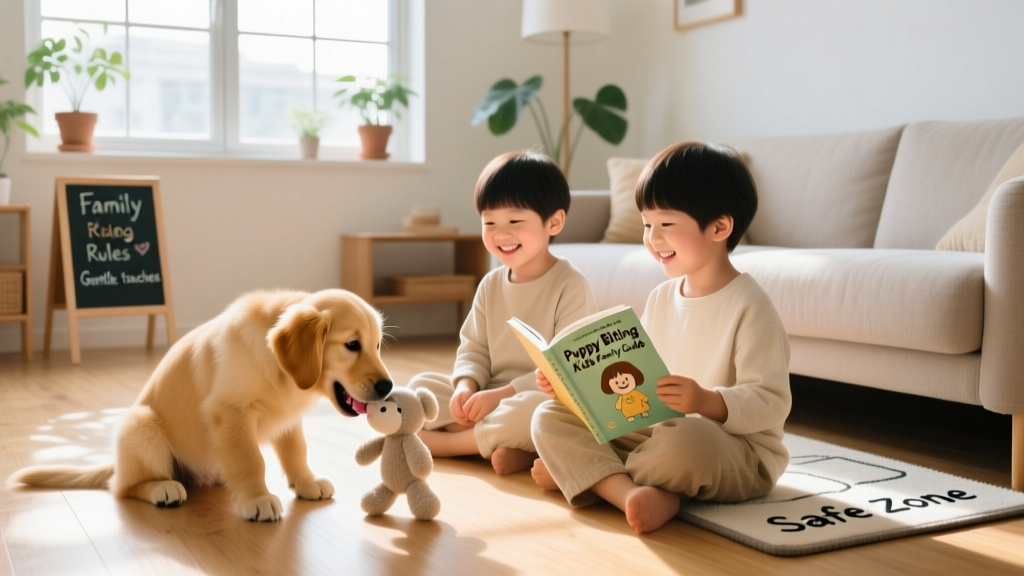
All puppies bite — it's how they explore the world and relieve teething discomfort. The goal is not to eliminate biting entirely (impossible during teething) but to teach bite inhibition: the ability to control jaw pressure.
Protocol:
- When puppy bites skin: say "ouch" in a calm, slightly high-pitched tone (mimics littermate yelp). Immediately withdraw attention for 10–15 seconds (stand up, turn away, or step over a baby gate).
- Redirect to an appropriate chew toy. Praise calmly when puppy chews the toy.
- If puppy continues biting after 3 redirects: they're overtired. Put them in their crate with a chew toy for a nap. Most puppy biting between 4–5 PM is simply fatigue-induced.
- Never hold the puppy's mouth shut, tap their nose, or use physical punishment — these methods increase fear and can escalate to defensive aggression.
Timeline: With consistent application, noticeable improvement within 2–3 weeks. Biting typically decreases significantly by 5–6 months as adult teeth finish erupting and impulse control develops.
Excessive Whining and Crying
- First 3 nights home: Whining in the crate is expected. Place the crate near your bed so puppy can hear/smell you. A Snuggle Puppy with heartbeat (~$35–$45) can ease the transition.
- After settling in: If puppy whines in the crate after being exercised, fed, and toileted, wait for a brief pause (even 5 seconds of silence) before acknowledging. Gradually extend the silence requirement.
- Demand whining during the day: Ignore completely. Reward quiet behavior with attention, treats, and play. This is differential reinforcement — rewarding the behavior you want while extinguishing the behavior you don't.
Destructive Chewing
Puppies chew to explore, relieve teething pain, and expend energy. Management is more effective than correction:
- Puppy-proof one or two rooms using baby gates — remove shoes, cords, books, and anything at puppy mouth-height
- Provide 5–8 approved chew items of varying textures (rubber, rope, edible, frozen)
- Rotate chews every 2–3 days to maintain novelty
- Apply bitter apple spray (~$8–$12, e.g., Grannick's Bitter Apple) to furniture legs and baseboards as a deterrent — test on a hidden area first for staining
- Ensure adequate physical exercise (age-appropriate) and mental enrichment (food puzzles, snuffle mats, training sessions)
First-Year Cost Breakdown: What to Budget
Raising a puppy is a significant financial commitment. Here's a realistic breakdown based on 2026 US pricing for a medium-sized dog (30–60 lb / 13.6–27.2 kg).
| Category | Low Estimate | Mid-Range Estimate | High Estimate | Notes |
|---|---|---|---|---|
| Puppy purchase/adoption | $250 (rescue) | $1,500 (responsible breeder) | $4,000+ (specialty breed) | Avoid puppy mills and pet stores; responsible breeders health-test parents |
| Initial vet visits (vaccines, exams, deworming) | $300 | $500 | $800 | Includes full puppy vaccine series, fecal tests, heartworm test |
| Spay/neuter | $200 (low-cost clinic) | $500 (general practice) | $900 (specialty/special circumstances) | Varies by dog size, sex, and clinic type |
| Food (12 months) | $360 ($30/mo) | $600 ($50/mo) | $960 ($80/mo) | Depends on brand, dog size, and food type |
| Supplies (crate, bed, leash, bowls, gates, toys) | $200 | $400 | $700 | One-time purchases; replace toys/chews regularly |
| Training (group classes) | $150 (6-week group) | $400 (group + private session) | $1,200 (private trainer) | Invest in puppy kindergarten + basic obedience minimum |
| Preventive medications (heartworm, flea/tick) | $200 | $400 | $600 | Year-round prevention recommended in most US regions |
| Pet insurance (annual premium) | $400 | $600 | $900 | Enroll at 8 weeks before conditions become pre-existing; $25–$75/month typical |
| Microchip | $0 (included at shelter) | $50 (vet office) | $50 | One-time cost; register with HomeAgain or AKC Reunite |
| Emergency fund / unexpected vet visits | $200 | $500 | $2,000+ | Puppies eat foreign objects, get injured, develop infections |
| Total First Year | $2,260 | $5,450 | $12,110+ |
Money-saving tips: Enroll in pet insurance at 8 weeks (pre-existing conditions are never covered — the earlier you enroll, the more comprehensive your coverage). Use Chewy or Amazon autosave for 5–10% savings on food and preventives. Look for local rescue-sponsored low-cost vaccine clinics for the puppy series.
Frequently Asked Questions
Is puppy strangles contagious to other dogs?
No. Puppy strangles (juvenile cellulitis) is an immune-mediated condition, not an infection. It cannot be transmitted to other dogs, other animals, or humans. However, if your puppy has open pustules or lesions, secondary bacterial infections could theoretically spread through direct contact, so keep the affected puppy separated until the skin heals under treatment.
How often should I feed my 10-week-old puppy?
Feed your 10-week-old puppy 3–4 meals per day, spaced evenly across waking hours. A typical schedule: 7 AM, 12 PM, 5 PM, and optionally 9 PM for very small breeds prone to hypoglycemia (under 10 lb expected adult weight). Consistency in meal timing also helps predict potty timing.
When will my puppy sleep through the night?
Most puppies can sleep 6–8 hours overnight without a potty break by 14–16 weeks of age. Toy breeds may take until 16–20 weeks due to smaller bladder capacity. To accelerate overnight training: remove water 1.5 hours before bedtime, take a final potty trip right before you sleep, and keep the crate in a dark, quiet area.
How do I stop my puppy from biting my children?
Supervise all interactions between puppies and children under 12. Teach children to be "trees" (stand still, arms crossed) when the puppy mouths them — movement excites puppies and encourages more biting. Give the puppy a frozen chew toy as an alternative. End play sessions the moment teeth touch skin. Never allow children to physically punish the puppy. Consider hiring a certified professional dog trainer (CPDT-KA certified) for family training sessions if biting persists.
Can puppy strangles come back after treatment?
Recurrence is uncommon but possible. Most puppies who develop puppy strangles respond well to a single course of corticosteroids and never experience it again. If symptoms return after tapering off steroids, your veterinarian may extend the treatment course or investigate other underlying immune conditions. The condition typically resolves permanently as the puppy's immune system matures past 6 months of age.
When can my puppy start going for walks?
Short, leashed walks on low-traffic surfaces (your yard, quiet residential streets) can begin at 8–10 weeks. Keep walks to 5 minutes per month of age — so a 10-week-old puppy gets about 12 minutes of structured walking. Avoid high-traffic dog areas until 1–2 weeks after the final DHPP vaccine at 14–16 weeks. Focus on exploration and sniffing rather than distance — mental stimulation from sniffing tires puppies out faster than walking.
Aaron Whyte
All our authors care for dogs every day — read more of their work on the authors page.