Vizsla Puppies: The Complete Week-by-Week Care & Training Guide
Everything you need to raise Vizsla puppies: age milestones, feeding portions, potty training, vaccinations, socialization, and first-year costs.
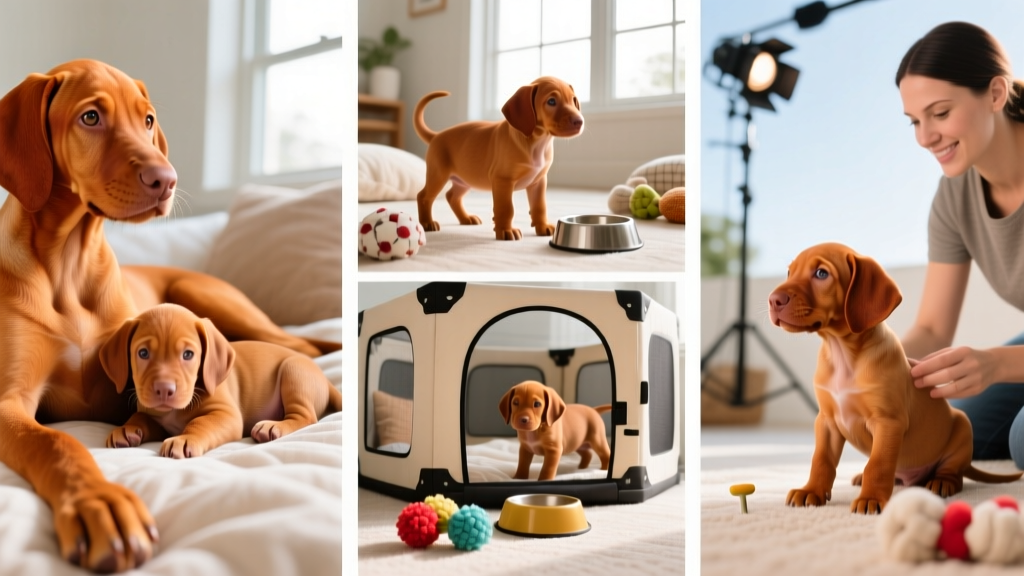
Bringing Home Vizsla Puppies: What Makes This Breed Different
Vizsla puppies are not your average sporting dog pups. Bred for centuries as Hungarian pointing dogs, these rust-gold athletes arrive in your home with a genetic blueprint for endurance, sensitivity, and an almost velcro-like attachment to their humans. That combination creates a puppy-raising experience unlike raising a Labrador or Golden Retriever.
First, Vizslas mature slowly. While some breeds settle into adulthood by 18 months, Vizslas often retain puppy-like energy and impulsivity until age 2 or even 3. Second, their short single coat means they feel cold acutely — a factor that affects everything from crate placement to outdoor potty training in winter. Third, their emotional sensitivity means harsh corrections shut them down fast; positive reinforcement isn't just preferred, it's essential for this breed.
This guide walks you through every developmental stage from the day you bring your Vizsla puppy home through their first year, with breed-specific adjustments you won't find in generic puppy manuals.
Vizsla Puppy Milestones: Week-by-Week Development Timeline
Understanding what's developmentally normal at each stage prevents unnecessary panic and helps you set realistic expectations. Here's what to expect as your Vizsla puppy grows.
Weeks 4–8 (Still With the Breeder)
During this period, your puppy is learning dog-to-dog communication from littermates and dam. The breeder should be introducing solid food (gruel transitioning to soaked kibble), beginning early neurological stimulation (ENS), and exposing puppies to household sounds. Vizsla puppies at this stage are highly impressionable — the quality of the breeder's environment shapes lifelong temperament. Ask your breeder about their socialization protocol and whether they follow Puppy Culture or Avidog methods.
Weeks 8–12 (The Adjustment Period)
Your Vizsla puppy arrives home weighing roughly 8–12 lb (3.6–5.4 kg). Expect the first 48–72 hours to involve clinginess, nighttime whining, and possibly loose stools from stress. This is normal. Key developmental features:
- Fear imprint period (8–11 weeks): Traumatic experiences during this window can create lasting phobias. Avoid forced interactions, loud environments, or painful procedures (like elective ear cropping, which isn't done on Vizslas anyway) during this window.
- Attention span: Roughly 2–5 minutes per training session. Keep it short.
- Sleep needs: 18–20 hours per day. An overtired Vizsla puppy becomes a biting, zoomie-fueled tornado.
Weeks 12–16 (Building Confidence)
Your puppy now weighs approximately 15–22 lb (6.8–10 kg) and is gaining coordination. This is prime time for:
- Introducing a structured routine for meals, potty breaks, naps, and play
- Starting basic cue training (sit, down, name recognition, recall foundation)
- Expanding socialization to new surfaces, sounds, and calm, vaccinated dogs
- Beginning leash walking indoors and in low-distaction yards
Weeks 16–24 (The Adolescent Transition)
Weight climbs to 25–40 lb (11.3–18.1 kg). The second fear period typically hits between 6–14 months, so you may notice your previously confident puppy suddenly spooking at garbage cans or unfamiliar objects. Don't force them to confront fears — use counter-conditioning with high-value treats at a distance where they remain comfortable.
Months 6–12 (Adolescence)
Your Vizsla reaches 35–50 lb (15.9–22.7 kg) and looks increasingly adult, but mentally they're still very much a teenager. Expect testing of boundaries, selective hearing on recall, and surges of energy. Many Vizsla owners find 8–10 months the most challenging stretch. Consistent training, adequate exercise (but not forced running on hard surfaces until growth plates close around 14–18 months), and patience carry you through.
Feeding Schedule for Vizsla Puppies: Portions and Frequency
Vizslas are lean, athletic dogs prone to rapid eating and bloat (gastric dilatation-volvulus). Feeding strategy matters enormously. Use a slow-feeder bowl or snuffle mat from day one, and never exercise your puppy vigorously for 60 minutes before or after meals.
Feed a large-breed puppy formula that meets AAFCO nutritional standards for growth. Look for a statement on the bag reading: "This food is formulated to meet the nutritional levels established by the AAFCO Dog Food Nutrient Profiles for growth." Large-breed puppy formulas contain controlled calcium and phosphorus ratios to support proper bone development.
| Age | Meals Per Day | Approximate Daily Total (cups) | Notes |
|---|---|---|---|
| 8–12 weeks | 3–4 meals | 1.5–2.5 cups | Soak kibble in warm water if puppy struggles with hard pieces |
| 3–6 months | 3 meals | 2.5–3.5 cups | Monitor body condition score; ribs should be easily felt but not visible |
| 6–12 months | 2 meals | 3–4.5 cups | Transition to adult food around 12 months; reduce calories if gaining excess weight |
| 12+ months | 2 meals | 2.5–4 cups | Active adult Vizslas need more; sedentary dogs need less |
How often should I feed my Vizsla puppy? At 8–12 weeks, divide food into 3–4 meals spaced evenly throughout the day. Drop to 3 meals at 12 weeks, and transition to 2 meals at 6 months. Consistent meal timing aids potty training — puppies typically need to eliminate 15–30 minutes after eating.
Vaccination Schedule for Your Vizsla Puppy
Vizslas follow the standard core vaccination protocol outlined by the American Animal Hospital Association (AAHA). Your veterinarian may adjust timing based on local disease prevalence and your puppy's risk factors. Always consult your veterinarian for a schedule tailored to your individual puppy.
| Age | Vaccine | Notes |
|---|---|---|
| 6–8 weeks | DHPP (Distemper, Hepatitis/Adenovirus, Parainfluenza, Parvovirus) — 1st dose | Often administered by the breeder; verify records |
| 10–12 weeks | DHPP — 2nd dose; Bordetella (optional, recommended if attending puppy classes) | Bordetella can be given intranasally or by injection |
| 14–16 weeks | DHPP — 3rd dose; Rabies (required by law in most states) | Some vets give a 4th DHPP at 18–20 weeks in high-parvo areas |
| 12–16 months | DHPP booster; Rabies booster; Bordetella booster | After this, DHPP and Rabies typically move to a 3-year schedule |
When can my Vizsla puppy go outside and meet other dogs? Until your puppy has completed their full DHPP series (final dose at 14–16 weeks), avoid public dog parks, pet store floors, and areas where unknown dogs eliminate. However, socialization shouldn't wait — carry your puppy in a sling or backpack to experience the world, and arrange playdates with known, fully vaccinated adult dogs in private yards. The AVMA supports this balanced approach: disease caution without sacrificing the critical socialization window.
The Critical Socialization Window: Weeks 3–14
Veterinary behaviorists agree that the primary socialization period for puppies closes around 14 weeks of age. What your Vizsla experiences — or doesn't experience — during this window profoundly shapes their adult temperament. Vizslas are naturally alert and can become wary of strangers or reactive to novel stimuli without deliberate, positive exposure.
- ✅ Meet at least 10 different people (varying ages, ethnicities, wearing hats/glasses/coats)
- ✅ Walk on 5+ different surfaces (grass, gravel, tile, carpet, metal grates)
- ✅ Hear household sounds: vacuum, blender, doorbell, thunderstorm recordings (play at low volume, pair with treats)
- ✅ Gentle handling of paws, ears, mouth, and tail daily (prepares for grooming and vet exams)
- ✅ Ride in the car for 3+ short trips (not just to the vet)
- ✅ See other species at a safe distance: cats, horses, birds
- ✅ Encounter children (supervised, calm children who've been coached on gentle interaction)
- ✅ Practice settling on a mat in a different room of the house each day
- ✅ Meet 3–5 friendly, vaccinated adult dogs in controlled settings
- ✅ Experience being gently restrained (for future vet holds and grooming)
Keep every exposure positive. If your Vizsla puppy shows fear, increase distance from the trigger and offer high-value treats (boiled chicken, freeze-dried liver). Never force a fearful puppy closer to something that scares them — flooding creates lasting trauma, not confidence.
Potty Training Your Vizsla Puppy: Timeline and Troubleshooting
Vizslas are generally quick to learn house manners, but "quick" still means 4–6 months for reliable potty training. Some individuals aren't fully reliable until 8–9 months, especially males who begin leg-lifting around 6–7 months.
When will my Vizsla puppy be fully potty trained? Most Vizsla puppies achieve daytime reliability between 4 and 6 months of age. Nighttime dryness typically follows 1–2 months later. If your puppy isn't showing improvement by 6 months, consult your veterinarian to rule out urinary tract infections, and consider working with a certified professional dog trainer (CPDT-KA).
The Potty Training Protocol
- Take puppy out immediately after: waking from a nap, finishing a meal, ending a play session, and every 1–2 hours in between.
- Use a consistent cue word: "Go potty" or "Hurry up" said while they're eliminating builds a verbal association.
- Reward immediately: Give a high-value treat within 2 seconds of finishing. Don't wait until you're back inside.
- Supervise or confine: When you can't watch them, they're in a crate or exercise pen. Unsupervised roaming leads to accidents, which build bad habits.
- Clean accidents with enzymatic cleaner: Products like Nature's Miracle or Rocco & Roxie break down urine proteins so the spot doesn't attract repeat visits.
| Time | Activity | Eliminated? (Y/N) | Location | Notes |
|---|---|---|---|---|
| 7:00 AM | Wake + outside | Y | Backyard | Urinated within 2 min |
| 7:30 AM | Breakfast | — | — | Ate ¾ cup in 4 min |
| 7:50 AM | Post-meal outside | Y (both) | Backyard | Good stool consistency |
Cold-weather troubleshooting: Vizslas have virtually no undercoat and hate cold, wet ground. If you live in a northern climate, expect potty training setbacks in winter. Use a covered potty area, dog boots (Ruffwear Grip Trex are a solid option), and a fleece coat for quick trips. Keep outings brief and reward generously.
Crate Training Progression: Building a Safe Space
A crate is essential for Vizsla puppies — it protects your home during unsupervised moments and gives your puppy a den where they learn to self-soothe. Vizslas are prone to separation anxiety, so crate training done correctly becomes a lifelong anxiety-management tool.
Time Limits by Age
- 8–10 weeks: Maximum 1–1.5 hours during the day (set an alarm for nighttime potty breaks every 3–4 hours)
- 10–14 weeks: Maximum 2–2.5 hours during the day
- 3–4 months: Maximum 3–4 hours during the day
- 4–6 months: Maximum 4–5 hours during the day
- 6+ months: Maximum 6 hours during the day (with adequate exercise before and after)
Progression steps:
- Leave the crate door open with a stuffed Kong or chew inside. Let puppy enter voluntarily.
- Feed all meals inside the crate with the door open, then gradually closed.
- Close the door for 1 minute while you sit nearby. Gradually extend to 5, 10, 15 minutes.
- Step out of the room for 30 seconds, return calmly. Extend absences gradually.
- Begin leaving the house for short errands (5 minutes, then 15, then 30).
Never use the crate as punishment. If your Vizsla puppy whines in the crate, wait for a brief pause in vocalization before letting them out — releasing during whining teaches that noise opens the door. However, always rule out a potty need first: a puppy who whines after 2+ hours may genuinely need to eliminate.
Teething Timeline and Relief Strategies (3–6 Months)
Vizsla puppies begin losing deciduous (baby) teeth around 12–16 weeks, with the process largely complete by 6 months. During this period, expect increased chewing, mild drooling, and occasional spots of blood on chew toys — all normal. If baby teeth haven't fallen out by 7 months and adult teeth are erupting alongside them, your vet may need to extract the retained teeth under anesthesia.
Safe Chew Recommendations
- Kong Classic (puppy rubber, pink/blue): Stuff with plain yogurt and banana, then freeze for a soothing cold chew.
- Benebone Puppy Wishbone: Nylon chew designed for puppy jaws; replace when deeply grooved.
- Frozen washcloth: Wet a clean washcloth, twist into a rope, freeze. Supervise use and remove when threads start coming loose.
- Earth Animal No-Hide Chews: Digestible alternative to rawhide, which poses choking and intestinal blockage risks.
Avoid: Rawhide, cooked bones (they splinter), hard antlers (risk of tooth fractures), and any chew small enough to swallow whole. If you're unsure whether a chew is safe, consult your veterinarian.
Common Vizsla Puppy Problems and Solutions
Puppy Biting and Nipping
How do I stop my Vizsla puppy from biting? Vizslas are mouthy dogs — it's in their pointing-and-retrieving DNA. Biting peaks between 10–16 weeks and again during teething. Use this protocol:
- Redirect: When teeth touch skin, say "Oops!" in a neutral tone, immediately offer a chew toy, and praise when they bite the toy instead.
- Withdraw attention: If redirecting fails, stand up, fold your arms, and be still for 10–15 seconds. Puppies learn that biting ends the game.
- Enforced naps: Overtired puppies bite more. If nipping escalates, your puppy probably needs sleep. Gently place them in their crate with a chew for a nap.
- Never hold the mouth shut, alpha roll, or yell. These methods damage trust and can increase fear-based aggression in sensitive breeds like Vizslas.
Whining and Vocalization
Vizslas are vocal dogs. Puppies whine from boredom, loneliness, overstimulation, or genuine need. Determine the cause before responding: a puppy who just eliminated, ate, and played but whines in the crate is likely learning to self-settle. A puppy who whines 3 hours after their last potty break probably needs to go out.
Destructive Chewing
A bored Vizsla puppy will dismantle your furniture, shoes, and baseboards with creative enthusiasm. Prevention requires:
- Providing 30–60 minutes of structured exercise and mental enrichment daily (snuffle mats, puzzle toys, training sessions)
- Managing the environment: use baby gates, pick up shoes, cover electrical cords
- Rotating chew toys every 2–3 days to maintain novelty
First-Year Cost Breakdown for a Vizsla Puppy
Budgeting realistically prevents sticker shock. These ranges reflect 2026 US pricing and assume a healthy puppy with no major medical events.
| Category | Low Estimate | High Estimate | Details |
|---|---|---|---|
| Puppy purchase (from responsible breeder) | $1,800 | $3,000 | Health-tested parents, OFA hips, genetic screening |
| Veterinary care (vaccines, wellness, spay/neuter) | $600 | $1,200 | Includes 3–4 wellness visits, vaccine series, fecal tests, heartworm prevention |
| Food (large-breed puppy formula) | $400 | $700 | Premium brands like Purina Pro Plan, Royal Canin, or Orijen |
| Supplies (crate, bed, leash, bowls, toys, gates) | $300 | $600 | 42-inch wire crate recommended for adult Vizsla size |
| Training (group classes + optional private sessions) | $200 | $800 | Puppy kindergarten + basic manners; private sessions $75–$150/hr |
| Pet insurance (optional but recommended) | $350 | $700 | Monthly premium $30–$60; enroll before first illness for pre-existing condition coverage |
| Total First Year | $3,650 | $7,000 | Excluding emergency veterinary care |
Annual costs after the first year typically drop to $1,500–$2,500 for food, routine veterinary care, preventives, and supplies.
Frequently Asked Questions About Vizsla Puppies
Are Vizsla puppies good for first-time dog owners?
Vizslas can work for committed first-time owners who are prepared for a high-energy, emotionally sensitive dog. They require more exercise and mental stimulation than many beginner-friendly breeds. If you work from home, enjoy outdoor activities, and are willing to invest in training classes, a Vizsla can be a rewarding first dog. If you're away 8+ hours daily or prefer a sedentary lifestyle, consider a lower-energy breed.
How much exercise does a Vizsla puppy need?
Use the "5 minutes per month of age, twice daily" guideline as a baseline. A 4-month-old Vizsla puppy gets roughly 20 minutes of structured exercise (leash walks, gentle play) twice daily, totaling 40 minutes. Free play in a fenced yard can supplement this. Avoid forced running, jogging alongside you, or repetitive jumping until growth plates close around 14–18 months — consult your veterinarian for breed-specific exercise guidance.
Do Vizsla puppies shed a lot?
Vizslas are low-shedding compared to most sporting breeds. Their short, single coat produces minimal hair, and weekly brushing with a rubber curry brush (like the Kong ZoomGroom) keeps loose hair under control. However, they are not hypoallergenic — they still produce dander and saliva proteins that trigger allergies.
What health tests should a Vizsla breeder have done on the parents?
According to the Vizsla Club of America's recommended health testing, breeding dogs should have: OFA or PennHIP hip evaluation, OFA elbow evaluation, OFA thyroid evaluation, and a CERF/OFA eye exam by a veterinary ophthalmologist. Genetic testing for von Willebrand disease and hyperuricosuria is also recommended. Ask to see documentation — reputable breeders happily share results posted on the OFA website.
When should I start training my Vizsla puppy?
Start the day they come home. At 8 weeks, training looks like name recognition, handling exercises, and rewarding desired behaviors. Formal group puppy classes can begin once your puppy has had their first DHPP vaccine (usually the 10–12 week visit). Early training prevents habits that become harder to undo later.
Raising a Vizsla puppy is demanding but deeply rewarding. Their intelligence, athleticism, and devotion make them extraordinary companions for active owners who invest the time in proper early development. Stay patient through the challenging adolescent months — the foundation you build in the first year supports a lifetime of partnership with one of the most loyal breeds in the sporting group.
Beth Carrasco
All our authors care for dogs every day — read more of their work on the authors page.


