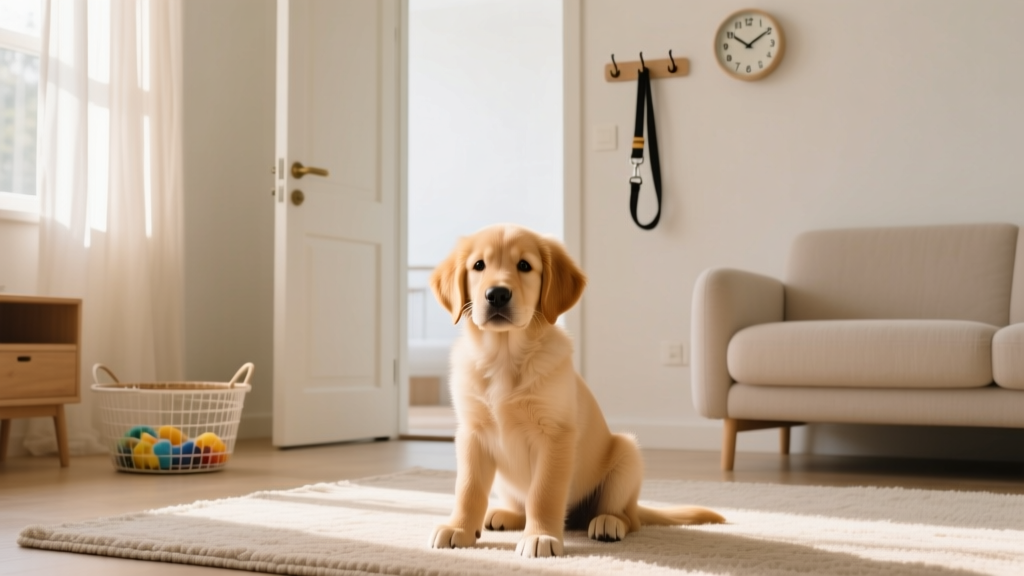
How to Teach a Puppy Not to Bite: A Golden Retriever Puppy Guide by Age
Learn how to teach a puppy not to bite with this age-by-age Golden Retriever guide covering feeding, potty training, vaccines, teething, and first-year costs.

Golden Retrievers are famously gentle adults, but as puppies they are mouthy, exuberant, and relentless little biters. If you've ever wondered how to teach a puppy not to bite while your Golden chews through your fingers like a teething shark, you're not alone — and the solution is deeply tied to understanding your puppy's developmental stage.
This guide walks you through every critical week of your Golden Retriever puppy's first year, with exact feeding amounts, crate time limits, vaccine schedules, and breed-specific biting solutions. Golden Retrievers were bred to carry game softly in their mouths, which means their bite inhibition training looks different than it would for a terrier or herding breed.
When to Bring Your Golden Retriever Puppy Home
The ideal age to bring a Golden Retriever puppy home is 8 weeks old. The AKC recommends that puppies remain with their littermates until at least 8 weeks to learn early bite inhibition through play. Littermates teach each other that biting too hard ends the game — a lesson you'll continue at home.
Some responsible Golden Retriever breeders keep puppies until 10-12 weeks to complete an additional socialization period. This is acceptable and often beneficial, but it means you'll inherit a puppy who has already begun forming habits (good and bad) that you'll need to shape.
Golden Retriever Puppy Milestones: Weeks 4 Through 12 Months
Understanding what's normal at each stage is the foundation of effective bite training. A behavior that's perfectly normal at 8 weeks becomes a problem if it persists at 5 months.
| Age Range | Development Stage | Biting Behavior to Expect | Your Response |
|---|---|---|---|
| Weeks 4-8 | Litter socialization; learning bite inhibition from siblings | Exploratory mouthing during play; puppies yelp and stop when bitten too hard | Not your phase yet — breeder's responsibility |
| Weeks 8-12 | Peak fear period (8-10 weeks); attachment forming | Mouthing hands, clothing, ankles; nipping during excited greetings | Redirect to chew toys; yelp or say "ouch" then withdraw attention for 10-15 seconds |
| Weeks 12-16 | Confidence building; testing boundaries | Grabbing sleeves, leash-biting on walks, jumping and mouthing together | Structured play with tug rules; reward calm mouth; time-outs in playpen |
| Weeks 16-24 | Teething onset (baby teeth fall out); adolescent energy surge | Increased chewing intensity; biting furniture, shoes, hands during overstimulation | Frozen chew options; enforced naps; structured exercise to burn energy |
| Months 6-12 | Adolescence; secondary fear period (6-10 months) | Mouthing should be mostly resolved; occasional regression during excitement | Reinforce training; increase mental stimulation; consult trainer if biting persists past 6 months |
How to Teach a Puppy Not to Bite: The Golden Retriever Method
Golden Retrievers are soft-mouthed by genetic design, but that doesn't mean they arrive pre-trained. Here's a step-by-step framework that leverages the breed's natural retrieving instinct and food motivation.
Step 1: Teach Bite Inhibition First (Weeks 8-12)
Bite inhibition means your puppy learns to control the force of their mouth. According to the Merck Veterinary Manual, puppies should learn this before 16 weeks or the window narrows significantly.
- When teeth touch skin: Say "ouch" in a high-pitched tone (mimicking a littermate yelp), then freeze and withdraw your hand for 10-15 seconds.
- If biting continues: Stand up and leave the interaction area for 30 seconds. This teaches that biting ends fun.
- Never punish physically: Holding a puppy's mouth shut, alpha-rolling, or tapping the nose creates fear and can escalate to defensive biting. Force-free methods are the only approach recommended by veterinary behaviorists.
Step 2: Redirect to Appropriate Chews (Ongoing)
Always have a legal alternative within arm's reach. For Golden Retrievers, the best redirect toys include:
- KONG Classic (Red, size Medium for 8-16 weeks; Large for 6+ months): Stuff with plain pumpkin and freeze — the cold soothes teething gums.
- Benebone Wishbone (Puppy formula): Softer nylon designed for developing teeth; replace when wear grooves appear.
- Bully sticks (6-inch, odor-free): Supervise all chewing; remove when the piece becomes small enough to swallow. Limit to 1 per day to avoid digestive upset.
- Frozen wet washcloth: Wet a clean washcloth, twist into a rope, and freeze. Great for 8-12 week puppies. Discard if threads start coming loose.
Step 3: Manage Overstimulation Biting
Golden Retriever puppies often bite most when they're overtired — similar to a toddler's meltdown. If your puppy becomes a land shark after 45-60 minutes of activity, they likely need a nap, not more training.
- Enforce crate naps: 8-week-old puppies need 18-20 hours of sleep per day
- Use a playpen with a bed and chew toys for "settle time" instead of free-roaming
- Track wake windows: puppies under 4 months typically can handle 1-2 hours awake before needing rest
Step 4: Teach "Leave It" and "Drop It" (Weeks 12+)
These two cues give you verbal control over your puppy's mouth:
- Leave It: Place a treat on the floor, cover with your hand, say "leave it," wait for puppy to look at you, then reward with a different treat from your other hand.
- Drop It: Offer a low-value toy, let puppy take it, then present a high-value treat at their nose. When they drop the toy, say "drop it" and give the treat. Gradually phase out showing the treat first.
Feeding Your Golden Retriever Puppy: Schedule and Portions
Proper feeding prevents the blood-sugar crashes that trigger cranky, bitey behavior. Golden Retrievers are prone to rapid growth-related orthopedic issues, so portion control matters for joint health too.
| Age | Meals Per Day | Daily Amount (large-breed puppy formula) | Notes |
|---|---|---|---|
| 8-12 weeks | 3-4 meals | 1.5-2 cups total (split across meals) | Feed at consistent times; remove uneaten food after 15 min |
| 3-6 months | 3 meals | 2-3 cups total | Adjust based on body condition score — ribs should be felt but not seen |
| 6-12 months | 2 meals | 3-4 cups total | Transition to 2 meals at 6 months; switch to adult food at 12-15 months |
Choose a food with an AAFCO statement specifically for "growth" or "all life stages" that also notes suitability for large-breed puppies. Golden Retrievers are classified as large breed (adult weight 55-75 lb / 25-34 kg), and large-breed puppy formulas contain controlled calcium and phosphorus ratios to protect developing joints.
Potty Training Timeline: Realistic Expectations
Golden Retrievers typically achieve reliable house training between 4-6 months, though some take until 8 months for full bladder control. The general rule: a puppy can hold their bladder for one hour per month of age, plus one. A 3-month-old can wait approximately 4 hours maximum — but that's a limit, not a target. Take them out far more frequently.
Age-by-Age Potty Plan
- 8-10 weeks: Every 30-60 minutes during the day, plus immediately after eating, drinking, playing, or waking from a nap. Expect 1-2 overnight accidents.
- 10-14 weeks: Every 1-2 hours during the day. One overnight outing around 2-3 AM. Accidents should decrease to 2-3 per week.
- 3-4 months: Every 2-3 hours. Most puppies can sleep 5-6 hours overnight without an outing.
- 4-6 months: Every 3-4 hours. Overnight holding reaches 7-8 hours for most Golden Retrievers.
- 6+ months: Reliable with 3-4 outings per day if schedule is consistent.
Vaccination Schedule for Your Golden Retriever Puppy
Your puppy's immune system is developing rapidly, and vaccination timing is precise. The AVMA and AAHA (American Animal Hospital Association) recommend the following core protocol:
| Age | Vaccines Given | Notes |
|---|---|---|
| 6-8 weeks | DHPP (Distemper, Hepatitis, Parainfluenza, Parvovirus) — Dose 1 | Often given by breeder before pickup |
| 10-12 weeks | DHPP — Dose 2; Bordetella (optional but recommended for group classes) | Do NOT allow contact with unknown dogs until series complete |
| 14-16 weeks | DHPP — Dose 3; Rabies (required by law in most states) | Final puppy series dose; some vets give a 4th DHPP at 18 weeks for high-risk areas |
| 12-16 months | DHPP booster; Rabies booster (1-year or 3-year depending on local law) | First annual wellness visit |
Non-core vaccines your vet may recommend based on lifestyle: Leptospirosis (common in areas with wildlife), Lyme disease (tick-endemic regions), and Canine Influenza (if attending daycare or boarding). Always consult your veterinarian to tailor the schedule to your area and lifestyle.
The Socialization Window: Weeks 3-14
This is the most critical period in your Golden Retriever's life. Research published in the Journal of Veterinary Behavior confirms that puppies who don't receive adequate socialization before 14 weeks are significantly more likely to develop fear-based aggression and anxiety later in life.
Since your puppy won't be fully vaccinated until 16 weeks, you must balance exposure with disease risk. The AVMA supports controlled socialization during this window, noting that behavioral risks of under-socialization outweigh disease risks when done safely.
Golden Retriever Socialization Checklist
- Surfaces: Gravel, grass, metal grates, wet pavement, carpet, tile, sand — walk puppy across each at least 3 times
- Sounds: Vacuum cleaner, doorbell, thunderstorms (play recordings at low volume), traffic, children screaming, fireworks clips
- People: Meet at least 30 different people by 12 weeks — varying ages, ethnicities, sizes, hats, sunglasses, uniforms, beards, wheelchairs, walkers
- Handling: Daily practice touching ears, paws (all 4), mouth, tail, belly — reward with treats after each
- Objects: Umbrellas opening, shopping carts, bicycles, trash cans, fluttering flags
- Other animals: Only with known, fully vaccinated, puppy-friendly adult dogs in controlled settings (no dog parks until vaccination series complete)
- Car rides: Short 5-10 minute trips to fun destinations (not just the vet) at least twice per week
- Grooming tools: Introduce brush, nail clippers (touch without cutting), and toothbrush with positive associations
Teething Timeline and Relief Strategies
Golden Retriever puppies begin losing baby teeth around 12-16 weeks, with the full set of 42 adult teeth typically in place by 6 months. The peak discomfort period is 3-5 months, which conveniently overlaps with the age when biting problems often worsen.
Teething Relief Protocol
- Weeks 12-16 (incisors falling out): Offer chilled (not frozen solid) rubber toys like the KONG Puppy in pink or blue. Soak a rope toy in low-sodium chicken broth and freeze.
- Months 4-5 (canines and premolars): This is peak pain. Provide frozen carrots, ice cubes made from bone broth, and rotate chew textures daily.
- Months 5-6 (molars finishing): Introduce harder chews like yak cheese chews or Himalayan dog chews. Supervise closely — Golden Retrievers can crack teeth on overly hard objects.
Crate Training Progression by Age
Golden Retrievers generally take to crates more readily than some breeds because they're den-oriented and food-motivated (easy to lure inside). However, crating too long creates distress that manifests as whining, destruction, and — yes — increased mouthiness when released.
| Age | Maximum Crate Time (Daytime) | Overnight Crate Time | Notes |
|---|---|---|---|
| 8-10 weeks | 1-2 hours | 3-4 hours (expect a midnight potty break) | Crate should be just large enough to stand, turn, and lie down |
| 10-14 weeks | 2-3 hours | 4-5 hours | Feed meals in crate; give a stuffed KONG when crating |
| 3-4 months | 3-4 hours | 6-7 hours | Begin leaving crate door open during supervised free time |
| 4-6 months | 4-5 hours | 7-8 hours | If no accidents, you can use a divider to give full crate space |
| 6+ months | 5-6 hours max | 8 hours (full night) | No dog should be crated more than 6 hours during the day regularly |
First-Year Cost Breakdown for a Golden Retriever
Golden Retrievers are large dogs with corresponding costs. Here's a realistic first-year budget based on 2026 pricing averages:
| Category | Estimated Cost | Details |
|---|---|---|
| Veterinary (wellness + vaccines) | $500-$900 | 3-4 puppy visits, spay/neuter ($300-$600), heartworm test, fecal exams |
| Food (large-breed puppy formula) | $400-$700 | Approximately 25-35 lb bag every 4-5 weeks; premium brands $60-$90/bag |
| Preventive medications | $200-$400 | Monthly heartworm + flea/tick prevention (e.g., Simparica Trio, Interceptor Plus) |
| Supplies | $300-$500 | Crate ($80-$150), playpen, bed, leash/harness, bowls, grooming tools, chew toys |
| Training | $150-$500 | Group puppy class ($150-$250 for 6 weeks); private sessions $80-$150/hour if needed |
| Pet insurance | $400-$700 | Monthly premiums $35-$60 for accident/illness coverage; enroll before 6 months to avoid pre-existing condition exclusions |
| Emergency fund buffer | $500-$1,500 | Golden Retrievers are prone to eating foreign objects; intestinal blockage surgery costs $2,000-$5,000 |
| Total First Year | $2,450-$5,200 | Excludes initial puppy purchase price ($1,500-$3,500 from a responsible breeder) |
Frequently Asked Questions
When should I bring my Golden Retriever puppy home?
Ideally at 8 weeks old. This allows you to capture the prime socialization window (8-14 weeks) and establish your household routines. Puppies brought home earlier than 8 weeks miss critical littermate bite-inhibition lessons and may develop behavioral issues.
How often should I feed my puppy at each age?
At 8-12 weeks, feed 3-4 meals per day totaling 1.5-2 cups of large-breed puppy food. At 3-6 months, reduce to 3 meals totaling 2-3 cups. At 6-12 months, transition to 2 meals totaling 3-4 cups. Always split the daily total evenly across meals.
When will my Golden Retriever be fully potty trained?
Most Golden Retrievers are reliably house-trained by 4-6 months with consistent scheduling. "Fully" trained means no accidents for 4+ consecutive weeks. If your puppy is still having regular accidents at 6 months, consult your vet to rule out medical causes like UTIs or anatomical issues.
What vaccines does my puppy need and when?
Core vaccines: DHPP at 6-8 weeks, 10-12 weeks, and 14-16 weeks, plus Rabies at 14-16 weeks. Non-core vaccines (Bordetella, Leptospirosis, Lyme, Canine Influenza) depend on your area and lifestyle. Boosters are given at 12-16 months.
How do I stop my Golden Retriever puppy from biting and nipping?
Use a three-part approach: (1) Teach bite inhibition by yelping and withdrawing attention when teeth touch skin, (2) Always redirect to an appropriate chew toy within 2 seconds, and (3) Manage overstimulation by enforcing crate naps after 45-60 minutes of activity. Most Golden Retrievers show significant improvement by 4-5 months with consistent practice.
When can my Golden Retriever puppy go outside and meet other dogs?
You can carry your puppy outside immediately for socialization exposure. However, avoid letting them walk in public areas where unknown dogs have been (parks, pet stores, dog parks) until 7 days after their final DHPP dose at 14-16 weeks. Controlled playdates with known, fully vaccinated, puppy-friendly dogs in private yards are acceptable from 10 weeks onward.
Raising a Golden Retriever puppy through the biting phase requires patience, but this breed's natural soft mouth and eagerness to please work in your favor. Stay consistent with redirect-and-withhold strategies, prioritize your puppy's sleep schedule, and remember that nearly all Golden Retrievers outgrow the land-shark phase by 5-6 months when you follow a structured developmental plan.
Aaron Whyte
All our authors care for dogs every day — read more of their work on the authors page.