Strong Dog Names for Male Puppies: A Complete Raising Guide
Discover strong dog names for male puppies plus a complete week-by-week guide to raising, feeding, training, and socializing your new companion.

Choosing a Strong Name That Matches Your Puppy's Spirit
Before you bring your new puppy through the front door, you need a name that fits. Strong dog names for male puppies aren't just about sounding tough — they reflect confidence, heritage, and the bond you're about to build. Whether you've adopted a German Shepherd, a Rottweiler, a Labrador, or a scrappy mixed-breed rescue, the right name sets the tone for training and communication from day one.
Dog trainers and behaviorists consistently note that shorter, two-syllable names ending in a vowel sound (like "Atlas," "Thor," or "Bruno") are easier for puppies to distinguish from everyday conversation. This matters because your puppy will hear their name thousands of times during training. A name that cuts through background noise and doesn't overlap with common commands ("sit," "stay," "no") gives you a real advantage.
- Titan — Greek mythology, means "defender"
- Odin — Norse god of wisdom and war
- Blaze — Evokes fire and energy
- Rex — Latin for "king"
- Brutus — Roman, meaning "heavy, strong"
- Apollo — Greek god of light and strength
- Koda — Indigenous origin, means "friend"
- Diesel — Modern, industrial strength
- Magnus — Latin for "great"
- Gunner — Old Norse, meaning "bold warrior"
- Caesar — Latin, imperial title
- Griffin — Mythological beast, guardian
- Hawk — Sharp, watchful, predatory grace
- Stone — Unshakeable, grounded
- Ares — Greek god of war
Once you've picked the name, use it consistently from the moment your puppy arrives. Pair it with high-value treats during the first 48 hours so your puppy builds a positive association. Say the name, reward immediately — repeat 10-15 times per session, three sessions per day for the first week.
Week-by-Week Puppy Milestones: What to Expect
Raising a puppy is a marathon, not a sprint. Each developmental window carries specific physical, behavioral, and neurological changes. Here's a concrete timeline so you know exactly what's happening at each stage.
| Age Range | Key Milestones | Your Action Items |
|---|---|---|
| Weeks 4–8 | Weaning from mother, first socialization with littermates, baby teeth fully erupted, fear imprint period begins (week 8) | If still with breeder: ensure exposure to varied surfaces, sounds, and gentle handling. Do NOT separate before 8 weeks. |
| Weeks 8–12 | Primary socialization window peaks, rapid brain development, bladder capacity ~1 hour per month of age, bite inhibition learning begins | Begin crate training, start potty schedule, expose to 12+ new people/environments, first vet visit and DHPP vaccine |
| Weeks 12–16 | Secondary fear period may emerge, baby teeth begin loosening, increased independence and testing boundaries | Continue positive exposures without forcing, begin basic cue training (sit, come, name recognition), second and third DHPP boosters |
| Weeks 16–24 | Adult teeth erupting, peak chewing/destructive phase, bladder control improving significantly, rabies vaccine eligible | Provide structured chew outlets, puppy-proof home thoroughly, enroll in group training class, finalize vaccine series |
| 6–12 Months | Adolescent hormonal surges (if intact), second fear period (6-10 months), increased energy and potential regression in training | Discuss spay/neuter timing with your vet, maintain training consistency, increase physical and mental exercise, revisit socialization |
Feeding Schedule: Exact Portions by Age and Weight
Puppies need precise nutrition to support rapid growth without overloading developing joints — especially important for large and giant breeds. Overfeeding is one of the most common mistakes new puppy owners make, and it directly correlates with orthopedic problems like hip dysplasia later in life.
Always choose a food that carries the AAFCO statement for "growth" or "all life stages." For large breeds (expected adult weight over 70 lb / 32 kg), select a formula specifically labeled for large-breed growth, which restricts calcium and caloric density to protect developing bones.
| Puppy Age | Meals Per Day | Small Breed (10–25 lb) | Medium Breed (25–50 lb) | Large Breed (50–100 lb) |
|---|---|---|---|---|
| 8–12 weeks | 4 meals | ¼–½ cup/meal | ½–¾ cup/meal | ¾–1 cup/meal |
| 3–6 months | 3 meals | ⅓–⅔ cup/meal | ¾–1 cup/meal | 1–1¾ cups/meal |
| 6–12 months | 2 meals | ½–¾ cup/meal | 1–1½ cups/meal | 1¾–2½ cups/meal |
These are starting points. Adjust based on your puppy's body condition score (BCS) — you should be able to feel ribs without pressing hard but not see them prominently. Consult your veterinarian to fine-tune portions, as caloric density varies significantly between brands (typically 350–450 kcal per cup for puppy formulas).
Vaccination Schedule: Protecting Your Puppy's Health
Puppies receive maternal antibodies through their mother's colostrum, but these antibodies wane between 6 and 16 weeks. The vaccine series is timed to close immunity gaps as those maternal antibodies decline. Skipping or delaying vaccines leaves your puppy vulnerable to life-threatening diseases like parvovirus and distemper.
| Age | Vaccines | Notes |
|---|---|---|
| 6–8 weeks | DHPP (Distemper, Hepatitis/Adenovirus, Parainfluenza, Parvovirus) | Often administered by breeder or rescue; verify records |
| 10–12 weeks | DHPP booster + Bordetella (optional, recommended for socialization classes) | Leptospirosis and Lyme may be added based on regional risk |
| 14–16 weeks | DHPP final booster + Rabies (required by law in most US states) | Full immunity develops approximately 2 weeks after final DHPP |
| 12–16 months | DHPP booster + Rabies booster | After this, DHPP typically moves to 3-year intervals per AVMA guidelines |
According to the Merck Veterinary Manual, core vaccines (DHPP and rabies) are recommended for all dogs regardless of lifestyle. Non-core vaccines (Bordetella, Leptospirosis, Lyme, Canine Influenza) depend on your geographic area and your puppy's exposure risk. Your veterinarian will determine the appropriate protocol.
The Socialization Window: Weeks 3–14 Exposure Checklist
The American Veterinary Society of Animal Behavior (AVSAB) identifies weeks 3 through 14 as the critical socialization period — a neurological window during which puppies form lasting impressions about what is safe versus threatening in their world. Missing this window doesn't mean your dog is doomed to fearfulness, but it does mean you'll work significantly harder to build confidence later.
The key principle: exposures must be positive. A puppy who is forced to interact with something frightening during this window may develop a permanent fear. Let your puppy approach new things at their own pace, and pair every new experience with treats and praise.
- People: Children, elderly individuals, people wearing hats/glasses/masks, people in wheelchairs, tall people, people with deep voices, people with high-pitched voices
- Surfaces: Grass, gravel, tile, hardwood, wet pavement, metal grates, carpet, stairs (carpeted and bare)
- Sounds: Vacuum cleaner, thunder (play recordings at low volume), doorbell, car horns, clapping, power tools, fireworks recordings, hairdryer
- Objects: Umbrellas opening, plastic bags rustling, bicycles, skateboards, strollers, shopping carts, balloons, flags flapping
- Handling: Paw touching, ear examination, mouth opening, nail trimming practice, collar/harness on and off, being lifted, being gently restrained
- Environments: Car rides, outdoor café patios, parking lots, quiet trails, friend's houses, pet-friendly stores (carry puppy until fully vaccinated)
- Other animals: Vaccinated adult dogs (known health status), cats (supervised), livestock if accessible
When can my puppy go outside and meet other dogs? Until your puppy completes the full DHPP series (typically around 16 weeks), avoid high-risk areas like dog parks, pet stores, and unknown dog populations where parvovirus may be present. However, controlled exposure to fully vaccinated, healthy adult dogs in private yards is safe and strongly encouraged during the socialization window. Carry your puppy in public spaces to expose them to sights and sounds without ground contact risk.
Potty Training: Realistic Timelines and Troubleshooting
When will my puppy be fully potty trained? Most puppies develop reliable house habits between 4 and 6 months of age, though small breeds may take up to 8–10 months due to smaller bladder capacity. "Reliable" means fewer than one accident per month with consistent management from you.
Bladder capacity follows a rough formula: one hour per month of age. A 10-week-old puppy can hold it for approximately 2.5 hours maximum — and that's during rest. Active puppies need more frequent trips.
| Time | Location (In/Out) | Result | Reward Given? | Notes |
|---|---|---|---|---|
| 6:30 AM | Outside | Pee + Poop | Yes (treat + verbal) | First thing after crate |
| 8:15 AM | Outside | Pee only | Yes | After breakfast + 15 min |
| 10:00 AM | Inside — kitchen | Accident (pee) | No — interrupted, carried out | Was playing, missed cue |
Use this log to identify patterns — most accidents happen after eating, playing, waking up, or during transitions. Adjust your schedule based on data, not guesswork.
Troubleshooting common potty training problems:
- Frequent small accidents indoors: You're likely waiting too long between trips. Add 15-minute intervals and watch for sniffing, circling, or sudden disengagement from play.
- Puppy pees outside then pees again inside 10 minutes later: The puppy didn't fully empty their bladder outside. Stay out longer, walk in a wider area, and reward only after a full void.
- Submissive/excitement urination: This is involuntary and common in puppies under 6 months. Avoid greeting with high energy — crouch sideways, speak softly, and ignore the puppy until they're calm.
- Nighttime accidents: Set an alarm for one overnight potty break until your puppy is 14–16 weeks old. Remove water 1.5 hours before bedtime.
Crate Training Progression and Time Limits
A crate is your puppy's safe den and your most effective potty training tool. Dogs naturally avoid soiling their sleeping area, which makes the crate invaluable for teaching bladder control. But crating too long backfires — a puppy who is forced to soil their crate loses that instinct entirely.
Crate time limits by age:
- 8–10 weeks: Maximum 30–60 minutes at a time during the day; one overnight trip outside around 2–3 AM
- 10–14 weeks: Maximum 1–2 hours during the day; overnight stretch of 3–4 hours
- 14–18 weeks: Maximum 2–3 hours during the day; overnight stretch of 5–6 hours
- 4–6 months: Maximum 3–4 hours during the day; overnight stretch of 6–8 hours
- 6+ months: Maximum 4–5 hours during the day (with exercise before and after); overnight 8 hours is typical
Progression steps:
- Days 1–3: Leave crate door open. Feed meals inside. Toss treats in and let puppy enter and exit freely. Place a worn t-shirt with your scent inside.
- Days 4–7: Close door for 1–5 minutes while you sit nearby. Gradually increase duration. Reward quiet behavior.
- Week 2: Close door and step out of sight for 1–5 minutes. Return before puppy becomes distressed. Build duration in 2–3 minute increments.
- Week 3+: Begin leaving for 15–30 minutes. Always exercise puppy thoroughly before crating. Provide a food-stuffed enrichment toy (e.g., Kong Classic filled with frozen puppy-safe peanut butter and banana).
When should I bring my puppy home? Puppies should remain with their mother and littermates until at least 8 weeks of age. For breeds prone to anxiety or small breeds under 5 lb adult weight, many responsible breeders keep puppies until 10–12 weeks. Bringing a puppy home before 8 weeks significantly increases the risk of behavioral problems including separation anxiety, fear-based aggression, and poor bite inhibition.
Teething Timeline and Safe Chew Strategies
Puppies have 28 deciduous (baby) teeth that begin erupting at 3–4 weeks and are fully in by 6–8 weeks. Starting around 12–16 weeks, these baby teeth fall out and are replaced by 42 permanent adult teeth. The entire teething process typically concludes by 6–7 months of age.
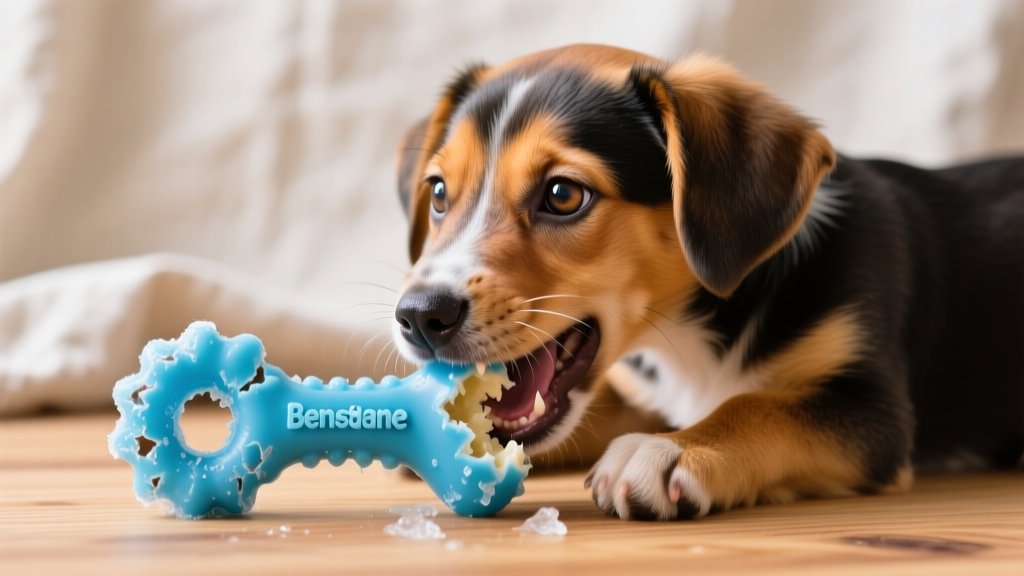
During peak teething (3–6 months), your puppy will chew relentlessly. This isn't misbehavior — it's a physiological need. The gums are inflamed, and chewing provides relief. Your job is to redirect, not punish.
Safe chew recommendations by age:
- 8–12 weeks: Soft rubber toys (Kong Puppy), chilled (not frozen) wet washcloths, soft rope toys
- 3–5 months: Medium-firm rubber toys (Kong Classic, West Paw Zogoflex), frozen carrot sticks, Benebone Puppy (softer formula)
- 5–7 months: Durable rubber toys (Kong Extreme, Goughnuts), bully sticks (supervised, remove at 2 inches), yak cheese chews (supervised)
Avoid: Rawhide (choking and intestinal blockage risk), cooked bones (splintering), antlers (tooth fracture risk in young dogs), and any chew small enough to swallow whole. If you suspect your puppy has ingested a foreign object, contact your veterinarian or the ASPCA Animal Poison Control at (888) 426-4435 (consultation fee applies).
Stopping Puppy Biting and Nipping
How do I stop puppy biting/nipping? Puppy biting is normal and developmentally appropriate — littermates teach each other bite inhibition through yelping and withdrawing from play. Your job is to continue this education.
The redirection method (recommended by certified trainers):
- When puppy's teeth touch skin, say "Oops!" or "Too bad!" in a calm, neutral tone.
- Immediately withdraw attention — stand up, cross arms, look away for 5–10 seconds.
- When puppy is calm, offer an appropriate chew toy.
- When puppy chews the toy, praise enthusiastically and engage in play.
This teaches: teeth on skin = fun stops. Teeth on toy = fun continues. Consistency from every household member is essential — if one person allows mouthing, the puppy receives mixed signals and the behavior persists longer.
What doesn't work: Holding the puppy's mouth shut, tapping the nose, alpha rolls, or yelling. These aversive methods increase fear and can escalate biting into defensive aggression. The American Veterinary Society of Animal Behavior explicitly advises against dominance-based training techniques due to their potential for harm.
Expect biting to peak around 12–16 weeks (coinciding with teething and increased play drive) and gradually decline as you consistently redirect. Most puppies show significant improvement by 5–6 months if all handlers follow the same protocol.
First-Year Cost Breakdown: Budgeting for Your Puppy
New puppy owners consistently underestimate first-year costs. Here's a realistic breakdown based on 2026 pricing across US markets:
| Category | Low Estimate | Medium Estimate | High Estimate |
|---|---|---|---|
| Puppy purchase/adoption fee | $250 (rescue) | $1,500 (responsible breeder) | $3,500+ (specialty breed) |
| Veterinary (vaccines, spay/neuter, wellness) | $600 | $1,200 | $2,000 |
| Food (quality puppy formula) | $300 | $600 | $1,000 |
| Supplies (crate, bed, leash, bowls, toys, gate) | $200 | $450 | $800 |
| Training (group classes + optional private sessions) | $150 | $400 | $1,200 |
| Preventive medications (flea/tick, heartworm) | $200 | $350 | $500 |
| Pet insurance (annual premium) | $0 (declined) | $600 | $900 |
| Emergency fund / unexpected illness | $0 | $500 | $3,000+ |
| TOTAL FIRST YEAR | $1,700 | $5,600 | $12,900+ |
Pet insurance purchased during puppyhood locks in lower premiums and covers conditions that develop later (cruciate ligament tears, allergies, hereditary conditions). Most policies exclude pre-existing conditions, so enrolling early is financially strategic. Compare providers like Trupanion, Healthy Paws, and Nationwide — premiums for an 8-week-old mixed-breed puppy typically range from $35–$65/month depending on coverage level and deductible.
Frequently Asked Questions
When should I bring my puppy home?
No earlier than 8 weeks of age. Many behaviorists and breeders recommend 9–10 weeks for optimal littermate socialization. Puppies removed before 8 weeks show higher rates of fear-based behaviors and poor bite inhibition. If you're adopting from a rescue, the puppy may already be 8–12 weeks — that's perfectly fine as long as the rescue has been providing socialization and initial veterinary care.
How often should I feed my puppy at 10 weeks old?
Four meals per day, spaced roughly 3–4 hours apart during waking hours. A typical schedule: 7 AM, 11 AM, 3 PM, 7 PM. Consistent feeding times create predictable potty patterns, which accelerates house training. Transition to three meals at around 12 weeks and two meals at 6 months.
When will my puppy be fully potty trained?
Most puppies achieve reliable house training between 4 and 6 months with consistent management. Small breeds (under 15 lb / 7 kg) may take 8–10 months due to smaller bladder capacity and faster metabolisms. "Accident-free for 4+ consecutive weeks" is a solid benchmark for reliability. If accidents persist beyond 7 months despite consistent training, consult your veterinarian to rule out urinary tract infections or anatomical issues.
What vaccines does my puppy need and when?
Core vaccines: DHPP at 6–8, 10–12, and 14–16 weeks, plus rabies at 14–16 weeks. Non-core vaccines (Bordetella, Leptospirosis, Lyme, Canine Influenza) depend on your region and lifestyle. After the initial series, DHPP boosters are typically given at 1 year, then every 3 years. Rabies boosters follow local law (1-year or 3-year intervals). Consult your veterinarian for a protocol tailored to your puppy's risk profile.
How do I stop puppy biting and nipping?
Use the redirection method: when teeth touch skin, calmly say "Oops!", withdraw attention for 5–10 seconds, then offer an appropriate chew toy. Praise enthusiastically when the puppy chews the toy. Every household member must follow this protocol consistently. Avoid physical punishment, which increases fear and can worsen biting. Expect peak nipping around 12–16 weeks with gradual improvement through 5–6 months.
When can my puppy go outside and meet other dogs?
Controlled outdoor exposure in low-risk environments (your yard, vaccinated friends' homes) can begin immediately. Avoid high-traffic dog areas (dog parks, pet store floors, boarding facilities) until 1–2 weeks after the final DHPP booster at 14–16 weeks. For socialization during the vulnerable period, carry your puppy in public spaces and arrange playdates only with fully vaccinated, healthy dogs whose owners you trust.
What's the best strong name for a male puppy that's easy to train with?
Names with two syllables and a hard consonant start — like "Bruno," "Rex," "Thor," or "Titan" — are easiest for puppies to distinguish from background noise and common commands. Avoid names that sound like "sit," "stay," or "no." Test your top choices by calling them aloud in an excited tone — if the name feels natural and your puppy turns toward the sound, you've found a winner.
Aaron Whyte
All our authors care for dogs every day — read more of their work on the authors page.