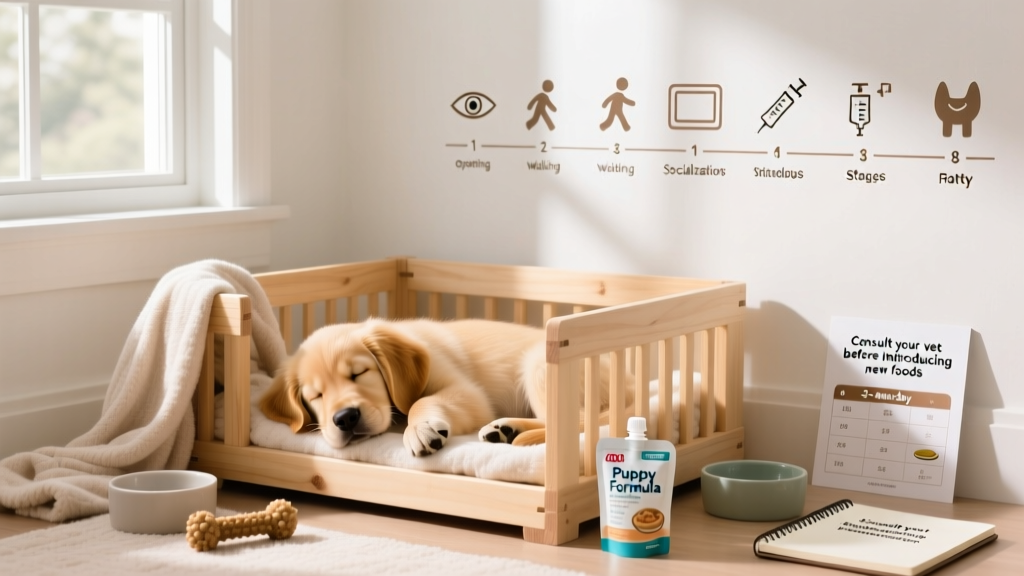
Small Puppy Care Guide: Week-by-Week Milestones, Feeding & Training
Complete small puppy care guide covering week-by-week milestones, feeding schedules, potty training timelines, vaccination dates, and first-year costs.

Bringing home a small puppy — whether a Chihuahua, Pomeranian, Toy Poodle, Yorkshire Terrier, or any breed under 20 lb / 9 kg at maturity — is equal parts thrilling and overwhelming. Small-breed puppies develop differently than their larger counterparts: they reach physical maturity faster, are more prone to hypoglycemia in the early weeks, and need carefully managed socialization because their tiny size makes them vulnerable to injury during play. This guide maps out exactly what to expect from week 4 through month 12, with concrete numbers for feeding, crating, vaccinating, and budgeting so you can plan confidently rather than guessing.
When to Bring Your Small Puppy Home
Most veterinarians and the American Kennel Club recommend that puppies stay with their mother and littermates until at least 8 weeks of age. For very small breeds (Chihuahuas, Toy Fox Terriers, Pomeranians under 3 lb / 1.4 kg at 8 weeks), many responsible breeders keep puppies until 10–12 weeks. The extra time with littermates helps tiny puppies develop bite inhibition and emotional resilience — critical buffers against the fearfulness that small breeds can be prone to.
Before your puppy arrives, have these supplies ready:
- A crate sized for the puppy's expected adult weight (most small breeds need an 18" × 12" × 14" crate with a divider panel)
- Shallow stainless-steel food and water bowls (4–8 oz capacity)
- Small-breed puppy kibble — the same brand the breeder or rescue was using (transition later over 7–10 days)
- Enzymatic cleaner for accidents (Nature's Miracle or Rocco & Roxie)
- Puppy-safe chew toys rated for dogs under 15 lb / 7 kg (Kong Puppy XS, Nylabone Petite)
- A 4-foot lightweight leash (nylon, 3/8" width) and a step-in harness — never attach a leash to a small puppy's collar, as tracheal collapse is a risk in toy breeds
Small Puppy Age Milestones: Week by Week
Weeks 4–8: The Breeder's Window
Your puppy is still with the breeder or foster during this period, but understanding what's happening helps you evaluate readiness. By week 4, puppies begin weaning onto gruel (kibble soaked in warm water or puppy milk replacer). By week 6, they should be eating soft solids and engaging in social play with littermates. Eyes and ears are fully functional, and the critical socialization period (weeks 3–14) is actively open. A good breeder introduces novel surfaces (tile, carpet, grass), gentle handling of paws and ears, and a variety of calm human visitors during these weeks.
Weeks 8–12: The Homecoming Phase
This is when most small puppies transition to their new home. Expect your puppy to sleep 18–20 hours per day. Attention spans are roughly 5–10 minutes. Bladder control is minimal — a general rule is one hour of hold time per month of age, so an 8-week-old puppy needs a potty break every 2 hours, including overnight. Start teaching name recognition and "sit" using tiny training treats (less than 5 calories each — Zuke's Mini Naturals or small bits of boiled chicken). Keep training sessions to 3–5 minutes, two to three times daily.
Weeks 12–16: Building Confidence
Your small puppy is becoming more coordinated and curious. This is the prime window for expanding socialization. Bladder control improves to roughly 3 hours. You can begin shaping leash walking indoors — let the puppy drag a light leash, then add gentle guidance with treats. Puppy kindergarten classes (positive-reinforcement only) can start once your vet confirms adequate vaccination coverage, typically after the second DHPP at 10–12 weeks. Look for classes that require proof of vaccination and keep small-breed puppies separated from larger puppies to prevent injury.
Weeks 16–24: Adolescence Begins
Small breeds enter adolescence earlier than large breeds — often by 4–5 months. You may notice selective hearing (ignoring known cues), increased chewing as adult teeth erupt, and testing of boundaries. This is normal developmental behavior, not regression. Maintain consistent rules and increase mental enrichment: food puzzles (Kong Classic XS stuffed with kibble and a smear of dog-safe peanut butter), snuffle mats, and short scent-work games. Continue socialization with controlled dog-to-dog introductions.
Months 6–12: Toward Adulthood
Most small breeds reach physical maturity between 9–12 months, though some (Chihuahuas, Pomeranians) may fill out until 14–18 months. Discuss spay/neuter timing with your veterinarian — current veterinary consensus, supported by the AVMA, supports spaying females before the first heat cycle (which can occur as early as 6 months in small breeds) and neutering males between 6–9 months for small breeds. Transition from puppy food to adult small-breed formula around 9–12 months, mixing gradually over 10 days.
Small Puppy Feeding Schedule by Age and Weight
Small-breed puppies have faster metabolisms and smaller stomachs than large-breed puppies. They need calorie-dense, small-kibble food formulated for small or toy breeds. Hypoglycemia (dangerously low blood sugar) is a real risk in puppies under 4 months weighing less than 5 lb / 2.3 kg — missed meals can cause lethargy, trembling, seizures, or collapse within hours.
| Puppy Age | Meals Per Day | Daily Amount (2 lb / 0.9 kg puppy) | Daily Amount (5 lb / 2.3 kg puppy) | Daily Amount (10 lb / 4.5 kg puppy) |
|---|---|---|---|---|
| 8–12 weeks | 4 meals | ⅓–½ cup | ½–¾ cup | ¾–1 cup |
| 12–16 weeks | 3 meals | ⅓–½ cup | ⅔–1 cup | 1–1¼ cups |
| 4–6 months | 3 meals | ½–⅔ cup | ¾–1¼ cups | 1¼–1½ cups |
| 6–9 months | 2 meals | ½–⅔ cup | ⅔–1 cup | 1–1½ cups |
| 9–12 months | 2 meals | ½ cup | ⅔–¾ cup | 1–1¼ cups |
These amounts assume a small-breed puppy kibble with approximately 400–450 kcal per cup (check your bag's feeding chart as a starting point, then adjust). A puppy with a healthy body condition score should have a visible waist when viewed from above and ribs you can feel but not see. If your puppy looks rounded or you cannot feel ribs easily, reduce portions by 10% and reassess in two weeks.
Hypoglycemia first aid: If a small puppy under 4 months becomes lethargic, wobbly, or unresponsive, rub a small amount of Karo syrup or honey on their gums and contact your veterinarian immediately. Keep Nutri-Cal gel on hand as a backup calorie source.
Vaccination Schedule for Small Puppies
Small puppies receive the same core vaccines as larger breeds, but their tiny size means post-vaccine reactions (lethargy, mild fever, facial swelling) can feel more alarming. Discuss with your vet whether premedication with an antihistamine is appropriate for your puppy's breed — some toy breeds have higher rates of vaccine reactions, according to the Merck Veterinary Manual.
| Age | Vaccine | What It Protects Against | Notes |
|---|---|---|---|
| 6–8 weeks | DHPP (1st dose) | Distemper, Hepatitis (Adenovirus), Parainfluenza, Parvovirus | Often given by breeder; confirm with records |
| 10–12 weeks | DHPP (2nd dose) + Bordetella (optional) | Same as above + Kennel Cough | Bordetella recommended if attending puppy classes |
| 14–16 weeks | DHPP (3rd dose) + Rabies | Core combo + Rabies virus | Rabies is legally required in most US states |
| 12–16 months | DHPP booster + Rabies booster | Maintains immunity | Rabies booster interval varies by jurisdiction (1 or 3 years) |
Non-core vaccines your vet may recommend: Leptospirosis (especially in areas with standing water or wildlife exposure), Lyme disease (tick-endemic regions), and Canine Influenza (H3N2/H3N8 — recommended for dogs in boarding or daycare). Your veterinarian will assess your puppy's lifestyle and geographic risk to determine which non-core vaccines are appropriate.
The Critical Socialization Window (Weeks 3–14)
Behavioral research consistently shows that puppies have a primary socialization period between approximately 3 and 14 weeks of age. Experiences during this window — positive, neutral, or negative — have an outsized impact on lifelong temperament. For small puppies, this window is especially important because fear-based behaviors (barking at strangers, trembling, reactivity toward larger dogs) are among the most common reasons small breeds are surrendered to shelters.
When can your puppy go outside and meet other dogs? Until your puppy has completed the full DHPP series (final dose at 14–16 weeks), avoid high-risk areas like dog parks, pet store floors, and unvaccinated dog gatherings. However, you can safely socialize by carrying your puppy in a sling or stroller through public spaces, hosting vaccinated adult dogs at your home, and attending veterinary-supervised puppy classes that require vaccination proof. The American Veterinary Society of Animal Behavior recommends that socialization begin before full vaccination is complete, using controlled, low-risk environments — the behavioral risk of inadequate socialization outweighs the disease risk when managed properly.
Potty Training Your Small Puppy: Realistic Timeline
Here's the honest truth that many guides gloss over: small puppies are generally harder to potty train than large puppies. Their bladders are physically smaller, their metabolisms process food faster, and — frankly — tiny accidents on a rug are easy to miss and harder to catch in the act. Most small puppies are reliably potty trained between 4 and 6 months of age, though some toy breeds may take until 8–9 months. This is normal, not a sign of failure.
How to potty train a small puppy — the method:
- Take them out on a consistent schedule: Immediately upon waking, after every meal, after play sessions, before crating, and before bed. For an 8–12-week-old puppy, this means trips outside roughly every 2 hours during the day.
- Use a verbal cue: Say "go potty" (or your chosen phrase) the moment they begin to eliminate. Reward immediately after they finish with a high-value treat and verbal praise — timing matters; the treat must arrive within 2 seconds.
- Supervise or confine: When not crated, keep your puppy in the same room as you, ideally on a non-porous surface. Use baby gates or an exercise pen to limit roaming.
- Clean accidents thoroughly: Use an enzymatic cleaner (not ammonia-based products) to eliminate scent markers that invite repeat accidents.
Potty Training Log Template
Track these data points for the first 4 weeks to identify your puppy's natural rhythm:
| Time | Activity (ate/drank/played/slept) | Went Outside? (Y/N) | Eliminated? (pee/poop/both) | Accident Indoors? (location) |
|---|---|---|---|---|
| 7:00 AM | Wake up → outside | Y | Pee + poop | — |
| 7:15 AM | Breakfast (¼ cup kibble) | Y (10 min after) | Poop | — |
After 1–2 weeks of logging, you'll see patterns — most puppies need to go out 15–30 minutes after eating and 10–15 minutes after vigorous play.
Troubleshooting common potty training setbacks:
- Submissive urination (peeing when greeted): Crouch sideways, avoid direct eye contact, and greet calmly outside. Do not scold — this is an involuntary response that fades with maturity, typically by 6–8 months.
- Marking behavior (small amounts on vertical surfaces): More common in intact males after 5–6 months. Discuss neutering timing with your vet and manage by supervising closely indoors.
- Regression after illness or environmental change: Temporary setbacks are normal after a move, new family member, or GI upset. Return to the basics — more frequent outings, tighter supervision — for 2–3 weeks.
Crate Training Progression and Time Limits
A properly introduced crate becomes your small puppy's safe den and is the single most effective potty training tool available. The key is gradual progression — never use the crate as punishment, and never exceed age-appropriate confinement limits.
| Puppy Age | Max Daytime Crate Time | Max Overnight Crate Time | Notes |
|---|---|---|---|
| 8–10 weeks | 1–2 hours | 2–3 hours (set alarm) | Expect overnight wake-ups for potty |
| 10–12 weeks | 2 hours | 3–4 hours | Bladder capacity slowly increasing |
| 3–4 months | 3 hours | 5–6 hours | Many puppies sleep through the night by 14–16 weeks |
| 4–6 months | 4 hours | 6–8 hours | Still need midday potty break if crated 4 hours |
| 6+ months | 4–5 hours | 8 hours | Adult dogs should not be crated more than 8 hours total |
Crate training steps for a small puppy:
- Place the crate in a common area with the door open. Toss high-value treats inside and let the puppy enter and exit freely.
- Feed meals inside the crate with the door open, then gradually closed (unlatched, then latched briefly).
- Give a long-lasting chew (frozen Kong Puppy XS stuffed with plain yogurt and blueberries) inside the crate to build positive association.
- Close the door for 1 minute while you sit nearby, then 5 minutes, then 10 minutes, gradually increasing duration before leaving the room.
- Leave the house for 5 minutes, return calmly (no big greeting), and gradually extend absences.
If your puppy whines in the crate: Wait for a 2–3 second pause in the whining before opening the door or letting them out. Opening the crate during active whining teaches the puppy that whining opens the door. If whining persists beyond 15–20 minutes, assess whether the puppy needs a potty break (take them out on leash, boring and businesslike, then return to crate).
Teething Timeline and Safe Chew Strategies
Small puppies begin losing their 28 deciduous (baby) teeth and gaining 42 adult teeth between approximately 3 and 6 months of age. The incisors are usually first to go (around 12–16 weeks), followed by canines (16–20 weeks), and premolars (20–24 weeks). By 6–7 months, most small puppies have their full adult dentition. During this period, chewing is not misbehavior — it is a biological need driven by gum discomfort.
Safe chew options for small puppies under 15 lb / 7 kg:
- Kong Puppy (XS or Small) — stuff with canned pumpkin (plain, not pie filling), mashed banana, or small-breed puppy kibble soaked in low-sodium chicken broth, then freeze for 2–4 hours
- Benebone Puppy (Small) — nylon chew designed for teething puppies, softer than adult versions
- Chilled wet washcloth — soak a clean washcloth in water, twist into a rope, freeze, and supervise chewing (discard if threads come loose)
- Bully sticks (thin, 4–6 inch) — fully digestible, high-protein; supervise to prevent choking on the final nub
- Rawhide (choking and GI blockage risk, especially in small dogs)
- Antlers, hooves, or weight-bearing bones (tooth fracture risk)
- Cooked bones of any kind (splintering risk)
- Children's toys, socks, or shoes (intestinal obstruction — small dogs can block on objects that pass through larger dogs)
If your puppy swallows a non-food object, contact your veterinarian or the ASPCA Animal Poison Control Center at (888) 426-4435 (24/7, consultation fee applies).
Common Small Puppy Problems and Solutions
Puppy Biting and Nipping
All puppies mouth and bite — it's how they explore and play. Small puppy teeth are needle-sharp, but the solution is never physical punishment (no alpha rolls, no muzzle grabbing, no tapping the nose). These methods increase fear and can trigger defensive aggression, which is particularly dangerous to instill in a small dog that may already feel vulnerable.
How to stop puppy biting using positive methods:
- Redirect: When teeth touch skin, say "ouch" in a calm, neutral tone, withdraw your hand, and immediately offer an appropriate chew toy. Praise when they bite the toy.
- Time-outs: If biting persists after 2–3 redirects, calmly stand up and leave the play area for 15–30 seconds. Return and resume play. The puppy learns that biting ends fun.
- Provide bite-inhibition practice: Controlled play with other vaccinated puppies (in a puppy class setting) is the most effective way to teach appropriate bite pressure. Littermates teach this naturally; your puppy needs continued practice.
Biting typically decreases significantly by 5–6 months as adult teeth come in and impulse control improves.
Nighttime Whining
A small puppy crying in the crate at night during the first 1–3 weeks home is normal — they are adjusting to sleeping alone. Strategies that help:
- Place the crate in your bedroom initially (moving it to the final location gradually over 2–3 weeks)
- Drape a light blanket over the crate to create a den-like feel
- Use a Snuggle Puppy (a plush toy with a heartbeat simulator and heat pack) — many small-breed owners report this significantly reduces first-week crying
- Tire the puppy out with a 10-minute play session 1–2 hours before bedtime (not right before — overstimulation backfires)
Destructive Chewing
Small puppies can destroy surprisingly expensive items — shoes, remote controls, phone chargers. Management is more effective than correction:
- Puppy-proof at floor level: crawl around on hands and knees to spot hazards
- Use an exercise pen (24-inch height is sufficient for most small breeds) to create a safe play zone when you cannot supervise directly
- Provide 4–5 approved chew options and rotate them every 2–3 days to maintain novelty
- Increase daily mental stimulation — 10 minutes of snuffle mat or puzzle toy work tires a small puppy more than 30 minutes of physical exercise
First-Year Cost Breakdown for a Small Puppy
Small puppies are less expensive to feed and medicate than large breeds (medications and preventives are weight-based), but the initial setup and veterinary costs are comparable. Here's a realistic budget for the first 12 months:
| Category | Estimated Cost (Low) | Estimated Cost (High) | Details |
|---|---|---|---|
| Puppy purchase/adoption | $200 (rescue) | $3,500 (responsible breeder) | Varies enormously by breed and source |
| Veterinary (first year) | $400 | $800 | 3–4 wellness visits, DHPP series, rabies, fecal tests, heartworm test, spay/neuter |
| Preventives (monthly) | $180/year | $360/year | Heartworm + flea/tick (e.g., Simparica Trio, Interceptor Plus) |
| Food | $200 | $400 | Small-breed puppy formula, then adult transition |
| Supplies (initial) | $200 | $450 | Crate, bed, bowls, harness, leash, toys, gates, enzymatic cleaner |
| Training classes | $150 | $400 | Puppy kindergarten (6–8 weeks) + basic manners |
| Grooming (if applicable) | $0 | $600 | Smooth-coated breeds: $0; Poodles, Yorkies, Shih Tzus: $50–75 every 6–8 weeks |
| Pet insurance (optional) | $300/year | $600/year | $25–50/month for accident/illness coverage on a small-breed puppy |
Total first-year cost (excluding purchase price): approximately $1,430–$3,610. Pet insurance is strongly recommended — small breeds are prone to dental disease, luxating patellas, and tracheal collapse, and a single emergency surgery (foreign body removal, for example) can cost $2,000–$5,000 out of pocket.
Frequently Asked Questions
When should I bring my small puppy home?
Ideally between 8 and 12 weeks of age. Very small toy breeds (under 3 lb / 1.4 kg at 8 weeks) benefit from staying with the breeder until 10–12 weeks for additional socialization and stability. Never bring a puppy home before 8 weeks unless there is a medical necessity, in which case you will need to follow specialized care protocols under veterinary guidance.
How often should I feed my small puppy?
Feed 4 meals per day from 8–12 weeks, 3 meals per day from 12 weeks to 6 months, and transition to 2 meals per day from 6 months onward. Never skip meals in a puppy under 4 months — small breeds are at risk for hypoglycemia. Set a phone alarm if you need to; consistency helps regulate digestion and potty schedules.
When will my small puppy be fully potty trained?
Most small puppies are reliably potty trained between 4 and 6 months, though some toy breeds take until 8–9 months. "Reliably" means fewer than one accident per month with proper management. If your puppy is still having frequent accidents past 6 months, consult your veterinarian to rule out urinary tract infections or anatomical issues like an ectopic ureter.
What vaccines does my small puppy need and when?
The core schedule is DHPP at 6–8 weeks, 10–12 weeks, and 14–16 weeks, plus a rabies vaccine at 14–16 weeks. Non-core vaccines (Bordetella, Leptospirosis, Lyme, Canine Influenza) depend on your puppy's lifestyle and geographic risk. Your veterinarian will tailor the protocol — always follow their specific recommendation rather than online schedules.
How do I stop my small puppy from biting and nipping?
Use redirection (offer a chew toy when teeth touch skin), time-outs (leave the play area for 15–30 seconds after a bite), and structured puppy play sessions with other vaccinated puppies to practice bite inhibition. Never use physical punishment — it damages trust and can create fear-based aggression. Biting typically decreases significantly by 5–6 months.
When can my small puppy go outside and meet other dogs?
You can carry your puppy in a sling through public spaces immediately after bringing them home — this is excellent socialization. Direct ground contact in high-traffic dog areas (dog parks, pet stores) should wait until 1–2 weeks after the final DHPP vaccine at 14–16 weeks. Controlled playdates with known, vaccinated adult dogs in private yards are safe earlier. Puppy classes that require vaccination proof are also appropriate after the second DHPP dose.
Raising a small puppy is a marathon, not a sprint. The first 16 weeks set the foundation for the next 12–16 years of your dog's life. Invest in positive socialization, consistent routines, and a strong veterinary partnership, and you'll have a confident, well-adjusted companion who happens to fit in your lap.
Beth Carrasco
All our authors care for dogs every day — read more of their work on the authors page.