Safe Peanut Butter for Puppies: A Complete Feeding & Care Timeline
Learn when and how to introduce safe peanut butter for puppies, plus age-specific feeding schedules, milestones, vaccination timelines, and first-year costs.

Is Peanut Butter Safe for Puppies? The Short Answer
Peanut butter is safe for puppies over 8 weeks old as long as it contains no xylitol (birch sugar), no added salt, and no chocolate or raisin mix-ins. Serve in small, age-appropriate portions as a treat or training aid — never as a meal replacement.
Peanut butter has become one of the most popular training tools and enrichment treats in the dog world. It's high-value, easy to dispense from puzzle toys, and most puppies find it irresistible. But introducing any human food to a developing puppy requires understanding the right timing, the right type, and the right amount. This guide covers everything you need to know about safe peanut butter for puppies — and places it within the broader context of your puppy's first-year feeding, health, and developmental milestones.
Always consult your veterinarian before introducing new foods, especially if your puppy has known food sensitivities, pancreatitis risk, or is on a prescription diet.
Choosing Safe Peanut Butter: What to Look For (and What to Avoid)
Not all peanut butter is created equal. The single most dangerous ingredient for dogs is xylitol (sometimes labeled as "birch sugar" or "birch sap"), a sugar substitute that causes rapid hypoglycemia and liver failure in dogs. Even small amounts can be lethal.
| Ingredient | Safe? | Notes |
|---|---|---|
| Peanuts (only ingredient) | ✅ Yes | Best option — single-ingredient, no additives |
| Salt | ⚠️ Limit | Small amounts OK; avoid "extra salt" varieties |
| Sugar / Molasses | ⚠️ Limit | Unnecessary calories; avoid daily use |
| Palm Oil / Hydrogenated Oils | ⚠️ Limit | High fat; can contribute to pancreatitis in susceptible dogs |
| Xylitol / Birch Sugar | 🚫 TOXIC | Fatal to dogs. Check every label, every time. |
| Chocolate coating / mix-ins | 🚫 No | Chocolate is toxic; avoid combination products |
| Raisin pieces | 🚫 No | Grapes and raisins cause acute kidney failure |
Recommended Brands (Xylitol-Free, Verified as of 2026)
- Smucker's Natural Creamy (ingredients: peanuts, salt) — widely available, affordable (~$4/jar)
- Teddie All Natural (peanuts only) — no salt option, ~$6/jar
- Greenies Blue Dog Bakery Peanut Butter — formulated for dogs, AAFCO-compliant treat, ~$8
- Hyper Pet IQ Peanut Butter — dog-specific, no xylitol, comes in dispensing tube, ~$10
If your puppy ingests peanut butter containing xylitol, call the ASPCA Animal Poison Control Center: (888) 426-4435 (24/7, consultation fee applies) or the Pet Poison Helpline: (855) 764-7661 immediately. Symptoms include vomiting, weakness, collapse, and seizures within 30-60 minutes. This is a life-threatening emergency — go to the nearest veterinary ER.
Puppy Feeding Schedule by Age: Where Peanut Butter Fits In
Peanut butter is a treat, not a meal. According to veterinary nutritionists, treats should never exceed 10% of your puppy's daily caloric intake. Here's how to structure your puppy's core feeding schedule and fit peanut butter in safely.
| Age | Meals/Day | Kibble per Meal (est.) | Max Peanut Butter/Day | Calories from PB |
|---|---|---|---|---|
| 4–8 weeks | 3–4 (gruel/puppy mush) | ¼–½ cup softened puppy kibble | None | — |
| 8–12 weeks | 3–4 | ¼–¾ cup (breed-dependent) | ½ teaspoon | ~16 cal |
| 12–16 weeks | 3 | ½–1 cup | 1 teaspoon | ~31 cal |
| 16–24 weeks | 2–3 | ¾–1½ cups | 1–2 teaspoons | ~31–62 cal |
| 6–12 months | 2 | 1–2½ cups (breed-dependent) | 1 tablespoon | ~94 cal |
Note: Kibble amounts assume a medium-breed puppy (projected adult weight 30–50 lb / 14–23 kg) fed a standard AAFCO-approved puppy formula. Small breeds need less; large/giant breeds need more and should be on large-breed puppy food to control growth rate. Check your food's feeding chart and adjust based on body condition score.
How to Use Peanut Butter in Training
- Crate training lure: Smear ½ teaspoon inside a Kong Classic (puppy size) and freeze for 30 minutes. Give when crating to build positive association.
- Nail trimming distraction: Spread a thin layer on a lick mat (e.g., Hyper Pet Lickimat Soother, ~$8) to keep your puppy occupied during grooming.
- Medication delivery: Hide a pill in a small dab of peanut butter — most puppies swallow without noticing.
- Recall reward: A tiny lick of peanut butter from your finger works as a high-value reward for coming when called.
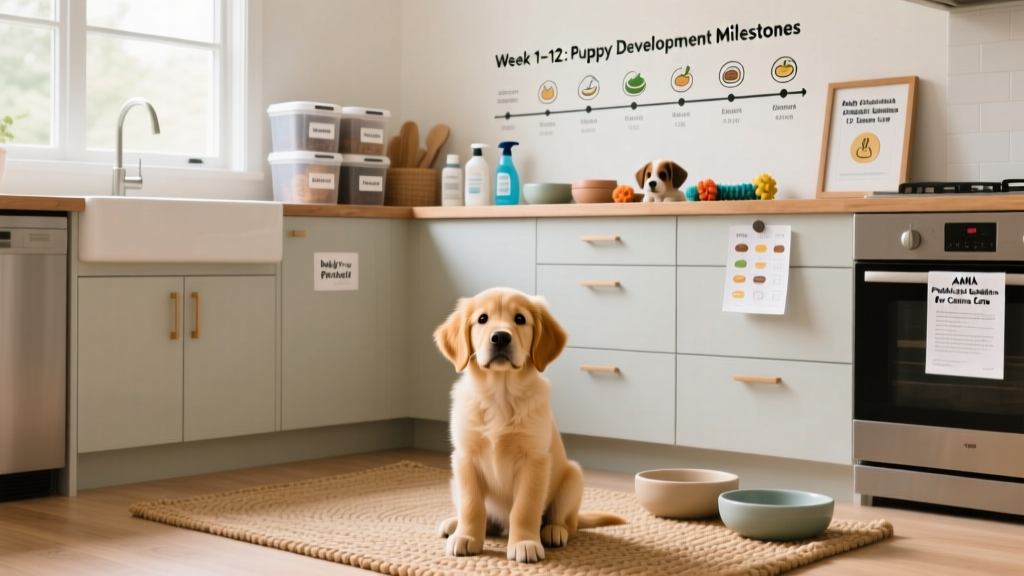
Developmental Milestones: Weeks 4 Through 12 Months
Understanding your puppy's developmental stages helps you know when to introduce new foods like peanut butter, when to start training, and what behaviors are normal at each phase.
Weeks 4–8: The Weaning Window
Puppies transition from mother's milk to solid food during this period. Breeders typically introduce puppy mush (kibble soaked in warm water or puppy formula) around week 4. No peanut butter during this stage — a puppy's digestive system is still developing, and introducing rich, high-fat foods too early can cause diarrhea. Focus on a single, high-quality puppy food (brands like Royal Canin, Hill's Science Diet, or Purina Pro Plan are formulated to AAFCO puppy standards). Expected milestones:
- Week 4–5: First interest in solid food; still nursing frequently
- Week 6–7: Eating gruel 3–4 times daily; baby teeth fully erupted (28 deciduous teeth)
- Week 8: Fully weaned; ready for first veterinary visit and transition to new home
Weeks 8–12: Home Adjustment & Foundation
This is when most puppies come home. You can introduce a tiny taste of safe peanut butter (¼–½ teaspoon) as a training reward starting around week 10, once your puppy is settled and eating puppy food reliably. Key milestones:
- Week 8–9: First vet visit; DHPP vaccine #1; begin crate training (15–30 minute intervals)
- Week 10: Introduce novel tastes — peanut butter, plain yogurt, pumpkin puree — one at a time, monitoring for GI upset over 24 hours
- Week 11–12: DHPP vaccine #2; begin short leash walks (5 minutes per month of age rule); basic "sit" and name recognition
Weeks 12–16: Socialization Prime Time
Your puppy's brain is highly receptive to new experiences. This is the tail end of the critical socialization window. Peanut butter becomes a powerful tool here — use it to reward calm behavior during exposure to new surfaces, sounds, and people. Milestones:
- Week 12–14: Peak socialization; expose to 5–10 new stimuli per day (see checklist below)
- Week 14–16: DHPP vaccine #3; can begin supervised outdoor exploration in low-risk areas after final vaccine
- Week 16: Rabies vaccine (legally required in most US states); puppy is "fully vaccinated" approximately 1–2 weeks after final DHPP
Weeks 16–24 (4–6 Months): Teething & Testing
Adult teeth begin replacing baby teeth. Chewing intensity peaks. Peanut butter stuffed into frozen chew toys becomes essential for redirecting destructive chewing. Milestones:
- Month 4–5: Baby teeth fall out (you may find them or puppy swallows them — both normal); adult incisors emerge
- Month 5–6: Spay/neuter window (most veterinarians recommend 5–6 months for medium breeds, per AVMA guidelines); can increase peanut butter to 2 teaspoons/day
- Month 6: Transition to 2 meals/day; begin heartworm preventive if not already started
Months 6–12: Adolescence
Energy levels surge, and "forgotten" training may resurface. Consistency is critical. Peanut butter can be increased to 1 tablespoon/day for large enrichment toys (Kong Extreme, West Paw Toppl). Milestones:
- Month 7–9: Sexual maturity in intact dogs; consider spay/neuter if not yet done
- Month 10–12: Approaching adult size (small breeds mature faster than large breeds); transition to adult food around 12 months for small/medium breeds, 18–24 months for large/giant breeds
- Month 12: Annual vet exam; DHPP and rabies boosters due
Socialization Checklist: The Critical Window (Weeks 3–14)
The American Kennel Club and veterinary behaviorists identify weeks 3–14 as the primary socialization period. Puppies exposed to diverse positive experiences during this window are significantly less likely to develop fear-based behavioral problems later. Use peanut butter as a reward for calm responses to each new stimulus.
Check off each category. Aim for 3–5 positive exposures per category before week 14.
Surfaces:
- ☐ Grass / gravel / sand / mulch
- ☐ Wet floor / slippery tile / metal grate
- ☐ Carpet / hardwood / concrete
People:
- ☐ Children (supervised, calm interactions)
- ☐ People wearing hats, sunglasses, hoodies
- ☐ People with mobility aids (canes, wheelchairs, walkers)
- ☐ People of different heights, builds, and skin tones
- ☐ Delivery workers / strangers approaching the door
Sounds:
- ☐ Vacuum cleaner / blender / hair dryer
- ☐ Thunderstorm recordings (play at low volume with peanut butter reward)
- ☐ Fireworks recordings / doorbell / car horns
- ☐ Clapping / shouting (at moderate distance)
Other Animals:
- ☐ Fully vaccinated, friendly adult dogs (supervised play)
- ☐ Dogs of different sizes (small, medium, large)
- ☐ Cats (if applicable to your household)
Handling & Body Awareness:
- ☐ Paw handling / ear touching / mouth opening
- ☐ Gentle restraint (simulating vet exam)
- ☐ Nail clippers near paws (without cutting initially)
- ☐ Brush / comb on coat
Environments:
- ☐ Car rides (short trips ending in something positive)
- ☐ Outdoor café / park bench (carried or in stroller pre-vaccination)
- ☐ Puppy kindergarten class (after 2nd DHPP, per trainer's protocol)
Vaccination Schedule: Exact Timing & What Each Vaccine Covers
Your puppy's immune system needs a series of vaccines to build adequate protection. The schedule below follows AAHA (American Animal Hospital Association) canine vaccination guidelines, which most US veterinarians follow.
| Age | Vaccine | What It Protects Against | Est. Cost |
|---|---|---|---|
| 6–8 weeks | DHPP #1 (Distemper, Hepatitis/Adenovirus, Parainfluenza, Parvovirus) | Core: Distemper, adenovirus-2, parvovirus, parainfluenza | $25–$45 |
| 8–10 weeks | Bordetella (optional, recommended for social puppies) | Non-core: Kennel cough (Bordetella bronchiseptica) | $20–$35 |
| 10–12 weeks | DHPP #2 | Booster — maternal antibodies declining; building active immunity | $25–$45 |
| 12–14 weeks | Leptospirosis #1 (recommended for outdoor/suburban dogs) | Non-core: Leptospira bacteria (zoonotic — transmissible to humans) | $25–$40 |
| 14–16 weeks | DHPP #3 + Rabies | Final puppy DHPP booster; Rabies (legally required, zoonotic) | $40–$70 combined |
| 14–16 weeks | Leptospirosis #2 (booster) | Completes initial Lepto series | $25–$40 |
| 12 months | DHPP booster + Rabies booster | Annual/3-year boosters per veterinarian recommendation | $40–$80 |
When can my puppy go outside or meet other dogs? After the second DHPP vaccine (around 10–12 weeks), your puppy can attend structured puppy classes and interact with known, fully vaccinated dogs in controlled environments. Avoid high-risk areas (dog parks, pet store floors, public sidewalks with heavy dog traffic) until 1–2 weeks after the final DHPP at 14–16 weeks. Low-risk socialization — carrying your puppy through stores, sitting on benches watching the world — is safe and encouraged from 8 weeks onward.
Potty Training Timeline & Troubleshooting
Realistic expectation: most puppies are reliably house-trained by 4–6 months, with occasional accidents up to 8–12 months. Small breeds may take longer due to smaller bladder capacity. There is no "3-day potty training" shortcut that works universally — consistency over weeks is what builds the habit.
Age-Based Bladder Capacity
- 8–10 weeks: Can hold ~1–2 hours max. Take out every 30–60 minutes during the day, plus after every meal, nap, and play session.
- 10–14 weeks: Can hold ~2–3 hours. Begin extending intervals by 15 minutes each week.
- 14–20 weeks: Can hold ~3–4 hours. Overnight crate holds of 5–6 hours become possible.
- 5–6 months: Can hold ~5–6 hours. Most puppies can sleep through the night without a potty break.
- 6–12 months: Can hold 6–8 hours. If accidents persist beyond 6 months, consult your vet to rule out UTI or anatomical issues.
Troubleshooting Common Problems
| Problem | Likely Cause | Solution |
|---|---|---|
| Accidents in crate | Crate too large; puppy not taken out frequently enough | Use divider panel so crate fits puppy snugly; increase potty frequency |
| Submissive urination when greeted | Normal developmental behavior in puppies under 6 months | Ignore puppy for first 2 minutes upon entering; greet calmly at their level outdoors |
| Puppy pees outside, then inside 10 min later | Bladder didn't fully empty; puppy didn't "finish" | Wait longer outside; use a consistent potty cue word; reward with peanut butter treat immediately after elimination |
| Nighttime accidents (after 4 months) | Too much water before bed; inconsistent schedule | Remove water bowl 1.5 hours before bedtime; last potty break right before you sleep |
Teething Timeline & Safe Relief Strategies
Puppy teething is intense. Between 3 and 6 months, all 28 baby teeth are replaced by 42 adult teeth. Your puppy will chew everything in reach — this is not misbehavior, it's a biological drive to relieve gum pressure.
Teething Phases
- 3–4 months: Incisors begin loosening; increased mouthing and nipping
- 4–5 months: Canines and premolars erupt; peak chewing intensity; you may see small spots of blood on toys (normal)
- 5–6 months: Molars come in; chewing gradually decreases as adult teeth settle
Safe Chew Recommendations
- Frozen Kong Classic (Puppy size, ~$12): Fill with peanut butter + plain yogurt, freeze 2 hours. Soothes gums and provides 20–30 minutes of enrichment.
- Nylabone Puppy Chew (soft flex material, ~$6): Designed for baby teeth; too-hard chews can fracture developing teeth.
- Frozen carrot sticks: Low-calorie, safe, crunchy. Supervise to prevent choking on large pieces.
- Wet washcloth (frozen): Twist a clean washcloth, soak in water, freeze. Excellent for gum massage. Supervise and discard if tearing.
- Rawhide (choking and intestinal blockage risk, especially for puppies under 6 months)
- Antlers / hooves / weight-bearing bones (too hard — can fracture puppy teeth)
- Ice cubes (some vets OK them; others warn about tooth fractures — use crushed ice instead)
- Old shoes or socks (puppies cannot distinguish "old" from "new" — you're teaching them shoes are chew toys)
Crate Training Progression & Time Limits
A crate is your puppy's safe den — never a punishment space. Time limits are critical: exceeding them leads to distress, whining, and setbacks. The general guideline is 1 hour per month of age for daytime crating, with longer overnight holds as bladder control develops.
| Puppy Age | Max Daytime Crate Time | Max Overnight Crate Time | Peanut Butter Strategy |
|---|---|---|---|
| 8–10 weeks | 1–2 hours | 3–4 hours (set alarm for potty break) | Smear ¼ tsp PB inside crate to build positive association |
| 10–12 weeks | 2–3 hours | 4–5 hours | Frozen mini-Kong with ½ tsp PB |
| 12–16 weeks | 3–4 hours | 5–6 hours | Kong stuffed with PB + kibble, frozen |
| 4–6 months | 4–5 hours | 6–7 hours | West Paw Toppl with PB + banana, frozen |
| 6–12 months | 5–6 hours (not daily max) | 7–8 hours | Large Kong with 1 tbsp PB, frozen overnight |
Important: No puppy or dog should be crated for more than 6 hours during the day on a regular basis. If you work full-time, arrange a midday dog walker or come home for a break. Extended crating leads to anxiety, muscle stiffness, and behavioral deterioration.
Common Puppy Problems & Solutions
Puppy Biting and Nipping
Every puppy bites. It's how they explore the world and relieve teething discomfort. The goal isn't to eliminate mouthing entirely (impossible during teething) but to teach bite inhibition — that human skin is completely off-limits.
- Redirect: When puppy teeth touch skin, say "oops" calmly, withdraw attention for 5 seconds, then offer a chew toy. Reward chewing the toy with praise or a tiny smear of peanut butter.
- Time-out: If nipping continues after 2 redirects, place puppy in a playpen for 30–60 seconds. This teaches that biting ends play. Return and try again.
- Never: Hold the mouth shut, shake, alpha roll, or yell. These aversive methods increase fear and can worsen biting or create defensive aggression. Force-free, positive reinforcement methods are the only approach recommended by the American Veterinary Society of Animal Behavior.
Whining in the Crate
- Distinguish need vs. protest: If puppy was recently outside, fed, and exercised, whining is likely protest. Wait 2–5 minutes before responding. Reward silence with a treat or calm praise.
- If whining persists beyond 10 minutes: Take puppy out on leash for a boring potty break (no play), then return to crate. This prevents reinforcing whining with fun while ruling out a bathroom need.
- Cover the crate with a breathable blanket to reduce visual stimulation. Play white noise or soft classical music.
Destructive Chewing
- Puppy-proof your home: shoes in closets, cords behind furniture, remote controls on shelves.
- Provide 5–7 approved chew toys of varying textures. Rotate every 3 days to maintain novelty.
- Use peanut butter-stuffed enrichment toys during times your puppy typically chews destructively (often late afternoon/early evening — the "witching hour").
First-Year Cost Breakdown
Budgeting for a puppy's first year helps avoid financial surprises. Costs below reflect 2026 national averages for a medium-breed puppy (30–50 lb adult weight) in a suburban US setting. Urban areas and coastal cities may be 20–40% higher.
| Category | Items | Estimated Cost Range |
|---|---|---|
| Veterinary | 3–4 puppy exams, DHPP series, rabies, bordetella, leptospirosis, fecal tests, heartworm test, spay/neuter | $600–$1,200 |
| Preventive Medications | Heartworm preventive (monthly), flea/tick preventive (monthly) | $200–$450 |
| Food | AAFCO-approved puppy food (12 months); treats including peanut butter | $350–$700 |
| Supplies | Crate ($50–$120), bed ($30–$60), leash/harness ($25–$50), bowls ($15–$30), Kong toys ($12–$25 each), lick mat, puppy pads, grooming tools | $200–$500 |
| Training | Puppy kindergarten class (6–8 weeks); optional private sessions | $150–$500 |
| Microchip & Licensing | Microchip implant + registration; local dog license | $50–$100 |
| Pet Insurance (Optional) | Accident + illness policy (e.g., Trupanion, Healthy Paws, Lemonade) | $350–$700/year |
| Total First Year | $1,900–$4,150 |
These costs do not include the puppy purchase price ($500–$3,000+ from a responsible breeder, or $50–$500 adoption fee from a rescue). Emergency veterinary visits can add $500–$5,000+ per incident — this is where pet insurance or a dedicated emergency fund becomes essential.
Frequently Asked Questions
When should I bring my puppy home?
The ideal age is 8–10 weeks. Puppies need weeks 6–8 with their littermates to learn bite inhibition and canine social skills. Taking a puppy home before 8 weeks is associated with higher rates of behavioral problems including fear, aggression, and separation anxiety. Some breeders of toy breeds keep puppies until 10–12 weeks due to fragility and hypoglycemia risk.
How often should I feed my puppy at each age?
Feed 3–4 meals daily from 8–12 weeks, 3 meals daily from 12–16 weeks, then transition to 2 meals daily from 6 months onward. Consistent meal timing (same hours each day) supports potty training predictability. Free-feeding (leaving food out all day) is not recommended — it makes potty schedules unpredictable and can lead to overeating.
When will my puppy be fully potty trained?
Most puppies are reliably house-trained by 4–6 months with consistent schedule enforcement. Small breeds (under 15 lb / 7 kg) may take 6–8 months due to smaller bladders. Occasional accidents are normal up to 12 months, especially during excitement, routine changes, or illness. If your puppy is still having daily accidents after 6 months, consult your veterinarian to rule out urinary tract infection, anatomical abnormalities, or diabetes.
Can I give peanut butter to an 8-week-old puppy?
Technically, a very small amount (¼ teaspoon) of xylitol-free peanut butter is not harmful at 8 weeks. However, most veterinarians recommend waiting until 10–12 weeks when the puppy's digestive system is more mature and they're reliably eating puppy food. Introduce any new food one at a time and monitor for vomiting, diarrhea, or itching for 24 hours.
How do I stop my puppy from biting me?
You can't stop it overnight — teething puppies need to chew. The strategy is consistent redirection: every time teeth touch skin, calmly withdraw attention for 5 seconds, then offer an appropriate chew toy. Reward the puppy for chewing the toy. This takes 2–4 weeks of consistent repetition. Avoid punishment-based methods, which the AVSAB has shown increase behavioral problems. If biting is intense and causing injury, consult a certified professional dog trainer (CPDT-KA) or veterinary behaviorist.
When can my puppy go to the dog park?
Wait until 1–2 weeks after the final DHPP vaccine (typically around 16–18 weeks of age). Dog parks carry elevated disease risk (parvovirus can survive in soil for months). Even after full vaccination, many trainers recommend avoiding dog parks until 6 months when your puppy has better recall and can handle rougher play. Structured puppy playdates with known, vaccinated dogs are a safer alternative during the 3–6 month period.
Is crunchy or creamy peanut butter better for puppies?
For puppies under 6 months, creamy is safer. Large peanut pieces in crunchy varieties can pose a mild choking risk for very small puppies, though this is uncommon. Either type is fine as long as it's xylitol-free. For enrichment toys like Kongs, creamy peanut butter is easier to stuff and freeze.
Can peanut butter cause allergies in puppies?
Peanut allergy in dogs is rare but possible. Signs include itching (especially paws and ears), hives, facial swelling, vomiting, or diarrhea within 1–12 hours of ingestion. If you notice any of these, stop feeding peanut butter and contact your veterinarian. Dogs with known food allergies or sensitive stomachs may do better with alternatives like sunflower seed butter (unsalted, xylitol-free) or pumpkin puree as Kong stuffers.
Tom Renshaw
All our authors care for dogs every day — read more of their work on the authors page.