When Do Puppies Need Their Shots? A Complete First-Year Puppy Care Guide
Learn when do puppies need their shots, plus feeding, potty training, socialization, and cost breakdowns for your puppy's first year.

When Do Puppies Need Their Shots? The Core Timeline Every Owner Needs
If you've just brought home a puppy — or are about to — the question of when do puppies need their shots is likely top of mind. The short answer: puppies need their first set of core vaccines (DHPP) between 6 and 8 weeks of age, followed by booster rounds at 10–12 weeks and 14–16 weeks. Rabies vaccination typically happens at 12–16 weeks, depending on your state's legal requirements.
But vaccination is just one piece of the first-year puzzle. This guide walks you through every critical milestone — feeding portions, potty training expectations, the socialization window that closes faster than most owners realize, teething relief, and the real dollar cost of raising a puppy through year one.
Veterinary Disclaimer: This guide provides general educational information. Always consult your veterinarian for personalized vaccination schedules, dietary recommendations, and health decisions for your puppy. Protocols vary by region, breed, and individual health status.
Puppy Vaccination Schedule: Week-by-Week Breakdown
The American Veterinary Medical Association (AVMA) recommends core vaccines for all puppies, with non-core (lifestyle) vaccines added based on risk factors like geography, boarding frequency, and exposure to other dogs.
| Age | Vaccine | Type | Notes |
|---|---|---|---|
| 6–8 weeks | DHPP (Distemper, Hepatitis/Adenovirus, Parainfluenza, Parvovirus) | Core | First dose; maternal antibodies may partially interfere |
| 10–12 weeks | DHPP booster #1 | Core | Strengthening immune response as maternal antibodies wane |
| 10–12 weeks | Bordetella (optional) | Non-core | Recommended if attending puppy classes, boarding, or grooming |
| 10–12 weeks | Leptospirosis (optional) | Non-core | Recommended in areas with wildlife exposure or standing water |
| 12–16 weeks | Rabies | Core (legally required) | Timing varies by state law; typically 12–16 weeks |
| 14–16 weeks | DHPP booster #2 | Core | Critical final puppy dose — ensures protection after maternal antibodies fully decline |
| 14–16 weeks | Leptospirosis booster (if started) | Non-core | Two-dose initial series required |
| 6–12 months | DHPP booster + Rabies booster | Core | First annual booster; subsequent rabies may be 1- or 3-year depending on vaccine type and local law |
Why so many boosters? Puppies receive maternal antibodies through colostrum (first milk) that protect them early but also block vaccines from working. These antibodies decline unpredictably between 6 and 16 weeks. The Merck Veterinary Manual explains that repeated boosters ensure at least one dose lands after maternal antibodies drop enough for the puppy's own immune system to respond.
Age-Specific Milestones: What to Expect from Week 4 Through Month 12
Weeks 4–8: The Breeder/Foster Window
- Physical: Baby teeth fully erupted; eyes and ears fully functional; coordination improving rapidly
- Social: Learning bite inhibition from littermates; beginning to explore solid food
- Health: First deworming typically at 2, 4, 6, and 8 weeks; first DHPP at 6–8 weeks
- Your role: If visiting before pickup, handle the puppy daily for short periods (5–10 minutes) to build human bonding
Weeks 8–12: Home Adjustment Period
- Physical: Rapid growth phase; sleeping 18–20 hours per day is normal
- Behavioral: Fear imprint period (8–11 weeks) — traumatic experiences during this window can create lasting phobias; keep introductions positive
- Training: Begin name recognition, sit, and crate introduction; keep sessions under 5 minutes
- Health: First vet visit within 48–72 hours of bringing puppy home; DHPP booster at 10–12 weeks
Weeks 12–16: Confidence Building
- Physical: Bladder control improving (can hold approximately 1 hour per month of age plus one); adult teeth beginning to push in
- Behavioral: Second fear period may begin around 14–16 weeks; maintain positive exposure
- Training: Leash introduction, recall foundation, settle/mat training
- Social: After final DHPP at 14–16 weeks, supervised playdates with known vaccinated dogs become safer
Weeks 16–24: Adolescence Begins
- Physical: Teething peaks; chewing intensity increases dramatically; growth rate begins to slow for small/medium breeds
- Behavioral: Testing boundaries; previously reliable commands may seem "forgotten" — this is normal developmental regression
- Training: Increase difficulty gradually; consider enrolling in a structured positive-reinforcement group class
- Health: Spay/neuter discussion with your vet (timing varies by breed size; large breeds often benefit from delayed alteration per current veterinary research)
Months 6–12: Approaching Adulthood
- Physical: Small breeds near adult size by 9–10 months; large/giant breeds continue growing until 18–24 months
- Behavioral: Sexual maturity (if intact); energy remains high but attention span lengthens
- Training: Solidify obedience; introduce advanced skills or dog sports foundations
- Health: Annual wellness exam; DHPP and rabies boosters; transition to adult food at breed-appropriate age (small breeds ~10–12 months, large breeds ~12–18 months)
Feeding Schedule: Exact Portions by Age and Weight
Puppies need significantly more calories per pound than adult dogs because they're building bone, muscle, and organ tissue simultaneously. The American Kennel Club recommends feeding a food that meets AAFCO standards for "growth" or "all life stages."
| Age | Meals/Day | Small Breed (10–25 lb adult) | Medium Breed (25–55 lb adult) | Large Breed (55–100 lb adult) |
|---|---|---|---|---|
| 6–8 weeks | 3–4 | ¼–⅓ cup per meal (puppy mush/kibble softened with warm water) | ⅓–½ cup per meal | ½–¾ cup per meal |
| 8–12 weeks | 3–4 | ⅓–½ cup per meal | ½–¾ cup per meal | ¾–1¼ cups per meal |
| 12–16 weeks | 3 | ½–⅔ cup per meal | ¾–1 cup per meal | 1–1¾ cups per meal |
| 16–24 weeks | 2–3 | ½–¾ cup per meal | 1–1½ cups per meal | 1½–2½ cups per meal |
| 6–12 months | 2 | ½–1 cup per meal (transition to adult food at ~10–12 months) | 1–2 cups per meal (transition at ~12 months) | 2–3½ cups per meal (transition at ~14–18 months) |
Important adjustments: These are starting points. Monitor your puppy's body condition score (BCS) — you should be able to feel ribs easily without pressing hard, and see a visible waist from above. If ribs are hard to feel, reduce portions by 10%. If ribs are visible, increase by 10%. Large and giant breeds should eat a food specifically formulated for large-breed growth to prevent rapid bone development that leads to orthopedic problems like hip dysplasia.
Potty Training Timeline: Realistic Expectations and Troubleshooting
Here's the truth most puppy guides gloss over: most puppies are not reliably house-trained until 4–6 months of age, and some small breeds take until 8–10 months due to smaller bladder capacity and higher metabolic rates. The "potty trained in 3 days" promise is marketing, not reality.
The Bladder Rule of Thumb
A puppy can hold their bladder for approximately (age in months + 1) hours during the day. So a 3-month-old puppy can manage about 4 hours — but this is a maximum, not a target. Take them out far more frequently to prevent accidents.
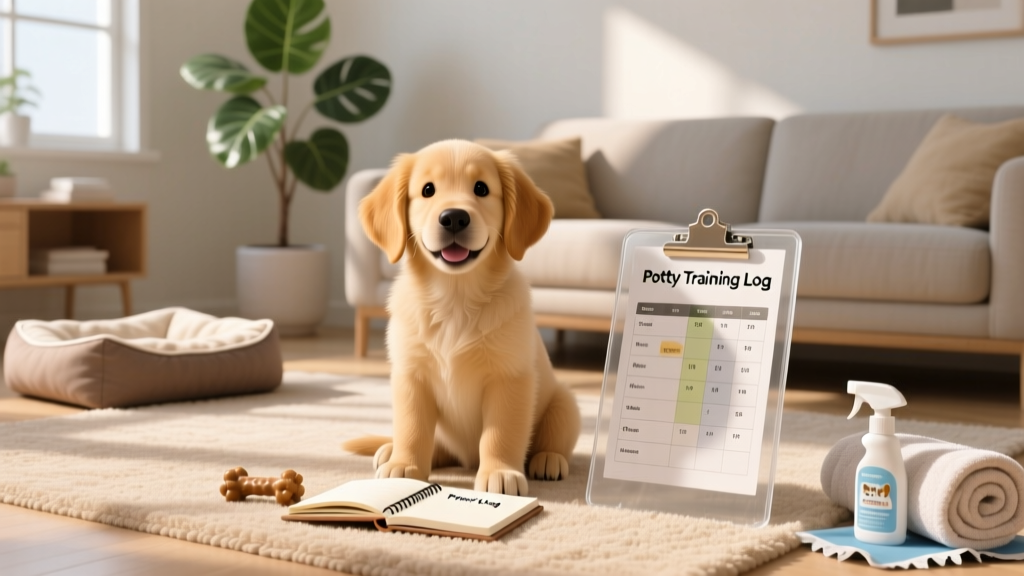
| Time | Activity | Result | Reward Given | Notes |
|---|---|---|---|---|
| 6:30 AM | Wake-up, carried outside | ✅ Pee + poop | Small treat + "yes!" | Normal morning output |
| 7:15 AM | After breakfast (15 min) | ✅ Pee | Verbal praise | — |
| 9:00 AM | After play session | ✅ Pee | Small treat | — |
| 11:30 AM | Accident in kitchen | ❌ Pee | N/A — interrupted, carried outside | Missed signal; was sniffing corner |
Key take-outs outside: Immediately after waking, 15–20 minutes after every meal, after every play session, after every nap, and before bedtime. For an 8–12 week old puppy, this means going outside every 1–2 hours during the day.
Accident protocol: If you catch the puppy mid-accident, interrupt calmly ("oops!") and carry them outside to finish. Never punish — rubbing noses in it or yelling creates fear of eliminating in front of you, which makes training harder. Clean accidents with an enzymatic cleaner (Nature's Miracle or Rocco & Roxie) to remove the scent markers that attract repeat offenses.
The Critical Socialization Window (Weeks 3–14)
This is arguably the most time-sensitive part of puppy development. The AVMA and veterinary behaviorists emphasize that the primary socialization window closes around 12–14 weeks of age. After this period, unfamiliar things are more likely to trigger fear than curiosity.
Socialization Exposure Checklist
Surfaces: Grass, gravel, tile, carpet, wet pavement, metal grates, wood chips, sand
Sounds: Vacuum, thunderstorm recordings (start at low volume), doorbell, children playing, traffic, construction, fireworks recordings, clapping, umbrellas opening
People: Children (supervised), elderly individuals, people in hats/sunglasses/uniforms, people using wheelchairs or crutches, tall people, people with deep voices, delivery workers
Animals: Other vaccinated puppies (structured play), calm adult dogs, cats (if applicable), livestock (if rural)
Handling: Paw touching, ear examination, mouth opening, tail lifting, nail clipping simulation, gentle restraint, being picked up from different angles
Environments: Car rides, parking lots, outdoor café patios, friend's houses, pet store (carried before full vaccination), vet clinic (happy visits with treats, no procedures)
Objects: Plastic bags fluttering, brooms, bicycles, skateboards, strollers, balloons, flags
The vaccination-socialization tension: Your puppy won't be fully vaccinated until after 16 weeks, but the socialization window closes around 14 weeks. The AKC and the American Veterinary Society of Animal Behavior (AVSAB) recommend controlled socialization during this period — meaning: avoid dog parks and unknown dogs, but DO expose your puppy to known-vaccinated dogs in private settings, carry them through public spaces, and invite healthy, vaccinated dogs to your home. The risk of behavioral problems from under-socialization statistically outweighs the disease risk when managed carefully.
Teething Timeline and Relief Strategies (3–6 Months)
Puppies have 28 deciduous (baby) teeth that begin erupting around 3–4 weeks and are fully in by 6–8 weeks. Starting around 12–16 weeks, adult teeth push the baby teeth out. By 6–7 months, all 42 adult teeth should be in place.
| Age | Stage | Symptoms | Relief Strategies |
|---|---|---|---|
| 3–4 weeks | Baby incisors erupt | Minimal — nursing mother may notice | N/A |
| 4–6 weeks | Baby canines and premolars erupt | Puppy begins mouthing littermates | N/A |
| 12–16 weeks | Adult incisors push in; baby incisors shed | Increased chewing, drooling, small blood spots on toys | Chilled (not frozen) washcloth, Kong Classic stuffed with softened kibble |
| 16–20 weeks | Adult canines and premolars erupt | Peak chewing intensity, possible decreased appetite, mild gum redness | Benebone Wishbone, Nylabone Puppy Chew (soft formula), frozen carrot sticks |
| 20–28 weeks | Adult molars erupt; final teeth set | Chewing gradually decreases | West Paw Toppl, bully sticks (supervised), dental chews sized for puppy weight |
Safety notes: Avoid ice cubes (too hard — risk of tooth fracture), rawhide (choking and intestinal blockage risk), and any chew toy harder than a fingernail (press your thumbnail into the material; if it doesn't leave a slight indent, it's too hard for puppy teeth). Always supervise chew sessions and remove pieces small enough to swallow whole.
Retained baby teeth: Small breeds are particularly prone to baby teeth that don't fall out when the adult tooth erupts, creating a "double tooth" that traps food and causes early dental disease. If you see an adult tooth emerging alongside a baby tooth that hasn't loosened after two weeks, ask your vet about extraction at the time of spay/neuter.
Crate Training Progression: Time Limits by Age
A crate is a management tool and a safe space — not a punishment. The goal is for your puppy to voluntarily choose the crate for naps and feel calm when confined. Here's a realistic progression:
| Age | Maximum Daytime Crate Time | Maximum Nighttime Crate Time | Training Focus |
|---|---|---|---|
| 8–10 weeks | 30–60 minutes | 2–3 hours (expect 1–2 nighttime potty breaks) | Build positive association: feed meals in crate, toss treats inside, nap with door open |
| 10–12 weeks | 1–2 hours | 3–4 hours (1 nighttime potty break typical) | Begin short absences from room; practice calm entry/exit without fanfare |
| 12–16 weeks | 2–3 hours | 4–5 hours (may sleep through the night) | Extend duration gradually; provide a safe chew toy for occupation |
| 16–24 weeks | 3–4 hours | 5–7 hours | Puppy should enter crate willingly; if whining persists, evaluate exercise and mental stimulation |
| 6–12 months | 4–5 hours maximum | 7–8 hours | Transition to longer freedom periods if reliable; some dogs prefer crate as "bedroom" indefinitely |
Whining protocol: If the puppy whines in the crate, first determine the cause. If they need to eliminate (based on time since last outing), take them out on leash, boring and quiet, then return to crate. If they've recently eliminated and are whining for attention, wait for a brief pause in vocalization (even 3 seconds of silence) before opening the crate — this teaches that quiet, not noise, opens the door. Never release a whining puppy mid-tantrum unless elimination is needed.
Common Puppy Problems and Solutions
🦷 Puppy Biting and Nipping
Why it happens: Puppies explore the world with their mouths. Littermates teach bite inhibition by yelping and stopping play when bites are too hard. You need to continue this education.
Solution:
- When teeth touch skin, say "ouch" in a calm, medium volume and freeze/withdraw attention for 10–15 seconds
- Redirect to an appropriate chew toy immediately
- If biting continues after 2–3 redirects, end the play session (puppy is likely overtired — crate for a nap)
- Never hold the mouth shut, tap the nose, or use physical punishment — these create fear and defensive biting
Timeline: Mouthing decreases significantly after adult teeth are in (around 6–7 months), but consistent redirection accelerates the process.
😢 Whining and Crying
Why it happens: Communication — puppy needs something (elimination, food, comfort, stimulation) or is frustrated/overstimulated.
Solution:
- Rule out physical needs first (potty, hunger, pain, temperature)
- For attention-seeking whining: ignore completely until quiet, then reward calm behavior
- For crate whining: ensure adequate exercise before crating; a tired puppy settles faster
- For separation-related whining: build alone-time gradually starting at 5-minute increments
🪑 Destructive Chewing
Why it happens: Teething discomfort, boredom, insufficient exercise, or anxiety.
Solution:
- Provide 4–5 appropriate chew options of varying textures (rubber, nylon, edible)
- Rotate toys every 3–4 days to maintain novelty
- Manage the environment: use baby gates, pick up shoes, use bitter apple spray on baseboards
- Ensure adequate physical exercise (breed-appropriate) and mental stimulation (food puzzles, sniffing walks, 5-minute training sessions)
When Can My Puppy Go Outside and Meet Other Dogs?
This question balances disease risk against socialization needs. Here's the practical framework:
Immediately (8+ weeks): Carry your puppy through public spaces — parks, outdoor markets, friend's homes. Let them observe the world from your arms. They can walk on your private property (yard, driveway) if no unknown dogs have access.
After first DHPP booster (10–12 weeks): Structured puppy classes with vaccinated peers are generally safe according to the AVSAB, as long as the facility requires proof of vaccination and sanitizes between sessions. Short walks on low-traffic sidewalks are reasonable.
After final DHPP (14–16 weeks): Your puppy can now safely walk in public areas, meet other known-vaccinated dogs, visit dog-friendly patios, and begin exploring more environments.
Avoid until fully vaccinated: Dog parks, pet store floors, unknown dogs, areas with high stray dog traffic, and any location with visible dog feces.
First-Year Cost Breakdown
| Category | Low Estimate | Mid Estimate | High Estimate | Details |
|---|---|---|---|---|
| Vaccinations (full puppy series) | $200 | $350 | $500 | Includes DHPP series, rabies, bordetella, leptospirosis if applicable |
| Spay/neuter | $250 | $500 | $900 | Varies by clinic type (low-cost clinic vs. specialty hospital) and dog size |
| Microchip + registration | $25 | $50 | $75 | Often included with adoption or breeder purchase |
| Food (12 months puppy formula) | $300 | $600 | $1,200 | Small breeds eat less; large breeds eat significantly more; premium brands cost more |
| Flea/tick + heartworm prevention | $200 | $350 | $500 | Year-round prevention recommended in most US regions |
| Supplies (crate, bed, bowls, leash, collar, toys, gates) | $200 | $400 | $700 | One-time purchases; quality gear lasts multiple dogs |
| Training (group classes + optional private sessions) | $150 | $400 | $1,200 | 6-week group class ~$150–$250; private sessions $80–$150/hour |
| Grooming (if applicable) | $0 | $400 | $1,200 | Short-coated breeds: minimal; doodles, poodles, double-coated breeds: professional grooming every 6–8 weeks at $60–$100/session |
| Pet insurance (optional but recommended) | $360 | $600 | $960 | $30–$80/month depending on breed, deductible, and coverage level |
| TOTAL FIRST YEAR | $1,685 | $3,650 | $7,235 | Does not include purchase/adoption fee or emergency veterinary care |
Budget tip: The biggest financial surprise for new puppy owners is emergency veterinary care. Puppies eat things they shouldn't, and a single foreign body surgery can cost $2,000–$7,000. Pet insurance enrolled at 8 weeks (before any pre-existing conditions develop) offers the best value and the widest coverage.
Frequently Asked Questions
When should I bring my puppy home?
The ideal age is 8–10 weeks. Puppies benefit from staying with their mother and littermates through at least 8 weeks for social development and bite inhibition learning. Some breeders of toy breeds keep puppies until 10–12 weeks due to their fragility and risk of hypoglycemia. Avoid taking a puppy home before 7 weeks unless there's a medical necessity requiring hand-rearing.
How often should I feed my puppy?
Feed 3–4 meals per day from 8–12 weeks, reduce to 3 meals from 12–16 weeks, then transition to 2 meals per day from 16 weeks onward. Exact portions depend on the food's caloric density and your puppy's breed size — check the feeding guide on your specific food bag and adjust based on body condition score.
When will my puppy be fully potty trained?
Most puppies achieve reliable house training between 4–6 months, though small breeds may take until 8–10 months due to smaller bladder capacity. Consistency in schedule, supervision, and positive reinforcement for outdoor elimination are the three factors that most accelerate the process. Expect occasional accidents even in "trained" puppies during excitement, routine changes, or illness.
What vaccines does my puppy need and when?
Core vaccines: DHPP at 6–8, 10–12, and 14–16 weeks, plus rabies at 12–16 weeks. Non-core vaccines (bordetella, leptospirosis, Lyme) depend on your puppy's lifestyle and geographic risk. Your veterinarian will design a protocol based on your specific situation. The 14–16 week DHPP booster is the most critical — skipping it leaves your puppy vulnerable to parvovirus, which has a mortality rate of up to 91% in untreated puppies.
How do I stop puppy biting and nipping?
Use the redirect-and-withdraw method: when teeth touch skin, say "ouch" calmly, withdraw attention for 10–15 seconds, then offer an appropriate chew toy. If biting persists, the puppy is likely overtired — a crate nap often resolves it. Consistency from all household members is essential. Biting typically diminishes significantly by 6–7 months as adult teeth fully erupt and impulse control improves.
When can my puppy go outside and meet other dogs?
Your puppy can explore your private yard immediately and be carried through public spaces from 8 weeks onward. Structured puppy classes with vaccinated peers are safe after the first DHPP booster (10–12 weeks). Full public access — dog parks, hiking trails, pet stores — should wait until after the final DHPP booster at 14–16 weeks. During the protected period, prioritize socialization through controlled environments: invite vaccinated dogs to your home, visit friends' yards, and carry your puppy through busy areas.
Anouk Beaumont
All our authors care for dogs every day — read more of their work on the authors page.