Puppy Vaccination Chart & First-Year Care Timeline: A Complete Guide
Follow our detailed puppy vaccination chart plus week-by-week milestones for feeding, potty training, socialization, and teething through the first year.

Bringing a new puppy home is equal parts thrilling and overwhelming. Between figuring out which vaccines are due, how much to feed, and why your shoes suddenly look delicious, the first year demands a reliable roadmap. This guide walks you through every critical window — from the 6-week puppy vaccination chart through the 12-month mark — with concrete numbers, realistic timelines, and the kind of detail you'll actually use.
Veterinary disclaimer: This guide provides general educational information. Always consult your veterinarian for personalized medical advice, as protocols vary by region, breed, and individual health status.
When Should I Bring My Puppy Home?
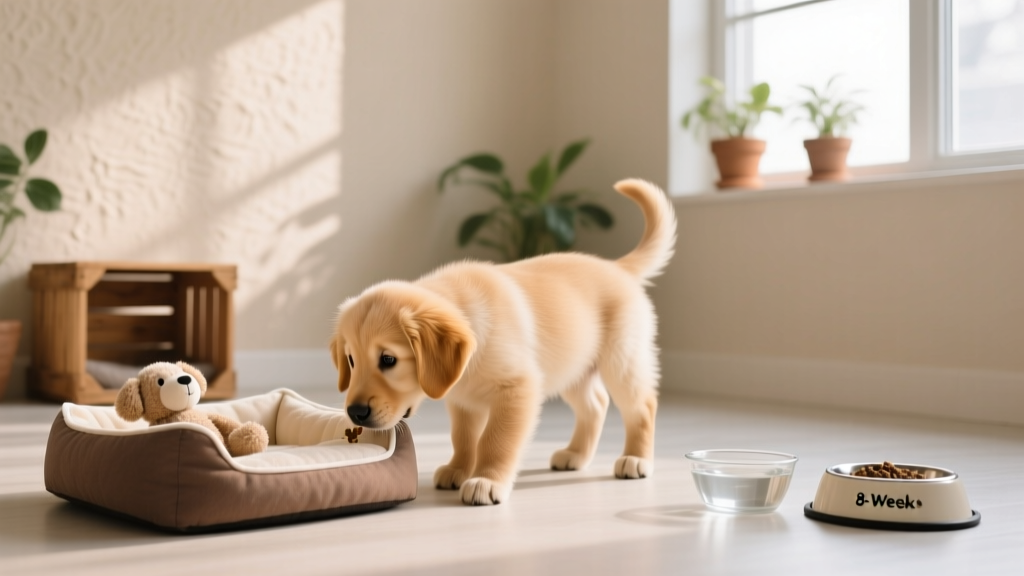
The American Veterinary Medical Association recommends puppies stay with their littermates and dam until at least 8 weeks of age. For toy breeds (Chihuahuas, Yorkshire Terriers, Pomeranians), many responsible breeders keep puppies until 10-12 weeks because small breeds mature more slowly and are prone to hypoglycemia if separated too early.
Here's why the timing matters: between weeks 3 and 8, puppies learn bite inhibition from siblings, develop basic canine communication skills, and receive maternal antibodies through nursing that protect them until their own immune systems mature. Removing a puppy before 8 weeks correlates with higher rates of fear-based reactivity and resource guarding later in life, according to research published in the Journal of Veterinary Behavior.
Age-Specific Milestones at a Glance
| Age Window | Physical Milestones | Behavioral Milestones | Owner Action Items |
|---|---|---|---|
| Weeks 4-8 | Baby teeth fully erupted; weaning onto solid food; weight gain of 5-10% daily | Social play with littermates; startle recovery develops; first fear imprint period (weeks 8-10) | Breeder handles daily; deworming at weeks 4, 6, 8; first DHPP vaccine at 6-8 weeks |
| Weeks 8-12 | Rapid growth phase; bladder capacity ~1-2 hours; sleep needs 18-20 hours/day | Primary socialization window open; attachment to humans forms; bite inhibition learning peaks | Vet wellness exam within 72 hours of homecoming; begin positive reinforcement training; structured socialization exposures |
| Weeks 12-16 | Growth rate begins to moderate; adult coat starts replacing puppy coat; coordination improves | Fear imprint period (weeks 8-11 winding down); testing boundaries; increased independence | Continue vaccine boosters; enroll in puppy kindergarten class; increase structured exercise gradually |
| Weeks 16-24 | Teething begins (~16 weeks); adult teeth erupting; growth plates still open | Secondary fear period possible (around 6-14 months); adolescent energy surge; sexual maturity approaching | Discuss spay/neuter timing with vet; provide appropriate chew outlets; maintain training consistency |
| 6-12 Months | Approaching adult size (small breeds mature faster at 8-10 months; large breeds continue growing to 18-24 months) | Adolescent boundary-testing; potential regression in training; social maturity developing | Rabies booster per local law; transition to adult food for small/medium breeds at 10-12 months; continue advanced training |
Puppy Vaccination Chart: Core and Non-Core Schedule
The puppy vaccination chart below follows the American Animal Hospital Association (AAHA) Canine Vaccination Guidelines, which most US veterinarians use as their protocol framework. Your vet may adjust timing based on local disease prevalence, breed risk factors, and maternal antibody levels.
| Age | Vaccine | Type | Notes |
|---|---|---|---|
| 6-8 weeks | DHPP (Distemper, Hepatitis/Adenovirus-2, Parainfluenza, Parvovirus) | Core | Often given by breeder; maternal antibodies may partially neutralize — boosters essential |
| 10-12 weeks | DHPP booster #2 | Core | Critical booster; maternal antibodies declining by this point |
| 10-12 weeks | Bordetella (kennel cough) | Non-core | Recommended if attending puppy classes, boarding, or groomer visits; intranasal or injectable |
| 10-12 weeks | Leptospirosis | Non-core | Recommended in areas with wildlife exposure or standing water access; 2-dose series |
| 14-16 weeks | DHPP booster #3 (final puppy series) | Core | Given at or after 16 weeks to ensure maternal antibodies no longer interfere |
| 14-16 weeks | Leptospirosis booster #2 | Non-core | Complete the 2-dose initial series if started at 10-12 weeks |
| 12-16 weeks | Rabies | Core (legal requirement) | Timing varies by state law — most require by 16 weeks; 1-year initial, then 3-year boosters |
| 6 months+ | Lyme disease | Non-core | For dogs in tick-endemic areas (Northeast, Upper Midwest, Pacific Coast); 2-dose series |
| 12-16 months | DHPP booster (1-year) | Core | After this, AAHA recommends DHPP boosters every 3 years or titer testing |
Important context on maternal antibodies: Puppies receive antibodies from their dam's colostrum (first milk) that protect them in early weeks but also block vaccines from working. This is why the puppy vaccination chart requires boosters every 2-4 weeks until at least 16 weeks of age — each booster catches the window when maternal antibodies have dropped enough for the puppy's immune system to respond. A single vaccine at 8 weeks provides incomplete protection for most puppies.
Estimated first-year vaccine costs: $75-$150 per wellness visit (exam + vaccines), with 3-4 visits in the first year. Total vaccine-related spending typically ranges from $200-$450 depending on your region and which non-core vaccines your vet recommends.
Feeding Schedule: Portions and Frequency by Age
Puppy feeding isn't one-size-fits-all. Caloric needs vary dramatically by expected adult size, activity level, and the specific food's caloric density. The portions below assume a commercially prepared, AAFCO-certified puppy food labeled for growth (approximately 350-450 kcal per cup).
| Puppy Age | Meals Per Day | Small Breed (adult 5-20 lb) Cups/Day | Medium Breed (adult 21-50 lb) Cups/Day | Large Breed (adult 51-100+ lb) Cups/Day |
|---|---|---|---|---|
| 8-12 weeks | 4 | ½ – ¾ | ¾ – 1¼ | 1½ – 2½ |
| 12-16 weeks | 3-4 | ¾ – 1 | 1¼ – 2 | 2½ – 4 |
| 16-24 weeks | 3 | 1 – 1¼ | 2 – 3 | 3½ – 5½ |
| 6-9 months | 2-3 | 1 – 1½ | 2½ – 3½ | 4 – 7 |
| 9-12 months | 2 | 1 – 1½ (may transition to adult food) | 2½ – 4 | 5 – 8 |
Critical feeding notes:
- Large/giant breeds: Use a large-breed puppy formula with controlled calcium (1.2-1.8% on a dry matter basis) and phosphorus to reduce hip dysplasia and osteochondrosis risk. Do not free-feed — measured meals prevent rapid growth that stresses developing joints.
- Toy breeds: Puppies under 5 lb are at risk for hypoglycemia. If your toy breed puppy is under 12 weeks, keep 4 meals per day and have Karo syrup on hand — rub a small amount on the gums if the puppy seems lethargic or wobbly, then call your vet immediately.
- Body Condition Score (BCS): Rather than fixating on cup measurements, learn to assess your puppy's BCS. You should feel (but not prominently see) ribs, and there should be a visible waist when viewed from above. A BCS of 4-5 on a 9-point scale is ideal for growing puppies.
Socialization Window: Weeks 3-14 (Don't Miss This)
The primary socialization period — roughly weeks 3 through 14 — is the single most influential developmental window in your puppy's life. During this time, the puppy's brain is primed to form positive associations with novel stimuli. After week 14, the brain's fear response strengthens, and unfamiliar things become harder to accept. According to the American Kennel Club, puppies who receive structured socialization during this window show significantly lower rates of fear, aggression, and anxiety throughout life.
The vaccine conflict: Your puppy won't be fully vaccinated until after 16 weeks, but the socialization window closes around 14 weeks. The AVMA and the American Veterinary Society of Animal Behavior (AVSAB) both state that the risk of behavioral euthanasia from poor socialization outweighs the risk of infectious disease — provided you socialize smartly. This means controlled exposures in low-risk environments, not dog parks.
Potty Training Timeline: Realistic Expectations
Let's set the record straight: no puppy is reliably house-trained in a weekend. Bladder control is a physiological developmental milestone, not just a behavioral one. A general rule from the Merck Veterinary Manual is that puppies can hold their bladder for approximately one hour per month of age, plus one — so a 3-month-old puppy maxes out around 4 hours (and that's during rest, not active play).
| Puppy Age | Max Bladder Hold Time (Awake) | Overnight Hold Time | Realistic Training Status |
|---|---|---|---|
| 8-10 weeks | 30-60 minutes | 2-3 hours (expect overnight wake-ups) | Learning the concept; 10-15 accidents per week is normal |
| 10-14 weeks | 1-2 hours | 3-4 hours | Starting to signal (sniffing, circling); accidents drop to 5-8/week with consistency |
| 14-20 weeks | 2-3 hours | 5-6 hours | Reliable with schedule; occasional regression during fear periods or routine changes |
| 20-32 weeks | 4-5 hours | 7-8 hours | Most puppies are "mostly trained" — 1-2 accidents per month |
| 6-12 months | 6-8 hours | 8-10 hours | Fully reliable for most dogs; intact males may begin marking behavior |
Potty Training Troubleshooting Framework
If accidents are increasing, check these variables in order:
- Medical causes first: Urinary tract infections (UTIs) are common in puppies. If your puppy is having accidents after a period of success, request a urinalysis from your vet ($35-$75). Symptoms include frequent small urinations, straining, or licking the genital area.
- Schedule gaps: Are you taking the puppy out within 15 minutes of waking, eating, drinking, and playing? Puppies have a gastrocolic reflex — they need to eliminate shortly after meals.
- Supervision failures: A puppy wandering unsupervised for even 5 minutes will find a corner. Use a 6-foot leash attached to your waist indoors, or confine to a crate or exercise pen when you can't watch.
- Cleaning protocol: Use an enzymatic cleaner (Nature's Miracle, Rocco & Roxie) on accident spots. Standard household cleaners don't break down uric acid crystals, and residual scent triggers repeat elimination.
- Reward timing: Treat and praise immediately after elimination outdoors — within 2 seconds. If you wait until you're back inside, the puppy associates the reward with coming indoors, not with eliminating outside.
Crate Training Progression and Teething Relief
Crate training and teething overlap significantly during the 3-6 month window, so addressing them together makes practical sense.
Crate Time Limits by Age
| Age | Max Daytime Crate Time | Max Overnight Crate Time | Crate Size Guidance |
|---|---|---|---|
| 8-10 weeks | 30-60 minutes | 2-3 hours (set alarm) | Just enough room to stand, turn, lie down — use divider panel in larger crate |
| 10-14 weeks | 1-2 hours | 3-5 hours | Expand divider as puppy grows; add a snuggle toy |
| 14-20 weeks | 2-3 hours | 5-7 hours | Full crate size for expected adult dimensions |
| 20-32 weeks | 3-4 hours | 7-8 hours | Begin leaving crate door open during day as a "den" |
| 6-12 months | 4-5 hours max | 8-10 hours | Transition to free-roaming if reliably house-trained and non-destructive |
Crate training method: Feed all meals in the crate with the door open for the first week. Introduce a cue word ("crate" or "kennel") and toss treats inside. Gradually close the door for 30 seconds, then 1 minute, then 5 minutes while you sit nearby. Build duration before distance. Never use the crate as punishment — it must remain a positive retreat.
Teething Timeline and Safe Relief Strategies
Puppies have 28 deciduous (baby) teeth that begin erupting around 3-4 weeks and are fully in by 6-8 weeks. The 42 adult teeth start pushing out baby teeth beginning around 12-16 weeks, with the process typically complete by 6-7 months.
| Age | Teething Stage | Signs | Safe Relief Options |
|---|---|---|---|
| 12-16 weeks | Incisors loosening | Increased chewing, mild drooling, finding tiny teeth on floor | Kong Classic (puppy size) stuffed with wet food and frozen; Nylabone Puppy Chew (soft formula) |
| 16-20 weeks | Canines and premolars erupting | Peak chewing intensity; possible gum bleeding; reluctance to eat hard kibble | Frozen washcloth (twisted and soaked in low-sodium chicken broth); Benebone Wishbone (puppy); carrot sticks (supervised) |
| 20-28 weeks | Molars erupting, final teeth settling | Chewing gradually decreases; some puppies have retained baby teeth (especially canines) | West Paw Zogoflex Hurley; bully sticks (supervised, remove when small enough to choke); veterinary check for retained deciduous teeth at spay/neuter |
Retained deciduous teeth: Small breeds are particularly prone to baby teeth that don't fall out when the adult tooth erupts. If you see two teeth occupying the same space (a "double tooth"), schedule a veterinary extraction — retained baby teeth cause crowding, misalignment, and periodontal disease. Most vets extract these during the spay/neuter procedure to minimize separate anesthesia events.
Toxic chew warnings: Avoid rawhide from unregulated sources (risk of chemical processing and choking), cooked bones (splinter hazard), and antlers or weight-bearing bones from large animals (tooth fracture risk in young puppies with developing enamel). If your puppy ingests anything potentially toxic, call ASPCA Animal Poison Control at (888) 426-4435 — a consultation fee applies, but the service is available 24/7.
Common Puppy Problems and Solutions
Puppy Biting and Nipping
Mouthing is normal puppy behavior — they explore the world with their mouths and are learning bite inhibition. The goal isn't to eliminate mouthing immediately but to teach that human skin is completely off-limits.
Protocol:
- When teeth touch skin, say "ouch" in a calm, neutral tone (not a dramatic yelp, which can excite some puppies).
- Immediately withdraw attention — stand up, turn away, or step behind a baby gate for 10-15 seconds.
- Return and redirect to an appropriate chew toy. Reward chewing the toy with praise and continued play.
- If biting persists after 3-5 redirections, the puppy is likely overtired. Puppies need 18-20 hours of sleep per day, and sleep-deprived puppies bite more. Enforce a crate nap.
Most puppies show significant bite inhibition improvement by 16-20 weeks with consistent application. If biting is intense, breaks skin consistently, or is accompanied by stiffening and growling over resources, consult a certified professional dog trainer (CPDT-KA) or veterinary behaviorist — this may indicate resource guarding that needs professional intervention.
Excessive Whining and Crying
Whining in the first week home is almost universal. Your puppy has been separated from everything familiar. Strategies that work:
- A Snuggle Puppy (with heartbeat simulator and heat pack) in the crate — approximately $40-$50, consistently rated effective by owners
- A worn t-shirt with your scent placed in the crate
- Placing the crate in your bedroom for the first 1-2 weeks, then gradually moving it to the desired location
- Not responding to demand whining with attention — wait for 3-5 seconds of silence before opening the crate or providing interaction
Destructive Chewing
Puppies chew for three reasons: teething discomfort, boredom, and exploration. Management is more effective than correction at this age:
- Puppy-proof one room or use exercise pens (MidWest Foldable Metal Exercise Pen, ~$35-$55) to limit access
- Provide a rotation of 4-5 approved chew toys — novelty maintains interest
- Ensure adequate physical exercise (5 minutes per month of age, twice daily, for structured walks) and mental enrichment (snuffle mats, frozen Kong toys, training sessions)
- Use bitter apple spray (Grannick's Bitter Apple, ~$8-$12) on furniture legs as a deterrent — but pair with providing appropriate alternatives, or the puppy will simply find an unsprayed item
When Can My Puppy Go Outside and Meet Other Dogs?
This is one of the most common questions new owners ask, and the answer requires balancing disease risk with socialization needs.
Safe from day one (homecoming):
- Your own yard, if no unknown dogs have access and no parvovirus cases have been reported in your area
- Being carried in a sling or backpack through public areas — exposure to sights and sounds without ground contact
- Visiting homes of friends whose dogs are fully vaccinated and temperament-tested
- Puppy kindergarten classes that require proof of at least one DHPP vaccine and a negative fecal test (many facilities accept puppies starting at 10-12 weeks under these conditions)
Wait until 1-2 weeks after the final DHPP booster (typically 17-18 weeks of age):
- Dog parks (also consider avoiding these long-term — they are high-risk environments for disease transmission and behavioral trauma from uncontrolled dog interactions)
- Public sidewalks and trails with heavy dog traffic
- Pet store floors
- Unsupervised interactions with dogs of unknown vaccination status
The AVSAB's position statement on puppy socialization explicitly states that waiting until full vaccination to begin socialization is a mistake — the behavioral risks of delayed socialization are greater than the disease risks when exposures are managed appropriately.
First-Year Cost Breakdown
Budgeting for a puppy's first year helps avoid sticker shock. Costs below reflect 2026 US averages and vary by region, breed size, and whether you choose premium services.
| Category | Low Estimate | Mid Estimate | High Estimate | Notes |
|---|---|---|---|---|
| Veterinary (wellness visits, vaccines, fecal tests, heartworm prevention) | $400 | $700 | $1,200 | 3-4 wellness visits; non-core vaccines add $30-$60 each |
| Spay/neuter | $200 | $500 | $900 | Varies by clinic, breed size, and whether pre-anesthetic bloodwork is included |
| Food (puppy formula) | $200 | $450 | $900 | Small breeds eat less; large/giant breeds eat significantly more; premium brands cost $60-$90/bag |
| Supplies (crate, bed, leash, collar, bowls, toys, gates, enzymatic cleaner) | $150 | $350 | $600 | One-time purchases; quality crates (MidWest iCrate) run $40-$80 depending on size |
| Training (puppy kindergarten, group classes) | $100 | $300 | $700 | Group classes $150-$300 for 6-8 week sessions; private sessions $80-$150/hour |
| Preventive medications (heartworm, flea/tick) | $120 | $250 | $400 | Products like Simparica Trio, NexGard, or Interceptor Plus; varies by dog weight |
| Microchipping | $25 | $50 | $75 | Often included in spay/neuter visit; register with HomeAgain or AKC Reunite (~$20 lifetime) |
| Pet insurance (optional but recommended) | $300 | $500 | $800 | Monthly premiums $25-$70 depending on breed, deductible, and coverage level; enroll before first illness |
| Total First-Year Estimate | $1,495 | $3,100 | $5,575 | Does not include initial purchase/adoption fee ($0-$3,500+) |
Budget tip: Pet insurance premiums are lowest when enrolled at 8-10 weeks (before any pre-existing conditions develop). Companies like Trupanion, Healthy Paws, and Figo offer puppy-specific plans. Most policies exclude conditions documented before enrollment, so enrolling early maximizes lifetime coverage.
Frequently Asked Questions
How often should I feed my puppy at 10 weeks old?
At 10 weeks, feed 4 meals per day spaced roughly 4 hours apart (e.g., 7 AM, 11 AM, 3 PM, 7 PM). Divide the daily portion equally among meals. Consistent feeding times also make potty training more predictable — puppies typically need to eliminate 15-30 minutes after eating.
When will my puppy be fully potty trained?
Most puppies achieve reliable house training between 4-6 months of age with consistent scheduling and supervision. Small breeds may take longer (6-8 months) due to smaller bladder capacity and higher metabolism. If your puppy is still having frequent accidents after 6 months of consistent training, schedule a veterinary exam to rule out medical causes such as ectopic ureters or urinary tract infections.
Can my puppy have a bath before vaccinations are complete?
Yes, bathing is safe at any age — it doesn't affect vaccine efficacy. Use a puppy-specific, soap-free shampoo (Earthbath Oatmeal & Aloe Puppy Shampoo or similar) and lukewarm water. Avoid getting water in the ears. Do not bathe more than once every 2-3 weeks to prevent skin dryness. Wait 24-48 hours after a vaccination to bathe, as injection sites can be temporarily tender.
My puppy has diarrhea after coming home — should I worry?
Stress-related loose stools are common in the first 3-7 days after a move. If the stool is soft but formed and your puppy is eating, drinking, and acting normally, try adding 1-2 tablespoons of plain canned pumpkin (not pie filling) to meals and feeding a bland diet (boiled chicken and white rice, 1:2 ratio) for 2-3 days. However, contact your vet immediately if you see watery diarrhea lasting more than 24 hours, blood in stool, vomiting, lethargy, or if the puppy is under 12 weeks — parvovirus can present as bloody diarrhea and is a life-threatening emergency.
What vaccines does my puppy need if I adopt from a rescue?
Rescue puppies often arrive with incomplete or unknown vaccination histories. Your vet will typically restart the DHPP series from the beginning if records are unreliable, following the same puppy vaccination chart timeline (boosters every 2-4 weeks until 16 weeks). Request any available records from the rescue and bring them to your first vet visit. Some rescues provide a voucher for a free first wellness exam at a partner clinic — ask about this at adoption.
Dr. Hannah Wickes
All our authors care for dogs every day — read more of their work on the authors page.