Puppy Training Biting: A Complete Week-by-Week Guide to Stop Nipping
Master puppy training biting with our week-by-week milestone guide covering teething timelines, socialization, feeding, potty training, and positive

Every puppy parent eventually asks the same desperate question at 10 weeks old: "Why is my puppy biting everything, and how do I make it stop?" Puppy mouthing and nipping are developmentally normal, but without a structured approach, those needle-sharp deciduous teeth can turn playtime into a painful ordeal. This guide walks you through exactly what to expect at each developmental stage and gives you breed-aware, force-free strategies to manage and eliminate biting behavior on a realistic timeline.
Before we begin: this guide provides general puppy care and training education. Always consult your veterinarian for health-specific questions about your individual puppy, and consider working with a certified professional dog trainer (CPDT-KA or IAABC-certified) for persistent behavioral challenges.
The Developmental Timeline: What to Expect Week by Week
Puppy biting peaks and subsides in predictable waves tied to neurological development and teething. Understanding these milestones helps you respond appropriately rather than react emotionally.
| Age Range | Developmental Stage | Biting Behavior Expectation | Key Milestones |
|---|---|---|---|
| Weeks 4–8 | Primary socialization with littermates; bite inhibition learning begins | High — puppies learn bite pressure from siblings | Eyes/ears fully functional; weaning onto solid food; first deworming |
| Weeks 8–12 | Human socialization window opens; fear imprint period (8–11 weeks) | Very high — exploring world with mouth; testing boundaries | First DHPP vaccine; transition to new home; crate training begins |
| Weeks 12–16 | Confidence building; second fear period may emerge around 12 weeks | Moderate to high — play biting continues; chewing increases | Second DHPP booster; rabies vaccine (12–16 weeks); longer crate durations |
| Weeks 16–24 | Deciduous teeth shed; adult teeth erupt; juvenile energy surge | Peak chewing phase — teething discomfort drives oral fixation | Final DHPP booster; spay/neuter discussion; advanced socialization |
| Months 6–12 | Adolescence; hormonal changes (if intact); secondary fear period (6–14 months) | Declining — most mouthing resolved; occasional regression during fear periods | Adult dentition complete; transition to adult food; advanced obedience |
When Should I Bring My Puppy Home?
The American Kennel Club recommends that puppies remain with their mother and littermates until at least 8 weeks of age, with many responsible breeders keeping puppies until 10–12 weeks. This window is critical because littermates teach bite inhibition — when one puppy bites too hard, the other yelps and stops playing, providing natural feedback about jaw pressure.
Puppies removed before 8 weeks often show heightened biting intensity and poorer bite inhibition throughout life. If you've adopted a puppy separated early (common in rescue situations), expect to invest extra time in bite inhibition training using the techniques outlined below.
How to Stop Puppy Biting: A Positive Reinforcement Protocol
Forget outdated advice about holding your puppy's mouth shut, alpha rolling, or yelping loudly (which often excites high-drive puppies further). Modern veterinary behaviorists recommend force-free methods built on redirection and reinforcement.
The 4-Step Bite Inhibition Method
- Freeze and disengage: When teeth touch skin, immediately stop all movement and interaction. Stand up, cross your arms, look away. This removes the "reward" (your attention and movement) that reinforces biting.
- Wait 5–10 seconds: Allow your puppy to reset. Most will sit, look at you, or lick — all calm behaviors.
- Redirect to an appropriate chew: Present a toy (Kong Classic, Nylabone Power Chew, or a frozen washcloth) and engage enthusiastically. The moment teeth contact the toy, praise warmly and resume play.
- Reinforce soft-mouth behavior: When your puppy licks you or mouths gently without pressure, reward with treats, praise, or continued play. This teaches "soft mouth = good things happen."
Managing Biting During the Teething Phase (3–6 Months)
Between 12 and 24 weeks, your puppy's 28 deciduous (baby) teeth are replaced by 42 permanent adult teeth. The discomfort of erupting teeth drives intense chewing and biting urges. Relief strategies:
- Frozen Kongs: Stuff a Kong Classic (puppy size for dogs under 35 lb) with plain yogurt mixed with kibble, then freeze for 4 hours. The cold numbs gums while the chewing satisfies oral fixation.
- Chilled carrots: Whole baby carrots refrigerated (not frozen) provide safe, low-calorie gnawing. Supervise to prevent choking.
- Benebone Wishbone: This nylon chew toy's ergonomic shape lets puppies grip and gnaw without jaw strain. Choose the puppy-specific formula (softer nylon).
- Wet frozen washcloth: Twist a damp washcloth into a rope, freeze for 2 hours, and let your puppy chew under supervision. Discard if fabric begins to fray.
Avoid rawhide, pig ears, and antlers during teething — these can fracture developing adult teeth or cause intestinal blockages if large pieces are swallowed.
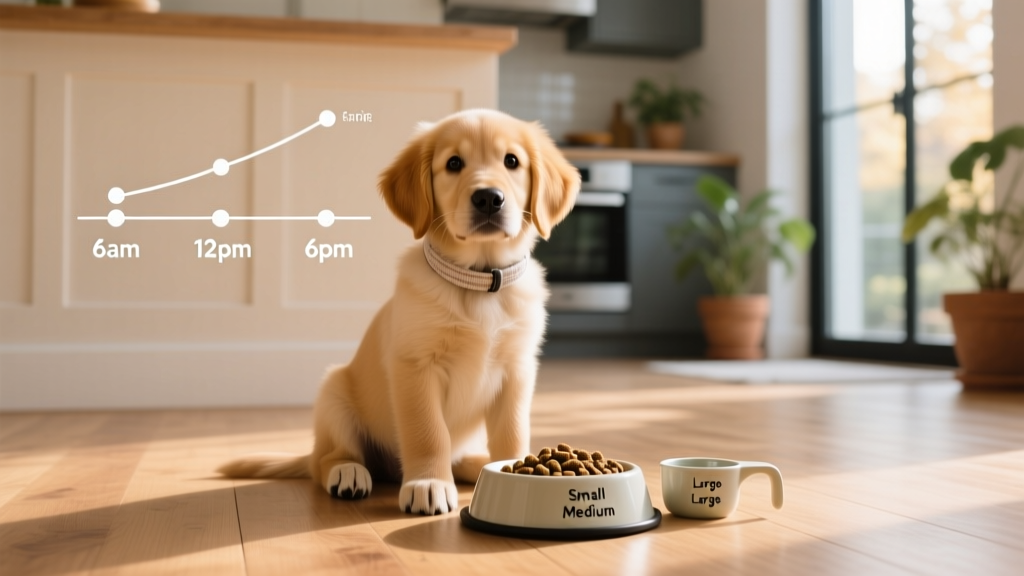
Feeding Schedule: Portions by Age and Weight
Proper nutrition supports healthy development and reduces irritability-driven biting (hungry puppies bite more). The following table provides baseline portions for a puppy expected to reach 30–50 lb at maturity. Adjust based on your puppy's body condition score (BCS) — you should feel ribs without seeing them, and observe a visible waist from above.
| Age | Meals Per Day | Daily Portion (Dry Kibble, Cups) | Notes |
|---|---|---|---|
| 8–12 weeks | 4 | 1.0–1.5 cups total (0.25–0.375 per meal) | Soak kibble in warm water for first 1–2 weeks if transitioning from breeder food |
| 12–16 weeks | 3 | 1.5–2.0 cups total (0.5–0.67 per meal) | Begin phasing out kibble soaking; introduce puzzle feeders for mental stimulation |
| 16–24 weeks | 3 | 2.0–2.75 cups total (0.67–0.92 per meal) | Monitor BCS weekly; adjust portions if ribs become visible or waist disappears |
| 6–9 months | 2 | 2.5–3.5 cups total (1.25–1.75 per meal) | Transition to 2 meals/day gradually over one week |
| 9–12 months | 2 | 2.5–3.5 cups total (1.25–1.75 per meal) | Begin transition to adult formula food around 10–12 months for medium breeds |
These are baseline figures. Your specific food's caloric density (check the guaranteed analysis on the bag) and your puppy's activity level will shift these numbers. Large and giant breeds (expected adult weight over 70 lb) require large-breed puppy formulas to control growth rate and reduce orthopedic disease risk.
Vaccination Schedule and Outdoor Safety
One of the most common questions new owners ask: "When can my puppy go outside and meet other dogs?" The answer balances disease risk against the critical socialization window.
| Age | Vaccine | What It Protects Against | Cost Range (2026) |
|---|---|---|---|
| 6–8 weeks | DHPP (Distemper, Hepatitis, Parainfluenza, Parvovirus) — 1st dose | Core viral diseases; parvovirus is fatal in ~80% of untreated puppies | $25–$50 |
| 10–12 weeks | DHPP — 2nd dose; Bordetella (optional based on lifestyle) | Booster for core immunity; kennel cough protection for social puppies | $30–$60 |
| 14–16 weeks | DHPP — 3rd dose; Rabies (required by law in most US states) | Final core booster; rabies is 100% fatal once symptomatic | $35–$75 |
| 12–16 months | DHPP booster; Rabies booster (1-year or 3-year depending on local law) | Maintenance immunity | $40–$85 |
The American Veterinary Medical Association notes that maternal antibodies can interfere with early vaccines, which is why the series extends to 16 weeks. Until your puppy has received at least the second DHPP dose (around 12 weeks), avoid high-risk areas like dog parks, pet store floors, and any surface where unknown dogs have eliminated.
However, the socialization window closes around 14–16 weeks. You can safely socialize during this period by:
- Carrying your puppy to outdoor environments (parks, outdoor cafés, busy sidewalks)
- Arranging playdates with fully vaccinated, temperament-tested adult dogs in private yards
- Attending puppy socialization classes that require proof of first vaccination and disinfect floors between sessions
- Exposing your puppy to surfaces, sounds, and sights without ground contact
Socialization Window Checklist (Weeks 3–14)
The primary socialization period — when puppies form lasting positive or negative associations with novel stimuli — runs from approximately 3 to 14 weeks. After 14 weeks, unfamiliar things trigger fear rather than curiosity by default. Here's your exposure checklist:
Pair every novel experience with high-value treats (boiled chicken, cheese, commercial training treats like Zuke's Mini Naturals). If your puppy shows fear, increase distance from the stimulus and reduce intensity — never force exposure, as this creates lasting negative associations.
Potty Training Timeline and Troubleshooting
Realistic expectation: most puppies achieve reliable house training between 4 and 6 months of age, though some toy breeds and high-energy working breeds take 8–12 months for full bladder control. "Trained in 3 days" programs create temporary suppression, not lasting habit formation.
Age-Based Bladder Capacity
A general guideline: puppies can hold their bladder for approximately one hour per month of age, plus one. A 3-month-old puppy can manage roughly 4 hours overnight but needs elimination breaks every 1–2 hours during active daytime hours.
| Time | Activity | Elimination? | Location | Reward Given |
|---|---|---|---|---|
| 6:30 AM | Wake up → immediate carry outside | Yes/No | Designated spot | Yes — treat + verbal praise |
| 7:00 AM | After breakfast (15–20 min post-meal) | Yes/No | Designated spot | Yes |
| 8:30 AM | After play session | Yes/No | Designated spot | Yes |
| 10:00 AM | After nap | Yes/No | Designated spot | Yes |
| 12:00 PM | After lunch | Yes/No | Designated spot | Yes |
Key troubleshooting scenarios:
- Accidents indoors: Never punish — your puppy cannot connect punishment with an action that happened minutes ago. Clean with enzymatic cleaner (Nature's Miracle or Rocco & Roxie) to eliminate scent markers. Increase supervision frequency.
- Submissive/excitement urination: Common in puppies under 6 months. Greet calmly, avoid leaning over the puppy, take outside immediately upon arriving home. This resolves with maturity and bladder muscle development.
- Refusing to eliminate outside: Stand still in one spot for up to 5 minutes. Use a consistent cue word ("go potty") the moment elimination begins. Reward immediately after completion, not after coming back inside.
Crate Training Progression and Time Limits
A crate provides a safe den, aids potty training (dogs avoid soiling their sleeping area), and prevents destructive chewing when unsupervised. But crating too long causes distress, whining, and setbacks.
Maximum crate durations by age:
- 8–10 weeks: 30–60 minutes during the day; 2–3 hours overnight (set an alarm for one potty break)
- 10–14 weeks: 1–2 hours during the day; 4–5 hours overnight
- 14–16 weeks: 2–3 hours during the day; 5–6 hours overnight
- 4–6 months: 3–4 hours during the day; 6–8 hours overnight
- 6+ months: 4–5 hours maximum during the day; 8 hours overnight (with evening potty break)
No dog of any age should be crated for more than 8 hours total in a 24-hour period without a break. Puppies who vocalize in the crate need a protocol check: Is the crate the right size (large enough to stand, turn, and lie down, but not so large they can eliminate in one corner)? Have they been exercised and mentally stimulated before crating? Have you fed them a meal 2 hours before crating to allow elimination? Address these before assuming separation anxiety.
First-Year Cost Breakdown
Budgeting realistically prevents surrender — the number one reason dogs enter shelters is owner financial unpreparedness. Here's what to expect for a medium-breed puppy (30–50 lb adult weight) in 2026:
| Category | Items | Estimated Cost Range |
|---|---|---|
| Veterinary (Preventive) | Vaccine series (3 visits), deworming (2–3 rounds), heartworm test, fecal exams, spay/neuter | $500–$1,200 |
| Food | Puppy formula kibble (12 months), treats for training | $400–$800 |
| Supplies | Crate, bed, leash/harness, bowls, chew toys, puzzle feeders, enzymatic cleaner, grooming tools | $250–$600 |
| Training | Puppy socialization class (6–8 weeks), basic manners class (6–8 weeks), optional private sessions | $200–$800 |
| Preventive Medications | Heartworm prevention (monthly), flea/tick prevention (monthly) | $200–$500 |
| Emergency Fund | Reserved for unexpected illness, injury, or foreign body ingestion | $500–$2,000+ (set aside) |
Total first-year estimate: $1,550–$5,900+, depending on your location, veterinary clinic pricing, and whether emergencies arise. Pet insurance (typically $30–$70/month for puppies) can offset emergency costs significantly — enroll before pre-existing conditions develop.
Frequently Asked Questions
How long does puppy biting last?
Most puppies show significant reduction in mouthing by 5–6 months as adult teeth fully erupt and impulse control improves. With consistent redirection training, noticeable improvement appears within 2–4 weeks of starting a protocol. Complete cessation typically occurs by 7–9 months, though adolescent regression (brief return of nipping during excitement) can happen around 8–10 months.
Should I yelp when my puppy bites me?
The "yelp like a littermate" technique works for some puppies but backfires with high-arousal or high-prey-drive breeds, who interpret the sound as exciting prey squealing. A more universally effective approach is the freeze-and-disengage method described above. If yelping causes your puppy to bite harder or become more excited, stop using it immediately.
My puppy bites my children — is this aggression?
Puppy nipping at children is almost always play behavior, not aggression. However, it requires management: never leave puppies unsupervised with children under 10, teach children to freeze (not run or scream) when mouthed, and redirect the puppy to a toy. If biting is accompanied by stiffening, growling over resources, or snapping without play context, consult a veterinary behaviorist promptly.
When can my puppy go to the dog park?
Wait until at least one week after the final DHPP vaccine (typically given at 14–16 weeks), meaning around 16–17 weeks minimum. Even then, dog parks carry risk — unvaccinated dogs, disease-carrying wildlife feces, and rough play from adult dogs can harm young puppies. Controlled playdates with known, vaccinated dogs are safer for puppies under 6 months.
How often should I feed my 10-week-old puppy?
At 10 weeks, feed 4 meals per day, spaced approximately 4–5 hours apart during waking hours (e.g., 7 AM, 11 AM, 3 PM, 7 PM). Consistent meal timing aids potty training predictability, as puppies typically need to eliminate 15–30 minutes after eating.
What vaccines does my puppy need and when?
The core vaccine series consists of DHPP (protecting against distemper, hepatitis, parainfluenza, and parvovirus) given at 6–8 weeks, 10–12 weeks, and 14–16 weeks. Rabies vaccination is legally required in most US states and is given at 12–16 weeks. Lifestyle-dependent vaccines your veterinarian may recommend include Bordetella (kennel cough), Leptospirosis, and Lyme disease, depending on your geographic area and your puppy's exposure risk.
Managing puppy biting is a marathon, not a sprint. The key is consistency across every family member — if one person allows mouthing and another punishes it, your puppy receives conflicting information and the behavior persists longer. Stick to the redirection protocol, provide abundant appropriate chew outlets during the teething window, and remember: this phase ends. The bite inhibition your puppy learns now protects people, other animals, and even your puppy (a dog with good bite inhibition who bites under extreme stress inflicts far less damage than one who never learned jaw control).
Jonas Cole
All our authors care for dogs every day — read more of their work on the authors page.