Puppy Separation Anxiety: A Breed-Specific Prevention & Training Guide
Prevent and manage puppy separation anxiety with age-specific milestones, crate training timelines, socialization checklists, and breed-aware strategies for 2026.

Understanding Puppy Separation Anxiety Before It Starts
Separation anxiety in puppies isn't just "missing you" — it's a genuine distress response where a dog panics when left alone, manifesting as destructive chewing, excessive vocalization, inappropriate elimination, escape attempts, and sometimes self-injury. According to the Merck Veterinary Manual, separation-related behaviors affect an estimated 20–40% of dogs, and the roots often trace back to how independence was (or wasn't) built during puppyhood.
Some breeds are genetically predisposed to forming intense attachment bonds — Labrador Retrievers, German Shepherds, Australian Shepherds, Vizslas, Weimaraners, and many toy breeds top the list. If you're bringing home a breed known for velcro-dog tendencies, your prevention strategy needs to start on day one.
This guide walks you through every developmental stage from weeks 4 through 12 months, giving you concrete expectations, feeding protocols, vaccination timelines, and — most critically — a structured independence-building framework that prevents separation anxiety before it takes root.
When Should I Bring My Puppy Home?
The ideal age to bring a puppy home is 8 to 10 weeks. Here's why the timing matters specifically for separation anxiety prevention:
- Weeks 3–6 (with breeder): The socialization window opens. Puppies learn bite inhibition, canine communication, and resilience through littermate play. Removing a puppy during this window eliminates critical peer-learning that builds emotional stability.
- Weeks 6–8 (with breeder): Puppies begin forming individual attachments and learning that brief separations from the mother are survivable. A good breeder starts short alone-time sessions during this period.
- Weeks 8–10 (transition to you): The puppy has enough neurological development to handle a new environment but is still within the prime socialization window (which closes around 14–16 weeks). This gives you 4–6 weeks of critical influence.
- After 12 weeks: Missed socialization opportunities become harder to remediate. Puppies from pet stores or situations where they had little environmental variety may already show fear-based responses to being alone.
Age-Specific Milestones: What to Expect Week by Week
Every developmental window carries specific independence-building opportunities. Missing these windows doesn't mean failure — but it does mean more remedial work later.
Weeks 4–8 (With Breeder)
You likely won't witness this stage directly, but a responsible breeder should be doing the following:
- Introducing novel surfaces (tarps, wobble boards, different flooring) by week 5
- Short crate exposure sessions (2–5 minutes) starting week 6
- Individual handling sessions away from littermates (5–10 minutes daily by week 7)
- Introduction to varied sounds — vacuum cleaners, doorbells, recorded thunderstorms at low volume
- First deworming and initial veterinary exam
Separation anxiety checkpoint: Ask your breeder specifically: "Have the puppies spent time alone, away from littermates, even briefly?" If the answer is no, you'll need to compensate heavily in weeks 8–12.
Weeks 8–12 (The Bonding & Foundation Window)
This is your most influential period. Your puppy is forming core expectations about whether the world is safe and whether being alone is tolerable.
- Week 8: Puppy is bonding intensely to you. Sleep disruptions, crying in the crate, and clingy following behavior are completely normal. This is NOT separation anxiety yet — it's transitional stress.
- Week 9: Begin structured alone-time training (see crate progression below). Puppy should tolerate 10–15 minutes alone in a confined space without panicking.
- Week 10: Fear impact period often hits around this time. A previously confident puppy may suddenly startle at familiar objects. Don't force independence during acute fear phases — shorten alone sessions and rebuild.
- Weeks 11–12: Puppy should be comfortable with 30-minute alone sessions, can begin short departures from the house (5–10 minutes), and should show recovery (self-settling) within 2–3 minutes of initial distress.
Weeks 12–16 (Building Duration & Confidence)
- Alone-time tolerance should extend to 45–60 minutes
- Puppy can handle being in a different room from you for 15–20 minutes without vocalizing
- Start practicing "boring departures" — leaving and returning without ceremony, no excited hellos or sad goodbyes
- Enroll in a positive-reinforcement puppy class for structured socialization outside the home
- Second fear impact period may occur around 14–16 weeks
Weeks 16–24 (Adolescent Testing Phase)
- Alone-time tolerance: 1–2 hours comfortably, building toward 3–4 hours
- Teething peaks (see teething section below) — destructive chewing may escalate and mimic separation anxiety symptoms
- Adolescent regression: previously settled puppies may suddenly protest being alone again. This is hormonal and developmental, not a training failure
- Spay/neuter typically occurs during this window — post-surgery confinement can trigger or worsen separation distress if not managed with enrichment
Months 6–12 (Social Maturity)
- Most puppies can handle 4–6 hours alone by 8–9 months if independence training was consistent
- Breed-specific maturity varies: giant breeds (Great Danes, Mastiffs) may not reach emotional maturity until 18–24 months; toy breeds often mature faster emotionally but may have breed-tendency attachment issues
- If separation anxiety hasn't surfaced by 12 months with consistent training, your prevention protocol worked
Feeding Schedule: Exact Portions by Age and Weight
Consistent feeding routines reduce overall anxiety by creating predictable structure. An anxious puppy with an unpredictable feeding schedule has two stressors instead of one. Portions below assume a high-quality AAFCO-approved puppy kibble (approximately 350–400 kcal/cup). Adjust based on your specific food's caloric density and your puppy's body condition score.
| Puppy Age | Meals/Day | Small Breed (10–25 lb adult) | Medium Breed (25–50 lb adult) | Large Breed (50–90 lb adult) | Giant Breed (90+ lb adult) |
|---|---|---|---|---|---|
| 8–12 weeks | 4 | ¼–⅓ cup/meal | ⅓–½ cup/meal | ½–¾ cup/meal | ¾–1 cup/meal |
| 12–16 weeks | 3 | ⅓–½ cup/meal | ½–¾ cup/meal | ¾–1¼ cups/meal | 1–1½ cups/meal |
| 4–6 months | 3 | ½–¾ cup/meal | ¾–1 cup/meal | 1–1¾ cups/meal | 1½–2½ cups/meal |
| 6–9 months | 2 | ¾–1 cup/meal | 1–1½ cups/meal | 1½–2½ cups/meal | 2½–4 cups/meal |
| 9–12 months | 2 | Transition to adult food | 1–2 cups/meal | 2–3 cups/meal | 3–5 cups/meal |
Separation anxiety feeding tip: Use your puppy's meals strategically. Feed breakfast in a food puzzle toy (like a Kong Wobbler or Outward Hound Fun Feeder) 20 minutes before a planned alone session. Food-engaged puppies associate your departure with a positive activity rather than panic. For high-anxiety breeds, frozen Kong toys stuffed with kibble soaked in low-sodium chicken broth can occupy a puppy for 20–40 minutes — often long enough for them to fall asleep before realizing you're gone.
Vaccination Schedule: What Your Puppy Needs and When
Vaccination timing directly impacts your socialization and alone-time training plan because it determines when your puppy can safely access public spaces. The AKC recommends the following core protocol:
| Age | Vaccines | Notes |
|---|---|---|
| 6–8 weeks | DHPP (Distemper, Hepatitis, Parainfluenza, Parvovirus) | Often given by breeder; first in the series |
| 10–12 weeks | DHPP booster + Bordetella (optional) | Second DHPP; Bordetella recommended if attending puppy classes |
| 14–16 weeks | DHPP final booster + Rabies | Rabies required by law in most US states; DHPP series complete |
| 12–16 weeks | Leptospirosis, Lyme, Influenza (risk-based) | Discuss with your vet based on regional prevalence and lifestyle |
Critical timing note: Your puppy is NOT fully protected until 7–10 days after the final DHPP booster at 14–16 weeks. This means your primary socialization window (weeks 8–14) overlaps with incomplete immunity. The AVMA and American Veterinary Society of Animal Behavior (AVSAB) both recommend that the risk of behavioral problems from insufficient socialization outweighs the disease risk — carry your puppy in public spaces, use a stroller or sling, and arrange playdates with known-vaccinated dogs rather than waiting until 16 weeks to begin socialization.
When Can My Puppy Go Outside and Meet Other Dogs?
This question sits at the intersection of disease prevention and separation anxiety prevention, because a well-socialized puppy is a more confident, less anxious puppy.
- Immediately (8+ weeks): Carry your puppy in a sling or carrier to public spaces — outdoor cafés, parks (on a blanket, not on grass where unknown dogs have eliminated), busy sidewalks. Exposure to sights, sounds, and people without ground contact.
- After 10–12 week vaccine (12+ weeks): Supervised playdates in private yards with fully vaccinated, healthy dogs. Puppy kindergarten classes that require proof of vaccination are generally safe — the AVSAB specifically endorses structured puppy classes starting at 7–8 weeks with at least one prior vaccination.
- After 16-week final vaccine + 7 days: Full access to public parks, trails, dog-friendly stores, and dog parks (though dog parks carry behavioral risks — structured playgroups are preferable for puppies).
Socialization Window: The Critical Weeks 3–14 Exposure Checklist
The primary socialization window closes between 12–14 weeks (some sources extend to 16 weeks, but sensitivity increases markedly after 12). During this window, puppies need positive, non-traumatic exposure to the stimuli they'll encounter throughout life. A puppy who hasn't experienced being alone in varied environments during this window is at significantly higher risk for separation anxiety.
- ☐ At least 100 different people (varying age, ethnicity, clothing, hats, glasses, mobility aids)
- ☐ 10+ different floor surfaces (grass, gravel, tile, metal grates, wet surfaces)
- ☐ Car rides (minimum 5 trips to pleasant destinations, not just the vet)
- ☐ 5+ different environments where puppy practices being calm alone (a friend's house, a pet-friendly store, a park bench)
- ☐ Household sounds: vacuum, blender, hair dryer, doorbell, TV at varying volumes
- ☐ Handling exercises: paw touching, ear inspection, mouth opening, nail clipping simulation
- ☐ At least 3–5 positive interactions with vaccinated, puppy-friendly adult dogs
- ☐ Exposure to children (supervised, with children coached on gentle interaction)
- ☐ Alone-time practice in at least 3 different physical locations
- ☐ Introduction to a crate, exercise pen, and baby gate confinement as positive spaces
Crate Training Progression: Building Alone-Time Tolerance
The crate is your single most important tool for preventing puppy separation anxiety — but only if introduced correctly. A puppy who views the crate as a safe den will self-settle when alone. A puppy who views it as punishment will escalate distress behaviors every time you leave.
Time Limits by Age
| Puppy Age | Max Crate Time (awake) | Overnight | Method |
|---|---|---|---|
| 8–10 weeks | 30–60 minutes | 3–4 hours (set alarm for potty break) | Crate in your bedroom; door open when you're present |
| 10–12 weeks | 1–2 hours | 4–5 hours | Begin moving crate to transitional space; practice short absences |
| 12–16 weeks | 2–3 hours | 5–6 hours | Crate in living area; departures from the house (5–30 min) |
| 4–6 months | 3–4 hours | 6–8 hours | Full departures; puppy cam recommended to monitor stress levels |
| 6–9 months | 4–5 hours | 7–8 hours | Transition to exercise pen or puppy-proofed room if crate-trained |
| 9–12 months | 5–6 hours max | Open or crated (dog's choice) | Dog should not regularly exceed 6 hours confined without a break |
Step-by-Step Crate Introduction (Weeks 8–10)
- Days 1–3: Crate door open. Meals fed inside the crate. High-value treats (freeze-dried liver, small cheese pieces) tossed inside for puppy to retrieve. No closing the door.
- Days 4–7: Close door during meals. Open immediately when puppy finishes. If puppy protests, wait for 3 seconds of silence before opening (you're teaching that quiet opens the door, not barking).
- Week 2: Close door after meals for 2–5 minutes while you sit nearby. Gradually increase to 10 minutes. Give a stuffed Kong when closing.
- Week 3: Close door, step 3 feet away for 5 minutes. Return before puppy becomes distressed. Gradually increase distance and duration.
- Week 4: Close door, leave the room for 5–10 minutes. Return calmly. No fanfare. Begin leaving the house for 2–5 minutes.
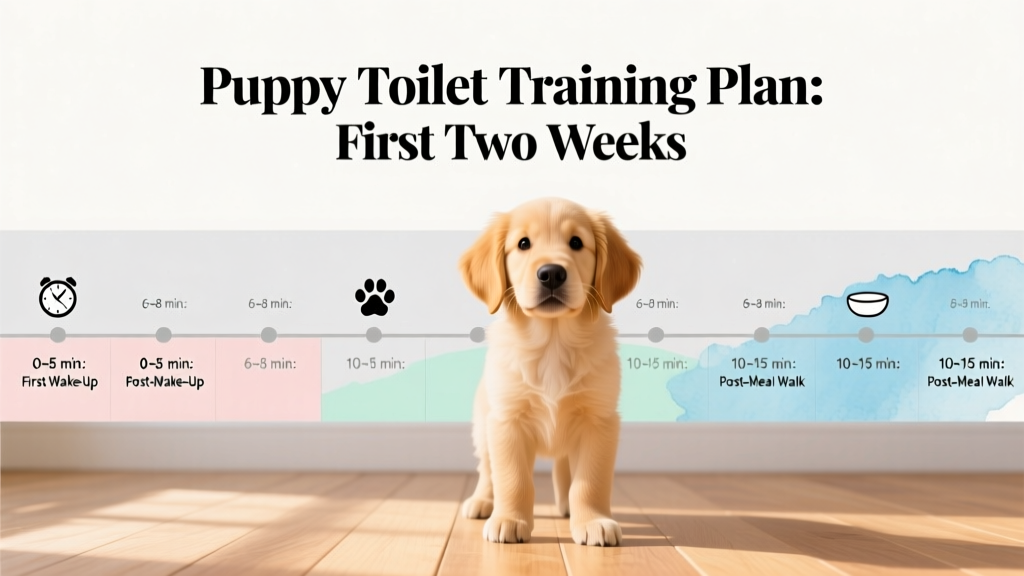
Potty Training Timeline: Realistic Expectations
Potty training progress directly affects your confidence in leaving your puppy alone — and a puppy who soils the crate develops negative crate associations that fuel separation anxiety. Here's a realistic timeline based on bladder capacity and neurological development:
| Age | Bladder Hold Time (approx.) | Accidents Expected | Milestone |
|---|---|---|---|
| 8–10 weeks | 1–2 hours | Multiple daily | Learning the concept of "outside = potty" |
| 10–14 weeks | 2–3 hours | 1–2 per day | Beginning to signal (go to door, whine) |
| 4–5 months | 3–4 hours | Occasional (1–2 per week) | Reliable with scheduled outings |
| 6–8 months | 5–6 hours | Rare (stress or schedule disruption) | Considered "house trained" by most standards |
| 9–12 months | 6–8 hours | Very rare | Fully reliable in most environments |
Rule of thumb: A puppy can hold their bladder for approximately their age in months plus one hour (a 3-month-old puppy = ~4 hours maximum). This is a ceiling, not a target — take your puppy out far more frequently than their maximum capacity.
Troubleshooting regression: If a previously reliable puppy starts having accidents, rule out medical causes first (urinary tract infection is common in puppies — your vet will run a urinalysis, typically $35–$65). If medical causes are ruled out, regression often coincides with developmental leaps, household changes, or increased alone-time duration. Return to a more frequent potty schedule for 1–2 weeks and rebuild.
Teething Timeline: Months 3–6 Relief Strategies
Teething is one of the most commonly misidentified causes of "separation anxiety" — a teething puppy left alone will chew destructively, and owners often interpret this as anxiety rather than developmental need. Understanding the timeline helps you respond correctly.
- 3–4 months: Deciduous (baby) teeth begin loosening. Puppy chews more frequently. You may find tiny teeth on the floor.
- 4–5 months: Peak discomfort. Adult incisors and canines erupting. Bleeding gums are normal. Chewing intensity peaks.
- 5–6 months: Premolars and molars erupting. Most baby teeth should be shed by 6 months. Retained deciduous teeth (common in toy breeds) require veterinary extraction.
- 6–8 months: All 42 adult teeth should be in. If your vet identifies retained baby teeth during spay/neuter anesthesia, request extraction at that time.
Safe Chew Recommendations by Stage
- 8–16 weeks: Kong Classic (puppy rubber, pink/blue), Nylabone Puppy Chew (softer formula), frozen washcloths soaked in water or low-sodium broth
- 4–6 months: Kong Classic (adult red rubber, size-appropriate), Benebone Wishbone (size per weight), bully sticks (supervised only — remove when small enough to swallow)
- 6+ months: Yak cheese chews, Kong Extreme (black rubber for power chewers), West Paw Zogoflex Hurley
Avoid: Rawhide (choking and intestinal blockage risk), antlers and weight-bearing bones from large animals (tooth fracture risk — the AVMA cautions against hard chews that exceed tooth hardness), and any chew small enough to be swallowed whole.
Common Puppy Problems: Biting, Whining, and Chewing Solutions
Puppy Biting and Nipping
Puppy biting peaks between 8–16 weeks and is a normal developmental behavior, not aggression. Puppies explore the world with their mouths and learn bite inhibition through feedback. Here's the force-free protocol:
- Redirect: When teeth touch skin, immediately offer an appropriate chew toy. Praise when puppy mouths the toy instead.
- Withdraw attention: If redirecting doesn't work, stand up, cross your arms, and become boring for 10–15 seconds. Resume interaction when puppy is calm.
- Time-out: For persistent biting, calmly place puppy in their crate or a playpen for 30–60 seconds with a chew toy. This teaches that biting ends play, not that the crate is punishment.
- Ensure adequate exercise: Overtired puppies bite more. An 8–12 week old puppy needs 15–20 minutes of active play followed by 1–2 hours of enforced nap time. Yes, enforced — puppies don't self-regulate sleep well.
Whining and Vocalization
Context determines your response:
- Whining in crate at night (first 1–2 weeks): Likely needs to eliminate. Take puppy out on leash, boring and quiet, return to crate immediately. If puppy just eliminated and is still whining, wait for 30–60 seconds of quiet before any interaction.
- Whining when you leave: This is the separation anxiety signal. If it lasts less than 10–15 minutes and then stops, your puppy is self-settling — this is progress. If it continues for 30+ minutes, shorten your departure duration and rebuild more gradually.
- Demand whining (when you're home): Ignore completely. Reward quiet behavior with attention, treats, or play. Never give in to demand vocalization — you'll create a lifelong pattern.
Destructive Chewing
Management is 90% of the solution for puppies under 6 months:
- Puppy-proof one room completely rather than half-proofing the whole house
- Provide 5–7 appropriate chew options rotated every 2–3 days to maintain novelty
- Use bitter apple spray (Grannick's Bitter Apple, ~$8–12) on furniture legs and baseboards as a deterrent, paired with redirecting to appropriate chews
- Supervise or confine — there is no middle ground for a puppy under 6 months
First-Year Cost Breakdown
Budgeting accurately prevents the financial stress that leads to rehoming — and rehoming is devastating for a dog already prone to separation anxiety. Costs below reflect 2026 US averages and vary by region (urban areas typically 20–40% higher).
| Category | Low Estimate | Mid Estimate | High Estimate | Notes |
|---|---|---|---|---|
| Puppy purchase/adoption | $300 (rescue) | $1,500 (responsible breeder) | $3,500+ (high-demand breed) | Avoid breeders under $800 for purebreds — likely backyard operations |
| Veterinary care (first year) | $400 | $700 | $1,200 | Includes vaccines, spay/neuter, microchip, wellness exams |
| Food (12 months) | $300 | $600 | $1,000 | Varies dramatically by breed size and food quality tier |
| Supplies (initial) | $200 | $400 | $700 | Crate, bed, leash, harness, bowls, gates, toys, grooming tools |
| Training classes | $150 | $400 | $800 | Puppy kindergarten + basic obedience; private sessions cost $80–150/session |
| Pet insurance (annual) | $400 | $600 | $900 | Enroll by 12 weeks to avoid pre-existing condition exclusions |
| Emergency fund reserve | $500 | $500 | $500 | Minimum recommended reserve for unexpected illness or injury |
| Total first year | $2,250 | $4,700 | $8,600+ |
Recognizing True Separation Anxiety vs. Normal Puppy Behavior
Not every puppy who cries when you leave has separation anxiety. Here's how to differentiate:
- Whines or barks for 5–15 minutes when left alone, then settles
- Chews inappropriate items but also uses provided chew toys
- Has an accident if left longer than bladder capacity
- Is excited when you return but recovers quickly
- Eats treats and food puzzles when alone
- Non-stop vocalization for 30+ minutes without settling
- Refuses all food and treats when alone (even high-value items)
- Self-injury: broken teeth, bloody paws from digging at doors/crates
- Excessive drooling (puddles, not just dampness) during alone time
- Elimination in crate despite being recently emptied and within bladder capacity
- Escape behavior: bending crate bars, breaking through barriers
- Destruction focused exclusively on exit points (doors, windows) rather than random items
- Pacing, panting, or trembling that begins before you even leave (during pre-departure cues like picking up keys)
If your puppy shows three or more of the concerning signs, early intervention is critical. A veterinary behaviorist (Diplomate of the American College of Veterinary Behaviorists — DACVB) can assess whether medication (typically fluoxetine or clomipramine, combined with behavior modification) is warranted. In puppies under 6 months, behavior modification alone is usually the first approach, but severe cases may benefit from short-term anti-anxiety medication to allow learning to occur.
Frequently Asked Questions
How often should I feed my puppy at 10 weeks?
At 10 weeks, feed 4 meals per day spaced approximately 4 hours apart (e.g., 7 AM, 11 AM, 3 PM, 7 PM). Total daily portion depends on your puppy's expected adult weight and your food's caloric density — check the feeding chart on your food bag and adjust based on body condition score. You should be able to feel ribs without pressing hard but not see them prominently.
When will my puppy be fully potty trained?
Most puppies are reliably house trained by 6–8 months with consistent scheduling. Small breeds may take longer (8–12 months) due to smaller bladder capacity. If your puppy isn't showing improvement by 5 months despite consistent training, consult your veterinarian to rule out medical causes like ectopic ureters or urinary tract infections.
How do I stop puppy biting and nipping?
Redirect to appropriate chew toys, withdraw attention for 10–15 seconds when teeth touch skin, and ensure your puppy is getting adequate sleep (18–20 hours per day for an 8–12 week old). Biting typically peaks at 12–16 weeks and declines significantly by 5–6 months as adult teeth come in and bite inhibition improves. Never hold a puppy's mouth shut, tap their nose, or use physical punishment — these damage trust and can increase fear-based biting.
My puppy cries every time I leave the room. Is this separation anxiety?
In the first 2–4 weeks home, this is normal transitional behavior. Your puppy has never been without their littermates and mother before. Build alone-time tolerance gradually — start with 30 seconds, then 1 minute, then 5 minutes. If crying persists beyond 4 weeks of consistent training, or if your puppy shows physical signs of panic (excessive drooling, self-injury, non-stop vocalization for 30+ minutes), consult a certified separation anxiety trainer or veterinary behaviorist.
Can I use calming supplements for my anxious puppy?
Products containing L-theanine (like Solliquin or Composure), Adaptil pheromone diffusers, and calming music (Through a Dog's Ear) have some evidence supporting mild anxiety reduction. They're safe for puppies and can be useful as part of a broader training plan — but they won't resolve separation anxiety on their own. Always consult your veterinarian before starting any supplement, especially if your puppy is on other medications.
Should I get a second dog to keep my puppy company?
Not as a separation anxiety treatment. A second dog may create a situation where your puppy is fine when the other dog is present but panics when either you or the other dog leaves. Treating separation anxiety requires building your puppy's confidence in being alone, not providing a permanent companion. If you genuinely want a second dog for your own reasons, wait until your first dog is emotionally mature (18–24 months) and has solid independence skills.
Dr. Hannah Wickes
All our authors care for dogs every day — read more of their work on the authors page.