Puppy Potty Training by Age: A Week-by-Week Timeline That Actually Works
Master puppy potty training with our age-specific timeline, feeding schedules, crate limits, and troubleshooting tips from week 4 through 12 months.

Why Most Puppy Potty Training Plans Fail (And How to Fix Yours)
If you've read three different potty training guides and your puppy is still having accidents on the rug, you're not alone — and you're not doing anything wrong. The problem isn't your consistency. It's that most guides treat "puppy" as a single category when a 9-week-old Labrador and a 5-month-old Border Collie have radically different bladder capacities, attention spans, and learning readiness.
Bladder control develops on a predictable physiological timeline. A puppy can typically hold their bladder for roughly one hour per month of age, plus one — so a 3-month-old puppy maxes out around four hours during the day. Expecting more sets both of you up for failure. This guide maps puppy potty training to developmental milestones so you know exactly what to expect, when to push forward, and when to adjust your strategy.
The Complete Puppy Potty Training Timeline: Week by Week
Here's what realistic potty training progress looks like across every developmental stage. Use this as your benchmark — if your puppy is roughly on track, keep going. If they're significantly behind, jump to the troubleshooting section.
| Age Range | Bladder Capacity | Potty Breaks Needed (Daytime) | Realistic Expectation |
|---|---|---|---|
| 4–8 weeks | 15–30 minutes | Every 30–45 min | No control — breeder's job to maintain clean whelping area |
| 8–12 weeks | 30–60 minutes | Every 1–2 hours + after meals/naps/play | Learning the concept of "outside = potty." Expect 2–5 accidents per week |
| 12–16 weeks | 1–2 hours | Every 2–3 hours | Starting to signal (sniffing, circling, going to door). 1–2 accidents per week is normal |
| 16–24 weeks | 2–4 hours | Every 3–4 hours | Reliably signaling. Occasional accident after excitement or schedule disruption |
| 6–12 months | 4–8 hours | Every 4–6 hours | Fully trained for most breeds. Small breeds may take until 12 months |
When Will My Puppy Be Fully Potty Trained?
Most puppies reach reliable daytime house training between 4 and 6 months of age. However, small and toy breeds (Chihuahuas, Yorkshire Terriers, Pomeranians) often take until 8–12 months due to smaller bladder capacity and higher metabolic rates. Giant breeds (Great Danes, Saint Bernards) may have the bladder capacity earlier but can be slower to mature behaviorally.
"Fully trained" means fewer than one accident per month under normal conditions. If your 7-month-old puppy is still having weekly accidents, review the troubleshooting section below before assuming a medical issue.
Feeding Schedule: How Meal Timing Drives Potty Success
Potty training and feeding are inseparable. A predictable feeding schedule creates a predictable elimination schedule. Free-feeding (leaving food out all day) is the single biggest sabotage to potty training progress because you can't predict when your puppy will need to go.
| Puppy Age | Meals Per Day | Portion Guide (per meal)* | Potty Break After Eating |
|---|---|---|---|
| 8–12 weeks | 4 meals/day | ¼–½ cup (small breed) / ¾–1 cup (large breed) | 5–15 minutes after finishing |
| 12–16 weeks | 3 meals/day | ⅓–¾ cup (small) / 1–1½ cups (large) | 10–20 minutes after finishing |
| 16–24 weeks | 3 meals/day | ½–1 cup (small) / 1½–2 cups (large) | 10–20 minutes after finishing |
| 6–12 months | 2 meals/day | ¾–1½ cups (small) / 2–3½ cups (large) | 15–30 minutes after finishing |
*Portion ranges are approximate for AAFCO-complete dry kibble. Always follow the feeding chart on your specific food brand, adjusted for your puppy's body condition score (BCS). You should be able to feel ribs without pressing hard but not see them prominently. Consult your veterinarian for breed-specific nutritional needs.
Pro tip: Pick up your puppy's water bowl 2 hours before bedtime. For an 11 PM bedtime, remove water at 9 PM. This dramatically reduces overnight accidents without causing dehydration — your puppy will drink enough during the day to compensate.
Crate Training Progression: Time Limits That Protect Potty Training
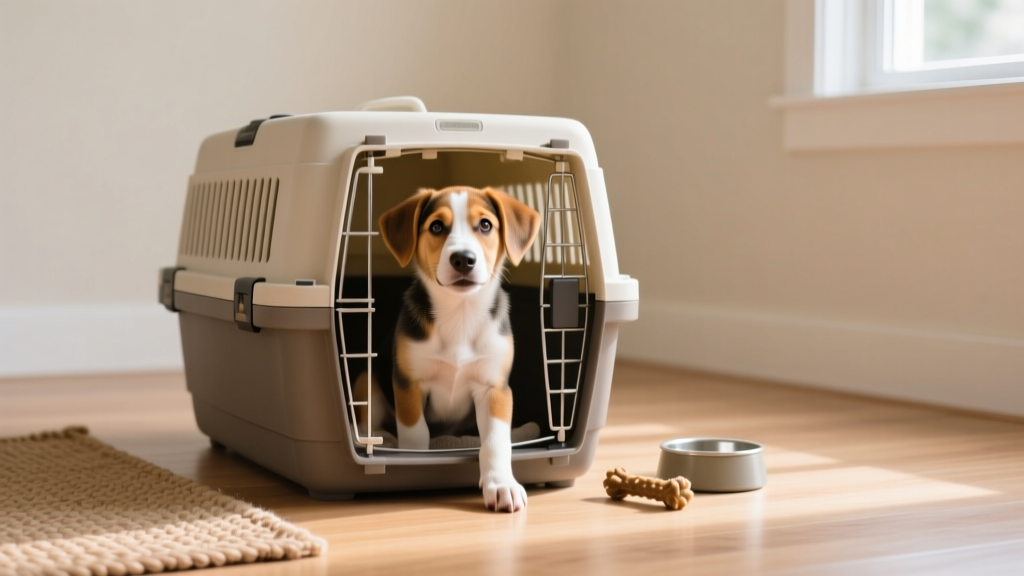
A crate is your most powerful potty training tool — but only if you respect your puppy's physical limits. A puppy forced to soil their crate learns that the crate is a bathroom, which destroys the very instinct you're trying to leverage.
- 8–10 weeks: 1–2 hours max (set overnight alarms)
- 10–12 weeks: 2 hours max (one overnight alarm around 2 AM)
- 12–16 weeks: 3 hours max (may sleep 5–6 hours overnight)
- 16–20 weeks: 4 hours max (most sleep 7–8 hours overnight)
- 20–24 weeks: 5 hours max daytime / 8+ hours overnight
- 6+ months: 6 hours max daytime (never exceed 8 hours for any adult dog)
For overnight crate training, place the crate in your bedroom for the first 4–6 weeks. Your puppy can hear and smell you, which reduces anxiety-driven whining. Set your phone alarm for one overnight potty break (around 1–3 AM) for puppies under 14 weeks. Keep lights low, use a calm voice, carry them outside, reward elimination with a quiet treat, and return immediately to the crate. No play, no conversation.
Socialization Window (Weeks 3–14): The Clock You Can't Rewind
The American Veterinary Society of Animal Behavior (AVSAB) identifies weeks 3–14 as the critical socialization period. After 14 weeks, puppies become increasingly cautious about novel stimuli. This window overlaps directly with your potty training period, which means you're managing two developmental priorities simultaneously.
The key tension: your puppy needs socialization exposure before their vaccination series is complete. The AVSAB's position is clear — the risk of behavioral problems from inadequate socialization outweighs the disease risk when you use controlled environments. Carry your puppy or use a stroller for public outings until 16 weeks. Avoid dog parks and unknown dog feces until fully vaccinated.
Socialization Exposure Checklist
Aim for positive, low-stress exposure to each of these by 14 weeks. "Positive" means your puppy is relaxed or curious — not fearful, cowering, or frozen. If your puppy shows fear, increase distance and pair the stimulus with high-value treats (boiled chicken, cheese).
- ✓ Vacuum cleaner (running, at distance)
- ✓ Thunderstorm sounds (YouTube, low volume)
- ✓ Umbrella opening
- ✓ Hat/sunglasses on you
- ✓ Children (supervised, calm)
- ✓ Elderly person with walker/cane
- ✓ Person in wheelchair
- ✓ Bicycle passing at distance
- ✓ Car rides (short, positive destination)
- ✓ Different floor surfaces (tile, gravel, grass, metal grate)
- ✓ Nail clippers near paws (no clipping yet)
- ✓ Toothbrush in mouth
- ✓ Being handled by stranger (vet tech, groomer simulation)
- ✓ Other vaccinated, friendly adult dogs
- ✓ Cat (if household has one, supervised)
- ✓ Doorbell/knocking sounds
- ✓ Being left alone for 5–15 minutes
- ✓ Different breeds/sizes of dogs (visual exposure counts)
Vaccination Schedule and Outdoor Access Timeline
Your puppy's vaccination timeline directly dictates when they can safely walk on public ground, which affects your potty training location options. Here's the standard schedule recommended by the American Animal Hospital Association (AAHA):
| Age | Vaccines Administered | Safe Outdoor Access Level |
|---|---|---|
| 6–8 weeks | DHPP (Distemper, Hepatitis, Parainfluenza, Parvovirus) — 1st dose; Bordetella (optional, if high-exposure environment) | Private yard only, no unknown dog areas. Carry puppy for socialization outings |
| 10–12 weeks | DHPP — 2nd dose; Leptospirosis (1st, if recommended for your area); Lyme (1st, if tick-endemic region) | Controlled walks on sidewalks. Puppy classes with vaccinated peers OK. Still avoid dog parks |
| 14–16 weeks | DHPP — 3rd (final) dose; Rabies (required by law in most US states); Leptospirosis 2nd; Lyme 2nd (if applicable) | Full outdoor access 7 days after final DHPP. Dog parks, hiking trails, beaches now safe |
When can my puppy go outside and meet other dogs? Your puppy can explore your private yard immediately. For public areas, wait until 7 days after the final DHPP booster (typically around 17 weeks). Puppy socialization classes with proof-of-vaccination requirements are safe from 10 weeks onward — these are one of the best investments you can make.
Teething Timeline (3–6 Months): When Potty Training Regresses
Between 12 and 24 weeks, your puppy loses 28 deciduous (baby) teeth and grows 42 adult teeth. This process causes gum inflammation, discomfort, and a strong urge to chew. Teething is the number one cause of potty training regression in the 3–6 month window because puppies under stress or discomfort lose focus on learned behaviors.
Safe Chew Recommendations by Stage
- 8–12 weeks (early teething prep): Frozen wet washcloth (twisted and soaked in water), Kong Classic Puppy (pink/blue rubber, sized XS or S) stuffed with softened kibble and frozen
- 12–16 weeks (baby teeth loosening): Benebone Puppy (nylon, bacon flavor), frozen carrot sticks, Nylabone Puppy Chew (soft flex material — not the hard adult version)
- 16–24 weeks (peak teething pain): Frozen Kong stuffed with plain yogurt and blueberries, West Paw Zogoflex Toppl, chilled (not frozen) bully sticks — supervise all edible chews
- 24+ weeks (adult teeth settling): Transition to adult-weight chew toys. Introduce antlers only if your dog is not an aggressive chewer (risk of tooth fracture in power chewers)
Stopping Puppy Biting and Nipping: A Positive Reinforcement Protocol
Puppy biting peaks between 6 and 16 weeks. This is normal developmental behavior — puppies explore the world with their mouths, and littermates teach bite inhibition through yelping and disengagement. When you bring a puppy home at 8 weeks, that feedback loop is gone. You become the teacher.
Here's the step-by-step protocol that certified force-free trainers recommend:
- Redirect (Weeks 8–12): When teeth touch skin, say "oops" in a calm tone, withdraw your hand, and immediately offer an appropriate chew toy. Reward enthusiastically when they chew the toy. Do not yank your hand away quickly — fast movement triggers prey drive and makes biting more exciting.
- Time-out (Weeks 12–16): If redirecting fails after two attempts, calmly stand up, turn your back, and leave the room for 10–15 seconds. Return and resume play. This teaches "teeth on skin = fun ends." No scolding, no physical punishment.
- Bite inhibition (Weeks 16–24): By now your puppy should be using a soft mouth during play. If you feel any pressure, implement the time-out. The goal is zero skin contact by 6 months.
- Manage arousal: Puppies bite most when overtired or overstimulated. If biting is intense and relentless, your puppy likely needs a nap, not more training. Enforce a crate nap — most puppies fall asleep within 5 minutes.
Never hold your puppy's mouth shut, tap their nose, use alpha rolls, or shove fingers down their throat. These methods increase fear and can create defensive aggression. The AVSAB's position statement clearly advises against dominance-based techniques.
First-Year Cost Breakdown: What Puppy Ownership Actually Costs
Budgeting accurately prevents the number one reason puppies are surrendered to shelters: unexpected costs. Here's a realistic first-year breakdown for a medium-to-large breed puppy in the US (2026 estimates). Small breeds will be on the lower end; giant breeds on the higher end.
| Category | Low Estimate | High Estimate | Notes |
|---|---|---|---|
| Veterinary (vaccines, spay/neuter, wellness exams) | $500 | $1,200 | Spay/neuter cost varies by clinic and breed size |
| Food (AAFCO-complete puppy formula) | $350 | $800 | Premium brands (Royal Canin, Hill's, Purina Pro Plan) cost more |
| Supplies (crate, bed, leash, bowls, toys, gate) | $250 | $600 | Wire crate ($50–$90), exercise pen ($40–$70) |
| Training (group puppy class + private sessions) | $150 | $600 | 6-week group class: $150–$250. Private: $80–$150/session |
| Preventive medications (heartworm, flea/tick) | $200 | $450 | Simparica Trio, NexGard, or Interceptor Plus range |
| Pet insurance (optional but recommended) | $350 | $700 | Enroll at 8 weeks for lowest premiums and no pre-existing exclusions |
| TOTAL FIRST YEAR | $1,800 | $4,350 | Excludes purchase/adoption fee and emergency care |
Potty Training Troubleshooting: When Things Go Off Track
Even with a perfect plan, setbacks happen. Here are the most common problems and their solutions:
Problem: Puppy pees in crate overnight.
Check: Is the crate too large? Use a divider panel so the crate is only big enough for your puppy to stand, turn, and lie down. A too-large crate lets them designate one corner as a bathroom. Also verify you're not exceeding the time limits listed above, and that the last potty break before bed is within 15 minutes of crating.
Problem: Puppy was trained, then started having accidents again at 5–7 months.
This is almost always one of three things: (1) a urinary tract infection — get a urinalysis from your vet ($50–$120), (2) marking behavior as sexual maturity approaches — schedule spay/neuter if not done, or (3) you relaxed supervision too early. Go back to structured potty breaks for two weeks and rebuild.
Problem: Puppy pees outside but poops inside.
Puppies often need more time and privacy to defecate. They may be distracted outside, or the surface doesn't feel right. Try a longer leash (15–20 feet) to give them space to wander and sniff. Walk a consistent route. Defecation typically happens 15–30 minutes after a meal — time your outings accordingly.
Problem: Puppy squats outside but nothing comes out, then pees inside 5 minutes later.
This is a patience problem, not a training problem. Your puppy hasn't fully emptied their bladder outside. Wait longer — some puppies need 5–10 minutes of sniffing before they go. Use a consistent cue word ("go potty," "do your business") said calmly once, then wait silently. Reward heavily when they finally go.
Frequently Asked Questions
When should I bring my puppy home?
The optimal age is 8 to 10 weeks. Puppies separated before 8 weeks miss critical littermate socialization (bite inhibition, canine communication). Puppies taken after 12 weeks may have a narrower socialization window remaining. If adopting from a rescue that keeps puppies in foster homes until 10–12 weeks, that's acceptable — foster environments provide richer socialization than a kennel.
How often should I feed my puppy at each age?
Feed 4 meals daily from 8–12 weeks, 3 meals from 12–24 weeks, and transition to 2 meals at 6 months. Consistent meal timing is the backbone of predictable potty training — your puppy will typically need to eliminate within 5–30 minutes of eating.
What vaccines does my puppy need and when?
Core vaccines: DHPP at 6–8, 10–12, and 14–16 weeks, plus Rabies at 14–16 weeks. Non-core (based on lifestyle and geography): Bordetella, Leptospirosis, Lyme, and Canine Influenza. Your veterinarian will tailor the protocol to your area's disease prevalence and your puppy's exposure risk.
How do I stop puppy biting and nipping?
Redirect to an appropriate chew toy every time teeth touch skin. If biting continues, implement a 10–15 second time-out by calmly leaving the room. Ensure your puppy gets 16–20 hours of sleep per day (yes, really — overtired puppies bite more). Never use physical punishment.
My puppy pees every 20 minutes — is this normal?
At 8–10 weeks, yes. Every 30–45 minutes is typical. If your 16-week-old puppy is still urinating more than once per hour, consult your veterinarian to rule out a UTI, diabetes, or a congenital kidney issue. Bring a fresh urine sample to the appointment.
Should I use puppy pads?
For most households, no. Puppy pads teach your dog that it's acceptable to eliminate indoors on soft, absorbent surfaces — which can generalize to rugs and bathmats. The exception: apartment dwellers on high floors who cannot get outside quickly, or owners with mobility limitations. If you must use pads, place them on a designated tray and move the tray progressively closer to the door over several weeks.
Robin Maitland
All our authors care for dogs every day — read more of their work on the authors page.