Puppy Long Leash Training: A Complete Breed-Specific Guide for Every Age
Master puppy long leash training with age-specific milestones, socialization checklists, feeding schedules, and potty training timelines from week 4 to 12 months.

Why a Puppy Long Leash Changes Everything in Early Training
If you've ever watched a puppy discover the world on a standard 6-foot leash, you know the frustration: constant pulling, zero recall practice, and a dog who only listens when physically restrained. A puppy long leash — typically 15 to 30 feet of lightweight flat webbing or biothane — gives your developing dog the freedom to explore while you build reliable recall, loose-leash walking, and impulse control during the most critical neurological windows of their life.
Long leash work isn't just about giving your puppy space. It's a structured training tool that bridges the gap between controlled indoor environments and full off-leash reliability. According to the American Kennel Club, puppies who practice recall and loose-leash skills on long lines during their first six months develop significantly stronger handler focus than those trained exclusively on short leads.
This guide walks you through every developmental stage from week 4 through month 12, with exact feeding portions, vaccination timing, socialization checklists, and long leash integration points so you know precisely what to do and when.
When Should You Bring Your Puppy Home?
The American Veterinary Medical Association and most veterinary behaviorists agree: 8 weeks is the earliest responsible age to bring a puppy home, with 8-10 weeks being ideal for most breeds. Puppies removed from their litter before 7 weeks show higher rates of separation anxiety, resource guarding, and bite inhibition problems throughout life.
Weeks 4-8 with the breeder or foster are non-negotiable for development:
- Weeks 4-5: Puppies begin weaning, learn early bite inhibition from littermates, and start exploring solid food textures.
- Weeks 5-6: Social hierarchy play emerges. Puppies learn to read canine body language and develop basic emotional regulation.
- Weeks 6-7: First deworming and initial DHPP vaccine typically administered by the breeder's vet.
- Weeks 7-8: Fear imprint period begins. Negative experiences during this window can create lasting phobias. This is why the transition environment matters enormously.
Age-Specific Milestones: Week 4 Through Month 12
Every developmental window has specific neurological and behavioral benchmarks. Here's what to expect — and where your puppy long leash fits into each phase.
| Age Range | Key Milestones | Long Leash Use | What to Expect |
|---|---|---|---|
| Weeks 4-8 (with breeder) |
Weaning, littermate socialization, first vaccine, fear imprint period begins | Not applicable — puppy is with breeder/foster | Puppy learning bite inhibition from siblings, beginning solid food, first veterinary visit |
| Weeks 8-12 (home transition) |
Bonding, crate introduction, name recognition, potty training begins, second DHPP vaccine | 10-15 ft leash, indoor/yard only. Drag-line for recall games. 5-minute max sessions. | Frequent accidents, crying in crate, mouthing everything, following you room to room. Sleep needs: 18-20 hours/day. |
| Weeks 12-16 (socialization peak) |
Third DHPP, rabies vaccine (12-16 wk), socialization window closes, basic cues emerging | 15-20 ft leash for outdoor recall practice. Begin name-response drills at distance. 10-minute sessions. | Increased confidence, testing boundaries, first fear period may cause sudden spookiness. Potty accidents decrease. |
| Weeks 16-24 (adolescence begins) |
Teething peaks, spay/neuter window, recall regression common, second fear period (6-8 months) | 20-30 ft leash for park/open area work. Emergency recall training. Proofing "come" around distractions. | "Selective hearing" emerges. Puppy may ignore previously reliable cues. Chewing intensifies. Energy spikes. |
| Months 6-12 (late adolescence) |
Adult teeth fully in, sexual maturity, growth plates closing (varies by breed size), impulse control developing | 30 ft leash for off-leash preparation. Distance stays, recall under heavy distraction. Transition to off-leash in safe areas if reliable. | Behavior may seem to regress. Consistency pays off. Most dogs reach emotional maturity between 12-24 months depending on breed size. |
Feeding Schedule: Exact Portions by Age and Weight
Overfeeding puppies accelerates growth rate, which directly increases the risk of developmental orthopedic diseases like hip dysplasia and osteochondritis dissecans (OCD), particularly in large and giant breeds. The Merck Veterinary Manual recommends feeding to maintain a lean body condition score (BCS 4/9) rather than allowing "all-you-can-eat" access.
Below is a feeding framework based on projected adult weight. Always check your specific food's feeding chart, as caloric density varies significantly between brands (typically 300-450 kcal/cup for puppy formulas).
| Age | Meals/Day | Small Breed (under 20 lb adult) |
Medium Breed (20-50 lb adult) |
Large Breed (50-100 lb adult) |
|---|---|---|---|---|
| 8-12 weeks | 4 meals | ¼-½ cup/meal | ½-¾ cup/meal | ¾-1 cup/meal |
| 3-6 months | 3 meals | ⅓-½ cup/meal | ¾-1 cup/meal | 1-1½ cups/meal |
| 6-12 months | 2 meals | ½-¾ cup/meal | 1-1½ cups/meal | 1½-2½ cups/meal |
Potty Training Timeline: Realistic Expectations and Troubleshooting
Here's the honest truth that most puppy guides skip: most puppies are not fully potty trained until 4-6 months of age, and some small breeds take up to 8-9 months due to smaller bladder capacity. Any guide promising "potty trained in 3 days" is setting you up for frustration.
Bladder control develops roughly as: age in months + 1 = hours they can hold it (maximum, during the day). A 3-month-old puppy can hold for approximately 4 hours maximum, but should be taken out far more frequently to prevent accidents.
Potty Training Schedule by Age
- 8-10 weeks: Take outside every 1-2 hours, plus immediately after waking, eating, drinking, and playing. Expect 1-2 accidents per day even with perfect management.
- 10-14 weeks: Every 2-3 hours during the day. One overnight trip may still be needed. Accidents should decrease to 2-3 per week.
- 3-4 months: Every 3-4 hours. Most puppies can sleep 6-7 hours overnight without a break. Accidents should be rare (1-2 per week at most).
- 4-6 months: Every 4-5 hours. Full overnight sleep (8 hours). Occasional accidents still normal, especially after exciting events or schedule changes.
- 6+ months: Reliable bladder control for most breeds. If accidents persist beyond 6 months, consult your veterinarian to rule out urinary tract infection or anatomical issues.
Common Potty Training Problems and Fixes
Problem: Puppy pees inside 5 minutes after coming back in from outside.
Cause: Puppy was distracted outdoors and didn't fully empty bladder. Fix: Stay outside longer (10-15 minutes), use a consistent "go potty" cue, reward immediately after elimination with a high-value treat.
Problem: Puppy only pees on pee pads, won't go outside.
Cause: Surface preference developed. Fix: Gradually move pad closer to door over several days, then place pad outside on grass, then remove pad. This is called surface transitioning.
Problem: Puppy has accidents only when left alone.
Cause: Separation anxiety or insufficient crate training. Fix: Build alone-time tolerance gradually (start with 5 minutes, increase by 5-minute increments). Consult a certified behaviorist if anxiety escalates.
Vaccination Schedule: What Your Puppy Needs and When
Vaccination timing isn't arbitrary — it's calibrated to the window when maternal antibodies (received through colostrum) decline enough for the puppy's own immune system to respond, but before the puppy becomes vulnerable to disease. This window varies between individual puppies, which is why a series of boosters is required.
| Age | Vaccine | What It Protects Against | Typical Cost |
|---|---|---|---|
| 6-8 weeks | DHPP (1st dose) | Distemper, Hepatitis (Adenovirus-2), Parainfluenza, Parvovirus | $25-$40 |
| 10-12 weeks | DHPP (2nd dose), Bordetella (optional) | Same core diseases + kennel cough (if Bordetella given) | $30-$50 |
| 14-16 weeks | DHPP (3rd dose), Rabies (12-16 wk) | Core diseases + rabies (legally required in all US states) | $40-$65 |
| 12-16 months | DHPP booster, Rabies booster | Immunity reinforcement | $45-$75 |
Non-core vaccines your vet may recommend based on lifestyle: Leptospirosis (urban/water exposure), Lyme disease (tick-endemic areas), Canine Influenza (boarding/daycare dogs). Discuss these at your 10-12 week visit.
Socialization Window (Weeks 3-14): Your Puppy Long Leash Is Key
The primary socialization period — weeks 3 through approximately 14 — is the single most important developmental window in your dog's life. Research published in the Journal of Veterinary Behavior has consistently shown that puppies with inadequate socialization during this period are significantly more likely to develop fear-based aggression, separation anxiety, and noise phobias later in life.
Your puppy long leash is essential here: it allows controlled exposure to novel stimuli at a distance where your puppy remains under their fear threshold. If a puppy is overwhelmed (over threshold), the experience creates a negative imprint rather than building confidence.
Socialization Exposure Checklist
Aim for positive, low-pressure exposure to each category. "Positive" means your puppy is curious or neutral — not fearful, not overly aroused. Use your long leash to let them approach at their own pace.
- Surfaces: Grass, gravel, metal grates, wet pavement, sand, mulch, carpet, tile, wood flooring
- Sounds: Vacuum cleaner, doorbell, thunder (play recordings at low volume), traffic, children shouting, construction noise, fireworks recordings
- People: Tall people, people in hats, people with canes/wheelchairs, children (supervised), people wearing sunglasses, delivery workers, people of different ethnicities
- Animals: Vaccinated adult dogs (calm, well-socialized), cats (controlled introduction), livestock if rural
- Objects: Umbrellas opening, plastic bags rustling, bicycles, skateboards, strollers, shopping carts
- Environments: Car rides, pet store visits (after 2nd vaccine), outdoor café patios, parking lots, school playgrounds (from a distance)
- Handling: Paw touching, ear examination, mouth opening, nail clipping simulation, being held gently, towel drying
When Can My Puppy Go Outside and Meet Other Dogs?
This is where veterinary advice has evolved. The old recommendation — "keep puppy inside until all vaccines are complete at 16 weeks" — is now considered harmful because it closes the socialization window. The AVMA's position statement on puppy socialization supports controlled exposure after the first DHPP vaccine (6-8 weeks), with these precautions:
- After 1st DHPP (6-8 weeks): Carry puppy in arms or use a stroller for outdoor exposure. Avoid ground contact in high-traffic dog areas. Meet known, vaccinated adult dogs in private yards.
- After 2nd DHPP (10-12 weeks): Short leash walks in low-traffic residential areas. Puppy classes (all attendees vaccinated). Avoid dog parks entirely.
- After 3rd DHPP + Rabies (14-16 weeks): Broader outdoor access. Still avoid dog parks until 6+ months and full vaccination series. Your puppy long leash is ideal for controlled park-adjacent walks.
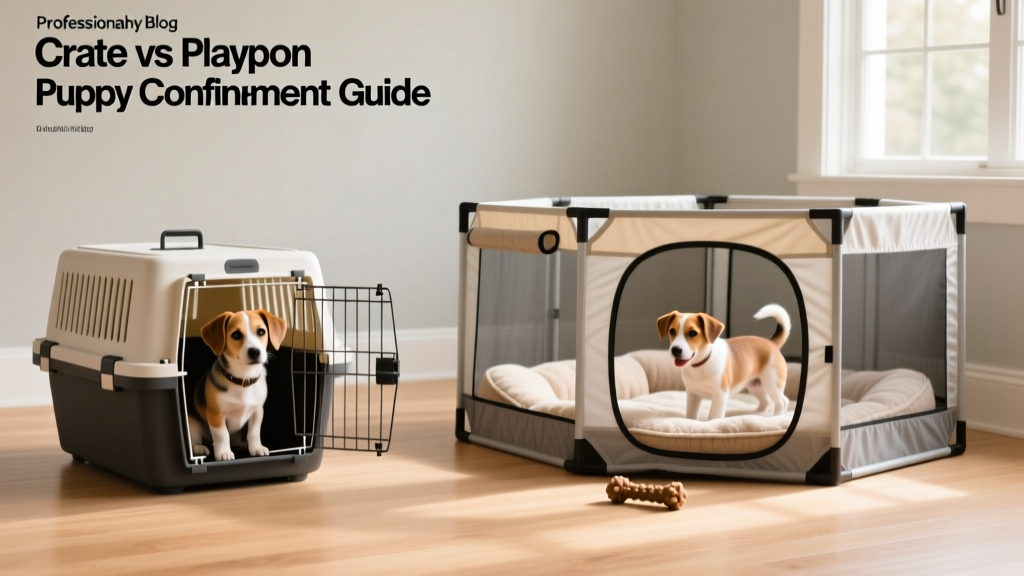
Crate Training Progression and Time Limits
A crate is not a punishment tool — it's a den that provides security and aids potty training by leveraging a dog's natural instinct not to soil their sleeping area. The key principle: never exceed the puppy's physical ability to hold their bladder, or the crate becomes associated with distress.
Maximum Crate Time by Age (Daytime)
- 8-10 weeks: 30-60 minutes maximum between potty breaks
- 10-12 weeks: 1-2 hours maximum
- 3-4 months: 2-3 hours maximum
- 4-5 months: 3-4 hours maximum
- 6+ months: 4-5 hours maximum during the day
Overnight, puppies can typically hold it 1-2 hours longer than daytime maximums because they're sleeping and metabolism slows. A 10-week-old puppy may need one overnight potty break around 2-3 AM; by 14 weeks, most can sleep 6-7 hours straight.
Crate Training Steps Using Positive Reinforcement
- Days 1-3: Leave crate door open. Feed all meals inside the crate. Toss high-value treats inside for puppy to retrieve. No door closing yet.
- Days 4-7: Close door during meals. Open immediately when puppy finishes. Begin closing door for 1-2 minutes while you sit nearby. Reward calm behavior.
- Week 2: Close door for 5-10 minutes while you remain in the room. Gradually move further away within the room. If puppy whines, wait for a brief pause in vocalization before opening (so you don't reinforce whining).
- Weeks 3-4: Leave the room for short periods (5-15 minutes). Return before puppy becomes distressed. Build duration gradually.
- Ongoing: Puppy should enter crate voluntarily for naps. Cover crate with a light blanket for den-like feel. Place crate in your bedroom overnight for the first few weeks — proximity to you reduces anxiety.
Teething Timeline (3-6 Months): Relief Strategies and Safe Chews
Puppies have 28 deciduous (baby) teeth that begin erupting at 3-4 weeks and are fully in by 6-8 weeks. Starting around 12-16 weeks, these are gradually replaced by 42 permanent adult teeth. The teething process — when baby teeth loosen and adult teeth push through the gums — peaks between 3 and 6 months and is genuinely uncomfortable for your puppy.
Teething Milestones
- 12-16 weeks: Incisors begin loosening. You may find tiny teeth in bedding or toys. Increased mouthing behavior.
- 16-20 weeks: Canine teeth (fangs) loosen. This is peak discomfort — expect the most chewing during this window.
- 20-24 weeks: Premolars and molars erupt. Chewing intensity may remain high.
- 6-7 months: All 42 adult teeth should be in. If any baby teeth remain (retained deciduous teeth), your vet should extract them during spay/neuter to prevent crowding and dental disease.
Safe Chew Recommendations
- Frozen washcloth: Wet a clean washcloth, twist into a rope, freeze for 2 hours. The cold numbs gums. Supervise and remove when thawed.
- Rubber Kong (puppy size): Stuff with plain yogurt or pumpkin puree and freeze. Provides 15-30 minutes of soothing activity.
- Benebone Puppy or Nylabone Puppy: Designed for developing teeth (softer material). Choose appropriate size — too small is a choking hazard.
- Carrots (whole, cold): A cold whole carrot is a safe, edible chew that soothes gums. Supervise to prevent choking on large pieces.
Common Puppy Problems and Solutions
Puppy Biting and Nipping
Mouthing is normal canine behavior — puppies explore the world with their mouths, and littermates teach bite inhibition through yelping and withdrawing from play. When you bring your puppy home, you become the littermate.
How to stop puppy biting:
- When teeth touch skin, let out a brief, high-pitched "ouch" or yelp (mimicking littermate feedback).
- Immediately withdraw attention — stand up, turn away, or step behind a baby gate for 10-15 seconds.
- Return and redirect to an appropriate chew toy. Praise enthusiastically when they chew the toy.
- If biting persists or escalates, end the play session entirely. Puppy is likely overtired — most biting spikes when puppies need a nap.
Never hold the puppy's mouth shut, push fingers into their throat, or use physical punishment. These methods increase fear and can create defensive aggression. If biting is severe or accompanied by growling and stiffening, consult a certified professional dog trainer (CPDT-KA) or veterinary behaviorist.
Nighttime Whining in the Crate
Most puppies cry the first 2-5 nights in a new home. This is normal separation distress, not a sign something is wrong.
- Place crate in your bedroom so puppy can hear and smell you.
- Use a heartbeat toy (like a Snuggle Puppy) or a warm water bottle wrapped in a towel.
- Take puppy out for a potty break at a consistent time (e.g., 2 AM for an 8-10 week old), keep it boring and dark, return immediately to crate.
- If puppy cries after a recent potty break, wait for a brief pause in crying before ignoring. Do not open crate while puppy is actively vocalizing.
Destructive Chewing
Puppies chew for three reasons: teething pain, boredom, and exploration. Management is more effective than correction.
- Provide 5-8 appropriate chew toys of varying textures. Rotate them every few days to maintain novelty.
- Puppy-proof your home: use bitter apple spray on baseboards, keep shoes in closed closets, use cord protectors on electrical wires.
- Ensure adequate physical exercise (age-appropriate) and mental stimulation (food puzzles, training sessions, sniff walks on your puppy long leash).
- A tired puppy is a well-behaved puppy. Most destructive chewing happens when puppies are under-exercised or left alone too long without enrichment.
First-Year Cost Breakdown: Budgeting for Your Puppy
New puppy owners consistently underestimate first-year costs. Here's a realistic breakdown based on 2026 pricing from veterinary industry data:
| Category | Low Estimate | Medium Estimate | High Estimate |
|---|---|---|---|
| Puppy purchase/adoption | $150 (rescue) | $1,500 (responsible breeder) | $3,500+ (specialty breeds) |
| Veterinary (vaccines, spay/neuter, wellness) | $400 | $800 | $1,500 |
| Food (quality puppy formula, 12 months) | $300 | $600 | $1,000 |
| Supplies (crate, leash, bed, bowls, toys, gate) | $200 | $400 | $700 |
| Training (puppy class + group classes) | $150 | $400 | $1,200 (private sessions) |
| Preventive medications (flea/tick, heartworm) | $200 | $350 | $500 |
| Pet insurance (optional but recommended) | $360/yr | $600/yr | $900/yr |
| Total first year | $1,760 | $4,650 | $9,300+ |
Emergency veterinary care is not included in these estimates. A single emergency visit for parvovirus treatment can cost $2,000-$5,000; a foreign body surgery can run $3,000-$7,000. Pet insurance purchased while your puppy is young (before any pre-existing conditions develop) provides the best value.
Integrating Your Puppy Long Leash Into Daily Life
A long leash isn't just for formal training sessions. Here's how to weave it into your puppy's daily routine for maximum developmental benefit:
- Morning potty: Clip the 15-foot leash and let puppy wander to their preferred spot. This teaches them to eliminate at a distance from you — critical for future off-leash reliability.
- Sniff walks: Let puppy lead the direction on a 20-foot leash for 15-20 minutes. Sniffing is mentally exhausting — a 15-minute sniff walk tires a puppy as much as a 45-minute structured walk.
- Recall games: In a fenced area, attach the 30-foot leash. Call puppy's name, reward with high-value treat (boiled chicken, cheese) when they come. Gradually increase distance and add distractions.
- Socialization outings: At a park bench or outdoor café, use the long leash to let puppy observe foot traffic, other dogs, and bicycles at a comfortable distance. Reward calm watching.
- Settle training: Attach long leash to a sturdy anchor point near you while you work or eat. Puppy learns to settle on a mat or bed at a distance without being confined to a crate.
Frequently Asked Questions
How often should I feed my 10-week-old puppy?
Four meals per day, spaced roughly 4-5 hours apart (e.g., 7 AM, 12 PM, 4 PM, 8 PM). Consistent feeding times help regulate potty schedules — puppies typically need to eliminate 15-30 minutes after eating.
When will my puppy be fully potty trained?
Most puppies achieve reliable house training between 4-6 months. Small breeds (under 15 lb) may take 6-9 months due to smaller bladder capacity. Consistency, frequent outdoor trips, and zero punishment for accidents are the keys. If your puppy is 6+ months and still having daily accidents, consult your veterinarian to rule out medical causes.
What size puppy long leash should I start with?
Start with a 15-foot leash at 8-12 weeks for indoor and yard use. Move to 20 feet at 12-16 weeks for outdoor recall work. Graduate to 30 feet at 4-6 months for open-area training. Choose ½-inch width for puppies under 25 lb, ¾-inch for medium breeds, and 1-inch for large breeds over 50 lb.
How do I know if my puppy's long leash harness fits properly?
You should be able to slide two fingers flat between the harness and your puppy's body at every strap. The harness should not restrict shoulder movement. Check fit weekly — puppies grow rapidly, and a harness that fit last week may be too tight today. A poorly fitted harness can cause chafing, restricted gait, and tracheal pressure.
Should I use a retractable leash instead of a long line?
No. Retractable leashes (like the Flexi brand) maintain constant tension, which teaches puppies to pull. The thin cord can cause rope burns on both human and dog skin. The locking mechanism frequently fails under sudden force. A flat long line with a harness gives you far more control and teaches the puppy that slack in the leash is the default state.
When can I start off-leash training after using the long leash?
Most trainers recommend a minimum of 3-6 months of consistent long leash recall practice before attempting off-leash work in unfenced areas. Your puppy should respond to recall at 30 feet with moderate distractions (other dogs at a distance, squirrels, people) on the long line at least 90% of the time before you unclip. Even then, start in low-distraction, enclosed areas before progressing.
My puppy bites the long leash during walks. What should I do?
Leash biting is extremely common in puppies under 5 months. Solutions: carry a second toy to redirect when biting starts, use a leash with a bitter taste deterrent spray (test a small section first), or switch to a chain-link "chew-proof" section near the clip for the first few months. Most puppies outgrow this behavior by 6 months as teething resolves.
Disclaimer: This guide provides general educational information. Every puppy is an individual, and breed-specific needs vary significantly. Always consult your veterinarian before making changes to your puppy's diet, vaccination schedule, or exercise routine. For behavioral concerns, work with a certified professional dog trainer (CPDT-KA) or veterinary behaviorist (DACVB).
Robin Maitland
All our authors care for dogs every day — read more of their work on the authors page.