Puppy Gate Setup & Training Guide: Managing Your New...
Complete puppy gate setup guide covering age milestones, feeding schedules, potty training timelines, vaccinations, and crate training by breed size for new puppy owners.

Bringing a new puppy home means rethinking your entire living space — and a well-placed puppy gate is often the single most important piece of equipment you'll buy before day one. Unlike a crate, which confines your puppy to one spot, a puppy gate creates flexible safe zones: blocking off staircases, limiting access to kitchens with dropped food, or sectioning off a puppy-proofed play area where your dog can make choices without constant supervision.
But a gate alone doesn't raise a well-adjusted dog. This guide maps your puppy's entire first year — from the moment you bring them home through adolescence — with breed-size-specific feeding portions, vaccination timelines, socialization checklists, and realistic potty training expectations. Whether you're raising a 5-pound Chihuahua or a 90-pound Labrador, the milestones are universal, but the logistics change dramatically.
When to Bring Your Puppy Home and Setting Up Gates Before Arrival
The American Veterinary Medical Association and most breed specialists agree: puppies should remain with their littermates and dam until at least 8 weeks of age. For toy breeds (under 12 lb adult weight), many responsible breeders keep puppies until 10-12 weeks because these dogs mature more slowly and are prone to hypoglycemia if separated too early.
Before your puppy arrives, install puppy gates in these key locations:
- Top and bottom of staircases — Falls from even 4-5 steps can fracture a toy breed puppy's leg. Use hardware-mounted gates (not pressure-mounted) at the top of stairs. Models like the Cardinal Gates Stairway Special ($80-$95) swing open and latch securely.
- Kitchen entryway — Dropped onions, xylitol-containing products, and chicken bones make kitchens high-risk zones. A 30-inch gate blocks most puppies under 6 months.
- Puppy play pen perimeter — Use two or three freestanding or pressure-mounted gates (like the Iris USA 4-panel pet playpen, $60-$80) to create a 4x8 foot safe zone with bedding, water, and toys.
- Bedroom or home office doorways — Standard 28-32 inch doorway gates work here. The Regalo Easy Step Walk-Through Gate ($35-$45) fits openings 29-39 inches wide.
Gate height matters by breed size. Toy breeds (Chihuahuas, Yorkies, Pomeranians) rarely attempt to jump a 24-inch gate before 6 months. Medium breeds (Beagles, Cocker Spaniels) can clear 24-inch gates by 4 months, so start with 30-inch models. Large and giant breeds (Golden Retrievers, German Shepherds, Great Danes) need 36-inch gates from day one — a 16-week-old Lab puppy can already jump 24 inches.
Age-Specific Puppy Milestones: What to Expect Month by Month
Every puppy develops on a predictable neurological timeline. Understanding these windows prevents you from expecting too much too soon — or missing critical developmental periods.
| Age Range | Developmental Stage | What to Expect | Gate & Space Management |
|---|---|---|---|
| 4-8 weeks | Socialization onset; littermate play; weaning | Puppy learns bite inhibition from siblings; begins eating solid food; fear imprinting begins around week 8 | Still with breeder; no gates needed at your home yet |
| 8-12 weeks | Primary socialization window; rapid bonding; bladder control minimal | Peak fear period (8-11 weeks); can hold bladder ~1 hour per month of age; sleeps 18-20 hours/day; mouthy exploration | Gates limit puppy to 1-2 rooms; playpen area for unsupervised moments; gate off all stairs |
| 12-16 weeks | Socialization window closing; baby teeth loosening; independence emerging | Bladder control improves to 2-3 hours; chewing intensity increases; may test gate boundaries; responds to name reliably | Can expand gated area to 3-4 rooms if puppy-proofed; begin leaving gate open during supervised time |
| 16-24 weeks | Teething peak; juvenile energy; secondary fear period possible | Adult teeth erupting (3-6 months); may attempt gate jumping; increased chewing destruction; can hold bladder 4-5 hours | Upgrade to 36-inch gates for medium/large breeds; add gate topper extensions if puppy is climbing |
| 6-12 months | Adolescence; sexual maturity; boundary testing | May regress in potty training; selective hearing; full bladder control by 8-10 months; chewing may decrease after adult teeth settle (~7 months) | Begin phasing out gates in low-risk areas if dog demonstrates reliability; keep stair gates permanently for safety |
Feeding Schedule: Exact Portions by Age, Weight, and Breed Size
Puppy caloric needs change rapidly. Underfeeding stunts growth; overfeeding — especially in large breeds — accelerates skeletal development and increases hip dysplasia risk. The Merck Veterinary Manual recommends feeding a diet labeled as meeting AAFCO standards for "growth" or "all life stages" through at least 12 months (18-24 months for giant breeds over 70 lb adult weight).
Below are daily feeding amounts for a typical AAFCO-compliant dry kibble (approximately 350-400 kcal per cup). Adjust based on your specific food's caloric density — always check the feeding chart on the bag and your puppy's body condition score (BCS).
| Puppy Age | Meals/Day | Toy Breed (5-12 lb adult) | Small Breed (13-25 lb adult) | Medium Breed (26-55 lb adult) | Large Breed (56-100 lb adult) |
|---|---|---|---|---|---|
| 8-12 weeks | 4 meals | ¼ - ½ cup total | ½ - ¾ cup total | ¾ - 1¼ cups total | 1½ - 2½ cups total |
| 12-16 weeks | 3 meals | ⅓ - ⅔ cup total | ¾ - 1 cup total | 1 - 1¾ cups total | 2 - 3½ cups total |
| 16-24 weeks | 3 meals | ½ - ¾ cup total | 1 - 1½ cups total | 1½ - 2½ cups total | 3 - 5 cups total |
| 6-12 months | 2 meals | ½ - ¾ cup total | 1 - 1½ cups total | 2 - 3 cups total | 3½ - 5½ cups total |
Key feeding rules: Use a puppy gate to block kitchen access during meal prep — dropped food is a leading cause of puppy GI upset. Remove uneaten food after 15-20 minutes per meal to establish a routine. Toy breed puppies under 4 months are at risk for hypoglycemia; if your puppy refuses two consecutive meals, rub Karo syrup on their gums and call your vet immediately.
Vaccination Schedule: Core and Non-Core Vaccines by Week
Your puppy arrives with maternal antibodies that gradually wane between 6 and 16 weeks. The vaccination series is timed to immunize your puppy as those antibodies drop. The American Kennel Club outlines this core schedule, which your veterinarian may adjust based on local disease risk.
| Age | Vaccines Administered | What It Protects Against | Estimated Cost |
|---|---|---|---|
| 6-8 weeks | DHPP (Distemper, Hepatitis/Adenovirus, Parainfluenza, Parvovirus) — 1st dose; optional Bordetella | Canine distemper (fatal neurological disease), infectious hepatitis, kennel cough, parvovirus (often fatal GI disease) | $25-$45 per combination shot |
| 10-12 weeks | DHPP — 2nd dose; Leptospirosis (2-dose series begins); optional Lyme, Canine Influenza (H3N2/H3N8) | Boosters core immunity; Lepto protects against bacterial kidney/liver disease from wildlife urine | $40-$75 (including non-core) |
| 14-16 weeks | DHPP — 3rd dose; Rabies (required by law); Leptospirosis 2nd dose; optional Lyme, Influenza 2nd dose | Completes core series; Rabies is legally mandated and protects against fatal viral encephalitis | $50-$90 |
| 12-16 months | DHPP booster; Rabies booster (1-year or 3-year depending on product); all non-core boosters as indicated | First annual boosters establish long-term immunity | $60-$120 |
Until your puppy completes the DHPP series at 16 weeks, they are vulnerable to parvovirus — which can survive in soil for over a year and has a 16-35% fatality rate even with treatment. You can carry your puppy in a sling or stroller to expose them to sights and sounds, but avoid dog parks, pet store floors, and unknown yards. After the 16-week DHPP dose, wait 5-7 days for immunity to build, then begin controlled introductions with fully vaccinated, known-healthy dogs. The AVMA provides detailed parvo prevention guidance.
The Critical Socialization Window: Weeks 3-14 Exposure Checklist
Behavioral research published in the Journal of Veterinary Behavior confirms that the primary socialization period closes between 12-14 weeks. Puppies deprived of diverse positive experiences during this window are significantly more likely to develop fear-based reactivity, separation anxiety, and aggression. This is the single most time-sensitive aspect of puppy raising — more urgent than potty training or obedience.
Use your puppy gate system to manage controlled exposure: invite visitors into your gated puppy area rather than overwhelming your puppy with open-house chaos.
Socialization Checklist — aim for positive (treat-paired) exposure to each by 14 weeks:
- People: Men with beards, children ages 4-10 (supervised), people wearing hats/sunglasses/hoodies, people using wheelchairs or crutches, delivery workers at the door, people of different ethnicities and heights
- Surfaces: Gravel, wet grass, metal grates, tile floors, plastic tarps, bubble wrap, wobbly balance discs
- Sounds: Vacuum cleaner (start 20 feet away, pair with treats), thunderstorm recordings (low volume), doorbell, traffic noise, fireworks recordings, clapping, dropped pots
- Handling: Paw touching, ear examination, mouth opening, nail clipping simulation, being lifted onto a table, gentle restraint in a hug position for 5 seconds
- Objects: Umbrellas opening, plastic bags rustling, bicycles passing, skateboards, rolling suitcases, balloons
- Animals: Fully vaccinated adult dogs (calm, known temperament), cats (if household has them), exposure to livestock sounds or visuals if rural
- Environments: Car rides (short trips ending in fun, not just vet visits), outdoor café patios, hardware store parking lots, school playground perimeters (from a distance)
Rule of thumb: If your puppy tucks their tail, freezes, or hides behind you, you've moved too fast. Increase distance, lower intensity, and pair the stimulus with high-value treats (boiled chicken, string cheese). Never force a frightened puppy closer to a scary stimulus — this is flooding, not socialization, and it creates lasting fear.
Potty Training Timeline: Realistic Expectations and Troubleshooting
Let's be direct: no puppy is "fully potty trained in 3 days." Bladder control is a physiological milestone, not just a learned behavior. A puppy's ability to hold urine correlates directly to age — roughly one hour per month of age, plus one.
| Puppy Age | Max Bladder Hold Time | Expected Accidents/Week | Gate Strategy |
|---|---|---|---|
| 8-10 weeks | 1-2 hours | 5-10 (normal) | Puppy confined to small gated area + crate; taken out every 60-90 minutes |
| 10-14 weeks | 2-3 hours | 2-5 | Gated area can expand slightly; maintain strict outdoor schedule |
| 14-20 weeks | 3-4 hours | 0-2 | Begin supervised access to additional rooms; gate off carpeted areas after accidents |
| 5-8 months | 5-7 hours | 0-1 | May regress during adolescence; re-tighten gate boundaries temporarily |
| 8-12 months | 8+ hours | Rare (0-1/month) | Most gates can be opened during the day; maintain for safety zones |
Troubleshooting common issues:
- Puppy pees in crate: Crate may be too large (puppy eliminates in one corner, sleeps in another). Use a divider to size the crate so puppy can stand, turn, and lie down — no more. Also rule out urinary tract infection with your vet if accidents are sudden.
- Puppy sneaks behind furniture to eliminate: This is why gates matter — they prevent your puppy from finding secluded spots. Block off behind-furniture gaps with gates or furniture rearrangement.
- Submissive/excitement urination: Common in puppies under 6 months when greeting. Don't punish — it's involuntary. Greet calmly, take puppy outside immediately upon arrival, and avoid leaning over them.
- Marking behavior (lifting leg): Typically begins 6-9 months in intact males. Neuter reduces but doesn't always eliminate marking. Use enzymatic cleaner (Nature's Miracle or Rocco & Roxie, $12-$18) on all marked spots — ammonia-based cleaners attract re-marking.
Crate Training Progression and Teething Relief: Months 3-6
Crate training and puppy gates work as a system: the crate is for sleeping and short-term confinement; the gated area is for supervised play when you can't give full attention. Neither should be used as punishment.
Crate time limits by age:
- 8-10 weeks: 30-60 minutes maximum during the day; overnight stretches of 3-4 hours (you will need a middle-of-night potty break)
- 10-14 weeks: 1-2 hours during the day; overnight 4-5 hours
- 14-20 weeks: 2-3 hours during the day; overnight 6-7 hours
- 5-6 months: 3-4 hours during the day; overnight 7-8 hours
Exceeding these limits causes distress, undermines training, and can trigger separation anxiety. A puppy left crated for 6 hours at 10 weeks will associate the crate with panic, not safety.
Teething timeline and relief strategies:
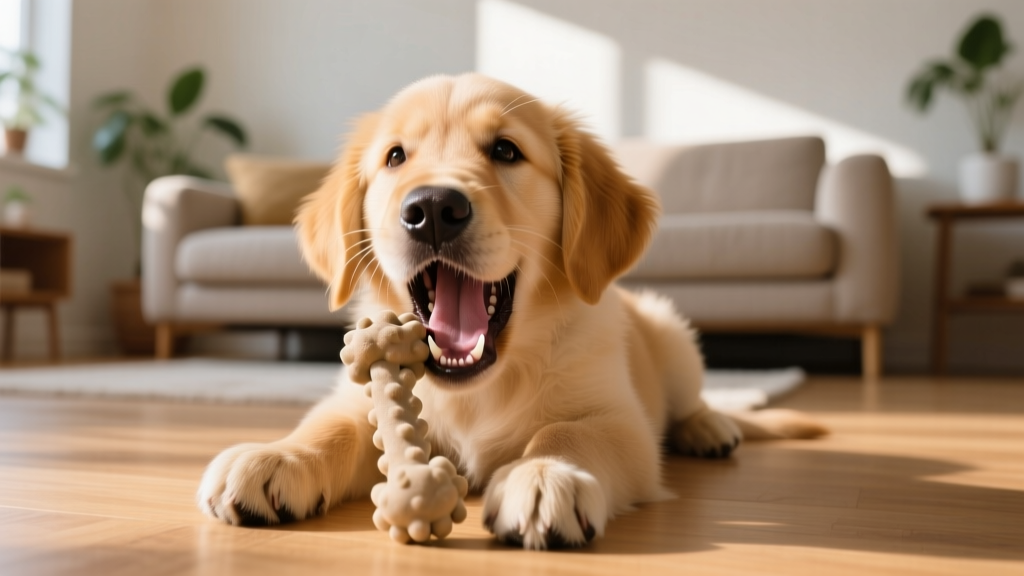
Deciduous (baby) teeth begin erupting at 3-4 weeks and are fully in by 6-8 weeks. Adult teeth begin pushing out baby teeth at approximately 12-16 weeks, with the process completing around 6-7 months. During peak teething (3-6 months), puppies chew to relieve gum pressure — and your baseboards, shoes, and furniture are at risk.
• Frozen Kong Classic ($15-$22, size-appropriate) stuffed with plain yogurt and banana, frozen 4+ hours
• Benebone Wishbone ($14-$20) — nylon chew with raised grip; choose puppy-specific version with softer material
• Frozen wet washcloth — soak in water, wring, twist into rope shape, freeze 2 hours; supervise to prevent ingestion of fabric
• Nylabone Puppy Chew ($6-$10) — specifically the "puppy" line, which is softer than adult versions
• Carrots (whole, chilled) — low-calorie, natural crunch; supervise to prevent choking in toy breeds
Avoid: Rawhide (choking/blockage risk), hard antlers or hooves (can fracture puppy teeth), any chew small enough to swallow whole. If your puppy ingests a foreign object, contact ASPCA Animal Poison Control at (888) 426-4435 (24/7, consultation fee applies) or your emergency vet immediately.
Common Puppy Problems: Biting, Whining, and Chewing — Solutions That Work
Every puppy owner hits the "is this normal?" wall around weeks 10-14. Here are the three most common issues and evidence-based solutions using positive reinforcement methods only.
Puppy Biting and Nipping
Puppies explore the world with their mouths, and littermates teach bite inhibition through yelping and withdrawing play. When you bring your puppy home, you become their play partner — and human skin is far more delicate than puppy fur.
What works:
- When teeth touch skin, say "ouch" in a calm, flat tone (not a dramatic yelp — high-pitched sounds can excite some puppies more).
- Immediately withdraw attention: stand up, cross your arms, look away for 10-15 seconds.
- Redirect to an appropriate chew toy. When puppy chews the toy, praise and resume play.
- If biting persists, the puppy is likely overtired. Puppies need 18-20 hours of sleep; a biting puppy at 4 PM usually needs a nap, not more training. Place them in their crate with a chew for a 90-minute enforced nap.
What doesn't work (and can make it worse): Holding the puppy's mouth shut, alpha rolls, tapping the nose, or any physical punishment. These create fear of hands and can escalate to defensive biting. The American Veterinary Society of Animal Behavior position statement explicitly recommends against aversive methods.
Nighttime Whining in the Crate
Nighttime whining in the first 1-2 weeks is normal — your puppy is in a new environment, separated from littermates. Strategies:
- Place the crate in your bedroom for the first 2-3 weeks so your puppy can smell and hear you.
- Use a Snuggle Puppy ($30-$40) — a plush toy with a heartbeat simulator and heat pack that mimics littermate contact.
- Take puppy out for a potty break at a set time (e.g., 2 AM for 8-week-olds) using minimal stimulation — no play, no lights, carry them out and back.
- If puppy whines immediately after being crated (not after 3+ hours), wait 5-10 minutes before responding to avoid reinforcing the whine-reward cycle.
Destructive Chewing
Chewing peaks during teething (3-6 months) and again during adolescence (8-10 months). Management is more effective than correction at this age:
- Use puppy gates to block access to rooms with tempting items (shoes, remote controls, books).
- Provide 5-8 appropriate chew options rotated weekly to maintain novelty.
- Exercise before leaving: a 15-minute training session or fetch tires a puppy mentally and reduces boredom chewing.
- Apply bitter apple spray ($8-$12) to furniture legs and cords as a deterrent — test first, as some puppies are undeterred.
First-Year Cost Breakdown: Budgeting for Your Puppy
New puppy owners consistently underestimate first-year costs. Here's a realistic breakdown based on 2026 pricing for a medium-breed puppy (30-50 lb adult weight). Costs scale up 30-50% for large/giant breeds and down 20-30% for toy breeds.
| Category | Items | Low Estimate | High Estimate |
|---|---|---|---|
| Purchase/Adoption | Responsible breeder or rescue adoption fee | $350 (rescue) | $3,500 (breeder) |
| Veterinary (Year 1) | Vaccine series, spay/neuter, microchip, fecal tests, heartworm prevention, wellness exams (3-4 visits) | $600 | $1,500 |
| Food | 12 months of AAFCO growth-formula kibble | $300 | $700 |
| Supplies | Crate, puppy gates (2-3), bed, bowls, leash/harness, collar, ID tags, toys, chews, enzymatic cleaner, grooming tools | $250 | $600 |
| Training | Puppy kindergarten class (6-8 weeks), optional private sessions | $150 (group class) | $800 (private + group) |
| Insurance/Emergency | Pet insurance premiums (12 months) or emergency fund | $360 ($30/mo insurance) | $2,000 (emergency visit) |
| TOTAL | $2,010 | $9,100 |
Pet insurance is strongly recommended before your puppy's first vet visit. Pre-existing conditions are excluded by all major insurers, so enrolling at 8 weeks locks in coverage for conditions like hip dysplasia, allergies, and cruciate ligament tears that may develop later. Companies like Trupanion, Healthy Paws, and Lemonade offer puppy-specific plans ranging from $25-$65/month depending on breed, location, and deductible.
Frequently Asked Questions
When should I bring my puppy home?
At minimum 8 weeks of age. Toy breeds benefit from staying with the breeder until 10-12 weeks due to slower emotional and physical maturation. Puppies removed before 8 weeks miss critical littermate socialization that teaches bite inhibition and canine communication signals.
How often should I feed my puppy?
Four meals per day from 8-12 weeks, three meals from 12-24 weeks, and two meals from 6 months onward. Toy breeds under 4 months may need 4-5 smaller meals to prevent hypoglycemia. Always feed measured portions rather than free-feeding — obesity in puppies stresses developing joints.
When will my puppy be fully potty trained?
Most puppies achieve reliable house training between 5-8 months, though small breeds may take longer (up to 10-12 months) due to smaller bladder capacity. "Reliable" means fewer than one accident per month. Consistency in schedule, crate use, and gated management are the three biggest predictors of faster training.
What vaccines does my puppy need and when?
Core vaccines include DHPP at 6-8, 10-12, and 14-16 weeks, plus Rabies at 14-16 weeks. Non-core vaccines (Bordetella, Leptospirosis, Lyme, Canine Influenza) depend on your lifestyle and geographic region. Your veterinarian will determine which non-core vaccines are appropriate — a puppy in rural Minnesota has different risk factors than one in a Manhattan apartment.
How do I stop puppy biting and nipping?
Use the redirect-and-withdraw method: say "ouch" calmly when teeth touch skin, withdraw attention for 10-15 seconds, then redirect to an appropriate chew toy. Ensure your puppy is getting 18-20 hours of sleep — overtired puppies bite more. Never use physical punishment, which creates fear-based aggression. Most nipping decreases significantly by 5-6 months as adult teeth fully erupt.
When can my puppy go outside and meet other dogs?
You can carry your puppy outdoors immediately for socialization exposure (sights, sounds, smells). For ground-level exploration in public areas, wait until 5-7 days after the 16-week DHPP vaccine. Controlled playdates with known, fully vaccinated dogs in private yards can begin after the 12-week DHPP dose. Avoid dog parks until at least 16 weeks plus one week, and ideally until your puppy is confident enough to handle unpredictable dogs — many trainers recommend waiting until 6+ months for dog park visits.
Jonas Cole
All our authors care for dogs every day — read more of their work on the authors page.