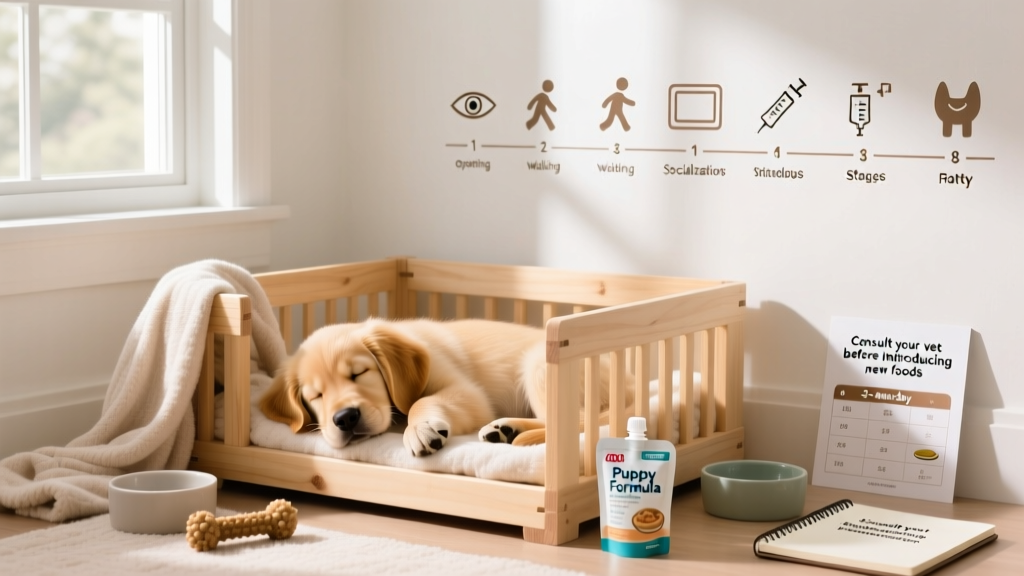
Puppy Crate Training by Age: The Complete Week-by-Week Guide
Complete puppy crate training guide with age-specific milestones, time limits, potty schedules, feeding portions, vaccination timelines, and first-year costs.

Bringing a new puppy home is equal parts thrilling and overwhelming — and nowhere does that collision of emotions hit harder than the first night with a puppy crate. Will they cry? How long can they hold it? What size crate do you actually need? These questions don't have one-size-fits-all answers. A 10-week-old Labrador Retriever puppy has vastly different crate training needs than a 16-week-old Chihuahua. This guide breaks down crate training progression alongside every other critical milestone — feeding, potty training, vaccinations, socialization, and teething — so you can build a plan that matches your puppy's exact developmental stage.
When Should You Bring Your Puppy Home?
The American Kennel Club and most veterinary behaviorists agree: 8 weeks is the earliest appropriate age to separate a puppy from its litter. Puppies removed before 8 weeks miss critical bite inhibition lessons learned from littermates and often develop heightened separation anxiety.
That said, many responsible breeders keep puppies until 10-12 weeks, particularly for toy breeds (Chihuahuas, Yorkshire Terriers, Pomeranians) that mature more slowly and benefit from additional socialization within the litter. If your breeder offers a 10-12 week start, take it — your puppy crate training will actually progress faster because the puppy arrives with better emotional regulation.
Here's what your puppy should have before coming home:
- At least one round of DHPP vaccination (given at 6-8 weeks)
- First deworming treatment (typically at 2, 4, 6, and 8 weeks)
- Microchip registration (if breeder-provided)
- Written health guarantee and veterinary exam records
- Transition food supply (same brand/formula the breeder used)
Age-Specific Milestones: What to Expect Each Stage
Every puppy develops on a biological timeline that doesn't care about your work schedule. Understanding these windows prevents frustration and sets realistic expectations for crate training, potty progress, and behavior.
| Age Range | Developmental Stage | Crate Expectations | Key Milestones |
|---|---|---|---|
| 4-8 weeks | Socialization with littermates; learning bite inhibition from siblings; weaning onto solid food | No crate training — puppy should be with breeder/dam | First DHPP vaccine (6-8 wks); eyes/ears fully functional; beginning to explore |
| 8-12 weeks | Fear imprint period begins (8-11 wks); peak socialization window; rapid bonding with humans | 30-60 min max during day; 2-3 hours overnight with potty breaks | Second DHPP (10-12 wks); begin name recognition; sit/lure training |
| 12-16 weeks | Fear period may continue; testing boundaries; increased independence; chewing intensifies | 1-2 hours during day; 4-5 hours overnight | Third DHPP (14-16 wks); rabies vaccine (12-16 wks); socialization window closing |
| 16-24 weeks | Juvenile period; teething begins; increased energy; possible regression in training | 2-3 hours during day; 6-8 hours overnight | Baby teeth begin falling out; final puppy vaccines; spay/neuter discussion with vet |
| 6-12 months | Adolescence; sexual maturity; second fear period (6-14 months); boundary testing peaks | 4-6 hours during day; 8 hours overnight (most breeds) | Adult teeth fully in; transition to adult food (breed-dependent); possible training regression |
Choosing and Setting Up Your Puppy Crate
The right crate setup makes or breaks the training process. A crate that's too large allows the puppy to soil one end and sleep in the other — defeating the den instinct that makes crate training work. A crate that's too small causes physical discomfort and creates negative associations.
Crate Sizing by Expected Adult Weight
| Expected Adult Weight | Crate Size | Crate Dimensions (L×W×H) | Example Breeds |
|---|---|---|---|
| Under 12 lb / 5.4 kg | X-Small | 18" × 12" × 14" | Chihuahua, Pomeranian, Maltese |
| 12-25 lb / 5.4-11.3 kg | Small | 24" × 18" × 19" | French Bulldog, Dachshund, Pug |
| 26-40 lb / 11.8-18.1 kg | Medium | 30" × 19" × 21" | Beagle, Cocker Spaniel, Brittany |
| 41-70 lb / 18.6-31.8 kg | Large | 36" × 23" × 25" | Border Collie, Labrador, Boxer |
| 71-90 lb / 32.2-40.8 kg | X-Large | 42" × 28" × 30" | German Shepherd, Golden Retriever, Rottweiler |
| 90+ lb / 40.8+ kg | XX-Large | 48" × 30" × 33" | Great Dane, Mastiff, Saint Bernard |
Budget tip: Buy the adult-size wire crate now (MidWest iCrate or Frisco double-door models run $40-$80 depending on size) and use the included divider panel to shrink the space as your puppy grows. This avoids buying three crates in year one.
Crate Setup Essentials
- Bedding: Start with a tightly woven blanket or Vetbed (a fleece-like mat that resists chewing and wicks moisture, ~$25-$40). Avoid plush beds until the puppy is past the destructive chewing phase (usually 6-8 months).
- Water: Attach a no-drip water bottle (Lixit brand, ~$8) to the crate bars rather than a bowl that spills.
- Cover: A breathable crate cover or light blanket over three sides reduces visual stimulation and helps settle anxious puppies. Leave the front open for airflow.
- Placement: Put the crate in a common area during the day (kitchen, living room) so the puppy doesn't feel isolated. Move to the bedroom at night to reduce separation distress.
Feeding Schedule by Age and Weight
Crate training and feeding schedules are inseparable — what goes in on a schedule comes out on a schedule. Predictable mealtimes create predictable potty windows, which is the foundation of successful house training.
| Puppy Age | Meals Per Day | Approximate Daily Portion (Dry Kibble) | Timing Notes |
|---|---|---|---|
| 8-12 weeks | 3-4 meals | Small breeds: ¼-½ cup/day Medium breeds: ¾-1 cup/day Large breeds: 1½-2½ cups/day |
Last meal by 5:00 PM to allow digestion before overnight crate |
| 12-16 weeks | 3 meals | Small breeds: ⅓-⅔ cup/day Medium breeds: 1-1½ cups/day Large breeds: 2-3½ cups/day |
Space meals ~5 hours apart; remove food after 15 min |
| 16-24 weeks | 2-3 meals | Small breeds: ½-¾ cup/day Medium breeds: 1½-2 cups/day Large breeds: 3-4½ cups/day |
Transition to 2 meals around 5-6 months |
| 6-12 months | 2 meals | Follow adult feeding guide on food bag; adjust based on body condition score | Morning and evening; consistent timing daily |
These portions assume an AAFCO complete-and-balanced puppy formula with a caloric density of approximately 350-400 kcal/cup. Always check your specific food's feeding chart — calorie content varies significantly between brands. Purina Pro Plan Puppy, Royal Canin Puppy, and Hill's Science Diet Puppy all publish detailed feeding guides on their packaging.
Potty Training Timeline and Crate Integration
The single most important rule: a puppy can hold their bladder for approximately one hour per month of age, plus one. A 3-month-old puppy can hold it for roughly 4 hours maximum. This biological limit determines your crate duration and overnight break schedule.
Realistic Potty Training Expectations
| Puppy Age | Max Bladder Hold Time | Overnight Crate Breaks | Accident Expectation |
|---|---|---|---|
| 8-10 weeks | 1-2 hours | Every 2-3 hours (set alarm) | Multiple daily accidents are normal |
| 10-14 weeks | 2-3 hours | Every 3-4 hours (1-2 breaks) | 1-2 accidents per week with consistent routine |
| 14-20 weeks | 3-5 hours | Once overnight (around 2-3 AM) | Rare accidents; signal behavior developing |
| 5-6 months | 5-6 hours | May sleep through the night | Mostly reliable; regression possible with schedule changes |
| 6-12 months | 6-8 hours | None needed | Fully reliable in most puppies by 7-9 months |
When Will My Puppy Be Fully Potty Trained?
Most puppies achieve reliable house training between 5-7 months of age, though toy breeds often take until 8-10 months due to smaller bladder capacity. "Reliable" means fewer than one accident per month with a consistent schedule. If your puppy is still having daily accidents past 6 months, consult your veterinarian to rule out urinary tract infections, anatomical abnormalities, or diabetes.
Potty Training Troubleshooting
Problem: Puppy cries in crate at night immediately after being taken out.
Solution: Wait 5-10 minutes before responding. If crying continues, take them out on leash (no play), stand in one spot, wait 3 minutes. If no elimination, return to crate. This teaches that crying produces a bathroom trip, not playtime.
Problem: Puppy has accidents 20-40 minutes after coming inside from a potty break.
Solution: You're likely not staying outside long enough, or the puppy is distracted. Use a 6-foot leash, stand in one grassy area, and wait up to 10 minutes. Reward immediately (within 2 seconds) with a high-value treat and verbal praise when they eliminate.
Problem: Puppy was doing great and suddenly regressed at 4-5 months.
Solution: This is extremely common during the juvenile period. Go back to more frequent potty breaks (every 1-2 hours), supervise constantly when not crated, and rule out UTI with your vet. Regression typically resolves within 2-3 weeks of consistent management.
Vaccination Schedule: Protecting Your Puppy Before Full Immunity
Your puppy's vaccine schedule directly impacts when they can safely leave the crate for outdoor socialization. The American Veterinary Medical Association outlines core and non-core vaccines based on lifestyle risk.
| Age | Vaccine | Type | What It Protects Against |
|---|---|---|---|
| 6-8 weeks | DHPP (1st dose) | Core | Distemper, Hepatitis (Adenovirus), Parainfluenza, Parvovirus |
| 8-10 weeks | Bordetella (optional) | Non-core | Kennel cough — recommended if attending puppy classes or boarding |
| 10-12 weeks | DHPP (2nd dose) | Core | Booster for distemper combo; Leptospirosis may be added based on risk |
| 12-16 weeks | Rabies | Core (legally required) | Rabies — required by law in most US states; 1-year or 3-year formulation |
| 14-16 weeks | DHPP (3rd dose) | Core | Final puppy DHPP booster; completes primary series |
| 16-18 weeks | Lyme, Leptospirosis, Canine Influenza (risk-based) | Non-core | Based on geographic region, outdoor exposure, and boarding frequency |
When Can My Puppy Go Outside and Meet Other Dogs?
This creates a genuine tension: the critical socialization window closes around 14-16 weeks, but full vaccination isn't complete until roughly the same age. The Merck Veterinary Manual and the American Veterinary Society of Animal Behavior (AVSAB) recommend controlled, low-risk socialization starting at 8 weeks:
- Safe from 8 weeks: Carrying your puppy in a sling or carrier through public areas (no ground contact); visits to homes of known, fully vaccinated, friendly adult dogs; controlled puppy classes that require proof of first DHPP and Bordetella vaccination
- Safe from 12 weeks (after 2nd DHPP): Brief, supervised playdates with one known vaccinated puppy; walking on your own lawn (if no unknown dogs have access)
- Safe from 17-18 weeks (1-2 weeks after final DHPP): Dog parks, pet stores, public sidewalks, group walks, grooming salons
Socialization Window: The 3-14 Week Critical Period
Behavioral euthanasia is the leading cause of death in dogs under 3 years old — not cancer, not accidents. Most of these dogs were never properly socialized during the 3-14 week window. This is not alarmism; it's data from veterinary behaviorists. Your puppy's brain is literally wiring itself to determine what is "normal" and "safe" during this period, and the window will not reopen.
Week-by-Week Socialization Checklist
Weeks 8-10 (immediately after bringing puppy home):
- Expose to 10+ different floor surfaces (tile, carpet, hardwood, gravel, grass, metal grates)
- Introduce to people wearing hats, sunglasses, hoodies, uniforms, and backpacks
- Play recorded sounds: thunderstorms, fireworks, vacuum cleaners, doorbells (start at low volume, pair with treats)
- Handle paws, ears, mouth, and tail daily for 30-60 seconds each (preps for grooming and vet exams)
- Introduce collar/harness and let puppy drag a light leash indoors
Weeks 10-12:
- Enroll in a positive-reinforcement puppy class (look for CPDT-KA or KPA-CTP certified trainers)
- Visit 3-5 different environments: a friend's backyard, a quiet park bench, a parking lot, a pet-friendly store lobby
- Arrange playdates with 2-3 known, vaccinated, gentle adult dogs
- Introduce crate as a positive space: feed meals inside with door open, provide stuffed Kongs (frozen with peanut butter and banana)
- Practice brief separations: leave puppy in crate for 5-10 minutes while you're in another room
Weeks 12-14:
- Increase environmental complexity: outdoor café patios (carried or in stroller), car rides to new locations, children's playgrounds (observing from a distance)
- Introduce novel objects: umbrellas opening, balloons, wobble boards, automatic doors
- Practice meeting strangers who offer treats (teach "four on the floor" — no jumping for greetings)
- Begin short alone-time practice: leave the house for 15-30 minutes while puppy is crated
Crate Training Progression: Step-by-Step
The goal is a puppy who voluntarily enters the crate, settles calmly, and views it as a safe retreat — not a punishment zone. This takes 2-4 weeks of consistent, daily practice.
Phase 1: Building Positive Associations (Week 1)
- Place the crate in a high-traffic area with the door removed or tied open.
- Scatter high-value treats (freeze-dried liver, small cheese pieces) inside throughout the day — let the puppy discover them without any prompting.
- Feed every meal inside the crate with the door open.
- Place a stuffed Kong or lick mat inside for 10-15 minute enrichment sessions.
- Never force the puppy inside or use the crate as punishment.
Phase 2: Door Closed, You Present (Week 2)
- Close the crate door during meals; open immediately when finished.
- Give a stuffed Kong, close the door, sit next to the crate. Open when the Kong is finished.
- Gradually increase duration: 1 minute, 3 minutes, 5 minutes, 10 minutes — while you remain visible.
- If the puppy whines, wait for 3 seconds of silence before opening. Opening during whining reinforces the behavior.
Phase 3: Door Closed, You Absent (Week 3-4)
- Close the door, give a long-lasting chew (bully stick, Yak cheese chew), and step out of the room for 1 minute.
- Return before the puppy finishes the chew. Gradually extend absences: 5 min, 15 min, 30 min, 1 hour.
- Practice departures without fanfare — no "I'll be back, be a good puppy!" speeches. Just leave quietly and return calmly.
- Begin crating for short daytime naps (puppies sleep 18-20 hours per day at 8-12 weeks).
Crate Time Limits by Age
| Puppy Age | Max Daytime Crate Duration | Max Overnight Duration | Total Daily Crate Time (Max) |
|---|---|---|---|
| 8-10 weeks | 30-60 minutes | 2-3 hours (with breaks) | 10-12 hours (mostly sleep) |
| 10-14 weeks | 1-2 hours | 3-4 hours (with breaks) | 12-14 hours (mostly sleep) |
| 14-20 weeks | 2-3 hours | 5-6 hours | 14-16 hours |
| 5-6 months | 3-4 hours | 7-8 hours | 14-16 hours |
| 7-12 months | 4-6 hours | 8 hours | 12-14 hours |
Teething Timeline and Relief Strategies
Puppies have 28 deciduous (baby) teeth that erupt between 3-6 weeks of age. These begin falling out around 12-16 weeks, and all 42 adult teeth should be fully in by 6-7 months. The peak discomfort period — and peak destructive chewing — occurs between 3-5 months when the adult teeth are pushing through the gums.
Safe Chew Recommendations by Stage
8-12 weeks (baby teeth still in):
- Rubber KONG Classic (puppy size, red rubber — softer than adult black KONG): ~$10-$12
- Nylabone Puppy Chew (softer formula, chicken or bacon flavor): ~$5-$7
- Frozen washcloth: soak a clean washcloth in low-sodium chicken broth, twist, freeze for 2 hours — supervise to prevent ingestion of fabric
12-24 weeks (active teething):
- Benebone Wishbone (puppy formula, softer nylon): ~$13-$16
- Yak cheese chews (Himalayan Dog Chew brand): ~$8-$12 per chew, long-lasting and digestible
- Frozen KONG stuffed with plain yogurt and blueberries
- Bully sticks (6-inch, odor-free): ~$4-$6 each — always supervise and remove when piece becomes small enough to swallow
6-12 months (adult teeth in, power chewing phase):
- Black KONG Extreme (toughest rubber): ~$14-$18
- Antler chews (split elk antler — softer center exposed): ~$15-$25 — monitor for tooth fractures
- GoughNuts Maxx 50 Ring (indestructible rubber with safety indicator): ~$30-$35
Common Puppy Problems and Solutions
Puppy Biting and Nipping
Every puppy bites. It's how they explore, play, and relieve teething discomfort. The goal isn't to eliminate mouthing entirely at 8 weeks — it's to teach bite inhibition (soft mouth) by 16 weeks and eliminate skin contact by 5-6 months.
Protocol for puppy biting:
- When teeth touch skin, say "Oops!" in a calm, neutral tone and immediately withdraw attention — stand up, cross arms, look away for 10-15 seconds.
- Return and redirect to an appropriate chew toy. Praise enthusiastically when they chew the toy.
- If biting continues (puppies under 14 weeks often will), implement a brief "time-out" — calmly pick up the puppy and place them in a puppy-proofed pen or small room for 30-60 seconds. This is not punishment; it's teaching that biting ends fun.
- Ensure the puppy is getting adequate sleep. Overtired puppies bite more — a puppy awake for more than 2 hours at 8-12 weeks is overtired and needs an enforced nap in the crate.
Whining in the Crate
Distinguish between types of whining:
- Demand whining (rhythmic, pauses to listen for your response): Ignore. Reward silence.
- Distress whining (continuous, escalating, with panting and pawing): The puppy may need to eliminate, may be too hot/cold, or may be genuinely panicked. Check on them calmly, address the need, and return them to the crate.
- Boredom whining (intermittent, paired with chewing on bars): Provide a stuffed Kong or lick mat. Increase daily mental enrichment.
Destructive Chewing Outside the Crate
Puppies under 6 months should not have free roam of the house. Use baby gates, exercise pens (MidWest foldable pens, ~$30-$45), or tether the puppy to you with a leash clipped to your belt when not crated. Every item the puppy chews that isn't a toy is a missed training opportunity and a potential emergency vet visit (foreign body surgery costs $2,000-$7,000).
First-Year Cost Breakdown
Budgeting realistically prevents surrender to shelters (financial hardship is a top-three reason dogs enter rescue). Here's what to expect in year one, based on 2025-2026 national averages:
| Category | Low Estimate | Medium Estimate | High Estimate |
|---|---|---|---|
| Puppy purchase/adoption | $200-$500 (rescue/shelter) | $1,500-$2,500 (responsible breeder) | $3,000-$5,000+ (rare/specialty breeds) |
| Veterinary (vaccines, spay/neuter, wellness exams) | $400-$600 | $700-$1,200 | $1,500-$2,500 (includes dental or unexpected illness) |
| Food (puppy formula, 12 months) | $250-$400 | $500-$800 | $900-$1,500 (premium/raw/large breed) |
| Supplies (crate, pen, bowls, leash, collar, bed, toys, chews) | $200-$350 | $400-$600 | $700-$1,200 |
| Training (puppy class + group classes) | $150-$300 | $400-$800 | $1,000-$3,000 (private sessions, board-and-train) |
| Preventive medications (flea/tick, heartworm, 12 months) | $150-$250 | $300-$500 | $500-$700 |
| Pet insurance (annual premium) | $0 (uninsured) | $400-$700 | $800-$1,200 (comprehensive coverage) |
| Grooming (if applicable, 12 months) | $0 (home grooming) | $400-$700 | $800-$1,500 (professional grooming, high-maintenance coats) |
| TOTAL First Year | $1,350-$2,600 | $4,200-$7,800 | $8,600-$17,100 |
Emergency veterinary care is not included above because it's unpredictable — but it's wise to maintain a $1,000-$2,000 emergency fund or carry pet insurance. Puppies are remarkably efficient at finding expensive trouble: swallowed socks, torn ACLs from overzealous play, and toxic ingestions are all common first-year emergencies.
Frequently Asked Questions
How often should I feed my puppy at 10 weeks old?
At 10 weeks, feed 3-4 meals per day spaced roughly 4-5 hours apart. A typical schedule: 7:00 AM, 12:00 PM, 5:00 PM, and optionally a small snack at 9:00 PM for toy breeds prone to hypoglycemia. Always remove uneaten food after 15 minutes to establish mealtime routines that support potty training predictability.
How do I stop my puppy from crying in the crate at night?
First, ensure the puppy has been exercised, mentally stimulated, and given a potty break immediately before crating. Place the crate next to your bed so the puppy can hear and smell you. Use a snuggle puppy toy with a heartbeat simulator (~$30-$40) for the first 2-3 weeks. If the puppy cries, wait for a brief pause in vocalization before opening the crate — even 3 seconds of silence counts. Never let the puppy "cry it out" for extended periods at 8-10 weeks; this can create lasting crate anxiety.
Can I crate my puppy while I'm at work for 8 hours?
No. Puppies under 6 months cannot physically hold their bladder for 8 hours, and extended crating causes both physical discomfort and psychological distress. Options include: hiring a pet sitter for midday visits ($15-$25 per visit), using a doggy daycare 2-3 days per week ($25-$45 per day), setting up an exercise pen with a potty area for puppies under 4 months, or arranging work-from-home days during the critical first 3-4 months.
My puppy hates the crate. Should I give up?
Almost every puppy protests the crate initially — it's a novel confinement experience. If you've followed the phased approach above for 2-3 weeks and the puppy is still showing signs of genuine panic (excessive drooling, bloody paws from scratching, self-injury, continuous vocalization for 30+ minutes), consult a certified professional dog trainer (CPDT-KA) or veterinary behaviorist (DACVB). In rare cases, confinement anxiety requires a modified approach — such as pen training first, then transitioning to the crate — or anti-anxiety medication prescribed by your veterinarian.
What size crate should I buy if I don't know my puppy's adult size?
If you adopted a mixed-breed puppy with unknown adult size, estimate based on current weight at 16 weeks: multiply by 2 for a rough adult weight estimate. Buy a 36" or 42" wire crate with a divider panel — these sizes accommodate the majority of medium-to-large dogs, and the divider lets you adjust the space. Measure the puppy standing: they should be able to stand without their head touching the top, turn around fully, and lie down stretched out in the adjusted space.
Tom Renshaw
All our authors care for dogs every day — read more of their work on the authors page.