Finding Puppies for Less in Temecula
Budget-friendly guide to finding puppies for less in Temecula, CA.

Bringing Home a Puppy in Temecula on a Budget
Temecula's wine-country charm and wide-open spaces make it an ideal place to raise a puppy. But between Southern California vet prices, quality food costs, and the sheer volume of gear a new puppy needs, first-year expenses can spiral past $4,000 if you aren't strategic. Whether you're adopting from a local rescue like the Riverside County Department of Animal Services or working with a reputable breeder in the Inland Empire, knowing exactly what to expect — week by week, dollar by dollar — is how you keep costs manageable without cutting corners on your puppy's health.
This guide walks through every milestone from 4 weeks to 12 months, with Temecula-area pricing, exact feeding portions, vaccination timing, and the socialization window you absolutely cannot afford to miss. Let's build your puppy plan.
When Should I Bring My Puppy Home?
The American Kennel Club and most veterinary behaviorists agree: 8 weeks is the earliest a puppy should leave the litter, and 8–10 weeks is the ideal window. Here's why the timing matters:
- Weeks 3–5: Puppies learn bite inhibition and social cues from littermates. Removing them early leads to harder biting and poor dog-to-dog communication later.
- Weeks 5–7: The mother dog teaches boundaries — a lesson no human can replicate as effectively.
- Week 8: The primary socialization window (3–14 weeks) is still wide open, giving you maximum time to shape your puppy's confidence.
If a breeder or seller in Temecula offers a puppy younger than 7 weeks, walk away. California law (Health & Safety Code §122125) requires puppies to be at least 8 weeks old before sale or transfer. Responsible breeders in the Temecula/Inland Empire area typically release puppies between 8 and 10 weeks, with some toy breeds held until 10–12 weeks due to their fragility.
Week-by-Week Puppy Milestone Timeline
Every week of your puppy's first six months shapes behavior, health, and your budget. Here's what to expect at each stage:
Weeks 4–8 (Breeder/Foster Care Stage)
- Puppies begin weaning onto gruel (puppy kibble soaked in warm water or puppy milk replacer)
- First deworming at 2, 4, 6, and 8 weeks (pyrantel pamoate, typically $15–$25 per dose at the vet)
- Sensory development peaks — eyes and ears fully functional by week 4
- Littermate play teaches bite inhibition; puppies start learning their name
- Your action: If visiting a breeder, handle the puppy at least 3 times before pickup to build familiarity
Weeks 8–12 (Home Adjustment & Bonding)
- Sleep needs: 18–20 hours per day — yes, really
- Attention span: roughly 1 minute per month of age (so ~2 minutes of focused training at 8 weeks)
- First vet visit within 72 hours of homecoming for a full physical exam
- Begin crate training with 30–60 minute sessions, never exceeding 2 hours
- Household rule consistency matters now — decide on furniture permissions before the puppy arrives
Weeks 12–16 (Learning & Socialization Peak)
- Fear imprint period (8–11 weeks) has passed; confidence building accelerates
- Can hold bladder approximately 1 hour per month of age plus 1 (so ~4 hours at 12 weeks during the day)
- Begin leash walking indoors, then in low-distraction outdoor areas once vaccinated
- Enroll in a positive-reinforcement puppy class — Temecula options include PetSmart Puppy Training (~$149 for 6 weeks) and local force-free trainers ($50–$80 per private session)
Weeks 16–24 (Adolescence Begins)
- Teething intensifies — adult teeth erupt between 3–6 months
- Second fear period can occur around 6–14 months; avoid forcing scary experiences
- Spay/neuter typically scheduled between 5–6 months for small breeds, 6–12 months for large/giant breeds (consult your vet for breed-specific timing)
- Exercise capacity increases to roughly 5 minutes of structured walking per month of age, twice daily
Months 6–12 (Adolescent Challenges)
- Hormonal changes if intact — roaming, marking, and mounting behaviors may emerge
- "Selective hearing" phase: previously reliable cues may seem forgotten (stay consistent, don't increase punishment)
- Adult coat replaces puppy coat; grooming needs may change significantly
- Transition to adult food between 9–12 months for small/medium breeds, 12–18 months for large breeds
Feeding Schedule: Exact Portions by Age & Weight
Overfeeding is the number one nutritional mistake puppy owners make. Excess calories during growth — especially in large breeds — increase the risk of developmental orthopedic diseases like hip dysplasia. Here's a feeding framework based on AAFCO guidelines and typical puppy kibble caloric densities (roughly 350–450 kcal/cup for most puppy formulas):
| Puppy Age | Meals Per Day | Small Breed (5–20 lb adult) | Medium Breed (21–50 lb adult) | Large Breed (51–100 lb adult) |
|---|---|---|---|---|
| 8–12 weeks | 4 | ¼ – ½ cup/meal | ½ – ¾ cup/meal | ¾ – 1 cup/meal |
| 12–16 weeks | 3 | ⅓ – ⅔ cup/meal | ¾ – 1 cup/meal | 1 – 1½ cups/meal |
| 4–6 months | 3 | ½ – ¾ cup/meal | 1 – 1½ cups/meal | 1½ – 2½ cups/meal |
| 6–12 months | 2 | ½ – 1 cup/meal | 1½ – 2 cups/meal | 2 – 3½ cups/meal |
Key feeding rules:
- Use a puppy-specific formula with an AAFCO statement confirming "complete and balanced for growth" — not adult maintenance food
- Large-breed puppies (expected adult weight >50 lb) need a large-breed puppy formula with controlled calcium (1.0–1.8% on a dry matter basis) and controlled caloric density
- Weigh your puppy weekly for the first 2 months, then biweekly — adjust portions if body condition score (BCS) drifts above 5/9 or below 4/9
- Remove uneaten food after 15–20 minutes to establish mealtime routines (critical for potty training predictability)
- Estimated monthly food cost in Temecula: $35–$60 for small breeds, $55–$90 for medium breeds, $70–$130 for large breeds (based on mid-range brands like Purina Pro Plan, Hill's Science Diet, or Royal Canin at Petco/PetSmart)
Vaccination Schedule: What Your Puppy Needs & When
Vaccination is non-negotiable for puppy survival — parvovirus has a mortality rate of up to 91% in untreated puppies and remains present in soil for months to years. The American Veterinary Medical Association outlines core vaccines every puppy needs, with boosters timed to overcome maternal antibody interference:
| Age | Vaccine | What It Protects Against | Typical Temecula Vet Cost |
|---|---|---|---|
| 6–8 weeks | DHPP (1st) | Distemper, Hepatitis (Adenovirus), Parainfluenza, Parvovirus | $25–$45 |
| 10–12 weeks | DHPP (2nd) | Same as above — booster to build immunity | $25–$45 |
| 10–12 weeks | Bordetella | Kennel cough (required for puppy classes, grooming, daycare) | $20–$35 |
| 14–16 weeks | DHPP (3rd) | Final puppy booster — immunity typically established 1–2 weeks after | $25–$45 |
| 14–16 weeks | Rabies | Rabies (California law requires by 16 weeks) | $20–$35 |
| 12–16 months | DHPP + Rabies booster | First adult booster; then every 1–3 years per vet recommendation | $45–$80 combined |
Optional but recommended vaccines for Temecula puppies:
- Leptospirosis: Transmitted through wildlife urine in standing water — relevant if you hike Temecula Creek trails or visit Santa Rosa Plateau Ecological Reserve. Two-dose series starting at 12 weeks ($30–$45 per dose).
- Lyme disease: Lower risk in Temecula than Northern California, but recommended if you travel to tick-heavy areas ($25–$40).
- Canine influenza (H3N2/H3N8): Recommended if your puppy will attend daycare or boarding facilities ($30–$45 per dose, 2-dose series).
Budget-saving tip: Many Temecula-area vets offer puppy wellness packages bundling 3 DHPP shots, rabies, Bordetella, deworming, and the first exam for $150–$250 total — compared to $300–$450 if purchased individually. Ask about "puppy plans" when scheduling your first visit.
The Socialization Window: Weeks 3–14 (Your Critical Deadline)
Behavioral euthanasia kills more dogs than parvovirus. The single biggest predictor of a dog's lifelong temperament is socialization during the 3–14 week window, with the peak sensitivity period between 6–8 weeks. After approximately 14 weeks, a puppy's brain begins treating novel stimuli as threats rather than curiosities. This window will not reopen.
The Merck Veterinary Manual defines proper socialization as controlled, positive exposure to novel stimuli — not flooding a puppy with overwhelming experiences. Here's your exposure checklist:
Socialization Checklist (Complete Before 14 Weeks)
- People (target: 12+ different people): Men with beards, women in hats, children ages 3–12, people in wheelchairs, people wearing sunglasses, delivery drivers, tall/large individuals
- Surfaces (target: 8+ surfaces): Gravel, wet grass, metal grates, sand, mulch, slippery tile, stairs (carpeted and wood), elevated platforms
- Sounds (target: 10+ sounds): Thunderstorms (play recordings at low volume first), vacuum cleaner, doorbell, clapping, traffic, skateboard wheels, fireworks recordings, hair dryer, blender, garbage truck
- Objects (target: 8+ objects): Umbrellas opening, plastic bags rustling, brooms, bicycles, skateboards, shopping carts, balloons, flags in wind
- Handling exercises (daily): Paw touching, ear inspection, mouth opening, nail clipping practice, collar grabbing, being rolled onto back, being lifted and carried
- Other animals (post-second DHPP at 12 weeks): Fully vaccinated adult dogs in controlled settings, cats (supervised), livestock if rural exposure is planned
- Environments: Car rides (short, positive), outdoor café patios, parking lots, pet-friendly stores (once vaccinated), friend's houses
Pre-vaccination safety: Before your puppy's second DHPP (10–12 weeks), carry them in a sling or backpack for outings. Do not place them on public ground where unvaccinated dogs may have been. Puppy classes that require proof of first vaccination and sanitize floors are generally safe after the first DHPP, per AVMA position statements supporting early socialization with managed disease risk.
Potty Training: Realistic Timeline & Troubleshooting
Forget the "potty trained in 3 days" promises. Here's the realistic timeline based on bladder physiology and learning theory:
- 8–10 weeks: Accidents every 1–2 hours. You are managing, not training. Take puppy out after every nap, meal, play session, and crate release.
- 10–14 weeks: Puppy begins to signal (sniffing, circling, heading to door). Accidents drop to 1–3 per week with consistent scheduling.
- 14–20 weeks: Reliable with reminders. May hold 3–4 hours during the day. Still needs overnight trips for small breeds.
- 20–26 weeks: Most puppies can hold 5–6 hours during the day. Overnight bladder control typically reaches 6–8 hours.
- 6–12 months: Considered "fully trained" if fewer than 1 accident per month. Male dogs may begin leg-lifting and marking — manage with supervision, not punishment.
Potty training log template (first 4 weeks):
| Time | Activity | Result | Reward Given |
|---|---|---|---|
| 6:30 AM | Out of crate → immediately outside | Urinated + defecated | Small treat + verbal praise |
| 7:00 AM | After breakfast (15 min post-meal) | Defecated | Treat + 5 min yard play |
| 8:15 AM | After play session | Urinated | Treat |
| — | — | — | — |
Common potty training mistakes:
- Punishing accidents after the fact: Dogs cannot connect past events to current scolding. You'll only teach them to hide when they eliminate.
- Using pee pads long-term: Pads teach puppies to eliminate indoors on soft surfaces — the opposite of your goal. Use them only if you live in a high-rise with no quick outdoor access.
- Inconsistent location: Take your puppy to the same spot each time. The residual scent acts as a trigger.
- Free-feeding: Scheduled meals create predictable elimination windows. Free-fed puppies eliminate randomly throughout the day.
Crate Training Progression & Time Limits
A crate is your puppy's den and your most powerful potty training tool — dogs instinctively avoid soiling their sleeping area. But crating too long causes distress and undermines the entire process. Follow this age-based progression:
- 8–10 weeks: Maximum 30–60 minutes during the day. Overnight: expect 1–2 potty breaks (set an alarm for 3–4 hours after bedtime).
- 10–14 weeks: Maximum 1–2 hours during the day. Overnight: 1 potty break around 4–5 hours in.
- 14–18 weeks: Maximum 2–3 hours during the day. Many puppies sleep 6–7 hours overnight without a break.
- 18–24 weeks: Maximum 3–4 hours during the day. Overnight: 7–8 hours is typical.
- 6–12 months: Maximum 4–5 hours during the day. Never crate a dog for 8+ hours — arrange a midday walk or dog walker ($18–$25 per visit in Temecula).
Crate training steps (positive reinforcement only):
- Leave the crate door open with high-value treats (freeze-dried liver, small cheese pieces) scattered inside. Let the puppy enter voluntarily for 2–3 days.
- Feed all meals inside the crate with the door open, then gradually closed but unlatched.
- Close and latch the door during meals. Stay in the room. Release immediately when eating finishes.
- Close the door, give a stuffed Kong or long-lasting chew, and sit nearby for 5–10 minutes. Gradually increase distance and duration over days.
- Leave the room for 1 minute, then 5, then 15. Return before the puppy whines — you want to reward calm behavior, not accidentally reinforce crying by releasing them mid-whine.
Teething Timeline: 3–6 Months (Survival Guide)
Puppies have 28 deciduous (baby) teeth that begin erupting at 3–4 weeks and are replaced by 42 adult teeth between 3–6 months. The peak discomfort period is 4–5 months, when the adult canines and premolars push through. You'll notice increased chewing, drooling, mild gum bleeding, and possibly a reluctance to eat hard kibble.
Safe teething relief strategies:
- Frozen washcloth: Wet a clean washcloth, twist it into a rope, freeze for 2 hours, and let your puppy chew under supervision. Discard when frayed.
- Kong Classic (puppy rubber, pink/blue): Fill with a mixture of plain yogurt and mashed banana, freeze overnight. The cold soothes gums and the puzzle element tires them mentally.
- Benebone Puppy Wishbone: Nylon chew designed for puppies under 6 months — softer than adult versions. Size appropriately ($12–$16 at most Temecula pet stores).
- Chilled carrots: Whole large carrots (not baby carrots, which are a choking hazard for small puppies) from the fridge provide cold crunch without calories overload.
What NOT to give: Ice cubes (can fracture teeth), cooked bones (splinter and cause GI perforation), rawhide (choking and blockage risk), tennis balls (abrasive fibers wear down teeth over time), and any toy small enough to swallow whole. If your puppy ingests a foreign object, contact ASPCA Animal Poison Control at (888) 426-4435 (24/7, consultation fee applies) or your emergency vet immediately.
Common Puppy Problems & Solutions
Puppy Biting and Nipping
Every puppy bites. It's how they explore the world and play. The goal isn't to stop all mouthing (impossible and developmentally inappropriate) but to teach bite inhibition — a soft mouth that doesn't break skin.
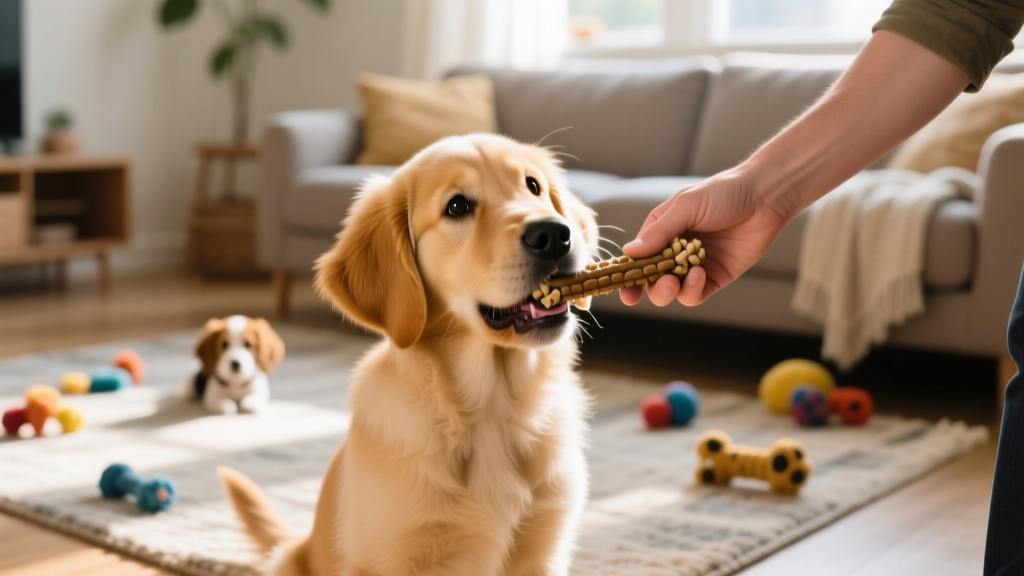
- Redirect: When teeth touch skin, say "oops" calmly, withdraw attention for 5 seconds, then offer an appropriate chew toy. Resume play when they chew the toy.
- Time-outs: If biting persists after 3 redirects, end the play session. Place puppy in a pen or crate for 30–60 seconds (not as punishment — as a calm-down reset).
- Never use: Muzzle grabbing, alpha rolls, holding the mouth shut, or spraying water. These create fear-based responses and damage trust.
- Timeline: Nipping decreases significantly by 5–6 months as adult teeth fully erupt and impulse control improves with maturity.
Excessive Whining in the Crate
- Rule out potty needs first (especially in puppies under 16 weeks)
- If recently pottied, wait for a 3–5 second pause in whining before releasing — this teaches silence, not noise, opens the door
- Place the crate in your bedroom for the first 2–3 weeks so your scent and breathing sounds are comforting
- Use a Snuggle Puppy (heartbeat toy, ~$30–$40) for the first few nights to simulate littermate contact
Destructive Chewing
- Puppies chew to relieve teething pain and relieve boredom — provide 5–7 appropriate chew options rotated weekly to maintain novelty
- Manage the environment: use baby gates to restrict access to rooms with tempting items (shoes, cords, remote controls)
- Apply bitter apple spray (Grannick's Bitter Apple, ~$8–$12) to furniture legs and baseboards as a deterrent — but only alongside providing better alternatives
- Ensure adequate physical exercise and mental enrichment (snuffle mats, frozen Kongs, training sessions) — a tired puppy chews less
First-Year Cost Breakdown: Temecula, CA
Here's a realistic first-year budget for a puppy in the Temecula area, based on 2026 Inland Empire pricing. Costs are divided into initial (one-time) and recurring (annual) expenses:
| Category | Item | Low Estimate | High Estimate |
|---|---|---|---|
| Acquisition | Adoption fee (rescue) OR breeder puppy | $150 (rescue) | $3,500 (breeder) |
| Veterinary | Initial exam + puppy vaccine series (3 visits) | $200 | $400 |
| Veterinary | Spay/neuter surgery | $300 | $800 |
| Veterinary | Microchip + registration | $45 | $75 |
| Veterinary | Flea/tick + heartworm prevention (12 months) | $180 | $360 |
| Food | Puppy food (12 months, varies by breed size) | $420 | $1,200 |
| Supplies | Crate, bed, leash, collar, bowls, toys, gate | $200 | $500 |
| Training | Puppy class (6–8 weeks) + optional private sessions | $149 | $600 |
| Licensing | City of Temecula dog license (annual) | $20 | $50 |
| Insurance | Pet insurance (optional, monthly premium) | $360 | $840 |
| Grooming | Breed-dependent (bathing, nail trims, haircuts) | $0 (home care) | $600 |
| TOTAL | First year (excluding acquisition) | $1,874 | $5,425 |
Budget-saving strategies for Temecula puppy owners:
- Adopt from a rescue — many include first vaccines, microchip, and spay/neuter in the adoption fee, saving $500–$1,200
- Ask about puppy wellness bundles at local vets (Temecula vet clinics typically offer 10–20% savings on bundled packages)
- Buy supplies from Chewy or Amazon during sales rather than full retail at brick-and-mortar stores (saves 15–30% on hard goods)
- Consider pet insurance early — premiums are lowest for puppies under 6 months, and pre-existing condition exclusions are minimized when you enroll before any health issues arise
Frequently Asked Questions
How often should I feed my puppy at 10 weeks old?
At 10 weeks, feed 4 meals per day spaced approximately 4 hours apart (e.g., 7 AM, 11 AM, 3 PM, 7 PM). Use the portion guide in the feeding table above based on your puppy's expected adult weight. Remove uneaten food after 15–20 minutes and adjust portions at the next meal based on body condition.
When can my puppy go outside and meet other dogs?
Your puppy can go outside in your own yard (if no unvaccinated dogs have access) immediately. For public spaces and meeting other dogs, wait until 1–2 weeks after the second DHPP vaccine (typically around 12–14 weeks). Fully vaccinated adult dogs in clean, controlled environments are safe for socialization before the full series is complete. Avoid dog parks until the complete DHPP series is finished at 16+ weeks.
How do I stop puppy biting and nipping?
Redirect biting to appropriate chew toys every single time teeth touch skin. Withdraw attention for 5 seconds after a bite, then re-engage with a toy. Use 30–60 second calm-down time-outs in a pen if biting escalates. Never use physical punishment. Expect significant improvement by 5–6 months as adult teeth erupt and impulse control develops.
When will my puppy be fully potty trained?
Most puppies achieve reliable house training (fewer than 1 accident per month) between 5–7 months with consistent scheduling. Small breeds may take longer (up to 9–10 months) due to smaller bladder capacity. Setbacks are normal during adolescence (6–10 months) and during moves, schedule changes, or illness. If accidents suddenly increase after a period of reliability, schedule a vet visit to rule out urinary tract infections.
What vaccines does my puppy need and when?
Core vaccines include DHPP (distemper, hepatitis, parainfluenza, parvovirus) at 6–8, 10–12, and 14–16 weeks, plus rabies at 14–16 weeks. Bordetella (kennel cough) is recommended at 10–12 weeks if attending puppy classes. Leptospirosis, Lyme, and canine influenza are optional based on lifestyle. Consult your veterinarian to customize the schedule for your puppy's specific risk factors.
Is pet insurance worth it for a puppy?
Enrolling a puppy under 6 months typically costs $30–$70/month in the Temecula area (2026 pricing from major providers like Trupanion, Healthy Paws, and Lemonade). The advantage is locking in coverage before any conditions are documented — once a diagnosis appears in your puppy's medical record, it becomes a pre-existing condition exclusion for life. Given that emergency vet visits in Riverside County average $800–$3,000 and surgeries can exceed $5,000, insurance is a strong consideration for budget-conscious owners who want protection against catastrophic costs.
Tom Renshaw
All our authors care for dogs every day — read more of their work on the authors page.