Potty Training Tips Puppies Need by Age: A Complete Week-by-Week Guide
Expert potty training tips puppies actually respond to, organized by age milestones from 8 weeks to 12 months.
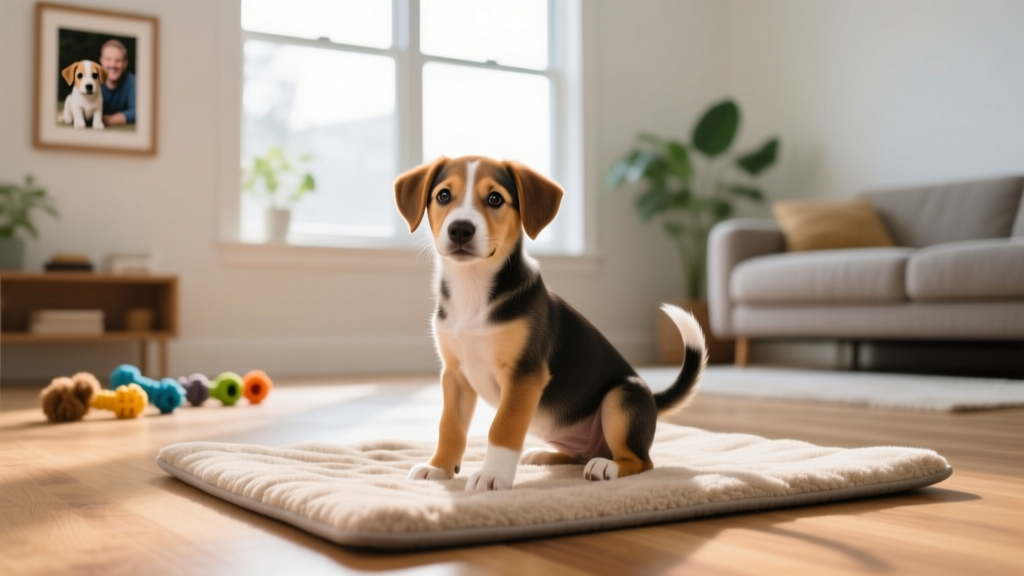
Bringing a new puppy home is exhilarating — until the third puddle on your rug at 2 a.m. If you're searching for potty training tips puppies actually follow, the secret isn't a magic spray or a single trick. It's understanding what your puppy is physically and mentally capable of at each developmental stage, then matching your expectations to their biology.
This guide walks you through every critical milestone from the day you bring your puppy home through their first year, with realistic timelines, exact feeding portions, vaccination schedules, and troubleshooting strategies that work in real multi-dog households. All training recommendations follow AVSAB's position on humane, force-free methods.
- 8–12 weeks: Accident-heavy; bladder holds 1–2 hours max
- 12–16 weeks: Patterns emerge; bladder holds 2–3 hours
- 16–24 weeks: Reliable with schedule; bladder holds 3–4 hours
- 6–12 months: Near-full reliability; bladder holds 5–8 hours
Note: Small and toy breeds may lag 2–4 weeks behind large breeds due to smaller bladder capacity.
When Should I Bring My Puppy Home?
The American Kennel Club recommends puppies stay with their mother and littermates until at least 8 weeks of age (56 days). For toy breeds like Chihuahuas, Yorkshire Terriers, and Pomeranians, many responsible breeders keep puppies until 10–12 weeks because they mature more slowly and are more fragile during the transition.
During weeks 4–8, littermates teach bite inhibition, social signaling, and basic canine communication. Puppies removed before 7 weeks show higher rates of fear-based aggression and separation anxiety later in life, according to a study published in the Journal of Veterinary Behavior.
What to Expect in the First 72 Hours Home
Plan for disrupted sleep, frequent potty breaks (every 60–90 minutes during the day), and stress-related loose stools. This is normal. Keep your puppy's world small: one room, one potty spot, one sleeping area. Overstimulation in the first week directly correlates with more accidents and more crying.
Age-Specific Milestones: What Your Puppy Can Do and When
Every training decision should map to your puppy's developmental window. Here's what to expect — and what to ask of them — at each stage.
| Age Range | Developmental Stage | Potty Capacity | Training Focus |
|---|---|---|---|
| 4–8 weeks | Socialization period begins; still with breeder/litter | 30–60 minutes | Breeder introduces potty area; substrate preference forms |
| 8–12 weeks | Human socialization peak; fear period begins (~8–11 weeks) | 1–2 hours | Establish potty spot, reward outdoor elimination, begin crate training |
| 12–16 weeks | Fear period may continue; teething begins; bladder control improves | 2–3 hours | Extend intervals, add verbal cue, troubleshoot regression |
| 16–24 weeks | Second fear period possible (~6–8 months); independence grows | 3–4 hours | Fade treat frequency, generalize to new locations, handle marking onset |
| 6–12 months | Adolescence; hormonal surges; sexual maturity | 5–8 hours | Address marking behavior, reinforce reliability, manage regression from spay/neuter recovery |
Feeding Schedule: Exact Portions by Age and Weight
Feeding drives potty schedules. Puppies typically need to eliminate 10–20 minutes after eating, so precise meal timing is the backbone of every successful potty training plan. Free-feeding (leaving food out all day) makes potty training nearly impossible because you can't predict elimination windows.
The portions below assume a high-quality, AAFCO-approved puppy kibble with approximately 350–420 kcal/cup. Always check your specific food's guaranteed analysis and feeding chart, then adjust based on body condition score (BCS). Your puppy should have a visible waist when viewed from above and ribs you can feel but not see.
| Age | Meals per Day | Small Breed (5–15 lb adult) | Medium Breed (25–50 lb adult) | Large Breed (60–100+ lb adult) |
|---|---|---|---|---|
| 8–12 weeks | 4 meals | ¼–½ cup/day total | ¾–1¼ cups/day total | 1½–2½ cups/day total |
| 12–16 weeks | 3 meals | ⅓–⅔ cup/day total | 1–1¾ cups/day total | 2–3½ cups/day total |
| 4–6 months | 3 meals | ½–¾ cup/day total | 1½–2½ cups/day total | 3–4½ cups/day total |
| 6–12 months | 2 meals | ½–¾ cup/day total | 2–3 cups/day total | 3½–5 cups/day total |
Potty Training Timeline: Realistic Expectations and Troubleshooting
Let's address the question every new puppy owner asks: When will my puppy be fully potty trained?
Most puppies achieve reliable house training between 4 and 6 months of age. Some small breeds (under 15 lb adult weight) take until 8–10 months due to smaller bladder capacity and higher metabolism. "Fully trained" means fewer than one accident per month with a consistent schedule — not zero accidents ever.
The Core Potty Training Protocol
- Take your puppy to the same outdoor spot every time. Scent triggers elimination.
- Use a consistent verbal cue like "go potty" or "do your business" as they begin to eliminate — not before.
- Reward immediately (within 1–2 seconds) with a high-value treat (freeze-dried liver, small cheese pieces) delivered outdoors, not after coming back inside.
- Supervise or confine. At 8–12 weeks, your puppy should be within eyesight or in a crate/pen at all times. A tethered leash to your waist works well during the day.
- Log everything. Track time of meals, water, potty trips, and accidents for the first 3 weeks. Patterns will emerge that let you prevent accidents before they happen.
| Time | Activity | Potty? | Notes |
|---|---|---|---|
| 6:30 AM | Wake up → outside immediately | ✅ Pee + poop | Took 4 minutes; used cue |
| 6:45 AM | Breakfast (½ cup kibble) | — | Ate in 6 minutes |
| 7:00 AM | Outside (post-meal trip) | ✅ Pee | Quick trip; no poop |
| 7:15 AM | Play session | — | 15 min play then crate nap |
Print or replicate this log for your first 21 days. You'll spot accident triggers (post-play, post-nap, post-meal) within a week.
Common Potty Training Problems and Fixes
Problem: Puppy pees inside 5 minutes after coming back in from outside.
Cause: They didn't actually eliminate outdoors — they were too distracted. Fix: Go back out immediately. Use a leash to keep them in the potty spot. Wait up to 10 minutes. If nothing happens, crate for 15 minutes, then try again. Do not give free roam until they've eliminated.
Problem: Puppy was doing great, then started having accidents again at 4–5 months.
Cause: This is a normal developmental regression linked to increasing independence and the second fear period. Fix: Return to 8-week-level supervision for 1–2 weeks. Increase potty trip frequency. Rule out a urinary tract infection with your vet if accidents involve small, frequent urination or straining.
Problem: Puppy only pees on pee pads, won't go outside.
Cause: Substrate preference established too strongly. Fix: Move the pad closer to the door each day, then outside, then remove it. Simultaneously, take the pad outside to the target potty spot so the scent transfers. This transition typically takes 7–14 days.
Socialization Window: Weeks 3–14 Exposure Checklist
The primary socialization window closes between 12 and 14 weeks of age. After this period, unfamiliar stimuli are more likely to trigger fear responses. The AVMA emphasizes that the behavioral risk of under-socialization (fear, aggression, relinquishment) outweighs the disease risk of controlled exposure before full vaccination.
This does NOT mean taking your unvaccinated puppy to dog parks or pet stores. It means structured, controlled exposure in safe environments.
Vaccination Schedule: What Your Puppy Needs and When
The AAHA canine vaccination guidelines recommend the following core vaccine schedule. Your veterinarian may adjust timing based on local disease prevalence and your puppy's risk profile.
| Age | Vaccine | Type | Notes |
|---|---|---|---|
| 6–8 weeks | DHPP (Distemper, Hepatitis/Adenovirus, Parainfluenza, Parvovirus) | Core | Often given by breeder; maternal antibodies may interfere |
| 10–12 weeks | DHPP booster + Bordetella (optional, based on lifestyle) | Core + Non-core | Bordetella recommended if attending puppy classes or boarding |
| 14–16 weeks | DHPP final booster + Rabies (required by law in most US states) | Core | This is the critical final booster; maternal antibodies have waned enough for full immune response |
| 12–16 months | DHPP booster + Rabies booster | Core | After this, DHPP moves to every 3 years; Rabies interval varies by state law (1 or 3 years) |
When can my puppy go outside and meet other dogs? Your puppy can explore your own yard (if no unknown dogs have access) immediately. For public spaces, dog parks, and group play, wait until one week after the final DHPP booster at 14–16 weeks — typically around 17 weeks of age. Controlled playdates with known, fully vaccinated dogs in private yards are safe earlier and essential for socialization.
Crate Training Progression and Time Limits by Age
A crate is the single most effective potty training tool because dogs instinctively avoid soiling their sleeping space. But crate time has hard biological limits. Exceeding them creates distress, not training.
| Puppy Age | Max Crate Time (Daytime) | Max Crate Time (Overnight) | Crate Size Guidance |
|---|---|---|---|
| 8–10 weeks | 30–60 minutes | 2–3 hours (expect overnight wake-up) | Just large enough to stand, turn, and lie down; use divider in larger crate |
| 11–14 weeks | 1–2 hours | 3–4 hours | Expand divider as puppy grows |
| 15–16 weeks | 2–3 hours | 4–5 hours | Full crate size if no accidents in crate |
| 4–6 months | 3–4 hours | 6–7 hours | Full adult crate size |
| 6+ months | 4–5 hours | 7–8 hours | Full adult crate size |
Crate training tips that work: Feed all meals in the crate with the door open for the first week. Introduce a stuffed Kong or lick mat to build positive association. Never use the crate as punishment. If your puppy whines after being settled for 15+ minutes, take them out to potty, then return them to the crate — this teaches that whining leads to potty trips, not playtime.
Teething Timeline (3–6 Months): Relief Strategies and Safe Chews
Puppy teething follows a predictable sequence. Deciduous (baby) teeth begin erupting at 3–4 weeks and are fully in by 6–8 weeks. Adult teeth start pushing through at approximately 12–16 weeks, and all 42 permanent teeth are typically in place by 6–7 months.
During peak teething (3–5 months), your puppy will chew everything. This is not misbehavior — it's pain relief.
Safe Chew Recommendations by Age
- 8–12 weeks: Soft rubber toys (Kong Puppy, West Paw Tux), frozen wet washcloths (twist, wet, freeze), Nylabone Puppy chew (soft formula)
- 12–16 weeks: Kong Classic (red, medium hardness), Benebone Puppy, frozen carrot sticks (supervised, discard small pieces)
- 4–6 months: Kong Classic (black, durable), bully sticks (supervised, remove when under 3 inches to prevent choking), yak cheese chews (for strong chewers)
Common Puppy Problems: Biting, Whining, and Chewing
How Do I Stop Puppy Biting and Nipping?
Puppy biting peaks between 8 and 16 weeks and is a normal part of play and teething exploration. It does NOT mean your puppy is aggressive. The goal is to teach bite inhibition — softening the mouth — not to eliminate mouthing entirely (that happens naturally as adult teeth come in).
The protocol:
- When teeth touch skin, say "oops" or "too bad" in a calm, neutral tone (not a yelp — yelping excites some puppies more).
- Immediately withdraw attention: stand up, cross your arms, look away for 10–15 seconds.
- Return and redirect to an appropriate chew toy.
- If biting continues after 3 redirections, the puppy is overstimulated. Place them in their crate for a 15–20 minute nap. Most biting episodes are caused by overtiredness, not defiance.
Puppies typically need 16–18 hours of sleep per day at 8–12 weeks. If your puppy is biting constantly in the evening, they're almost certainly sleep-deprived. Enforce naps.
Nighttime Whining in the Crate
Set an alarm for one overnight potty break (around 2–3 AM for an 8–10 week old). Take them out on leash, no play, no lights, straight back to crate. If they whine after eliminating and being settled, wait 5–10 minutes before intervening. Most puppies self-soothe within this window if they don't need to potty.
Destructive Chewing
Between 4 and 7 months, chewing intensity peaks as adult teeth set. Puppy-proof your home: use bitter apple spray (Grannick's Bitter Apple, approximately $8–12 per bottle) on baseboards and furniture legs. Provide 5–7 approved chew items rotated weekly to maintain novelty. Confine to a puppy-safe room or pen when unsupervised.
First-Year Cost Breakdown: What to Budget
New puppy owners consistently underestimate first-year costs. Here's a realistic breakdown based on 2026 US pricing for a medium-breed puppy (30–50 lb adult weight).
| Category | Low Estimate | Medium Estimate | High Estimate |
|---|---|---|---|
| Puppy purchase/adoption | $150 (rescue) | $1,500 (responsible breeder) | $3,500+ (specialty breed) |
| Veterinary (first year) | $400 | $700 | $1,200 |
| Spay/neuter | $200 | $500 | $800 |
| Food (12 months) | $300 | $550 | $900 |
| Supplies (crate, bed, leash, bowls, toys, chews) | $200 | $400 | $700 |
| Training (group classes or private) | $150 | $400 | $1,200 |
| Preventives (flea/tick, heartworm — 12 months) | $180 | $300 | $450 |
| Pet insurance (annual premium) | $350 | $600 | $900 |
| TOTAL FIRST YEAR | $1,930 | $4,950 | $9,650 |
Veterinary costs include initial exam, DHPP series (3 visits), rabies vaccine, fecal tests, deworming, and a wellness check. Emergency visits for common puppy issues (foreign body ingestion, parvo exposure, broken teeth) can add $800–$5,000+ per incident. Pet insurance purchased at 8 weeks typically has no pre-existing condition exclusions and lower premiums — making it most cost-effective when started early.
Frequently Asked Questions
How often should I feed my puppy at 10 weeks old?
Four meals per day, spaced approximately 4 hours apart (e.g., 7 AM, 11 AM, 3 PM, 7 PM). Each meal should be roughly 25% of the daily portion. Remove uneaten food after 15–20 minutes to establish meal-time routines. Consistent feeding schedules are the foundation of predictable potty schedules.
When will my puppy sleep through the night without a potty break?
Most puppies can hold their bladder for 6–8 hours overnight by 14–16 weeks of age. Before that, plan for at least one overnight trip. Set an alarm rather than waiting for whining — proactive trips prevent the whining habit from forming.
My puppy keeps peeing in the same spot inside. How do I break the habit?
Enzymatic cleaners are essential — standard household cleaners don't break down uric acid crystals that dogs can smell long after you can't. Use a product like Nature's Miracle or Rocco & Roxie (approximately $12–20 per bottle). Saturate the area, let it sit for 10–15 minutes, and blot. Then block access to that spot or place a food bowl nearby — dogs avoid eliminating near food.
Is it okay to use pee pads while potty training?
Pee pads can be useful for apartment dwellers on high floors or owners with mobility limitations. However, they teach puppies that indoor elimination is acceptable, which extends the overall training timeline by an estimated 3–6 weeks. If you must use pads, designate a specific area and plan to transition outdoors by gradually moving the pad closer to the door and then outside.
My puppy was house trained and now has accidents again. What's wrong?
Regression between 4–8 months is extremely common and usually linked to developmental changes, not failure. Return to intensive supervision and more frequent potty trips for 2 weeks. If accidents involve straining, blood in urine, excessive thirst, or diarrhea, schedule a vet visit to rule out UTI, parasites, or other medical causes before assuming it's behavioral.
Marcus Aldridge
All our authors care for dogs every day — read more of their work on the authors page.


