10 Popular Puppy Breeds With Pictures: A First-Year Care Guide
Explore 10 popular puppy breeds with pictures and get a complete first-year care guide covering feeding, potty training, vaccines, socialization, and costs.

Choosing Your Puppy: 10 Popular Breeds With Pictures and What to Expect
Bringing home a puppy is one of life's greatest joys — and one of its steepest learning curves. If you've been browsing puppy breeds with pictures trying to decide which dog fits your home, you've probably noticed that every breed looks adorable at eight weeks old. The real question isn't which puppy is cutest in a photo — it's which breed's temperament, energy level, adult size, and health profile align with your lifestyle for the next 12 to 15 years.
This guide walks you through 10 of the most popular puppy breeds in the U.S. with visual descriptions, then provides a detailed, age-by-age first-year care roadmap that applies whether you're bringing home a Labrador Retriever, a French Bulldog, or a Miniature Poodle. We'll cover exact feeding portions, vaccine timelines, potty training expectations, crate training progression, and realistic first-year costs — the kind of specifics most puppy guides gloss over.
10 Popular Puppy Breeds: Visual Profiles at a Glance
Below are 10 breeds that consistently top AKC registration and adoption popularity lists. Each profile includes what the puppy looks like, what the adult dog becomes, and the practical realities of raising that breed.
| Breed | Puppy Appearance | Adult Weight | Adult Height | Lifespan | Energy Level |
|---|---|---|---|---|---|
| Labrador Retriever | Stocky build, broad head, short dense coat in yellow, black, or chocolate. Floppy ears, otter-like tail. | 55–80 lb / 25–36 kg | 21.5–24.5 in | 11–13 years | High (60–90 min/day) |
| Golden Retriever | Creamy to rich gold wavy coat, gentle expression, sturdy build. Feathering on legs and tail. | 55–75 lb / 25–34 kg | 21.5–24 in | 10–12 years | High (60–90 min/day) |
| French Bulldog | Compact, muscular, bat-like erect ears, flat brachycephalic face, smooth short coat in fawn, brindle, or pied. | 16–28 lb / 7–13 kg | 11–13 in | 10–12 years | Low–Moderate (20–30 min/day) |
| German Shepherd | Large, pointed erect ears, tan/black saddle coat, long bushy tail. Alert, confident expression even as a puppy. | 50–90 lb / 23–41 kg | 22–26 in | 9–13 years | Very High (90–120 min/day) |
| Poodle (Standard/Miniature) | Curly, low-shedding coat in white, black, apricot, or parti. Elegant proportions, dark oval eyes, long drop ears. | Std: 40–70 lb / 18–32 kg Mini: 10–15 lb / 5–7 kg | Std: 15+ in Mini: 10–15 in | 12–15 years | Moderate–High (45–60 min/day) |
| Bulldog (English) | Heavy, low-slung body, massive pushed-in head, rose ears, wrinkled face, short smooth coat in red, white, fawn, or brindle. | 40–50 lb / 18–23 kg | 14–15 in | 8–10 years | Low (15–25 min/day) |
| Beagle | Compact hound, tricolor (black/tan/white) or lemon, long floppy ears, pleading brown eyes, short dense coat. | 20–30 lb / 9–14 kg | 13–15 in | 12–15 years | Moderate–High (45–60 min/day) |
| Rottweiler | Robust, black coat with defined tan markings on muzzle, chest, and legs. Broad head, cropped or natural drop ears. | 80–135 lb / 36–61 kg | 22–27 in | 9–10 years | Moderate–High (60–90 min/day) |
| Yorkshire Terrier | Tiny, silky straight coat (puppies are born black/tan, lightening with age), compact build, V-shaped erect ears, dark eyes. | 4–7 lb / 2–3 kg | 7–8 in | 13–16 years | Moderate (20–30 min/day) |
| Dachshund | Elongated body, very short legs, deep chest, long floppy ears. Smooth, longhaired, or wirehaired coat in red, black/tan, dapple, and more. | Std: 16–32 lb / 7–15 kg Mini: ≤11 lb / ≤5 kg | Std: 8–9 in Mini: 5–6 in | 12–16 years | Moderate (30–45 min/day) |
Age-by-Age Puppy Milestones: What to Expect From Week 4 to Month 12
Every puppy — regardless of breed — passes through predictable developmental stages. Understanding these windows helps you set realistic expectations and act during critical periods, especially the socialization window that closes around 14 weeks.
Weeks 4–8: Litter Life and Early Learning
Your puppy is still with the breeder or foster during this period. Key developments include:
- Sensory development: Eyes fully open by week 4; hearing sharpens. Puppy begins responding to human voices and handling.
- Social play: Littermates teach bite inhibition — a puppy that bites too hard gets yelped at and shunned. This is irreplaceable social learning.
- Weaning: Transition from mother's milk to gruel (puppy kibble soaked in warm water or puppy formula) around week 4, fully weaned by week 7–8.
- First deworming: Typically at 2, 4, 6, and 8 weeks (pyrantel pamoate is standard).
Weeks 8–12: The Homecoming and Fear Impact Period
This is when most puppies join their new families. Expect:
- Adjustment stress: Whining, crying at night, and clingy behavior for the first 3–7 nights is normal. A Snuggle Puppy (with heartbeat simulator, ~$35–$45) placed in the crate can ease the transition.
- Fear imprint period (8–11 weeks): Traumatic experiences during this window can create lasting phobias. Avoid forced interactions, loud environments, or painful procedures (like elective ear cropping) during this time if possible.
- Bonding: Your puppy is primed to attach. Spend at least 2–3 hours of structured, calm interaction daily.
- First vet visit: Schedule within 48–72 hours of bringing your puppy home for a wellness exam and to begin the vaccination series.
Weeks 12–16: Building Confidence and Foundation Skills
- Socialization peak: Your puppy should be meeting new people, surfaces, sounds, and environments regularly — aim for 2–3 novel experiences per day.
- Basic commands: This is the ideal window to introduce sit, down, come, name recognition, and leash walking using positive reinforcement (treat rewards, clicker training).
- Bladder control improving: Expect accidents to decrease as your puppy can hold for roughly 1 hour per month of age plus 1 (a 3-month-old can hold ~4 hours, but shouldn't be expected to regularly).
- Second fear period may begin: Around 12–14 weeks, some puppies become temporarily cautious. Don't force interactions; let your puppy observe from a distance and reward calm behavior.
Weeks 16–24: Adolescence Begins
- Testing boundaries: Your puppy may "forget" commands, become more distracted, and push limits. Consistency is critical — don't relax rules because your puppy is "older now."
- Teething begins (around 3–4 months): Baby teeth fall out, adult teeth erupt. Expect increased chewing, drooling, and occasional blood on toys (normal).
- Energy surge: Especially in sporting and working breeds (Labs, German Shepherds, Rottweilers), exercise needs increase. Add structured physical activity and mental enrichment (puzzle feeders, snuffle mats).
Months 6–12: The Teenage Phase
- Sexual maturity: Most breeds reach sexual maturity between 6–9 months. Discuss spay/neuter timing with your veterinarian — current veterinary research suggests delaying until growth plates close (around 12–18 months for large breeds) may reduce orthopedic risks.
- Size stabilization: Small breeds reach adult size around 9–12 months; large breeds continue growing until 18–24 months.
- Behavioral consolidation: Training habits established now become lifelong patterns. Enroll in intermediate obedience or sport classes (agility, rally, nose work) to channel adolescent energy constructively.
Feeding Schedule: Exact Portions by Age and Weight
Overfeeding is the most common nutritional mistake puppy owners make. Excess calories in large-breed puppies (like German Shepherds, Labs, and Rottweilers) can cause rapid bone growth that outpaces muscle and tendon development, increasing the risk of hip dysplasia and other orthopedic conditions. The Merck Veterinary Manual recommends feeding large-breed puppies a diet specifically formulated for large-breed growth (AAFCO statement should say "growth" or "all life stages" with a note about large-breed size).
| Age | Meals Per Day | Small Breed (≤20 lb adult) Cups/Day |
Medium Breed (21–50 lb adult) Cups/Day |
Large Breed (51–100 lb adult) Cups/Day |
Giant Breed (>100 lb adult) Cups/Day |
|---|---|---|---|---|---|
| 8–12 weeks | 4 | ½ – ¾ | 1 – 1½ | 1½ – 2½ | 2½ – 4 |
| 3–6 months | 3 | ¾ – 1 | 1½ – 2½ | 2½ – 4 | 4 – 6 |
| 6–12 months | 2 | ¾ – 1 (transition to adult food at 9–12 mo) | 2 – 3 (transition at 12 mo) | 3½ – 5 (stay on puppy food until 12–18 mo) | 5 – 8 (stay on puppy food until 18–24 mo) |
Important notes: These are starting estimates. Always adjust based on your puppy's body condition score (BCS) — you should be able to feel ribs without pressing hard, and see a visible waist when looking from above. Consult your veterinarian for breed-specific caloric needs. Look for an AAFCO statement of nutritional adequacy on any food you choose.
Vaccination Schedule: Core and Optional Vaccines by Week
Your puppy's immune system is immature at birth. Maternal antibodies from colostrum provide temporary protection, but these antibodies also interfere with vaccines — which is why puppies receive a series of boosters rather than a single shot. The series ensures at least one dose lands when maternal antibodies have dropped enough for the vaccine to trigger the puppy's own immune response.
| Age | Core Vaccines | Lifestyle/Optional Vaccines | Notes |
|---|---|---|---|
| 6–8 weeks | DHPP (Distemper, Hepatitis/Adenovirus, Parainfluenza, Parvovirus) — Dose 1 | Bordetella (if entering group classes or boarding) | Often given by breeder before pickup |
| 10–12 weeks | DHPP — Dose 2 | Leptospirosis (Dose 1), Lyme disease (if in endemic area), Canine influenza H3N2/H3N8 (Dose 1) | Maternal antibodies declining; immune response improving |
| 14–16 weeks | DHPP — Dose 3 Rabies (single dose, legally required) | Leptospirosis (Dose 2), Lyme (Dose 2), Canine influenza (Dose 2) | Final DHPP dose at ≥16 weeks is critical — this is when maternal antibodies are reliably low enough |
| 12–16 months | DHPP booster, Rabies booster (1-yr or 3-yr per local law) | Boosters for lifestyle vaccines as recommended | First annual wellness exam; discuss titer testing as an alternative to future DHPP boosters |
Potty Training: Realistic Timeline and Troubleshooting
Let's set expectations clearly: most puppies are not reliably house-trained until 4–6 months of age, and some breeds (especially toy breeds with tiny bladders) take up to 8–12 months. Any guide promising full potty training in 3 days is selling you frustration.
Bladder Capacity by Age
A useful rule of thumb: a puppy can hold their bladder for approximately 1 hour per month of age, plus 1 hour — but only during rest. Active puppies need more frequent breaks.
- 8–10 weeks: Every 30–60 minutes during the day, once or twice overnight
- 3 months: Every 1–2 hours during the day
- 4 months: Every 2–3 hours
- 6 months: Every 3–4 hours (approaching adult capacity)
Potty Training Protocol
- Establish a schedule: Take your puppy outside immediately upon waking, after every meal, after play sessions, and before bed. Use the same door and the same spot each time.
- Use a cue word: Say "go potty" (or your chosen phrase) consistently while they're eliminating. Within 2–3 weeks, most puppies will associate the cue with the action.
- Reward immediately: Give a high-value treat (small piece of chicken, cheese, or training treat) within 2 seconds of finishing outdoors. Delayed rewards don't connect the behavior to the consequence.
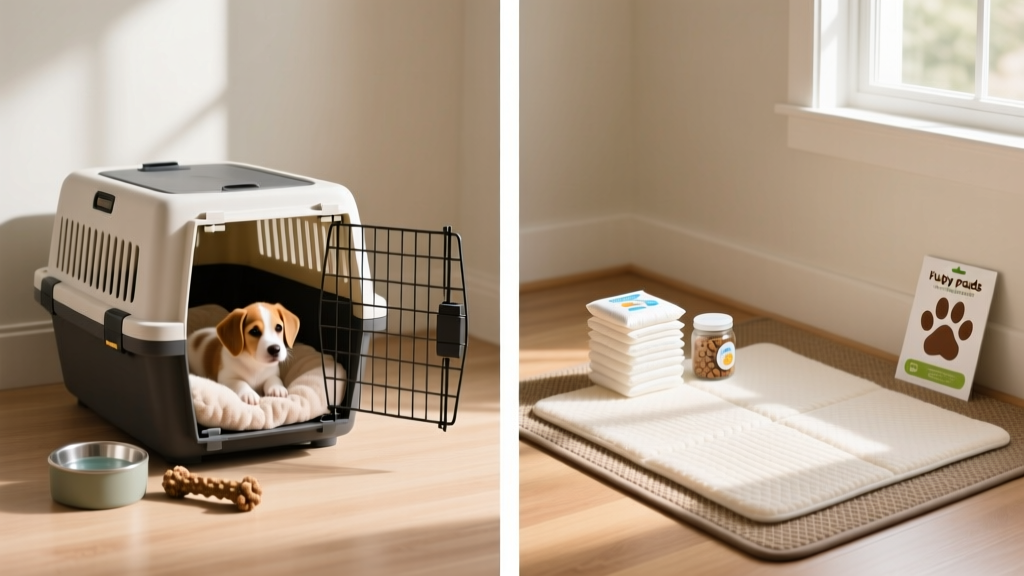
- Supervise or confine: When you can't watch your puppy, they should be in a crate or exercise pen. Unsupervised roaming is the #1 cause of potty training setbacks.
- Clean accidents enzymatically: Use an enzymatic cleaner (Nature's Miracle, Rocco & Roxie — $12–$18 per bottle) to completely break down urine proteins. Regular household cleaners leave residual scent that attracts repeat accidents.
Socialization Window: Your Puppy's Critical 3–14 Week Period
The primary socialization window — the period when puppies most readily accept new experiences without fear — runs from approximately 3 to 14 weeks of age. After this window closes, unfamiliar stimuli are more likely to trigger fear responses. Missed socialization is the leading behavioral reason dogs are surrendered to shelters.
Socialization Exposure Checklist
Aim to check off at least 3–5 items per day during weeks 8–14. Keep experiences positive — if your puppy shows fear, increase distance and use treats to create positive associations. Never force interactions.
- People: Children, elderly individuals, people wearing hats/sunglasses/masks, people with beards, people of different ethnicities, people using wheelchairs or crutches, delivery workers
- Surfaces: Grass, gravel, sand, metal grates, wet floors, carpet, tile, stairs, elevators
- Sounds: Vacuum cleaner, hair dryer, thunder (play recordings at low volume, gradually increase), fireworks recordings, doorbells, car horns, construction noise, children playing
- Objects: Umbrellas opening, plastic bags rustling, bicycles, skateboards, strollers, trash cans, automatic doors
- Handling: Paw touching, ear examination, mouth opening, nail clipping simulation, collar grabbing, being held gently, being placed on a table (grooming/vet prep)
- Other animals: Fully vaccinated, friendly adult dogs (arranged playdates), cats (supervised), livestock if in a rural area
- Environments: Car rides, parking lots, outdoor café patios, friends' homes, hardware stores (where permitted), veterinary clinic (positive visits without procedures)
Crate Training, Teething, and Common Puppy Problems
Crate Training Progression
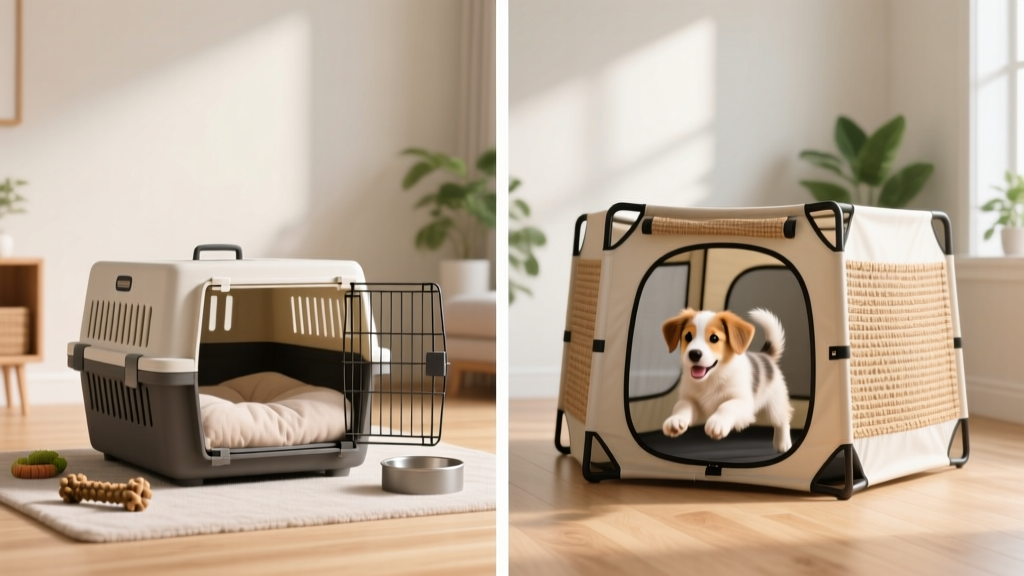
A crate is your puppy's safe den — not a punishment space. When introduced properly, most dogs come to voluntarily seek out their crate for rest. Here's a realistic time progression:
- 8–10 weeks: 30–60 minutes maximum while you're home; overnight, expect to set an alarm for one potty break (around 2–3 AM)
- 10–12 weeks: 1–2 hours during the day; overnight stretch increases to 4–5 hours for many puppies
- 3–4 months: 2–3 hours during the day; most puppies sleep through the night (6–8 hours) by 12–16 weeks
- 4–6 months: 3–4 hours during the day; never crate a puppy for more than 4 hours while awake and active — they need movement, socialization, and enrichment
Crate sizing: The crate should be large enough for your puppy to stand up, turn around, and lie down comfortably — but not so large that they can eliminate in one corner and sleep in another. For large-breed puppies, buy an adult-sized crate with a divider panel (MidWest iCrate with divider, $45–$75) and adjust as they grow.
Teething Timeline and Relief (3–6 Months)
Puppies have 28 deciduous (baby) teeth that begin erupting at 3–4 weeks and are fully in by 6–8 weeks. The 42 permanent teeth begin replacing them around 3–4 months, with the process typically complete by 6–7 months.
What to expect: Increased chewing, drooling, mild gum bleeding, temporary decrease in appetite, and finding baby teeth on the floor (though many puppies swallow them — harmless).
Safe relief strategies:
- Frozen washcloth: Wet a clean washcloth, twist into a rope, and freeze. The cold numbs gums and the texture satisfies chewing urges. Supervise to prevent swallowing fabric.
- KONG Classic (puppy rubber, pink/blue): Fill with a mixture of plain yogurt and mashed banana, then freeze. $12–$15 for the puppy-specific softer rubber formula.
- Nylabone Puppy Chew: Designed for developing teeth — softer than adult Nylabones. $6–$10. Replace when worn down to the size of a choking hazard.
- Carrot sticks (frozen): A low-calorie, safe edible chew. Supervise to prevent choking on large pieces.
Stopping Puppy Biting and Nipping
Puppy biting is normal — they explore the world with their mouths and haven't yet learned that human skin is completely off-limits. Here's how to address it using positive reinforcement methods:
- Redirect: When teeth touch skin, immediately offer an appropriate chew toy. Praise enthusiastically when they bite the toy instead.
- Withdraw attention: If redirecting doesn't work, stand up, cross your arms, and turn away for 10–15 seconds. This teaches that biting ends play — the opposite of what the puppy wants.
- Time-outs: For persistent biting, calmly place your puppy in their crate or a playpen for 30–60 seconds to calm down. This is a cool-down, not a punishment — keep it brief and neutral.
- Ensure adequate exercise and enrichment: Overtired and under-stimulated puppies bite more. A 12-week-old puppy needs roughly 15–20 minutes of structured activity per session, 3–4 times daily, plus 16–18 hours of sleep.
Never use physical punishment, muzzle grabbing, alpha rolls, or holding the mouth shut. These methods increase fear and aggression and damage your bond with your puppy.
First-Year Cost Breakdown: What to Budget
Puppy costs vary significantly by breed size, your location, and whether you choose premium or budget options. Below is a realistic first-year budget based on 2026 pricing for a medium-breed puppy (30–50 lb adult) in a mid-cost U.S. metro area.
| Category | Budget Range | Mid-Range | Premium |
|---|---|---|---|
| Puppy Purchase/Adoption | $150–$500 (rescue) | $1,500–$2,500 (responsible breeder) | $3,000–$5,000+ (show/working lines) |
| Veterinary (vaccines, exams, spay/neuter, preventives) | $600–$800 | $900–$1,400 | $1,500–$2,200 |
| Food (puppy formula, 12 months) | $300–$450 | $500–$750 | $800–$1,200 |
| Supplies (crate, bed, bowls, leash, collar, harness, toys, grooming tools) | $200–$350 | $400–$600 | $700–$1,000 |
| Training (group classes, 2–3 sessions) | $150–$250 | $300–$500 | $600–$1,200 (private sessions) |
| Pet Insurance (annual premium) | $350–$500 | $500–$800 | $800–$1,200 |
| Miscellaneous (dog walker, boarding, emergency fund contribution) | $200–$400 | $500–$1,000 | $1,500–$3,000 |
| TOTAL FIRST YEAR | $1,950–$3,250 | $5,600–$7,550 | $9,900–$14,800 |
Breed-specific cost notes: Giant breeds (Great Danes, Bernese Mountain Dogs) will cost 40–60% more in food and medication (dosed by weight). Brachycephalic breeds (French Bulldogs, English Bulldogs) often have higher veterinary costs due to respiratory issues, skin fold infections, and potential BOAS (brachycephalic obstructive airway syndrome) surgery, which can cost $3,000–$8,000. Pet insurance premiums are higher for breeds with known health predispositions.
Frequently Asked Questions
How often should I feed my puppy at 10 weeks old?
At 10 weeks, feed 4 meals per day, spaced roughly 4–5 hours apart during waking hours (for example: 7 AM, 12 PM, 5 PM, and 9 PM). Divide the daily portion equally across meals. Remove uneaten food after 15–20 minutes to establish a routine and monitor appetite — a sudden decrease in eating warrants a veterinary check.
What vaccines does my puppy need and when?
The core vaccine series is DHPP (protecting against distemper, hepatitis/adenovirus, parainfluenza, and parvovirus), given at 6–8 weeks, 10–12 weeks, and 14–16 weeks. Rabies is given once at 14–16 weeks and is legally required in all U.S. states. Lifestyle vaccines (Bordetella, Leptospirosis, Lyme, canine influenza) depend on your puppy's exposure risk — discuss with your veterinarian based on your area and activities.
How do I stop my puppy from biting everything?
Combine redirection (offer a chew toy the instant teeth touch skin), attention withdrawal (stop playing for 10–15 seconds), and ensure your puppy is getting adequate physical exercise and mental enrichment. Most puppies significantly reduce mouthing by 5–6 months as adult teeth come in and they learn boundaries. If biting is intense, frequent, or accompanied by growling and stiffening, consult a certified positive-reinforcement trainer or veterinary behaviorist.
When can my puppy go to the dog park?
Wait until at least 2 weeks after the final DHPP vaccine (typically given at 14–16 weeks), which means roughly 18 weeks of age. Even then, choose dog parks carefully — look for parks with separate small-dog areas, active supervision, and well-socialized dogs. Many trainers recommend avoiding dog parks entirely for puppies under 6 months due to the unpredictable nature of unknown dogs and the risk of traumatic encounters during developmental fear periods.
My puppy whines in the crate at night. What should I do?
First, rule out a potty need — take your puppy out on leash, keep it boring and quiet, then return to the crate. If they continue whining after eliminating, wait for a brief pause in the noise (even 3–5 seconds of silence) before offering calm reassurance. Avoid letting them out while actively crying, as this reinforces the behavior. Place the crate near your bed for the first few weeks so your puppy can hear and smell you. A worn t-shirt with your scent in the crate and a white noise machine can help. Most puppies adjust within 1–3 weeks.
Robin Maitland
All our authors care for dogs every day — read more of their work on the authors page.