Newfoundland Puppies: The Complete First-Year Care & Training Guide
Everything you need to raise Newfoundland puppies: age milestones, feeding schedules, vaccination timelines, potty training, socialization, and first-year costs.

Newfoundland puppies are among the most rewarding — and demanding — giant-breed pups you can bring home. A Newfie can go from a 12-pound fuzzball to a 120-pound adult in roughly 18 months, which means every feeding decision, training session, and veterinary visit carries outsized impact. Get the first year right and you'll have a calm, well-socialized companion; rush growth or skip critical socialization windows and you risk orthopedic problems, fear-based reactivity, and costly veterinary interventions.
This guide walks you through each developmental stage with exact numbers — portions, timeframes, costs — so you can plan realistically. Always consult your veterinarian before making changes to your puppy's diet, vaccination plan, or medication regimen, as individual needs vary.
When to Bring Your Newfoundland Puppy Home
Responsible breeders typically release Newfoundland puppies between 8 and 10 weeks of age. Some Newfie breeders hold puppies until 10-12 weeks to complete an additional round of vaccinations and early socialization — a practice supported by the AKC puppy development guidelines. Do not accept a puppy younger than 8 weeks; giant breeds need the extra littermate time to learn bite inhibition and canine communication.
Before pickup day, prepare:
- A 42-inch wire crate (you'll use this size for adulthood; block off excess space with a divider panel)
- An orthopedic bed rated for 100+ lb dogs (e.g., Big Barker 7" Pillow Top, ~$280-$340)
- Stainless steel bowls sized for 4-6 cups of food
- A 6-foot biothane leash and front-clip harness (size large, adjustable to 28-36" chest)
- Enzymatic cleaner (Nature's Miracle or Rocco & Roxie, ~$12-$18)
Newfoundland Puppy Milestones: Week by Week
Weeks 4–8: The Litter Phase (Breeder's Domain)
At 4 weeks, puppies begin weaning onto gruel (puppy kibble soaked in warm water or puppy-formulated milk replacer). By 6 weeks, most are eating solid food 3-4 times daily. This is when the breeder introduces novel textures, sounds, and gentle handling — known as the "sensory enrichment" period. Eyes and ears are fully functional by week 4, and puppies start practicing play-bowing, wrestling, and early bite inhibition with littermates. What you should verify: Ask your breeder for documentation of the puppy's first deworming (typically pyrantel pamoate at 2, 4, and 6 weeks) and a health certificate from a licensed veterinarian.
Weeks 8–12: The Homecoming Window
Your puppy weighs roughly 15-22 lb at 8 weeks and will gain approximately 3-5 lb per week during this period. Expect 18-20 hours of sleep per day, broken into 1-2 hour bursts. Puppies this age can hold their bladder for roughly 1 hour per month of age plus 1 — so about 3 hours maximum at 8 weeks, and 4 hours by 12 weeks. This is the peak of the socialization window, so prioritize positive exposure over formal obedience.
Weeks 12–16: Emerging Personality
Weight hits approximately 30-45 lb. Your puppy begins testing boundaries — ignoring recalls, mouthing harder, and showing early signs of resource guarding or leash reactivity if not addressed. Fear periods often occur around 12-14 weeks; a previously confident puppy may suddenly spook at garbage cans or unfamiliar surfaces. Never force exposure; let the puppy observe from a distance and reward calm behavior with high-value treats (boiled chicken, freeze-dried liver).
Weeks 16–24: The Adolescent Shift
Your Newfie now weighs 50-80 lb and has the energy and coordination to pull you off your feet. This is when many owners report "my puppy forgot everything" — a normal adolescent regression. Maintain training consistency, keep sessions short (5-10 minutes), and increase mental enrichment (snuffle mats, frozen Kongs, scent work). Teething peaks during this window (see teething section below).
Months 6–12: Giant-Breed Adolescence
By 6 months, your puppy weighs 65-90 lb. By 12 months, expect 95-130 lb depending on sex and genetics. Growth plates remain open until approximately 18-24 months, which means you must avoid forced running, jumping from heights, and repetitive high-impact exercise until your vet confirms growth plate closure via X-ray (typically $150-$250 for a screening set). Daily structured walks of 20-30 minutes plus free play are appropriate; avoid jogging or biking alongside your dog at this age.
Feeding Schedule and Portions for Newfoundland Puppies
Feed a large-breed puppy formula that meets AAFCO nutritional adequacy standards for growth, including large-breed growth (the label must state "including large-size dogs (70 lb or more as adults)"). Giant-breed puppies fed standard puppy food grow too rapidly, increasing the risk of hip dysplasia, elbow dysplasia, and osteochondritis dissecans (OCD). According to Merck Veterinary Manual, controlled growth rate is one of the most impactful factors in preventing orthopedic disease in giant breeds.
| Age | Est. Weight (lb) | Meals Per Day | Total Daily Portion (cups) | Calories/Day (approx.) |
|---|---|---|---|---|
| 8–12 weeks | 15–25 | 4 | 2.5–3.5 | 900–1,400 |
| 3–4 months | 25–40 | 3 | 3.5–4.5 | 1,200–1,800 |
| 5–6 months | 40–65 | 3 | 4.5–5.5 | 1,600–2,200 |
| 7–9 months | 65–95 | 2 | 5.5–7.0 | 1,900–2,800 |
| 10–12 months | 95–130 | 2 | 6.0–8.0 | 2,100–3,200 |
Key feeding rules for Newfies:
- Use a slow-feeder bowl or snuffle mat to reduce bloat (GDV) risk — giant deep-chested breeds are predisposed.
- Never feed one large meal; always split into at least two meals.
- Avoid elevated food bowls — a study published in the Journal of the American Veterinary Medical Association found elevated feeders may actually increase bloat risk in large breeds.
- Rest for 60-90 minutes after meals before exercise.
- Monitor body condition score (BCS): you should be able to feel ribs without pressing hard, and see a visible waist tuck from above. Aim for BCS 4-5/9.
Vaccination Schedule for Newfoundland Puppies
Your puppy's vaccination timeline is non-negotiable. Giant breeds follow the same core vaccine schedule as other dogs, but their larger body mass does not mean they need larger doses — vaccines are dosed uniformly regardless of weight. The AVMA vaccination guidelines and the AAHA Canine Vaccination Guidelines recommend the following schedule:
| Age | Vaccine(s) | Type | Est. Cost |
|---|---|---|---|
| 6–8 weeks | DHPP (Distemper, Hepatitis/Adenovirus, Parainfluenza, Parvovirus) | Core | $25–$45 |
| 10–12 weeks | DHPP booster + Leptospirosis (if risk area) + Bordetella (if boarding/daycare) | Core + Lifestyle | $40–$70 |
| 14–16 weeks | DHPP final booster + Rabies (required by law) | Core | $35–$60 |
| 12–16 months | DHPP booster + Rabies booster + Leptospirosis (annual if indicated) | Core + Lifestyle | $50–$90 |
Important notes:
- The final DHPP booster at 14-16 weeks is critical — maternal antibodies can interfere with earlier doses, leaving puppies vulnerable to parvovirus if the series is incomplete.
- Do not take your puppy to dog parks, pet stores, or group classes until at least 7 days after the final puppy vaccine (around 16-17 weeks).
- Some veterinarians recommend a Lyme vaccine for Newfies in tick-endemic areas (Northeast, Upper Midwest, Pacific Northwest). Discuss with your vet.
- Ask your vet about a titer test at 12 months to check antibody levels before automatically boosting.
The Socialization Window: Weeks 3–14
The primary socialization period closes around 12-14 weeks, and for Newfoundlands — a breed that can develop shyness or fear-based guarding if under-socialized — this window is especially important. According to the AKC socialization guidelines, positive exposure to a wide range of stimuli during this period shapes lifelong temperament.
Potty Training Your Newfoundland Puppy
Realistic timeline: most Newfoundland puppies are reliably house-trained by 5-7 months of age. Some individuals take longer — up to 9 months — because giant breeds mature more slowly in bladder control and cognitive development. Any guide promising full training in days is unrealistic for a giant breed.
Daily Potty Schedule Template (8-16 weeks):
- Immediately upon waking (every 1-2 hours overnight for 8-10 week olds)
- Within 10-15 minutes after every meal
- After every play session or training session
- After every nap
- Before crating
- Immediately after being released from the crate
- Every 1-2 hours during active periods regardless of the above
Troubleshooting common setbacks:
- Frequent small accidents: Rule out a urinary tract infection with your vet (urinalysis, ~$50-$80). UTIs are more common in female puppies.
- Submissive urination when greeted: Ignore the puppy for the first 30 seconds when arriving home. Greet calmly at their level without direct eye contact. This typically resolves by 6-8 months.
- Nighttime accidents after previously sleeping through: You may be hitting a growth spurt — temporarily set one overnight alarm at 3 AM for a quick potty break, then phase it out.
- Accidents only when left alone: This may signal separation distress, which Newfies are prone to. Consult a certified professional dog trainer (CPDT-KA) or veterinary behaviorist.
Crate Training Progression
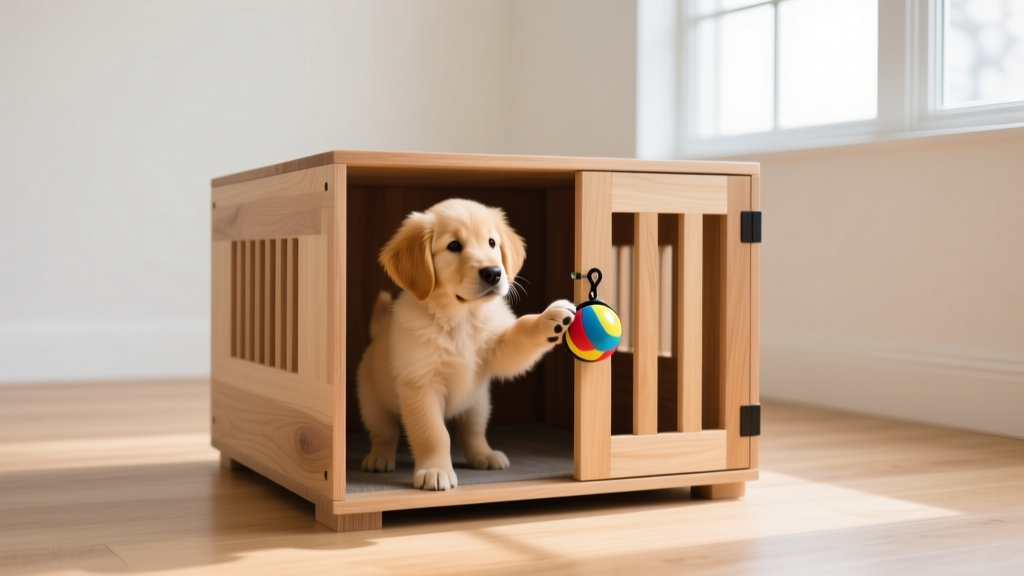
A properly crate-trained Newfie will accept confinement calmly throughout life — essential for vet visits, travel, and post-surgical recovery. Use a 42-inch wire crate with a divider panel; adjust the divider as your puppy grows so the space is just large enough to stand, turn around, and lie down.
| Puppy Age | Maximum Continuous Crate Time | Notes |
|---|---|---|
| 8–10 weeks | 1–2 hours (daytime), 2–3 hours (overnight with alarm) | Expect overnight whining; take out to potty and return immediately |
| 10–12 weeks | 2 hours (daytime), 4–5 hours (overnight) | Begin feeding meals inside the crate with door open |
| 3–4 months | 3 hours (daytime), 6–7 hours (overnight) | Introduce a stuffed Kong for longer sessions |
| 5–6 months | 4 hours (daytime), 7–8 hours (overnight) | Puppy should enter voluntarily for naps |
| 7–12 months | 5–6 hours (daytime), 8 hours (overnight) | Begin leaving crate door open during the day; dog chooses to rest inside |
Never use the crate as punishment. If your puppy soils the crate, clean it with enzymatic cleaner and evaluate whether you exceeded their bladder capacity or if the crate is too large (allowing them to eliminate in one corner and sleep in another).
Teething Timeline and Relief Strategies
Newfoundland puppies begin losing their 28 deciduous (baby) teeth around 3-4 months of age, with the full set of 42 adult teeth typically in place by 6-7 months. During this window, expect increased chewing, drooling, and occasional gum bleeding (a small amount on chew toys is normal).
Safe teething relief options:
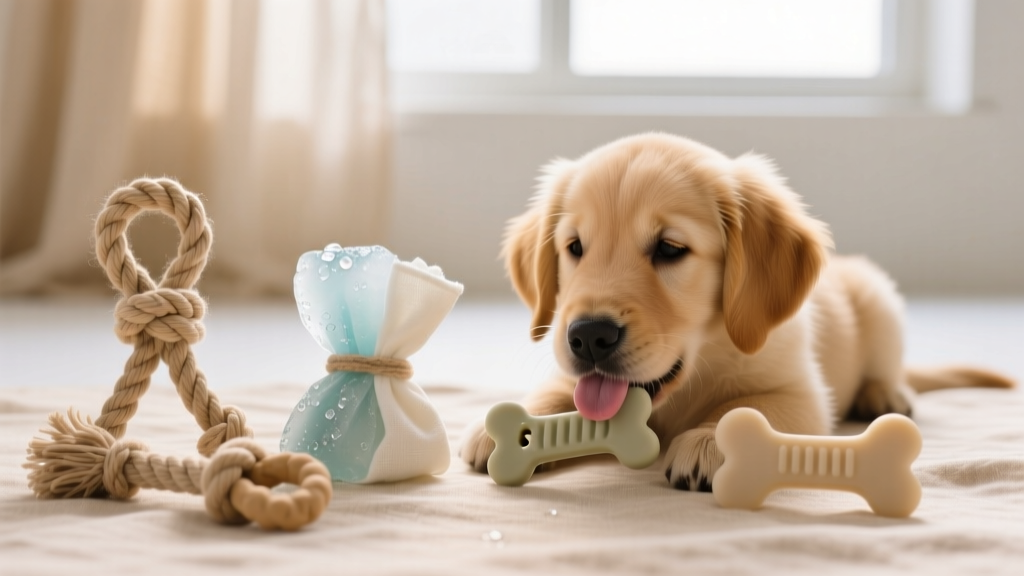
- Frozen Kong Classic (size XL for Newfies): Stuff with a mix of plain yogurt, mashed banana, and kibble, then freeze for 4-6 hours. The cold soothes inflamed gums.
- Benebone Puppy Wishbone: Made of softer nylon designed for puppy teeth. Replace once it's worn down to the wear indicator line (~$14-$18).
- Wet washcloth twist: Soak a clean washcloth in low-sodium chicken broth, twist into a rope shape, and freeze. Supervise to prevent swallowing fabric pieces.
- Yak cheese chews: Hard, long-lasting, and fully digestible. Choose a size your puppy cannot fit entirely in their mouth. Supervise and remove the last small piece to prevent choking.
Avoid: Rawhide (choking and blockage risk), ice cubes (can fracture teeth), cooked bones (splintering), and any chew toy smaller than your puppy's fist. If a retained baby tooth hasn't fallen out within 2 weeks of the adult tooth erupting beside it, your vet will need to extract it under sedation (~$150-$300 per tooth).
Common Newfoundland Puppy Problems and Solutions
Mouthing and Biting
Newfies are mouthy dogs — they were bred to haul nets, and carrying objects is in their DNA. Puppy nipping peaks between 8-16 weeks. When teeth touch skin, immediately say "oops" in a calm tone, stand up, and withdraw attention for 10-15 seconds. Redirect to an appropriate chew toy and reward. Never hold the puppy's mouth shut, tap the nose, or use any aversive technique — these damage trust and can escalate biting. If mouthing intensifies during the evening "witching hour," your puppy is likely overtired; initiate a calm crate nap with a frozen Kong.
Whining in the Crate
Distinguish between "I need to potty" whining (rhythmic, persistent, often after 2+ hours) and "I don't want to be alone" whining (intermittent, accompanied by scratching at the door). For potty whining: take out on leash, stand quietly for 5 minutes, return to crate if no elimination. For protest whining: wait for 3-5 seconds of silence before releasing, so you don't reinforce the noise. Covering the crate with a light blanket can reduce visual stimulation and help some puppies settle.
Destructive Chewing
Between 4-8 months, adolescent Newfies can destroy baseboards, shoes, and furniture legs with startling efficiency. Management is key: puppy-proof rooms by removing accessible items, use bitter apple spray on furniture legs, provide at least 4-5 rotating chew toys, and ensure 20-30 minutes of daily mental enrichment (training sessions, puzzle feeders, sniffaris). A tired Newfie puppy is a well-behaved Newfie puppy — but "tired" means mentally stimulated, not physically exhausted.
Jumping Up
A 40-lb puppy jumping on guests is amusing; a 120-lb adult doing the same is dangerous. Teach "four on the floor" from day one: reward all four paws on the ground with treats and attention. If the puppy jumps, turn sideways, fold your arms, and become uninteresting. Ask guests to do the same. For particularly persistent jumpers, keep your puppy on a leash during greetings and reward sitting 3 feet away from the person.
First-Year Cost Breakdown for a Newfoundland Puppy
Budget realistically. Giant-breed puppies are expensive in the first year due to food volume, large-size supplies, and preventive care scaled to their growing body.
| Category | Low Estimate | Typical Estimate | High Estimate |
|---|---|---|---|
| Puppy purchase (responsible breeder, health-tested parents) | $1,800 | $2,500 | $3,500 |
| Adoption (breed-specific rescue) | $400 | $600 | $800 |
| Veterinary care (vaccines, spay/neuter, wellness exams, fecal tests, heartworm prevention) | $800 | $1,200 | $2,000 |
| Food (large-breed puppy formula, 12 months) | $600 | $900 | $1,400 |
| Supplies (crate, bed, leash, harness, bowls, grooming tools, baby gates) | $400 | $650 | $1,000 |
| Training (puppy kindergarten + basic obedience group classes) | $200 | $400 | $800 |
| Grooming (professional baths and brush-outs, every 6-8 weeks) | $300 | $500 | $800 |
| Pet insurance (annual premium, comprehensive plan) | $500 | $750 | $1,200 |
| Emergency fund (recommended reserve) | $500 | $1,000 | $2,000 |
Total first-year cost (typical, breeder-purchased puppy): $7,000–$10,000. This does not include elective procedures (cosmetic ear cropping is not applicable to Newfies, but some owners opt for gastropexy — a preventive surgery to reduce bloat risk — at the time of spay/neuter, which adds $300-$600).
Frequently Asked Questions
When can my Newfoundland puppy go outside and meet other dogs?
Your puppy can explore your own yard immediately after coming home, provided no unvaccinated dogs have access to it. For public spaces and interactions with other dogs, wait until 7 days after the final DHPP booster at 14-16 weeks — typically around 16-17 weeks of age. Puppy socialization classes that require proof of at least the first two DHPP doses and maintain sanitized facilities are generally considered safe from 10-12 weeks onward, per AVMA guidance. Avoid dog parks entirely until the full vaccine series is complete and your puppy is confident enough to handle unpredictable adult dogs.
How do I stop my Newfoundland puppy from biting and nipping?
Use the "withdraw attention" method: when teeth contact skin, say a neutral marker word ("oops" or "too bad"), stand up, and turn away for 10-15 seconds. Then redirect to a chew toy and praise. Consistency from all household members is essential — if one person allows mouthing and another punishes it, the puppy becomes confused and the behavior persists. Expect mouthing to decrease significantly by 16-20 weeks as adult teeth come in and bite inhibition matures. If biting breaks skin or is accompanied by growling and stiff body language, consult a certified professional dog trainer (CPDT-KA) or veterinary behaviorist immediately.
How often should I feed my Newfoundland puppy?
At 8-12 weeks, feed 4 meals per day. At 3-6 months, reduce to 3 meals per day. At 7 months and beyond, feed 2 meals per day. Never feed a single daily meal — splitting food into multiple meals significantly reduces the risk of gastric dilatation-volvulus (bloat), a life-threatening emergency in giant breeds that requires immediate surgical intervention ($3,000-$7,000).
When will my Newfoundland puppy be fully potty trained?
Most Newfies achieve reliable house training between 5-7 months, with occasional accidents possible through 9 months. "Reliable" means zero accidents for 4+ consecutive weeks. If your puppy is still having frequent accidents past 6 months, consult your veterinarian to rule out medical causes (UTI, diabetes, kidney issues) before assuming it's a training problem.
What vaccines does my Newfoundland puppy need and when?
Core vaccines include DHPP (given at 6-8, 10-12, and 14-16 weeks, with a booster at 12-16 months) and Rabies (given at 14-16 weeks, booster at 12-16 months, then every 1-3 years per local law). Lifestyle vaccines your vet may recommend include Bordetella (for boarding/daycare), Leptospirosis (for dogs exposed to wildlife or standing water), and Lyme (for tick-endemic areas). See the vaccination table above for full details.
Should I spay or neuter my Newfoundland puppy, and when?
Current veterinary consensus for giant breeds recommends delaying spay/neuter until 12-18 months for females (after the first heat cycle) and 12-18 months for males. Early gonadectomy (before 6 months) has been associated with increased risk of orthopedic disorders (hip dysplasia, cranial cruciate ligament tears) and certain cancers in large and giant breeds, according to research from UC Davis. Discuss timing with your veterinarian, who can factor in your individual dog's health, lifestyle, and risk profile.
Raising a Newfoundland puppy is a significant investment of time, money, and patience — but the payoff is a gentle, loyal giant who bonds deeply with your family. Stay consistent with training, prioritize controlled growth over rapid size gains, and keep your veterinarian involved at every stage. Your future 130-pound lap dog will thank you.
Beth Carrasco
All our authors care for dogs every day — read more of their work on the authors page.