Neapolitan Mastiff Puppy Care
Complete Neapolitan Mastiff puppy guide covering feeding schedules, vaccination timelines, potty training, socialization, and first-year costs for this giant breed.

Bringing home a Neapolitan Mastiff puppy is not like bringing home a Labrador. These ancient Italian guardians grow into 150-pound dogs with deeply wrinkled faces, powerful protective instincts, and a stubborn streak that demands early, consistent training. The first twelve months shape whether your Neo becomes a calm, well-mannered family companion or an unmanageable giant. This guide walks you through every critical stage with breed-specific expectations, exact feeding amounts, and realistic timelines so you can raise your puppy with confidence.
When to Bring Your Neapolitan Mastiff Puppy Home
The American Kennel Club recommends that giant-breed puppies stay with their littermates until at least 10 to 12 weeks of age. For Neapolitan Mastiffs, the 12-week mark is ideal. Here's why:
- Weeks 8–10: The puppy is still learning bite inhibition from siblings. Removing them too early often results in harder mouthing and nipping that is much tougher to correct in a breed with jaws capable of 550+ PSI bite force.
- Weeks 10–12: The breeder should be introducing mild environmental stressors — different floor surfaces, car rides, unfamiliar people — to build resilience during the tail end of the primary socialization window.
- Health screening: A responsible breeder will have completed the puppy's first DHPP vaccine (around 6–8 weeks), at least two deworming rounds, and a preliminary veterinary exam before release.
Reputable Neapolitan Mastiff breeders registered with the AKC typically charge $2,500 to $5,000 for a pet-quality puppy. Expect a waitlist of 6 to 18 months. Always ask for OFA hip scores on both parents and a written health guarantee covering cherry eye, hip dysplasia, and cardiac conditions for at least two years.
Week-by-Week Milestone Timeline
Neapolitan Mastiff puppies develop on a different timeline than smaller breeds. Their massive skeletal frame takes 18 to 24 months to fully mature, and behavioral milestones lag behind physical growth. Use this timeline to set realistic expectations.
| Age Range | Weight Range (lb/kg) | Key Milestones | What to Expect |
|---|---|---|---|
| Weeks 4–8 | 10–25 lb / 4.5–11 kg | Weaning complete, first vaccine, littermate play | Puppy is with breeder. Teeth are sharp; mouthing is normal. Fear imprint period begins around week 8. |
| Weeks 8–12 | 25–45 lb / 11–20 kg | Home transition, crate introduction, name recognition | Expect 2–3 nights of crying. Puppy sleeps 18–20 hours/day. Begin short 5-minute leash walks on soft surfaces only. |
| Weeks 12–16 | 45–70 lb / 20–32 kg | Basic commands, potty training progress, second fear period | Growth spurts cause clumsiness. Puppy may suddenly refuse previously accepted stimuli. Keep training sessions under 5 minutes. |
| Weeks 16–24 | 70–110 lb / 32–50 kg | Teething peaks, advanced socialization, leash manners | Destructive chewing escalates. Puppy tests boundaries. Adolescent guarding behaviors may emerge — redirect, don't punish. |
| 6–12 Months | 110–150 lb / 50–68 kg | Sexual maturity, formal obedience classes, growth plate closure begins | Energy surges in short bursts followed by long naps. Spay/neuter discussion with vet (many giant-breed specialists recommend waiting until 12–18 months). |
Feeding Schedule and Portions by Age
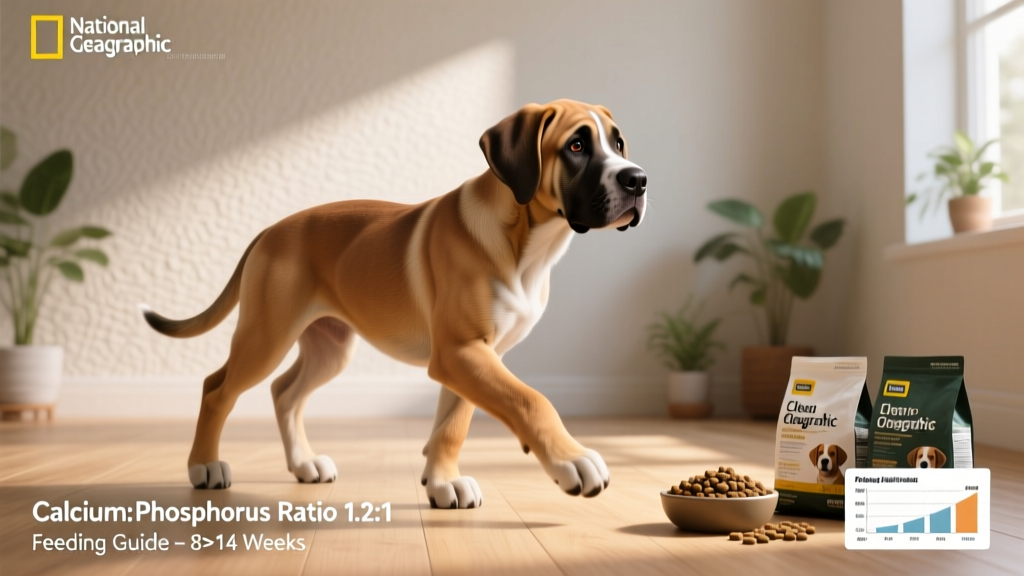
Neapolitan Mastiff puppies need a large-breed puppy formula with controlled calcium and phosphorus ratios (Ca:P between 1.1:1 and 1.4:1). Feeding a standard puppy food accelerates growth and increases orthopedic disease risk. Look for an AAFCO statement confirming the food meets nutritional profiles for "growth" or "all life stages" and specifically mentions large-breed puppies.
Recommended brands that formulate for giant breeds include Royal Canin Giant Puppy, Purina Pro Plan Large Breed Puppy, and Hill's Science Diet Large Breed Puppy. Expect to spend $70–$120 per month on food alone during peak growth (months 4–8).
| Age | Meals Per Day | Daily Amount (cups) | Notes |
|---|---|---|---|
| 8–12 weeks | 3–4 meals | 3–4 cups/day | Soak kibble in warm water for first week home. Feed at consistent times. |
| 3–4 months | 3 meals | 4–6 cups/day | Monitor body condition score (BCS) — ribs should be palpable but not visible. |
| 4–6 months | 2–3 meals | 6–8 cups/day | Peak growth velocity. Do NOT free-feed — bloat risk increases with large bolus meals. |
| 6–12 months | 2 meals | 7–10 cups/day | Transition to large-breed adult formula around 12 months per vet guidance. |
Vaccination Schedule for Your Neapolitan Mastiff Puppy
Giant-breed puppies follow the same core vaccination protocol as other breeds, but their large body mass means vaccine reactions (lethargy, facial swelling, vomiting) can be harder to spot under heavy skin folds. Monitor your puppy closely for 24 hours after each injection.
| Age | Vaccine | Details |
|---|---|---|
| 6–8 weeks | DHPP (1st dose) | Distemper, Hepatitis (Adenovirus), Parainfluenza, Parvovirus. Usually given by breeder. |
| 10–12 weeks | DHPP (2nd dose) + Bordetella | Bordetella (kennel cough) is recommended if attending puppy socialization classes. |
| 14–16 weeks | DHPP (3rd dose) + Rabies | Rabies vaccine is legally required in most US states. Final DHPP booster completes core series. |
| 12–16 months | DHPP + Rabies booster | First annual booster. After this, your vet may recommend 3-year intervals per AAHA guidelines. |
Optional vaccines to discuss with your veterinarian based on your region and lifestyle: Leptospirosis (common in areas with wildlife), Lyme disease (tick-endemic areas), and Canine Influenza (if boarding or attending group classes). The AVMA vaccination guidelines recommend risk-based assessments rather than blanket protocols.
Socialization Window: Weeks 3–14
The primary socialization window closes around 14 weeks. For a breed as naturally suspicious of strangers as the Neapolitan Mastiff, this window is the single most important period in your puppy's life. Under-socialized Neos develop fear-based aggression that is extremely difficult to modify in a 150-pound adult dog.
Before your puppy completes their DHPP series, avoid dog parks and high-traffic public areas where parvovirus risk is elevated. Instead, carry your puppy or use a stroller to expose them to new sights and sounds safely.
- ☐ At least 10 different people (varying ages, ethnicities, clothing styles, hats, sunglasses)
- ☐ 5+ different floor surfaces (tile, gravel, grass, metal grates, wet pavement)
- ☐ Car rides (short trips, engine running without moving, then 5-minute drives)
- ☐ Household sounds: vacuum, blender, doorbell, thunderstorms (use recorded audio at low volume)
- ☐ Handling exercises: touch ears, paws, tail, inside mouth — reward with high-value treats
- ☐ 3+ other fully vaccinated, friendly adult dogs (controlled introductions, not dog park)
- ☐ Children of different ages (supervised, teach children to approach calmly)
- ☐ Umbrellas opening, plastic bags rustling, bicycles passing
- ☐ Grooming tools introduced: soft brush on wrinkles, nail clippers touched to paws (no clipping yet)
- ☐ Different environments: pet store (carried), outdoor café patio, friend's house
Pair every new experience with high-value treats (boiled chicken, freeze-dried liver). If your puppy shows fear — flattened ears, tucked tail, refusal to move — do not force the interaction. Increase distance, let them observe, and reward calm behavior. This is classical counter-conditioning, and it builds lifelong confidence.
Potty Training Timeline and Troubleshooting
Neapolitan Mastiff puppies have large bladders relative to small breeds, but their metabolism and food intake are enormous. Expect frequent output. Most Neos are reliably house-trained between 5 and 7 months, though some males take until 9 months. Giant breeds physically mature slower, and bladder control develops on their own timeline.
When will my puppy be fully potty trained? Realistically, plan for 5–7 months of consistent management. "Fully trained" means fewer than 1–2 accidents per month with a predictable schedule. Some Neos never signal clearly at the door — you will need to maintain a timed outing routine.
| Time | Location | Result | Notes |
|---|---|---|---|
| 6:30 AM | Backyard, east corner | ✓ Urinated + defecated | Immediate after waking |
| 8:00 AM | Backyard | ✓ Urinated only | 20 min after breakfast |
| 10:15 AM | — | ✗ Accident on kitchen tile | Missed cue — increase frequency |
Track for 2 weeks to identify your puppy's natural rhythm. Adjust outing intervals based on accident patterns.
Key rules:
- Take puppy out within 15 minutes of every meal, after every nap, and after every play session.
- Use a consistent verbal cue ("go potty") while they eliminate — reward immediately after, not during.
- For accidents inside: clean with enzymatic cleaner (Nature's Miracle or Rocco & Roxie). Never punish — punishment teaches the puppy to hide when eliminating, not to go outside.
- Crate your puppy when unsupervised. Dogs instinctively avoid soiling their sleeping area, making the crate a powerful house-training tool.
Crate Training Progression and Time Limits
A Neapolitan Mastiff puppy will need an extra-large (54-inch) crate as an adult, but start with a 36- or 42-inch crate and use a divider panel to adjust space as they grow. Too much space defeats the purpose — the puppy will designate one corner as a bathroom.
| Age | Max Crate Time (Day) | Max Crate Time (Night) | Tips |
|---|---|---|---|
| 8–10 weeks | 30–60 minutes | 2–3 hours (then potty break) | Cover crate with blanket. Place near your bed for first 2 weeks. |
| 10–14 weeks | 1–2 hours | 3–4 hours | Feed meals in crate with door open. Introduce stuffed Kong for positive association. |
| 3–6 months | 2–3 hours | 5–6 hours | Begin closing door during short absences. Never use crate as punishment. |
| 6–12 months | 3–4 hours | 7–8 hours | If puppy is reliable, begin leaving crate door open during the day as a "den." |
Neo puppies are prone to drooling, and crate bedding will get soaked. Use a washable, waterproof mat (like a Drymate crate pad) rather than plush bedding, which they will shred. Check skin folds daily for moisture-related irritation if the puppy has been crated.
Teething Timeline and Relief Strategies
Neapolitan Mastiff puppies begin losing baby teeth around 12–16 weeks, with the full adult set of 42 teeth typically in place by 6–7 months. Because of their large jaw size, teething discomfort can manifest as intense chewing on furniture, shoes, and hands.
Teething phases:
- 3–4 months: Incisors loosen first. Puppy gnaws on everything. Offer frozen carrots and rubber teething toys (Kong Classic, filled and frozen with peanut butter — use xylitol-free peanut butter only).
- 4–5 months: Canines and premolars erupt. Bleeding gums are normal. Nylabone Puppy Chew (softer formula) and chilled damp washcloths twisted into rope shapes provide relief.
- 5–7 months: Molars come in. This is peak destruction time. Rotate 5–6 different chew toys to maintain novelty. Supervise all chewing — Neos have powerful jaws and can break pieces off "indestructible" toys.
Common Neapolitan Mastiff Puppy Problems and Solutions
Every breed has its quirks. These are the issues that catch new Neo owners off guard most often:
Excessive Mouthing and Biting
How do I stop puppy biting/nipping? Neapolitan Mastiff puppies mouth more than average breeds because they were historically selected for gripping and holding. When teeth touch skin, say "ouch" in a calm, firm voice and immediately withdraw attention for 10–15 seconds (stand up, turn away, or step behind a baby gate). Redirect to an appropriate chew toy and reward chewing on it. Never hold the puppy's mouth shut, slap, or use alpha rolls — these methods increase fear and can trigger defensive aggression in a breed that already has guarding instincts. Consistency from every family member is critical; mixed signals will prolong the behavior by months.
Wrinkle Skin Infections
The deep facial folds trap moisture, food, and bacteria. Starting in puppyhood, wipe wrinkles daily with a damp cloth or veterinary-recommended wrinkle wipe (like Squishface Wrinkle Wipes) and dry thoroughly. Watch for redness, odor, or discharge — these signal a yeast or bacterial infection that needs veterinary treatment.
Whining and Separation Distress
Neos bond intensely with their families and are prone to separation anxiety. Begin departure training at 12 weeks: leave the room for 10 seconds, return, reward calm behavior. Gradually increase to 30 seconds, 1 minute, 5 minutes. Keep departures and arrivals low-key. If whining escalates to destructive behavior or self-injury, consult a certified veterinary behaviorist (DACVB) — early intervention prevents lifelong anxiety patterns.
Stubbornness During Training
Neapolitan Mastiffs are intelligent but independent. They were bred to make their own decisions while guarding estates. If your puppy "ignores" a known command, they likely don't see the value in complying. Increase reward value (real chicken over kibble), shorten training sessions to 3–5 minutes, and always end on a success. Force-free training with high-value reinforcement works far better than compulsion with this breed.
First-Year Cost Breakdown
Owning a Neapolitan Mastiff is a significant financial commitment. Below is a realistic first-year budget based on 2025–2026 pricing across the United States.
| Category | Estimated Cost | Details |
|---|---|---|
| Puppy Purchase | $2,500–$5,000 | AKC-registered, health-tested parents. Rescue/adoption: $300–$600. |
| Veterinary (Routine) | $800–$1,500 | Vaccines, deworming, spay/neuter, microchip, annual exam. Giant-breed spay costs more due to size. |
| Food | $900–$1,500 | Large-breed puppy formula, 6–10 cups/day at peak. Higher for premium brands. |
| Supplies | $500–$900 | XL crate ($150–$250), heavy-duty leash/collar, slow-feeder bowls, grooming supplies, bedding, baby gates. |
| Training | $400–$1,200 | Group puppy class ($150–$300) + private sessions ($80–$150/session). Highly recommended for this breed. |
| Pet Insurance | $600–$1,200 | Monthly premiums $50–$100 for giant breeds. Critical given predisposition to hip dysplasia and bloat. |
| Emergency Fund | $500–$2,000 | Set aside for unexpected vet visits. GDV surgery alone costs $3,000–$7,000. |
| TOTAL FIRST YEAR | $6,200–$13,300 | Excluding puppy purchase: $3,700–$8,300 |
For context, ongoing annual costs after the first year typically run $2,500–$4,500 for food, routine veterinary care, insurance, and supplies. Budget carefully — many Neos end up in rescue because owners underestimate the financial commitment.
When Can My Puppy Go Outside and Meet Other Dogs?
This is one of the most common questions new Neo owners ask, and the answer balances disease risk against the closing socialization window.
Before completing the DHPP series (before ~16 weeks):
- Avoid dog parks, pet store floors, and areas where unknown dogs have eliminated.
- Carry your puppy or use a stroller for outdoor exposure — sidewalks, patios, friends' clean yards.
- Attend structured puppy socialization classes that require proof of at least one DHPP dose and Bordetella vaccination. The American Veterinary Society of Animal Behavior explicitly recommends puppy classes before full vaccination because the behavioral risk of under-socialization outweighs the disease risk in controlled settings.
- Introduce only to known, fully vaccinated, healthy adult dogs in private settings.
After the final DHPP booster (16+ weeks):
- Wait 1–2 weeks after the final vaccine for full immune response.
- Begin supervised visits to low-traffic dog areas. Avoid dog parks until at least 6 months — unpredictable dogs can injure a puppy whose growth plates are still open.
- Continue structured socialization through 12 months. For Neapolitan Mastiffs, ongoing positive exposure to strangers, children, and other animals should be a deliberate practice well into adulthood.
Frequently Asked Questions
When should I bring my Neapolitan Mastiff puppy home?
Ideally between 10 and 12 weeks. This allows the breeder to complete early socialization, administer the first vaccine series, and ensure the puppy has learned bite inhibition from littermates. Taking a Neo puppy at 8 weeks increases the risk of behavioral problems that are very difficult to reverse in a guardian breed.
How often should I feed my puppy at each age?
Feed 3–4 meals daily from 8–12 weeks, 3 meals from 3–4 months, 2–3 meals from 4–6 months, and 2 meals from 6 months onward. Always divide the daily portion across meals rather than feeding one large meal, which increases bloat risk.
When will my Neapolitan Mastiff puppy be fully potty trained?
Most Neos achieve reliable house training between 5 and 7 months with consistent scheduling. Males sometimes take until 9 months. Track outings and accidents in a log to identify patterns and adjust your schedule accordingly.
What vaccines does my puppy need and when?
The core series is DHPP at 6–8 weeks, 10–12 weeks, and 14–16 weeks, with Rabies given at 14–16 weeks. Bordetella is recommended before group classes. Discuss Leptospirosis, Lyme, and Canine Influenza with your veterinarian based on regional risk.
How do I stop my Neapolitan Mastiff puppy from biting?
Use the "ouch and withdraw" method: when teeth touch skin, say "ouch" calmly, withdraw attention for 10–15 seconds, then redirect to a chew toy and reward. Consistency from every household member is essential. Never use physical punishment — it damages trust and can provoke defensive aggression in this breed.
Is the Neapolitan Mastiff a good family dog?
Neos are deeply loyal and gentle with their own families, including children they are raised with. However, they are naturally wary of strangers and require extensive, ongoing socialization. They are not recommended for first-time dog owners. Their size, drool, and protective instincts require a household prepared for the commitment.
Should I get pet insurance for my Neapolitan Mastiff puppy?
Absolutely. Enroll before any pre-existing conditions develop — ideally within the first month home. Giant breeds are predisposed to expensive conditions including hip dysplasia ($3,000–$7,000 per hip for surgery), bloat/GDV ($3,000–$7,000 emergency surgery), and cherry eye ($500–$1,500 per eye). Companies like Trupanion, Healthy Paws, and Nationwide offer giant-breed plans. Compare policies carefully, paying attention to annual caps, breed-specific exclusions, and waiting periods.
Tom Renshaw
All our authors care for dogs every day — read more of their work on the authors page.