Mini Pinscher Puppy Care: Week-by-Week Growth & Training Guide
Complete mini pinscher puppy guide covering milestones, feeding schedules, potty training, vaccines, socialization, and first-year costs for confident ownership.

Understanding Your Mini Pinscher Puppy's Unique Needs
The Miniature Pinscher — often called the "King of Toys" — is not a miniature Doberman, despite the resemblance. This breed has its own distinct lineage tracing back to 17th-century Germany, where they were developed to hunt rats on farms. Your mini pinscher puppy inherits that same bold, fearless energy packed into a 5-to-10-pound frame, and raising one requires breed-specific strategies that generic puppy advice simply doesn't cover.
Min Pins are intensely curious, remarkably fast, and surprisingly fragile during their first six months. Their thin coat, lean body, and high metabolism mean they chill easily, burn calories fast, and can develop hypoglycemia if meals are skipped. Their notorious stubbornness also means that training windows close faster than with more biddable breeds. This guide maps every critical week of your mini pinscher puppy's first year so you can raise a confident, well-adjusted companion.
Age-Specific Milestones: What to Expect Each Stage
Miniature Pinschers mature slightly faster than larger breeds but remain emotionally adolescent well into their second year. Here is what each developmental window actually looks like for a Min Pin puppy.
Weeks 4–8: The Litter Phase (Still with Breeder)
During this period your mini pinscher puppy is learning bite inhibition from littermates and beginning to explore solid food. Eyes and ears are fully functional. The puppy should be dewormed at weeks 2, 4, 6, and 8 by the breeder. Weight at 8 weeks typically ranges from 1.5 to 3 lb (0.7–1.4 kg). Reputable breeders following AKC breeding guidelines will not release puppies before 8 weeks — and many Min Pin specialists hold puppies until 10–12 weeks due to the breed's vulnerability to hypoglycemia and stress.
Weeks 8–12: The Homecoming Window
This is prime bonding time. Your puppy will sleep 18–20 hours per day, eat 3–4 meals daily, and need potty breaks every 1–2 hours. Expect fear periods around weeks 8–10 — sudden skittishness is normal and should be met with calm reassurance, not forced exposure. A mini pinscher puppy at this age weighs roughly 2–5 lb (0.9–2.3 kg) and stands 4–6 inches at the shoulder.
Weeks 12–16: Confidence Building
Energy surges. Your Min Pin will begin testing boundaries, showing the breed's signature "big dog" attitude. Teething discomfort starts around week 12. This is the ideal window to begin structured positive-reinforcement training sessions (5 minutes maximum). Potty training reliability should reach about 60–70% by week 16 if you've followed a consistent schedule.
Weeks 16–24: The Adolescent Edge
Adult teeth erupt fully between months 4–6. Your puppy's ears may begin to stand erect if they haven't already. Energy levels peak — expect 30–45 minutes of structured exercise daily plus mental enrichment. Independence increases, and recall reliability often temporarily declines. This is the single most common age for Min Pin puppies to develop resource guarding if not proactively addressed.
Months 6–12: Approaching Maturity
Growth slows considerably after 6 months. Most Miniature Pinschers reach their adult height (10–12.5 inches / 25–32 cm) by 8–9 months and fill out to their adult weight (8–10 lb / 3.6–4.5 kg) by 10–12 months. Sexual maturity arrives early in this small breed — females may experience their first estrus as early as 6 months. Discuss spay/neuter timing with your veterinarian; current evidence from the AVMA supports individualized timing decisions based on health and behavior factors.
Feeding Schedule: Exact Portions by Age and Weight
Miniature Pinschers have one of the highest metabolic rates among toy breeds. A growing Min Pin puppy burns roughly 50–60 calories per pound of body weight daily — nearly double that of a large-breed puppy. Skipping even one meal can trigger hypoglycemia (low blood sugar) in puppies under 4 months, which can cause lethargy, trembling, and in severe cases, seizures.
| Puppy Age | Meals Per Day | Portion Per Meal (Dry Kibble) | Total Daily Amount | Key Notes |
|---|---|---|---|---|
| 8–12 weeks | 4 | ¼ cup | 1 cup/day | Moisten kibble with warm water; never skip meals |
| 12–16 weeks | 3–4 | ¼–⅓ cup | 1–1⅓ cups/day | Transition to dry kibble; monitor stool firmness |
| 4–6 months | 3 | ⅓ cup | 1 cup/day | High-protein puppy formula (min. 28% protein) |
| 6–9 months | 2 | ⅓–½ cup | ⅔–1 cup/day | Gradually transition to adult food at 9 months |
| 9–12 months | 2 | ⅓–½ cup | ⅔–1 cup/day | Adult small-breed formula; adjust for body condition score |
Choose a kibble that carries an AAFCO statement of nutritional adequacy for growth or all life stages. Look for a named animal protein (chicken, lamb, or fish) as the first ingredient and a guaranteed analysis showing at least 22% protein and 8% fat for puppy formulas. Small-breed-specific kibble with smaller piece size works best for a Min Pin's compact jaw.
Vaccination Schedule: Protecting Your Mini Pinscher Puppy
Miniature Pinschers follow the standard core vaccination protocol, but their small size means they are more likely to experience mild post-vaccine reactions such as lethargy or facial swelling. Your veterinarian may recommend splitting vaccines across multiple visits to reduce reaction risk.
| Age | Vaccines Administered | What It Protects Against | Estimated Cost |
|---|---|---|---|
| 6–8 weeks | DHPP (1st dose) | Distemper, Hepatitis (Adenovirus), Parainfluenza, Parvovirus | $25–$45 |
| 10–12 weeks | DHPP (2nd dose), Bordetella | Core boosters + Kennel Cough | $35–$60 |
| 14–16 weeks | DHPP (3rd dose), Rabies | Core boosters + Rabies (legally required) | $40–$75 |
| 12–16 months | DHPP booster, Rabies booster | Annual/triennial maintenance | $40–$80 |
Non-core vaccines your veterinarian may recommend based on your lifestyle include Leptospirosis (common in areas with wildlife) and Lyme disease (tick-endemic regions). Always discuss your mini pinscher puppy's individual risk profile rather than accepting a blanket protocol.
The Critical Socialization Window: Weeks 3–14
Research published in veterinary behavioral science establishes that a puppy's primary socialization period closes between 12 and 14 weeks. For Miniature Pinschers — a breed prone to wariness of strangers and reactive barking — this window is non-negotiable. Missing it often results in lifelong fear-based behaviors that are extremely difficult to reverse.
Mini Pinscher Socialization Exposure Checklist
- Surfaces (10+ types): Grass, gravel, tile, hardwood, carpet, metal grates, wet pavement, sand, rubber mats, stairs
- People categories (15+ types): Children (supervised), tall people, people wearing hats, sunglasses, hoodies, uniforms, beards, people using canes or wheelchairs, delivery workers
- Sound exposures (12+ types): Vacuum cleaner, doorbell, thunder (play recordings at low volume), traffic, construction noise, clapping, dropping pots, hair dryer, fireworks recordings, crying babies, sirens, door knocking
- Handling exercises (daily): Paw handling, ear touching, mouth opening, nail clipping simulation, being held on back, collar grabbing, towel drying
- Other animals (after 2nd DHPP at 10–12 weeks): Calm vaccinated adult dogs, puppies of various sizes, cats (supervised), livestock if accessible
- Environmental experiences: Car rides (short, positive), elevator rides, automatic doors, umbrellas opening, bicycles passing, being in a crate in a new location
Pair every new experience with high-value treats (small bits of boiled chicken or commercial training treats under 3 calories each). If your mini pinscher puppy shows fear — cowering, tail tucking, freezing — increase distance from the stimulus and let them approach at their own pace. Never force exposure; flooding a fearful puppy worsens the response.
Potty Training Timeline and Realistic Expectations
Here is the honest truth that many breeders gloss over: a mini pinscher puppy's tiny bladder (holding roughly 1 tablespoon of urine per pound of body weight at 8 weeks) means potty training takes longer than with larger breeds. Most Min Pins achieve reliable house training between 5 and 8 months — not 3 weeks, and not without setbacks.
Potty Training Frequency by Age
| Puppy Age | Maximum Time Between Breaks | Nighttime Hold Capacity | Expected Daily Accidents |
|---|---|---|---|
| 8–10 weeks | 1–1.5 hours | 2–3 hours (set alarm) | 3–5 per day |
| 10–14 weeks | 1.5–2 hours | 3–4 hours | 1–3 per day |
| 14–20 weeks | 2–3 hours | 5–6 hours | 0–2 per day |
| 5–8 months | 3–4 hours | 7–8 hours | 0–1 per week |
What works for Min Pins specifically: Their sensitivity to cold makes outdoor potty training a challenge in winter months. Many owners have success with an indoor grass pad (like Fresh Patch or DoggieLawn) placed on a balcony or near the door as a transitional tool. Use a consistent verbal cue such as "go potty" and reward immediately with a treat within 2 seconds of completion — not after they come back inside.
Troubleshooting regression: If your previously reliable 5-month-old suddenly has accidents, rule out a urinary tract infection (common in small-breed puppies) before assuming it's behavioral. A urinalysis at your vet typically costs $40–$65.
Crate Training Progression and Teething Relief
Crate Time Limits by Age
A crate should feel like a den, not a punishment. Mini Pinschers generally adapt well to crates because of their burrowing instinct — many owners report their Min Pin voluntarily retreating to the crate by month 4. Use a crate sized for an adult Min Pin (approximately 24" L × 18" W × 21" H) with a divider panel to reduce space as your puppy grows.
| Age | Maximum Continuous Crate Time (Day) | Maximum Crate Time (Night) |
|---|---|---|
| 8–10 weeks | 1–1.5 hours | 2–3 hours (with potty alarm) |
| 10–14 weeks | 2 hours | 3–4 hours |
| 14–20 weeks | 2–3 hours | 5–6 hours |
| 5–8 months | 3–4 hours | 7–8 hours |
Teething Timeline and Safe Chew Strategies
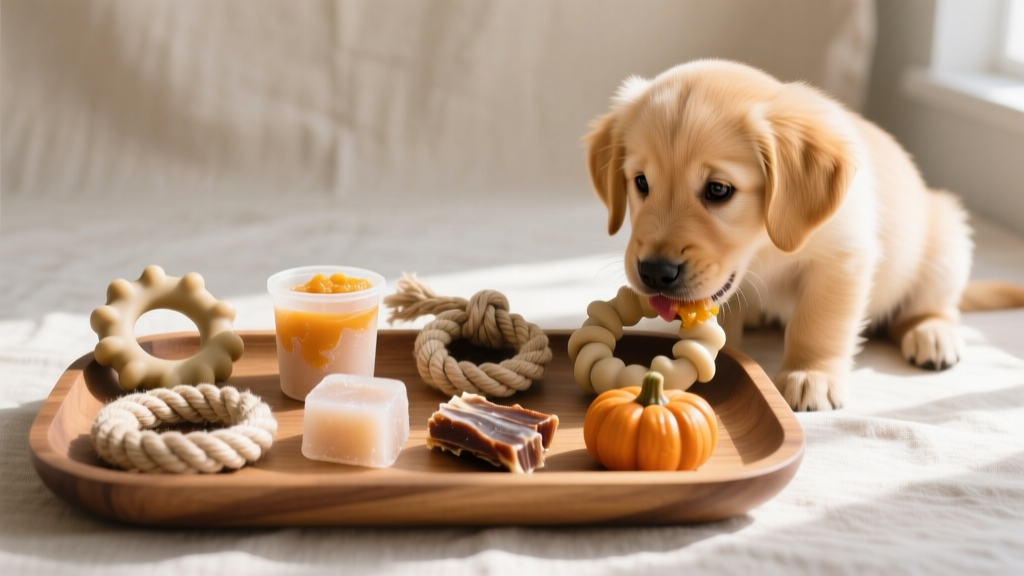
Your mini pinscher puppy will begin losing deciduous (baby) teeth around 12–16 weeks, with all 42 adult teeth typically erupted by 6 months. During this window, Min Pins chew aggressively and indiscriminately. Their small jaws, however, mean they can fracture teeth on overly hard chews.
Safe chew options for Min Pin puppies:
- Kong Puppy (Small or XS size): Fill with a smear of xylitol-free peanut butter and freeze for 20 minutes. The cold numbs sore gums.
- N-Bone Puppy Teething Rings: Edible, digestible, appropriately sized for toy breeds.
- Frozen wet washcloth: Twist a clean washcloth, soak in water or low-sodium chicken broth, freeze, and supervise chewing sessions.
- Benebone Puppy (Small): Nylon chew with appropriate give for baby teeth — discard once worn down significantly.
Avoid: Rawhide (choking and intestinal blockage risk in small breeds), antlers or hooves (too hard — risk of slab fractures on carnassial teeth), and any chew small enough to swallow whole. If you suspect your puppy has ingested a foreign object, contact ASPCA Animal Poison Control at (888) 426-4435 or your emergency vet immediately.
Common Mini Pinscher Puppy Problems and Solutions
Problem: Relentless Biting and Nipping
Min Pin puppies are mouthy — more so than many toy breeds. Their ratting heritage means they use their mouths to explore and interact. The solution is not to suppress mouthing entirely but to teach bite inhibition through a structured protocol:
- When teeth touch skin, say "ouch" in a calm, slightly high-pitched voice and immediately withdraw attention for 10–15 seconds.
- Redirect to an appropriate chew toy and praise enthusiastically when they bite the toy instead.
- If nipping escalates during play, end the session by calmly leaving the area for 30 seconds — this teaches that biting ends fun.
- Ensure your puppy gets 2–3 structured play sessions daily; overtired Min Pin puppies bite significantly more.
Problem: Excessive Whining in the Crate
Distinguish between protest whining (intermittent, stops when you don't respond) and distress whining (continuous, escalating, with physical signs like panting or drooling). For protest whining, wait for 3–5 seconds of silence before releasing or approaching. For distress whining, reduce crate duration and rebuild positive associations with feeding meals inside the crate with the door open.
Problem: Destructive Chewing on Furniture
Miniature Pinschers are athletic climbers and will reach items you thought were safe. Puppy-proof at their eye level (6–12 inches off the ground). Apply bitter apple spray to baseboards and furniture legs. Provide at least 4–5 approved chew items rotated weekly to maintain novelty.
First-Year Cost Breakdown: Budgeting for Your Mini Pinscher Puppy
Miniature Pinschers are on the less expensive end of purebred dogs to purchase, but their first-year care costs are meaningful. Here is a realistic breakdown based on 2026 U.S. pricing data.
| Category | Low Estimate | Mid-Range Estimate | High Estimate |
|---|---|---|---|
| Puppy purchase (responsible breeder) | $800 | $1,500 | $2,500 |
| Veterinary care (vaccines, spay/neuter, wellness) | $600 | $900 | $1,400 |
| Food (premium small-breed formula) | $200 | $300 | $450 |
| Supplies (crate, bed, leash, harness, bowls, toys) | $150 | $250 | $400 |
| Training (group puppy class, 6–8 weeks) | $100 | $200 | $350 |
| Preventive medications (flea/tick, heartworm) | $120 | $200 | $300 |
| Pet insurance (annual premium) | $300 | $480 | $720 |
| Grooming (Min Pins are low-maintenance) | $0 | $50 | $150 |
| TOTAL FIRST YEAR | $2,270 | $3,880 | $6,270 |
Adoption from a breed-specific rescue (such as the AKC Rescue Network) can reduce the puppy purchase cost to $300–$500 while still providing a vetted, temperament-evaluated dog. This is a genuinely excellent option, particularly for families who want an older puppy past the most fragile 8–12 week window.
Frequently Asked Questions About Mini Pinscher Puppies
When should I bring my mini pinscher puppy home?
The ideal homecoming age for a Min Pin is 10–12 weeks, slightly later than most breeds. This extra time with the breeder allows for better immune development, more complete littermate socialization, and reduced hypoglycemia risk. Never accept a Min Pin puppy younger than 8 weeks — this is both developmentally harmful and, in many U.S. states, illegal.
How often should I feed my puppy at each age?
Feed four meals daily from 8–12 weeks, three meals from 12 weeks to 6 months, then two meals daily from 6 months onward. Total daily intake ranges from ¾ to 1⅓ cups of high-quality small-breed puppy kibble depending on age, weight, and activity level. Always divide the daily total evenly across meals.
When will my mini pinscher puppy be fully potty trained?
Realistically, expect reliable house training between 5 and 8 months. Some Min Pins achieve reliability by 4 months with intensive scheduling; others take up to 10 months, particularly males. Consistency matters far more than speed — a steady routine produces lasting results while rushing creates setbacks.
What vaccines does my puppy need and when?
Core vaccines include DHPP (Distemper, Hepatitis, Parainfluenza, Parvovirus) at 6–8, 10–12, and 14–16 weeks, plus Rabies at 14–16 weeks. Bordetella (Kennel Cough) is recommended at 10–12 weeks if your puppy will attend group classes or boarding. Your veterinarian will tailor the protocol to your area and lifestyle.
How do I stop puppy biting and nipping?
Use the "ouch and redirect" method: vocalize calmly when teeth contact skin, withdraw attention for 10–15 seconds, then offer an approved chew toy. Consistency from all household members is essential. Ensure adequate physical exercise (20–30 minutes daily) and mental enrichment (puzzle toys, training sessions) to reduce mouthing driven by boredom or excess energy.
When can my puppy go outside and meet other dogs?
Your mini pinscher puppy can explore your own yard (if fully enclosed and not frequented by unknown dogs) immediately after homecoming. However, avoid high-traffic dog areas — parks, pet stores, sidewalks with heavy dog traffic — until 7 days after the final DHPP booster at 14–16 weeks. Controlled playdates with fully vaccinated, known-healthy dogs in private settings are acceptable from 10–12 weeks onward. The socialization window is too important to wait, so balance disease risk with exposure needs by choosing environments carefully.
Dr. Hannah Wickes
All our authors care for dogs every day — read more of their work on the authors page.