Microchipping for Puppies: Complete Breed-Specific Timeline & Care Guide
Learn everything about microchipping for puppies alongside breed-specific milestones, feeding schedules, vaccination timelines, and first-year costs.
Bringing a new puppy home is thrilling — and overwhelming. Between decoding vaccination schedules, navigating potty training setbacks, and figuring out microchipping for puppies, new owners often feel buried in conflicting advice. This guide cuts through the noise with age-specific milestones, exact feeding portions, realistic timelines, and a first-year cost breakdown so you can plan with confidence.
Whether you're raising a Labrador Retriever, a French Bulldog, or a mixed-breed rescue, the developmental windows below apply universally — but we'll call out where breed size (toy, medium, large, giant) changes the numbers. Bookmark this page; you'll reference it often over the next 12 months.
When Should I Bring My Puppy Home?
The American Kennel Club and most veterinary behaviorists agree: 8 weeks is the earliest acceptable age for a puppy to leave its mother and littermates. Some breeders of toy breeds (Chihuahuas, Yorkshire Terriers, Pomeranians) keep puppies until 10–12 weeks because small breeds mature slower physiologically and are more prone to hypoglycemia when stressed.
- Set up a confined "puppy zone" (exercise pen or gated room) with crate, water, and potty area
- Have the same food the breeder/shelter was feeding — transitions cause diarrhea
- Schedule a vet wellness exam within 48–72 hours of arrival
- Keep first-night expectations low: whining is normal, not a training failure
If you're adopting from a shelter, puppies may arrive at 6–7 weeks due to circumstances beyond anyone's control. In those cases, extra socialization effort and more frequent feeding (every 3–4 hours) become critical.
Puppy Development Milestones: Week-by-Week Timeline
Understanding developmental stages prevents you from expecting too much too soon — or missing critical windows. Here's what to expect at each phase:
| Age Range | Developmental Stage | What to Expect | Your Action Items |
|---|---|---|---|
| Weeks 4–8 | Socialization Period 1 (with litter) | Learning bite inhibition from siblings; first solid foods; curiosity peaks | If still with breeder: ensure exposure to varied surfaces, sounds, gentle handling |
| Weeks 8–12 | Fear Impact Period / Socialization Window Opens | Highly impressionable; traumatic events can create lasting phobias; rapid bonding to humans | Positive exposures only; no forced interactions; begin name recognition and lure-based sit |
| Weeks 12–16 | Socialization Window Closing / Testing Boundaries | Confidence grows; may start ignoring recall; chewing intensifies as baby teeth loosen | Enroll in puppy kindergarten (after 2nd DHPP); practice recall with high-value treats |
| Weeks 16–24 | Juvenile Period / Teething Peak | Adult teeth erupting; energy surges; may regress in potty training; sexual maturity begins in small breeds | Increase mental enrichment; schedule spay/neuter consultation; rotate chew toys daily |
| 6–12 Months | Adolescence | Second fear period possible (6–14 months); hormone-driven behaviors if intact; testing all trained behaviors | Maintain training consistency; avoid re-traumatizing during fear periods; increase structured exercise |
Feeding Schedule: Exact Portions by Age and Weight
Puppy metabolism runs hot — they burn calories faster than adults and need more frequent meals. The portions below assume an AAFCO-certified puppy-formula kibble (minimum 22% protein, 8.5% fat for growth). Adjust based on body condition score: you should feel ribs without pressing hard, and see a visible waist from above.
| Puppy Age | Meals Per Day | Toy Breed (5–15 lb adult) | Medium Breed (25–50 lb adult) | Large Breed (60–100 lb adult) |
|---|---|---|---|---|
| 8–12 weeks | 4 meals/day | ¼–½ cup total/day | ¾–1¼ cups total/day | 1½–2½ cups total/day |
| 12–16 weeks | 3 meals/day | ⅓–¾ cup total/day | 1–2 cups total/day | 2–3½ cups total/day |
| 4–6 months | 2–3 meals/day | ½–1 cup total/day | 1½–2½ cups total/day | 3–4½ cups total/day |
| 6–12 months | 2 meals/day | ¾–1¼ cups total/day | 2–3 cups total/day | 3½–5 cups total/day |
Vaccination Schedule and Microchipping for Puppies
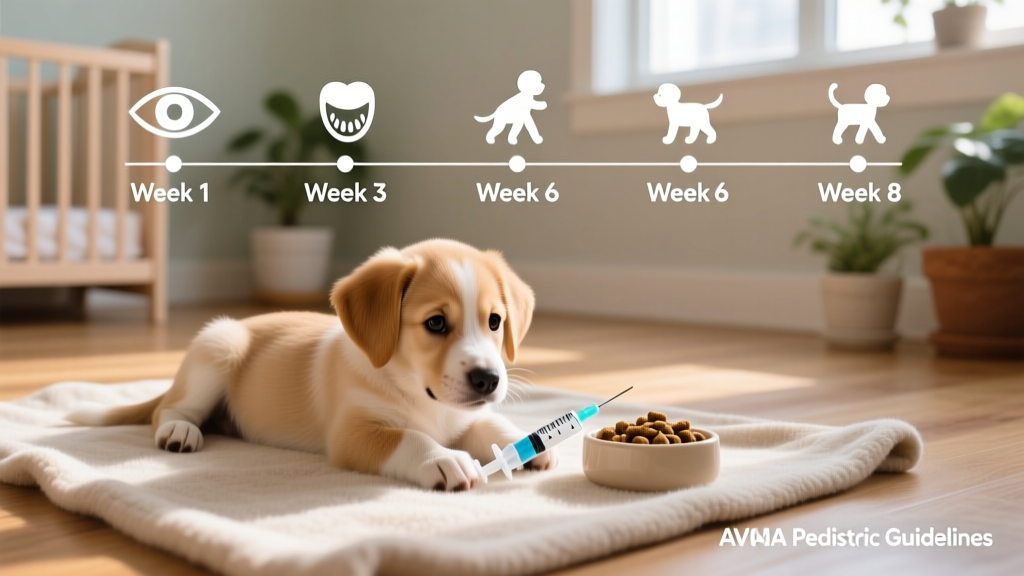
Vaccines protect against life-threatening diseases, and timing matters: maternal antibodies interfere with early vaccines, which is why boosters are given every 2–4 weeks until 16 weeks of age. The American Veterinary Medical Association recommends the following core schedule:
| Age | Vaccine(s) | What It Protects Against | Estimated Cost |
|---|---|---|---|
| 6–8 weeks | DHPP (1st dose), Bordetella (optional) | Distemper, Hepatitis (Adenovirus), Parainfluenza, Parvovirus; Kennel cough | $25–$50 |
| 10–12 weeks | DHPP (2nd dose), Leptospirosis (1st, if risk area), Lyme (if endemic) | Boosters core immunity; bacterial kidney/liver disease; tick-borne illness | $40–$75 |
| 14–16 weeks | DHPP (3rd dose), Rabies (required by law), Leptospirosis (2nd) | Final core booster; fatal viral encephalitis (zoonotic); completes Lepto series | $50–$90 |
Where Microchipping for Puppies Fits In
Most veterinarians recommend microchipping at the time of the 14–16 week visit, often alongside the rabies vaccine. The chip — about the size of a grain of rice (12mm × 2mm) — is injected subcutaneously between the shoulder blades using a pre-loaded syringe. No anesthesia is needed; the sensation is comparable to a routine injection.
- Cost: $25–$60 at a vet clinic; $15–$25 at shelter microchip events
- Registration: The chip is useless if not registered. Enroll in the chip manufacturer's database (HomeAgain, AKC Reunite, 24PetWatch) AND a free universal registry like AAHA's Universal Pet Microchip Lookup
- Chip type: In the US, 134.2 kHz ISO-compliant chips are standard. Avoid non-ISO chips — most US scanners can't read them
- Migration: Rare, but chips can shift 1–2 inches over time. Ask your vet to scan during every annual exam
- Earliest safe age: 8 weeks / 2 lb minimum body weight (some vets prefer waiting until 12+ weeks for toy breeds)
If your puppy was microchipped by the breeder or shelter before adoption, verify registration immediately — an estimated 40% of shelter-microchipped animals have outdated or missing registry data.
The Critical Socialization Window (Weeks 3–14)
Veterinary behaviorists identify weeks 3–14 as the primary socialization period — a developmental window during which puppies form lasting associations with novel stimuli. After week 14, neophobia (fear of new things) increases sharply. A puppy that never encountered a person in a hat, a skateboard, or a vacuum cleaner during this window is statistically more likely to develop fear-based reactivity later.
According to the Merck Veterinary Manual, under-socialized dogs are the leading behavioral reason for relinquishment to shelters. Here's a structured exposure checklist:
Socialization Exposure Checklist (Weeks 8–14)
People (aim for 10+ different types):
- ☐ Children ages 4–12 (supervised, calm interactions)
- ☐ People wearing hats, sunglasses, hoodies, uniforms
- ☐ People using canes, crutches, wheelchairs, walkers
- ☐ People of different ethnicities, heights, body types
- ☐ Person with a deep voice / loud laugh
Surfaces and Environments:
- ☐ Grass, gravel, sand, wet pavement, metal grates
- ☐ Car rides (start with 2-minute trips, build to 15+ minutes)
- ☐ Elevator or stairwell (if applicable to your lifestyle)
- ☐ Grooming table or raised surface (with non-slip mat)
Sounds (play recordings at low volume, pair with treats):
- ☐ Thunder, fireworks, sirens, doorbell
- ☐ Vacuum cleaner, blender, hair dryer
- ☐ Barking dogs (from a distance, positive association)
Handling Exercises (daily, 3–5 minutes):
- ☐ Touch paws, ears, tail, muzzle — reward calm acceptance
- ☐ Open mouth gently (prep for tooth-brushing and vet exams)
- ☐ Simulate nail trim pressure with a pen cap on each toe
- ☐ Brief gentle restraint (hug simulation for vet holds)
Key rule: Every new experience must be positive or neutral. If your puppy shows fear (cowering, tail tuck, freezing), increase distance from the stimulus and toss high-value treats (boiled chicken, cheese). Never force a puppy to "face their fear."
Potty Training Timeline: Realistic Expectations
Here's the truth most guides won't tell you: most puppies are not reliably house-trained until 4–6 months of age, and some small breeds take up to 8–10 months due to smaller bladder capacity and higher metabolic rates. A general rule: a puppy can "hold it" for roughly their age in months plus one hour (so a 3-month-old manages about 4 hours maximum — and that's overnight, not during active play).
Age-Based Potty Schedule
| Age | Daytime Outings | Overnight Capacity | Common Setbacks |
|---|---|---|---|
| 8–10 weeks | Every 1–1.5 hours + after meals, naps, play | 2–3 hours (set a 2 AM alarm) | Accidents every day; still learning the concept |
| 10–14 weeks | Every 1.5–2 hours | 3–4 hours | Submissive/excitement urination when greeting |
| 14–20 weeks | Every 2–3 hours | 5–6 hours | Regression common during teething and growth spurts |
| 5–6 months | Every 3–4 hours | 7–8 hours | Marking behavior may begin (especially males) |
- Accident in crate: Crate may be too large (use a divider). Dogs avoid soiling their sleeping area — but only if the space is appropriately sized.
- Only goes inside: You may have started outdoor training too late. Bring a used pee pad outside to transfer the scent cue.
- Sudden increase in accidents: Rule out urinary tract infection with a vet visit (urinalysis: $45–$80). UTIs are common in puppies and present as frequent small-volume urination with straining.
- Never punish accidents. Rubbing a puppy's nose in urine or yelling after the fact creates fear of eliminating in front of you — leading to hiding behind furniture to go. Instead, interrupt mid-act with a calm "let's go outside" and reward heavily outdoors.
Teething Timeline and Safe Relief Strategies (3–6 Months)
Puppies have 28 deciduous (baby) teeth that begin erupting at 3–4 weeks and are fully in by 6–8 weeks. Between 12 and 24 weeks, those baby teeth fall out and 42 adult teeth push through — often causing gum inflammation, drooling, and an intense need to chew on everything within reach.
Teething Relief: What Works
- Frozen Kong Classic (rubber, not plastic): Fill with peanut butter (xylitol-free — check the label; xylitol is highly toxic to dogs) or plain yogurt and freeze for 4+ hours
- Wet twisted washcloth: Soak a clean washcloth in water or low-sodium chicken broth, twist into a rope, freeze. Supervise to prevent swallowing fabric strips
- Benebone Wishbone or Nylabone Puppy Chew: Designed for developing jaws; softer than adult versions. Replace when worn down to nubs
- Chilled carrot sticks or apple slices: Remove seeds and core (apple seeds contain amygdalin, a cyanide precursor). Good for puppies who reject rubber toys
Avoid: Ice cubes (can fracture developing teeth in aggressive chewers), rawhide (choking and intestinal blockage risk), hard antlers or weight-bearing bones (tooth fractures), and any chew small enough to swallow whole.
If you find a baby tooth on the floor, don't panic — most are swallowed during eating. However, if an adult tooth has fully erupted alongside a retained baby tooth (common in toy breeds, especially the maxillary canines), schedule a veterinary dental exam. Retained deciduous teeth can cause malocclusion and periodontal disease.
Crate Training Progression with Time Limits
A crate is a management tool and a safe den — not a punishment space. The goal is for your puppy to enter voluntarily and relax. Here's a humane progression using positive reinforcement:
| Week | Daytime Crate Time | Overnight | Training Focus |
|---|---|---|---|
| Week 1 (8–9 wks) | 30–60 min max per session, 2–3 times/day | Crate beside your bed; expect 1–2 wake-ups | Meals in crate with door open; treat tossing inside; "kennel" cue |
| Week 2–3 | 1–1.5 hours, 2–3 times/day | Move crate to desired permanent location gradually | Door closed briefly; practice calm settling with a stuffed Kong |
| Week 4–6 | 1.5–2 hours, 1–2 times/day | 6–7 hour stretches becoming possible | Short departures from the house (5–15 min) to prevent separation anxiety |
| 3–4 months | 2–3 hours max (then exercise/potty break) | 7–8 hours with one late-night potty break | Crate should now be a positive default resting place |
Maximum crate time rule: Age in months + 1 = hours (during the day). A 10-week-old puppy should never be crated longer than 3 hours without a break. Overnight is the exception because metabolism slows during sleep. No puppy under 6 months should be crated more than 4 hours during waking hours without a potty and exercise break.
Common Puppy Problems and Solutions
Puppy Biting and Nipping
Mouthing is normal puppy behavior — they explore the world with their mouths, and littermates teach bite inhibition through yelping feedback. When a puppy joins your home, you become the littermate. Here's how to manage it:
- Redirect: When teeth touch skin, say "ouch" in a calm tone, withdraw attention for 5 seconds, then offer a chew toy. Reward chewing the toy enthusiastically.
- Time-outs (not punishment): If biting persists after 3 redirects, calmly place puppy in their pen or crate for 30–60 seconds to reset arousal levels. This teaches that biting ends play.
- Manage arousal: Puppies bite most when overtired. A puppy awake for more than 2 hours straight is likely overstimulated — enforce a nap.
- Never: Hold the mouth shut, alpha roll, bite back, or use spray bottles. These methods create fear and can escalate to defensive aggression.
Whining in the Crate
Distinguish between protest whining (stops within 5–10 minutes if ignored) and distress whining (escalating, panting, drooling, attempting to escape — may indicate separation anxiety or a potty emergency). If the puppy has been out recently and is simply protesting, wait for 3 seconds of silence before opening the crate — this prevents reinforcing the whining. If distress signs persist beyond 15 minutes, consult a certified professional dog trainer (CPDT-KA or IAABC-credentialed).
Destructive Chewing
Puppies chew for three reasons: teething discomfort, boredom, and exploration. Management is more effective than correction:
- Puppy-proof one room at a time (shoes in closets, cords behind furniture, toxic plants removed)
- Provide 5–7 approved chew options of varying textures (rubber, nylon, edible, frozen)
- Rotate toys every 3 days to maintain novelty
- Use management (gates, pen) when unsupervised rather than expecting the puppy to "choose correctly"
Grapes/raisins, xylitol (sugar-free gum, some peanut butters), chocolate, onions, garlic, macadamia nuts, rodenticides, and human NSAIDs (ibuprofen, naproxen). If ingestion is suspected, call ASPCA Animal Poison Control: (888) 426-4435 (24/7, consultation fee applies) or Pet Poison Helpline: (855) 764-7661 immediately. Do not induce vomiting without professional guidance — some substances cause more damage on the way back up.
When Can My Puppy Go Outside and Meet Other Dogs?
This is one of the most debated topics in puppy care. Old advice said "keep puppies home until fully vaccinated at 16 weeks." Modern veterinary behavior science says that's too late — you'd miss the entire socialization window.
The AVMA and the American Veterinary Society of Animal Behavior (AVSAB) recommend controlled socialization starting 7 days after the first DHPP vaccine (typically around 9–10 weeks), with these precautions:
- Safe environments: Private yards, homes of known-vaccinated dogs, structured puppy classes (most require proof of first DHPP and deworming)
- Avoid until fully vaccinated (16+ weeks): Dog parks, pet store floors, high-traffic public sidewalks where unknown dogs have eliminated (parvovirus survives in soil for 6+ months)
- Carry your puppy in a sling or backpack for neighborhood walks to expose them to sights and sounds without paw contact on potentially contaminated surfaces
- Puppy classes: Choose facilities that require vaccination proof, sanitize between classes, and group by age/size. These are among the safest socialization venues available
First-Year Cost Breakdown
Budgeting realistically prevents the "I can't afford this" surrenders that overwhelm shelters. These ranges reflect 2025–2026 US pricing from a survey of veterinary clinics and pet supply retailers:
| Category | Low Estimate | Mid-Range | High Estimate |
|---|---|---|---|
| Veterinary (vaccines, wellness exams, microchip, spay/neuter) | $400 | $700 | $1,200 |
| Food (quality puppy kibble, treats) | $250 | $500 | $900 |
| Supplies (crate, bed, leash, collar, bowls, toys, gates, grooming tools) | $200 | $400 | $700 |
| Training (puppy kindergarten, group classes, or private sessions) | $150 | $350 | $800 |
| Preventive medications (flea/tick, heartworm — 12 months) | $150 | $300 | $500 |
| Pet insurance (annual premium, optional but recommended) | $350 | $600 | $900 |
| Emergency fund (recommended buffer for unexpected vet visits) | $200 | $500 | $1,500+ |
| FIRST-YEAR TOTAL | $1,700 | $3,350 | $6,500+ |
These figures do not include the initial purchase or adoption fee ($50–$3,500+ depending on source and breed). Pet insurance premiums are lowest when enrolled at 8–10 weeks before any pre-existing conditions develop — consider enrolling at your first vet visit.
Frequently Asked Questions
Does microchipping hurt my puppy?
The needle used for microchipping is slightly larger than a standard vaccine needle (12-gauge vs. 22-gauge). Most puppies flinch briefly — similar to any injection — but the discomfort lasts seconds. There's no ongoing pain. Some toy breed owners opt to microchip during spay/neuter surgery while the puppy is under anesthesia, which eliminates any discomfort entirely.
How often should I feed my 10-week-old puppy?
At 10 weeks, feed 4 meals per day, spaced roughly 4 hours apart during waking hours (e.g., 7 AM, 11 AM, 3 PM, 7 PM). Use the portion table above based on your puppy's expected adult weight. Always measure with a standard measuring cup — "eyeballing" leads to overfeeding, which stresses developing joints.
My puppy bites my children — is this aggression?
Almost never. Puppy biting is exploratory mouthing, not aggression. However, children under 5 should never be left unsupervised with a puppy (for the safety of both). Teach children to "be a tree" (stand still, arms folded) when the puppy gets mouthy, and redirect the puppy to a toy. If biting breaks skin or is accompanied by growling with stiff body posture, consult a veterinary behaviorist — this is rare in puppies under 6 months but should be evaluated.
Can I register my puppy's microchip with multiple databases?
Yes, and it's recommended. Register with the chip manufacturer's database first (this is where shelters scan first), then add a secondary registration with a free service like the AAHA Universal Microchip Lookup tool. Keep your contact information updated in every registry — a chip with outdated phone numbers is functionally useless.
When will my puppy sleep through the night?
Most puppies can sleep 6–7 hours uninterrupted by 12–14 weeks, and 8 hours by 16–20 weeks. Set a consistent bedtime, remove water 1.5 hours before bed, and take a final potty trip right before crating. If your puppy wakes at night, take them out on leash with minimal stimulation (no play, low lights) and return to the crate immediately.
This guide provides general educational information based on widely accepted veterinary standards. Your puppy's individual health needs — especially regarding vaccination timing, diet selection, spay/neuter timing, and microchipping — should always be discussed with your veterinarian, who knows your dog's specific medical history, breed risks, and local disease prevalence. Never delay professional veterinary care based on internet guidance.
Marcus Aldridge
All our authors care for dogs every day — read more of their work on the authors page.