Labrador Puppies for Adoption: Complete Puppy Care Timeline
Your complete guide to Labrador puppies for adoption — milestones, feeding, potty training, vaccines, and costs for your new Lab puppy.

Finding Labrador puppies for adoption is exciting, but the first year with a Lab puppy requires a clear plan. Labs are energetic, mouthy, and fast-growing — a combination that catches many first-time owners off guard. This guide walks you through every developmental stage with exact feeding portions, vaccine dates, crate time limits, and realistic potty training timelines so you know exactly what to expect each week.
When to Bring Your Labrador Puppy Home
The ideal window to bring a Labrador puppy home is between 8 and 10 weeks of age. The American Kennel Club and most veterinary behaviorists agree that removing a puppy from its litter before 8 weeks increases the risk of fear-based behaviors, bite inhibition problems, and separation anxiety.
If you're adopting from a rescue, some Labrador puppies for adoption may already be 10–14 weeks old. That's perfectly fine — you'll just need to accelerate your socialization efforts since the critical socialization window closes around 14 weeks.
Labrador Puppy Milestones: Week by Week
Weeks 4–8 (Still With Breeder or Foster)
- Weight: 8–15 lb / 3.6–6.8 kg
- Eyes and ears fully functional; startle reflex diminishing
- Introduction to solid food (gruel/kibble softened with warm water)
- Littermate play teaches bite inhibition basics
- First deworming (pyrantel pamoate) typically at 2, 4, and 6 weeks
- Starts learning name recognition and basic handling
Weeks 8–12 (Home Transition & Bonding)
- Weight: 15–25 lb / 6.8–11.3 kg
- Peak fear imprint period (weeks 8–10) — avoid traumatic experiences
- Can learn sit, down, and name response using food lures
- Attention span: 2–5 minutes per training session
- Sleeps 18–20 hours per day — enforce naps in crate
- Chewing and mouthing intensifies as puppy explores the world orally
Weeks 12–16 (Confidence Building)
- Weight: 25–40 lb / 11.3–18.1 kg
- Fear imprint period ends around week 12; confidence grows
- Can hold bladder approximately 3–4 hours during the day
- Capable of learning stay (3–5 seconds), come, and leave it
- Adult teeth begin pushing out baby teeth around week 14
- Energy bursts last 15–20 minutes followed by sudden crashes
Weeks 16–24 (Adolescence Begins)
- Weight: 40–55 lb / 18.1–24.9 kg
- Teething peaks between 4–6 months — destructive chewing is most intense here
- May appear to "forget" previously learned commands (adolescent regression)
- Can hold bladder 4–6 hours during the day
- Growth plates still open — avoid forced running, jumping from heights, or agility equipment
- Spay/neuter discussion with your vet typically occurs around 6 months
6–12 Months (Young Lab Phase)
- Weight: 55–75 lb / 24.9–34 kg (males larger)
- Adult coat replaces puppy coat around 7–9 months
- Second fear period may emerge between 6–14 months
- Exercise capacity increases to 30–45 minute walks; still avoid high-impact activity until growth plates close (12–18 months per Merck Veterinary Manual)
- Calorie needs begin transitioning from puppy formula to adult maintenance around 12 months
Labrador Puppy Feeding Schedule & Portions
Labs are notorious overeaters. Free-feeding a Labrador puppy almost guarantees obesity, which accelerates hip and elbow dysplasia progression. Use measured meals and adjust based on body condition score (BCS) — you should feel ribs without pressing but not see them prominently.
| Age | Meals/Day | Daily Portion (cups) | Calories/Day | Notes |
|---|---|---|---|---|
| 8–12 weeks | 3–4 | 1.5–2 cups | 600–800 | Soften kibble with warm water if needed |
| 12–16 weeks | 3 | 2–2.5 cups | 800–1,000 | Transition to dry kibble fully |
| 4–6 months | 2–3 | 2.5–3.5 cups | 1,000–1,400 | Drop to 2 meals by 6 months |
| 6–12 months | 2 | 3–4 cups | 1,200–1,600 | Monitor BCS closely; adjust ±0.5 cup |
| 12+ months | 2 | 2.5–3.5 cups (adult food) | 1,000–1,400 | Transition to adult formula over 7–10 days |
Choose a large-breed puppy formula that meets AAFCO growth standards and contains controlled calcium (1.0–1.5% on a dry matter basis). Brands like Purina Pro Plan Large Breed Puppy, Royal Canin Labrador Retriever Puppy, and Hill's Science Diet Large Breed Puppy are formulated to slow growth rate, reducing skeletal stress.
Vaccination Schedule for Your Lab Puppy
Your veterinarian will customize this schedule based on local disease prevalence, but the core protocol follows AVMA and AAHA guidelines:
| Age | Vaccine | What It Protects Against | Estimated Cost |
|---|---|---|---|
| 6–8 weeks | DHPP (1st dose) | Distemper, Hepatitis (Adenovirus), Parainfluenza, Parvovirus | $25–$40 |
| 10–12 weeks | DHPP (2nd dose) + Bordetella | Same as above + Kennel Cough | $35–$55 |
| 14–16 weeks | DHPP (3rd dose) + Rabies | Same as above + Rabies (legally required) | $40–$65 |
| 12–16 weeks | Leptospirosis (optional, 2 doses, 3–4 weeks apart) | Leptospirosis — recommended if hiking, near water, or urban wildlife exposure | $25–$40 per dose |
The Critical Socialization Window: Weeks 3–14
Research published in the Journal of Veterinary Behavior confirms that puppies who receive inadequate socialization before 14 weeks are significantly more likely to develop fear-based aggression and anxiety disorders. For Labrador puppies for adoption — especially those from rescues with unknown early histories — maximizing this window is non-negotiable.
Potty Training Your Labrador Puppy: A Realistic Timeline
Labrador puppies for adoption are often touted as "easy to train," but potty training still takes 4–6 months of consistent management for most Labs. Some won't be fully reliable until 8–9 months.
Potty Training Timeline
- 8–10 weeks: Accident every 30–60 minutes. Take outside every 20–30 minutes during active periods. Expect 2–3 accidents per day with good management.
- 10–14 weeks: Bladder capacity grows. Take out every 45–60 minutes. Begin associating a verbal cue ("go potty") with elimination.
- 14–20 weeks: Can hold for 2–3 hours if crated or supervised. Accidents drop to 2–4 per week. Start extending freedom in the house.
- 20–28 weeks: Most Labs can hold 4–5 hours during the day. May still have occasional accidents after excitement or play.
- 6–9 months: Generally reliable with access to outdoors every 4–6 hours. Some males may begin marking indoors — interrupt and redirect without punishment.
Daily Potty Log Template
| Time | Location | Result | Treat Given? | Accident? |
|---|---|---|---|---|
| 7:00 AM | Backyard, same spot | ✅ Pee + poop | Yes (chicken) | No |
| 8:15 AM | Backyard | ✅ Pee | Yes | No |
| 9:30 AM | Kitchen | — | — | Yes (small puddle) |
Track patterns for 2 weeks. If accidents cluster at a specific time, add a scheduled potty break 15 minutes before that window.
Common Potty Training Troubleshooting
- Submissive urination: Common in Labs under 6 months. Don't greet with high energy — crouch sideways, avoid direct eye contact, greet calmly.
- Excitement urination: Keep greetings low-key. Take puppy outside before guests arrive if possible.
- Regression at 4–6 months: Normal. Return to tighter supervision and more frequent trips outside. Rule out UTI with your vet if accidents spike suddenly.
Crate Training Progression & Time Limits
A crate is essential for potty training, safety, and giving your Lab puppy a decompression space. Labs generally take to crates well if introduced positively — never use the crate as punishment.
| Age | Max Continuous Crate Time | Overnight |
|---|---|---|
| 8–10 weeks | 1–2 hours | 3–4 hours (expect one overnight potty break) |
| 10–14 weeks | 2–3 hours | 5–6 hours |
| 14–18 weeks | 3–4 hours | 6–7 hours |
| 4–6 months | 4–5 hours | 7–8 hours |
| 6+ months | 5–6 hours | 8 hours |
Recommended crate size: Start with a 36-inch wire crate with a divider panel (MidWest iCrate or Frisco crate). Adjust the divider as your Lab grows. The puppy should be able to stand, turn around, and lie down — but not have enough room to eliminate in one corner and sleep in another.
Teething Timeline & Safe Chew Strategies
Labrador puppies are among the most aggressive chewers of any breed. Teething runs from approximately 3 to 6 months, but the urge to chew persists well past 12 months.
Teething Stages
- 3–4 months: Incisors loosen. Increased mouthing of fingers and clothing.
- 4–5 months: Canines and premolars shed. You may find tiny teeth on the floor or notice small amounts of blood on chew toys — this is normal.
- 5–6 months: Molars erupt. Chewing intensity peaks. This is when furniture, baseboards, and shoes are at highest risk.
- 6–7 months: All 42 adult teeth should be in. Your vet should check for retained baby teeth (common in Labs, especially upper canines) during the spay/neuter exam.
Safe Chew Recommendations
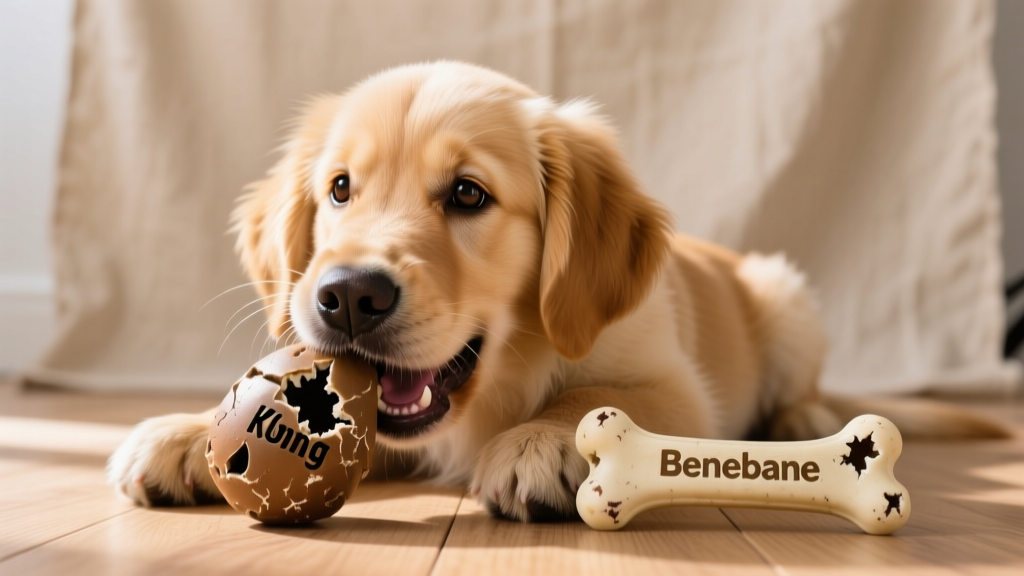
- KONG Classic (red or black, size Medium for puppies, Large by 6 months): Stuff with peanut butter (xylitol-free), plain yogurt, or canned pumpkin and freeze for 2–4 hours. Provides 20–40 minutes of engagement.
- Benebone Puppy Wishbone: Nylon chew flavored with real bacon or chicken. Replace when worn down by 25%.
- West Paw Toppl: Interlocking treat toy — pair two together for a harder puzzle. Dishwasher safe.
- Frozen washcloth: Wet a clean washcloth, twist into a rope, freeze. Supervise use and remove once shredded.
Stopping Puppy Biting & Nipping
Labrador puppies use their mouths the way human toddlers use their hands — they explore everything orally. Biting peaks between 8 and 16 weeks and typically diminishes by 5–6 months with consistent management.
Step-by-Step Bite Inhibition Protocol
- Yelp and freeze: When teeth touch skin, let out a high-pitched "ow!" and go still for 3–5 seconds. This mimics littermate feedback.
- Redirect to a toy: After the pause, present an appropriate chew toy. Praise calmly when the puppy mouths the toy instead.
- Time-out if biting continues: If the puppy bites again within 30 seconds, stand up and leave the area for 15–30 seconds (or place in a playpen). This teaches that biting ends play.
- Reward gentle mouthing: If the puppy licks or mouths without pressure, praise and continue interaction. You're not eliminating mouthing — you're shaping softness.
What doesn't work: Holding the muzzle shut, alpha rolling, spraying bitter apple in the mouth, or yelling. These methods suppress behavior temporarily but increase fear and can trigger defensive biting. Positive reinforcement and consistent redirection are the only methods recommended by veterinary behaviorists and certified trainers using LIMA (Least Intrusive, Minimally Aversive) principles.
First-Year Cost Breakdown for a Labrador Puppy
Budgeting accurately prevents surprises. Here's a realistic first-year cost range for a Labrador puppy adopted from a rescue or responsible breeder in the US:
| Category | Low Estimate | High Estimate | Details |
|---|---|---|---|
| Adoption/Purchase Fee | $200 (rescue) | $2,000 (AKC breeder) | Rescues often include first vaccines and spay/neuter |
| Veterinary Care | $500 | $1,200 | Vaccines, spay/neuter, fecal tests, heartworm prevention |
| Food (12 months) | $480 | $840 | $40–$70/month for quality large-breed formula |
| Supplies | $300 | $600 | Crate, bed, leash, harness, bowls, toys, grooming tools |
| Training Classes | $150 | $500 | Puppy kindergarten ($150–$250) + intermediate ($200–$300) |
| Preventive Medications | $200 | $400 | Heartworm (Heartgard Plus ~$85/yr), flea/tick (NexGard ~$150/yr) |
| Pet Insurance | $360 | $720 | $30–$60/month for accident/illness plan (Trupanion, Healthy Paws, Figo) |
| Emergency Fund | $0 | $2,000 | Foreign body ingestion (Labs eat everything) can cost $2,000–$5,000 |
Total first-year range: $2,190–$8,260 depending on adoption source, insurance choice, and whether emergencies arise. The median for a rescue Lab puppy with insurance and training runs approximately $3,500–$4,500.
Frequently Asked Questions About Labrador Puppies
When should I bring my Labrador puppy home?
Between 8 and 10 weeks of age. Earlier removal from the litter impairs bite inhibition and social development. If adopting an older puppy (12–16 weeks) from a rescue, prioritize socialization immediately since the critical window closes around 14 weeks.
How often should I feed my Lab puppy?
At 8–12 weeks, feed 3–4 meals per day (1.5–2 cups total daily). At 12–16 weeks, drop to 3 meals (2–2.5 cups total). By 6 months, transition to 2 meals per day (3–4 cups total). Always use measured portions — Labs will overeat if given the chance.
When will my puppy be fully potty trained?
Most Labrador puppies are reliably potty trained between 5 and 7 months with consistent management. Some take up to 9 months. "Fully trained" means fewer than one accident per month. If accidents persist past 8 months despite a consistent schedule, consult your vet to rule out urinary tract issues.
What vaccines does my Lab puppy need and when?
Core vaccines include DHPP at 6–8, 10–12, and 14–16 weeks, plus rabies at 14–16 weeks. Bordetella (kennel cough) is recommended at 10–12 weeks if attending puppy classes or boarding. Leptospirosis is optional but recommended for Labs that will hike, swim, or live near wildlife. Always consult your veterinarian to customize the schedule for your area.
How do I stop my Labrador puppy from biting?
Use the yelp-and-freeze method: emit a high-pitched "ow!" when teeth touch skin, go still for 3–5 seconds, then redirect to a chew toy. If biting continues, take a 15–30 second time-out by leaving the area. Reward gentle, pressure-free mouthing. Consistency from every household member is critical — mixed signals prolong the biting phase.
When can my puppy go outside and meet other dogs?
You can carry your puppy in public and arrange playdates with known, fully vaccinated dogs immediately. Avoid dog parks, pet stores, and high-traffic dog areas until 7 days after the final DHPP booster (typically around 16–17 weeks). The socialization window (3–14 weeks) is too valuable to spend entirely indoors — just manage exposure risk carefully.
Dr. Hannah Wickes
All our authors care for dogs every day — read more of their work on the authors page.