Korthal Griffon Puppies: Week-by-Week Growth, Training & Care Guide
Complete guide to raising Korthal Griffon puppies: milestones, feeding schedules, potty training, socialization, vaccinations, and first-year costs.

Why Korthal Griffon Puppies Are Unlike Other Sporting Breeds
The Korthals Griffon — sometimes called the Wirehaired Pointing Griffon — is a versatile hunting dog developed in the late 1800s by Dutch breeder Eduard Karel Korthals. These puppies grow into athletic, intelligent, and deeply bonded companions, but their early development has quirks that first-time owners often don't anticipate. Unlike Labrador or Golden Retriever puppies, Korthal Griffon puppies tend to be more independent thinkers, slower to mature mentally (often not fully "settling" until 2–3 years of age), and more sensitive to harsh training methods. Their rough, wiry coat also demands specific grooming attention from an early age.
This guide walks you through every critical stage of raising a Korthal Griffon puppy — from the day you bring them home through their first year — with breed-specific expectations, real numbers, and practical frameworks. According to the American Kennel Club breed standard, adult Wirehaired Pointing Griffons stand 20–24 inches at the shoulder and weigh 50–70 lb (23–32 kg), with a lifespan of 12–14 years. Understanding how your puppy grows into that frame is the first step toward raising a healthy, well-adjusted dog.
When Should I Bring My Korthal Griffon Puppy Home?
The ideal age to bring a Korthal Griffon puppy home is 8 to 10 weeks. While some breeders may release puppies at 8 weeks, many responsible Wirehaired Pointing Griffon breeders prefer to keep litters until 9–10 weeks. This extra time allows the breeder to evaluate temperament, begin early neurological stimulation (ENS), and ensure each puppy has received its first round of vaccinations.
Bringing a puppy home before 8 weeks is strongly discouraged. During weeks 6–8, puppies are learning critical bite inhibition and social signals from their littermates. Removing them too early correlates with increased mouthing, fear-based reactivity, and difficulty reading canine body language later in life — traits that are particularly problematic in a breed already predisposed to independence and strong prey drive.
If your breeder offers the option of a 10- or even 12-week pickup, consider it seriously. Korthal Griffon puppies at 12 weeks have typically had more structured socialization exposure, a second round of vaccines, and more reliable crate-training foundations. The trade-off is that you'll have a slightly shorter window for the critical socialization period (which closes around 14–16 weeks), so you'll need to be more intentional about continued exposure at home.
Korthal Griffon Puppy Milestones: Week by Week
Understanding what's developmentally normal at each stage prevents unnecessary anxiety and helps you set realistic expectations. Here's a breed-specific milestone timeline for your Korthal Griffon puppy:
| Age Range | Physical Milestones | Behavioral Expectations | Your Action Items |
|---|---|---|---|
| Weeks 4–8 (at breeder) | Eyes and ears fully functional; baby teeth erupting; first deworming and DHPP vaccine at 6 weeks; weight approximately 4–8 lb (1.8–3.6 kg) | Littermate play teaches bite inhibition; startle recovery developing; curiosity peaks; early scent interest may appear | Visit the litter at least twice; handle puppies daily if possible; discuss ENS protocols with breeder |
| Weeks 8–12 (home transition) | Rapid growth phase — expect ~2 lb (0.9 kg) gain per week; wiry puppy coat texture emerging; weight approximately 10–18 lb (4.5–8.2 kg) | Fear imprint period (8–11 weeks) — negative experiences can create lasting phobias; bonding intensely with new family; mouthing and chewing escalate | Keep environment calm and predictable; avoid traumatic vet/groomer experiences; begin name recognition and short training sessions (3–5 min) |
| Weeks 12–16 | Growth rate slows slightly; weight approximately 20–30 lb (9–13.6 kg); adult teeth begin pushing in around 14–16 weeks | Confidence increases; testing boundaries; second fear period may begin around 14 weeks; prey drive becomes more visible (chasing leaves, squirrels) | Expand socialization aggressively (this window is closing!); introduce recall games; begin leash walking in low-distraction areas |
| Weeks 16–24 | Approaching half adult weight (~30–40 lb / 13.6–18 kg); full adult teeth by 6 months; coat transitions from puppy soft to wiry adult texture | Increased independence; may seem to "forget" training; high energy with poor impulse control; chewing peaks during teething | Maintain consistent training; increase physical exercise to 30–45 min/day (split sessions); begin hand-stripping coat introduction |
| Months 6–12 | Reaching 75–90% of adult size; weight approximately 45–65 lb (20–29 kg); sexual maturity (discuss spay/neuter timing with vet) | Adolescent regression in obedience; strong hunting instincts emerge; may challenge household rules; still mentally puppy-like despite adult body | Enroll in intermediate obedience class; introduce structured scent work or field games; do NOT allow off-leash freedom in unsecured areas |
Feeding Schedule: Exact Portions for Your Korthal Griffon Puppy
Korthal Griffon puppies are active, medium-to-large sporting dogs that need a diet supporting steady growth without promoting rapid weight gain — which stresses developing joints and increases hip dysplasia risk. Choose a large-breed puppy formula that meets AAFCO guidelines for growth, with a calcium-to-phosphorus ratio between 1.1:1 and 1.4:1.
The following feeding schedule uses a typical large-breed puppy kibble with approximately 380–420 kcal/cup as a baseline. Adjust based on your specific food's caloric density and your puppy's body condition score (BCS).
| Puppy Age | Expected Weight | Meals Per Day | Total Daily Amount | Per-Meal Portion |
|---|---|---|---|---|
| 8–12 weeks | 10–18 lb (4.5–8.2 kg) | 4 meals | 1.5–2.5 cups | ~0.4–0.6 cups |
| 12–16 weeks | 20–30 lb (9–13.6 kg) | 3 meals | 2.5–3.5 cups | ~0.8–1.2 cups |
| 4–6 months | 30–45 lb (13.6–20 kg) | 3 meals | 3–4 cups | ~1–1.3 cups |
| 6–9 months | 45–55 lb (20–25 kg) | 2 meals | 3.5–4.5 cups | ~1.75–2.25 cups |
| 9–12 months | 55–65 lb (25–29 kg) | 2 meals | 3.5–5 cups | ~1.75–2.5 cups |
How to tell if you're feeding the right amount: Run your hands along your puppy's ribcage. You should be able to feel ribs with light pressure (like running your fingers over the back of your hand) but not see them prominently. A visible waist when viewed from above and a tucked-up abdomen from the side indicate a healthy BCS of 4–5/9. If your puppy looks round with no waist, reduce portions by 10%. If ribs are easily visible, increase by 10%.
Transition to adult food: Most Korthal Griffons should remain on large-breed puppy food until 12–14 months, then transition gradually over 7–10 days to an adult maintenance formula. Consult your veterinarian for the ideal timing based on your dog's growth curve.
Vaccination Schedule: What Your Korthal Griffon Puppy Needs and When
Korthal Griffon puppies follow the standard core vaccination protocol, but because they're often sourced from smaller, specialized breeders rather than large kennels, you may need to verify exactly which vaccines were administered before pickup. Request written vaccination records from your breeder and share them with your veterinarian at the first wellness visit (within 48–72 hours of bringing your puppy home).
| Age | Vaccine(s) | Type | Notes |
|---|---|---|---|
| 6–8 weeks | DHPP (Distemper, Hepatitis/Adenovirus, Parainfluenza, Parvovirus) — 1st dose | Core | Typically given by breeder; verify records |
| 10–12 weeks | DHPP — 2nd dose; Bordetella (optional based on lifestyle) | Core + Non-core | Bordetella recommended if attending puppy classes |
| 14–16 weeks | DHPP — 3rd dose; Rabies (given at 12–16 weeks per state law); Leptospirosis (2-dose series, optional) | Core + Non-core | Leptospirosis relevant for hunting/field dogs with wildlife water exposure |
| 12–16 months | DHPP booster; Rabies booster (1-year or 3-year per local law); Bordetella booster if applicable | Core + Non-core | After this, DHPP typically moves to 3-year intervals |
When can my puppy go outside or meet other dogs? Your Korthal Griffon puppy can explore your own yard (if it's secure and not frequented by unknown dogs) immediately. However, avoid public dog areas — parks, pet stores, dog-friendly patios — until at least 7 days after the second DHPP vaccine (approximately 11–13 weeks of age). Full protection isn't established until 7 days after the final puppy DHPP at 16 weeks. During the vulnerable window, you can carry your puppy in public spaces for socialization exposure without letting their paws touch shared ground.
Socialization Window (Weeks 3–14): Your Korthal Griffon's Critical Checklist
The primary socialization window for puppies closes between 12–14 weeks of age, according to the American Veterinary Medical Association. For Korthal Griffon puppies — a breed that can be reserved with strangers and wary of novel environments if under-socialized — this window is arguably the single most important investment you'll make in your dog's future temperament.
Below is a breed-specific socialization checklist. Aim to check off at least 2–3 new exposures per day during weeks 8–14. Keep every experience positive: pair novel stimuli with high-value treats (small pieces of boiled chicken, freeze-dried liver, or cheese). If your puppy shows fear, increase distance from the stimulus and let them approach at their own pace — never force an interaction.
- ☐ Meet 10+ different people (children, elderly, people wearing hats, sunglasses, uniforms, bulky coats)
- ☐ Encounter 5+ other vaccinated, friendly dogs of varying sizes
- ☐ Walk on 6+ surfaces (grass, gravel, sand, metal grates, wet pavement, carpet)
- ☐ Hear household sounds: vacuum, blender, doorbell, thunderstorm audio (played at low volume)
- ☐ Experience car rides (start with 5 minutes, build to 20+ minutes)
- ☐ Visit the vet clinic for a "happy visit" — just treats and praise, no procedures
- ☐ Handle paws, ears, mouth, and tail daily for grooming desensitization
- ☐ Introduce to a grooming table and brush (the wiry coat will need regular hand-stripping)
- ☐ Experience water: shallow kiddie pool, hose spray, lake shoreline
- ☐ See wildlife at a distance (birds, squirrels, deer — reward calm observation over chasing)
- ☐ Practice being alone: 5–15 minutes in crate while you're in another room
- ☐ Encounter bicycles, skateboards, wheelchairs, strollers at a comfortable distance
Why this matters specifically for Korthal Griffons: This breed was developed to hunt cooperatively with humans, which means they bond intensely to their family but can be aloof or suspicious with outsiders. Without deliberate socialization, a Korthal Griffon may become overly protective, anxious in new environments, or difficult to handle at the vet or groomer. Positive early exposure doesn't eliminate their natural wariness — it gives them the confidence to evaluate new situations calmly rather than react from fear.
Potty Training Timeline: Realistic Expectations for Your Griffon Puppy
Korthal Griffon puppies are intelligent but not always the fastest house-trainers among sporting breeds. Their independent streak means they may not signal clearly when they need to go out, especially in the early weeks. Expect the process to take 4–6 months for reliable daytime training and up to 8–12 months for full overnight bladder control.
When will my puppy be fully potty trained? Most Korthal Griffons achieve consistent daytime reliability by 5–6 months if you follow a structured schedule. Nighttime dryness typically follows 1–2 months later. Some individuals — particularly males — may have occasional marking accidents through 9–10 months. This is normal and not a sign of failed training.
| Puppy Age | Outdoor Trips Per Day | Max Time Between Trips | Overnight Expectation |
|---|---|---|---|
| 8–10 weeks | 10–12 trips | 1–1.5 hours | 1–2 nighttime wake-ups expected |
| 10–14 weeks | 8–10 trips | 1.5–2 hours | 1 nighttime wake-up |
| 14–20 weeks | 6–8 trips | 2–3 hours | Sleeping through most nights |
| 5–6 months | 5–6 trips | 3–4 hours | Full overnight (8 hours) |
Key techniques that work for this breed:
- Use a consistent verbal cue ("go potty" or "do your business") every time they eliminate outside. Korthal Griffons are verbal learners and will associate the cue quickly.
- Reward immediately with a high-value treat within 2 seconds of finishing — not after they come back inside.
- Supervise or confine: When you can't watch your puppy, they should be in their crate or a puppy-proofed pen. Freedom is earned gradually as accidents decrease.
- Never punish accidents. Rubbing a puppy's nose in urine or yelling creates fear of eliminating in front of you — which leads to hiding behind furniture to go. Clean accidents with an enzymatic cleaner (Nature's Miracle or Rocco & Roxie) to remove scent markers.
Crate Training Progression and Time Limits
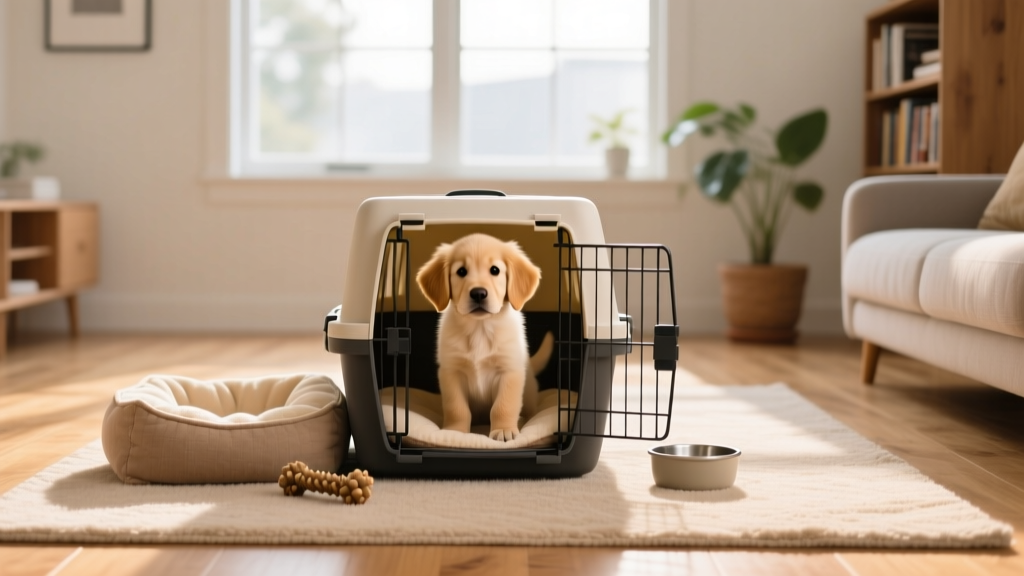
Crate training is essential for Korthal Griffon puppies, who can be creative destroyers when bored or anxious. The crate becomes their den and your management tool during the house-training process. Here's a progressive timeline:
- Weeks 8–10: Crate introduced with door open; feed meals inside; 15–30 minute sessions with you in the room; sleep in crate beside your bed at night. Max alone time: 30 minutes.
- Weeks 10–14: Door closed for short periods; move crate gradually to permanent location; begin leaving room for brief intervals. Max alone time: 1–2 hours.
- Months 4–6: Puppy can hold bladder longer; crate for 2–3 hours during the day if they've been exercised first. Max alone time: 3–4 hours.
- Months 6–12: Most Korthal Griffons can be crated for up to 4–5 hours during the day, provided they receive adequate exercise before and after. Never crate a puppy or adolescent dog for more than 5 hours at a stretch during waking hours.
Crate sizing for a growing Griffon: Purchase a 42-inch wire crate (MidWest iCrate or Frisco Heavy Duty) with an adjustable divider panel. The crate should be large enough for your adult Griffon to stand, turn around, and lie down — but the divider keeps the space puppy-sized to prevent soiling one end and sleeping in the other. Expect to spend $60–$90 for a quality crate with divider.
Teething Timeline (3–6 Months): Relief Strategies and Safe Chews
Korthal Griffon puppies begin losing baby teeth around 14–16 weeks, with the full set of 42 adult teeth typically in place by 6–7 months. During this period, expect intense chewing, drooling, occasional bleeding gums, and a strong urge to mouth anything within reach — including your hands, furniture legs, and shoes.
Safe chew recommendations by stage:
- 3–4 months (early teething): Frozen washcloth twisted into a rope, KONG Puppy (rubber, size Medium) stuffed with soaked kibble and frozen, Nylabone Puppy Chew (soft formula)
- 4–5 months (peak discomfort): KONG Classic (red rubber, size Medium) with peanut butter, Benebone Wishbone (puppy formula), frozen carrot sticks (supervised — some puppies bite off large chunks)
- 5–7 months (finishing eruption): Transition to KONG Extreme (black rubber, size Large), yak milk chews (Himalayan Dog Chew — supervise and remove small end pieces), BullyMaxx rubber tug toy for interactive chewing
Avoid: Rawhide (choking and digestive blockage risk), cooked bones (splinter hazard), hard antlers (can fracture puppy teeth), and any chew small enough to swallow whole. If you're unsure whether a chew is safe, apply the "fingernail test" — if you can't make an indentation with your thumbnail, it's too hard for puppy teeth.
Common Korthal Griffon Puppy Problems and Solutions
Puppy Biting and Nipping
How do I stop puppy biting and nipping? Korthal Griffon puppies are mouthy — this breed uses their mouth to explore the world, and their hunting heritage means they're naturally inclined to grab and hold. Biting typically peaks between 8–16 weeks and gradually decreases with consistent management.
Effective, force-free approach:
- When puppy teeth touch skin, say "ouch" in a calm, medium-volume tone and immediately withdraw attention (stand up, cross arms, look away) for 10–15 seconds.
- Redirect to an appropriate chew toy and praise enthusiastically when they bite the toy instead.
- If nipping continues after two redirects, end the play session with a 2–3 minute calm-down period in the crate or pen (not as punishment — as a reset).
- Ensure your puppy is getting adequate physical and mental exercise. Overtired puppies bite more. A 10-minute training session or a 5-minute sniff walk can reduce mouthing more effectively than extended physical play.
Expect mouthing to decrease significantly by 5–6 months as adult teeth come in, though adolescent Korthal Griffons may still grab hands during excited greetings. Continue redirecting consistently.
Whining and Vocalization
Korthal Griffons are more vocal than many pointing breeds. Puppies may whine when crated, when they want attention, or when they hear stimulating sounds outside. For crate whining: wait for 3–5 seconds of silence before opening the crate (so silence, not noise, opens the door). For demand whining: ignore completely — no eye contact, no talking, no touching — until the puppy is quiet, then reward the quiet with attention. Consistency from all household members is critical; one person giving in to whining undermines everyone else's training.
Destructive Chewing
This breed's intelligence and energy mean that a bored Korthal Griffon puppy will find creative ways to entertain themselves — usually at your expense. Prevention is more effective than correction:
- Puppy-proof every room: shoes in closets, cords behind furniture, remote controls out of reach
- Provide a rotation of 4–5 approved chew toys (rotate every 2–3 days to maintain novelty)
- Use food-puzzle toys (KONG, Outward Hound Nina Ottosson puzzles) for mental stimulation during alone time
- Ensure 30–45 minutes of structured exercise daily (walks, fetch, training games) split across 2–3 sessions
First-Year Cost Breakdown: Budgeting for Your Korthal Griffon Puppy
Korthal Griffon puppies are a significant financial commitment. Here's a realistic first-year budget based on 2025–2026 pricing across the United States. Costs vary by region (urban areas tend to be 15–30% higher than rural areas).
| Category | Low Estimate | Mid Estimate | High Estimate | Details |
|---|---|---|---|---|
| Puppy Purchase | $1,500 | $2,000 | $2,800 | From responsible breeder with health-tested parents; adoption/rescue may be $300–$600 |
| Veterinary Care | $600 | $900 | $1,400 | Wellness visits, vaccines, deworming, spay/neuter, flea/tick/heartworm prevention |
| Food | $480 | $720 | $1,080 | $40–$90/month depending on brand quality and puppy growth rate |
| Supplies | $300 | $500 | $800 | Crate, bed, leash/harness, bowls, toys, grooming tools, baby gates |
| Training | $150 | $400 | $800 | Group puppy class ($150–$250) + possible private sessions ($75–$125/session) |
| Grooming | $0 | $200 | $500 | Hand-stripping by professional ($60–$100/session, 3–4x/year) or DIY learning curve |
| Pet Insurance | $360 | $480 | $720 | $30–$60/month for accident+illness coverage (enroll before pre-existing conditions develop) |
| TOTAL FIRST YEAR | $3,390 | $5,200 | $8,100 | Does not include emergency vet visits ($500–$3,000+) |
Money-saving tips: Enroll in pet insurance during the first month (premiums are lowest for young puppies and pre-existing conditions won't be excluded yet). Buy quality supplies once — a $90 crate lasts a lifetime, while a $30 crate may need replacing. Learn basic hand-stripping from YouTube tutorials or a breeder mentor before paying for professional grooming.
Frequently Asked Questions About Korthal Griffon Puppies
How often should I feed my Korthal Griffon puppy at 10 weeks old?
At 10 weeks, feed your puppy 4 meals per day, spaced roughly 3–4 hours apart during waking hours (for example: 7 AM, 11 AM, 3 PM, 7 PM). Each meal should be approximately 0.4–0.6 cups of large-breed puppy kibble, depending on the food's caloric density and your puppy's current weight. Always provide fresh water in a shallow bowl that's accessible at all times.
Are Korthal Griffon puppies good with children?
Well-socialized Korthal Griffon puppies generally do well with respectful children aged 8 and up. They are sturdy enough to handle gentle play but can be mouthy during puppyhood, which may overwhelm toddlers. Always supervise interactions between puppies and young children, and teach children to let the puppy rest when it retreats to its crate. Never allow children to approach a puppy that is eating or sleeping.
How much exercise does a Korthal Griffon puppy need?
Follow the "5 minutes per month of age" guideline for structured walks: a 3-month-old puppy gets approximately 15 minutes of leash walking per session, twice daily. Supplement with free play in a fenced yard, training games, and scent work. Avoid forced running, jumping from heights, or repetitive high-impact exercise until growth plates close (typically 14–18 months). Over-exercising a growing Griffon increases the risk of joint injuries.
Will my Korthal Griffon puppy's coat change color?
Yes. Korthal Griffon puppies are often born darker than their adult color. The characteristic grizzled "chestnut and white" or "roan" coat typically develops between 6–18 months as the wiry adult coat replaces the soft puppy fur. Don't be alarmed if your brown puppy lightens significantly or develops white ticking — this is normal breed maturation.
Should I choose a male or female Korthal Griffon puppy?
Both sexes make excellent companions, but there are subtle differences. Males tend to be slightly larger (60–70 lb / 27–32 kg vs. 50–60 lb / 23–27 kg for females) and may be more outwardly affectionate. Females can be more independent and may be easier to house-train. If you already have a dog of one sex, choosing the opposite sex often reduces same-sex competition. Discuss temperament evaluations with your breeder — individual personality matters more than sex alone.
When should I start formal training classes?
Enroll in a positive-reinforcement puppy kindergarten class as soon as your puppy has received their second DHPP vaccine (typically around 11–12 weeks of age). Classes should require proof of vaccination for all attendees. Look for classes that use treat-based, force-free methods — avoid any trainer who recommends prong collars, shock collars, or dominance-based techniques. The AKC Training Club locator can help you find reputable programs near you.
What health tests should the breeder have done on the parents?
Responsible Korthal Griffon breeders should provide documentation of the following health clearances on both parents: OFA (Orthopedic Foundation for Animals) hip evaluation rated Good or Fair, OFA elbow evaluation, CERF (Canine Eye Registration Foundation) annual eye exam, and ideally a DNA test for degenerative myelopathy (DM). Ask to see the actual OFA certificates — a breeder who says "parents are health tested" but can't produce documentation is a red flag.
Anouk Beaumont
All our authors care for dogs every day — read more of their work on the authors page.