Kennel Training a Puppy: A Week-by-Week Guide for Golden Retrievers
Master kennel training a puppy with this Golden Retriever-specific guide covering crate progression, potty timelines, feeding schedules, and first-year costs.
Why Golden Retrievers Need a Tailored Kennel Training Approach
Golden Retrievers are among the most popular breeds in the United States, and for good reason — they're eager to please, highly social, and remarkably trainable. But their very traits that make them wonderful family dogs also create unique challenges when kennel training a puppy. Goldens are prone to separation anxiety, mouthy behavior that lasts well into adolescence, and a social intensity that can make confinement feel like punishment if introduced incorrectly.
This guide walks you through every developmental stage from 8 weeks through 12 months with specific crate training protocols, feeding measurements, vaccination timelines, and problem-solving strategies designed for how Golden Retriever puppies actually develop. Expect realistic timelines — not overnight miracles — and concrete numbers you can follow from day one.
When Should I Bring My Golden Retriever Puppy Home?
The ideal age to bring a Golden Retriever puppy home is 8 weeks (56 days). The American Kennel Club and veterinary behaviorists agree that puppies benefit from remaining with their littermates and dam through at least 8 weeks, as this is when critical bite inhibition and social signaling skills develop. Some responsible Golden breeders hold puppies until 9-10 weeks to complete an early socialization protocol, and this is perfectly acceptable.
Bringing a puppy home before 8 weeks risks incomplete socialization with littermates, which can manifest as excessive nipping, poor impulse control, and difficulty reading canine body language later in life. If you're working with a breeder who offers puppies at 6 weeks, push back — this is too early for any breed, but especially for a mouthy breed like the Golden Retriever.
Age-Specific Milestones: What to Expect Each Week
Weeks 4–8 (Still with Breeder)
- Development: Eyes and ears fully functional, primary socialization with littermates begins, deciduous teeth erupting
- Crate exposure: Breeder should introduce an open crate with bedding in the whelping area so puppies explore voluntarily
- Weight milestone: Golden puppies typically weigh 8–12 lb (3.6–5.4 kg) by 8 weeks
- Behavior marker: Littermate play-fighting teaches bite inhibition — puppies learn that biting too hard ends play
Weeks 8–12 (Home Transition)
- Development: Fear imprinting period begins (8–11 weeks) — negative crate experiences during this window can create lasting aversion
- Crate training goal: Puppy enters crate voluntarily for treats and naps; door closed for 10–30 minutes while you're present
- Bladder capacity: Approximately 1 hour per month of age, so a 2-month-old Golden can hold it roughly 2 hours maximum
- Weight milestone: 15–22 lb (6.8–10 kg) by 12 weeks
- Sleep needs: 18–20 hours per day — most of this should happen in the crate
Weeks 12–16 (Building Confidence)
- Development: Fear imprinting period ends around week 11; secondary socialization window still open through ~14 weeks
- Crate training goal: 1–2 hours crated while you're home; overnight crating 6–8 hours with one potty break
- Bladder capacity: 3–4 hours during the day
- Weight milestone: 25–35 lb (11.3–15.9 kg) by 16 weeks — time to transition to a larger crate or install the divider panel
- Behavior marker: Testing boundaries; may begin barking or whining in crate to demand release
Weeks 16–24 (Adolescence Begins)
- Development: Adult teeth erupting, chewing intensity peaks, early adolescent independence emerges
- Crate training goal: 3–4 hours crated during the day; full overnight sleep (7–8 hours) without potty break
- Bladder capacity: 4–6 hours
- Weight milestone: 40–55 lb (18.1–24.9 kg) by 6 months
- Behavior marker: Destructive chewing peaks — crate becomes essential for safety, not just training
Months 6–12 (Full Adolescence)
- Development: Sexual maturity (spay/neuter typically done 6–9 months for Goldens per current veterinary consensus), adult coat coming in, growth plates closing around 12–18 months
- Crate training goal: Dog can be trusted with crate door open in your home; crated 4–6 hours during workday without distress
- Bladder capacity: 6–8 hours (adult level)
- Weight milestone: Males: 55–70 lb (24.9–31.8 kg); Females: 45–60 lb (20.4–27.2 kg) by 12 months (will fill out until ~2 years)
- Behavior marker: "Second fear period" may occur around 6–10 months; previously crate-comfortable dogs may regress temporarily
Feeding Schedule: Exact Portions by Age and Weight
Golden Retrievers are prone to rapid growth-related orthopedic issues, including hip dysplasia. Research published in the Journal of the American Veterinary Medical Association shows that keeping Golden puppies lean — with a body condition score (BCS) of 4–5 on the 9-point scale — significantly reduces hip dysplasia incidence. Overfeeding is the most common owner mistake with this breed.
Use a large-breed puppy formula (AAFCO-approved, with calcium content between 1.0–1.5% on a dry matter basis). Here are specific feeding guidelines:
| Age | Weight Range | Daily Amount (Large-Breed Puppy Kibble) | Meals Per Day | Per-Meal Portion |
|---|---|---|---|---|
| 8–12 weeks | 10–22 lb (4.5–10 kg) | 1.5–2.5 cups | 3 meals | 0.5–0.83 cups |
| 3–6 months | 25–55 lb (11.3–24.9 kg) | 2.5–4 cups | 3 meals → 2 meals (at ~4 months) | 0.83–1.33 cups (3x) or 1.25–2 cups (2x) |
| 6–12 months | 45–70 lb (20.4–31.8 kg) | 3–4.5 cups | 2 meals | 1.5–2.25 cups |
Critical feeding-to-crate rule: Never put your Golden in the crate immediately after eating. Wait 30–45 minutes to reduce bloat (gastric dilatation-volvulus) risk, which Goldens are predisposed to. Feed meals outside the crate, then allow calm time before crating for a nap.
Brands that consistently meet WSAVA guidelines for large-breed puppy nutrition include Purina Pro Plan Large Breed Puppy, Royal Canin Golden Retriever Puppy, and Hill's Science Diet Large Breed Puppy. Expect to spend $55–$85 per 30-lb bag in 2026, which lasts roughly 3–4 weeks during peak growth months.
Potty Training Timeline: Realistic Expectations for Golden Retrievers
Golden Retrievers are generally among the easier breeds to house train thanks to their food motivation and desire to please, but "fully potty trained" means different things at different stages. Here's what the timeline actually looks like:
- 8–12 weeks: Accidents every day are normal. You are managing, not training. Take puppy out every 1–2 hours, immediately after waking, eating, drinking, and playing.
- 3–4 months: Accidents drop to 1–3 per week if you're consistent. Puppy begins to signal (goes to door, whines, paces).
- 4–6 months: Mostly reliable with supervision. Occasional accidents when routine changes or puppy is overly stimulated.
- 6–9 months: Reliable in familiar environments. May have regression during sexual maturity — intact males may begin marking.
- 9–12 months: Fully reliable. If accidents persist past 9 months with consistent training, consult your veterinarian to rule out urinary tract infection, anatomical issues, or behavioral anxiety.
- Time of last meal/water
- Time taken outside
- Result (urinate/defecate/both/nothing)
- Time of any accident + location in home
- Activity before accident (playing, sleeping, eating)
Crate-potty connection: The crate leverages a dog's natural instinct not to soil their sleeping area. A correctly sized crate is key — your Golden puppy should be able to stand, turn around, and lie down, but NOT have room to eliminate in one corner and sleep in another. Use the included divider panel in a 42-inch crate (the adult Golden size) and adjust as they grow.
Crate Training Progression: Time Limits and Step-by-Step Protocol
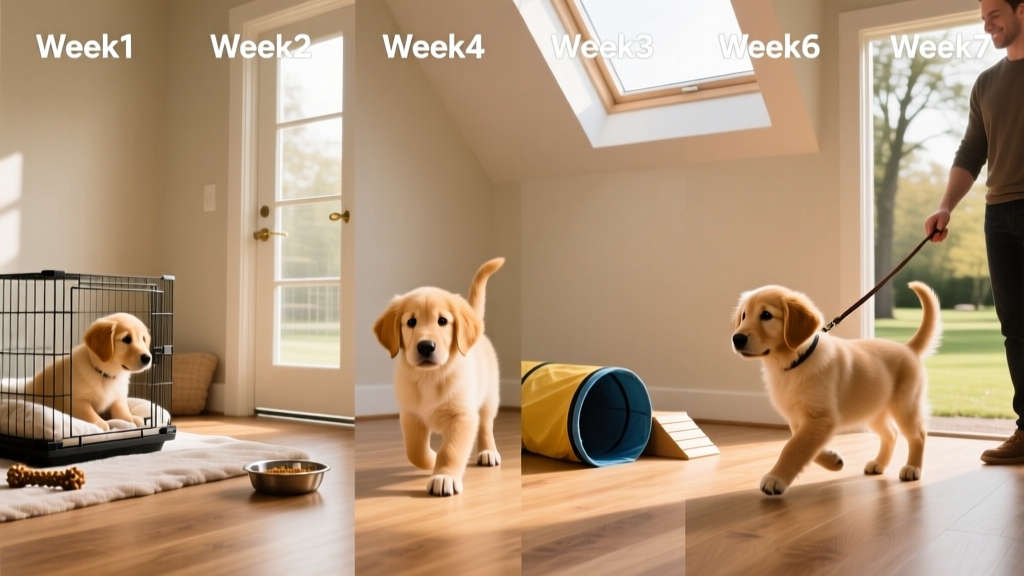
Kennel training a puppy successfully means building positive associations before demanding duration. Here is a breed-specific protocol for Goldens, who tend to be more vocal and physically expressive than some breeds during the learning process:
Phase 1: Introduction (Days 1–7 at Home, 8–9 Weeks Old)
- Place crate in a high-traffic family area (living room, not laundry room or garage)
- Remove the door entirely or secure it fully open for the first 3 days
- Feed all meals near the crate, then inside the crate with door open
- Scatter high-value treats (freeze-dried liver, small pieces of chicken) inside throughout the day
- Introduce a specific cue word — "kennel" or "go to bed" — only when puppy is already moving toward crate
- Close door for 1-minute intervals while you sit beside the crate, gradually increasing to 10 minutes
Phase 2: Building Duration (Weeks 2–4, Puppy Age 9–12 Weeks)
- Close door for 15–30 minute naps while you remain in the room
- Begin stepping out of the room for 1–5 minutes, returning before puppy shows distress
- Crate puppy for overnight sleep — place crate beside your bed initially so you can hear them and they feel your presence
- Set a nighttime alarm for one potty break (typically 3–4 hours after bedtime)
- Maximum daytime crating: 2 hours at a stretch at this age
Phase 3: Independence (Weeks 5–8, Puppy Age 12–16 Weeks)
- Move crate to its permanent location if different from bedroom
- Extend alone-in-crate time to 30–60 minutes while you leave the house briefly
- Practice departures without fanfare — no emotional goodbyes or greetings
- Introduce a stuffed Kong or lick mat as a crate-only enrichment item
- Maximum daytime crating: 3 hours at a stretch
Phase 4: Working Hours (Months 4–6, Puppy Age 16–24 Weeks)
- Build up to 4-hour stretches — but Golden puppies under 6 months should not be crated longer than 4 hours during the day without a potty break
- If you work full-time, arrange a midday potty break via dog walker, neighbor, or coming home
- Provide 60+ minutes of exercise and mental stimulation before long crate sessions
- Consider a puppy-proofed exercise pen attached to the crate as an alternative for longer absences
| Puppy Age | Maximum Daytime Crate Duration | Maximum Overnight Crate Duration | Crate Size Setting |
|---|---|---|---|
| 8–10 weeks | 1–2 hours | 3–4 hours (with potty break) | Divider at ~24 inches |
| 10–14 weeks | 2–3 hours | 5–6 hours (with potty break) | Divider at ~30 inches |
| 14–18 weeks | 3–4 hours | 7–8 hours | Divider at ~36 inches |
| 4–6 months | 4 hours max | 8 hours | Full crate (42 inches) |
| 6–12 months | 4–6 hours | 8 hours | Full crate (42 inches) |
Vaccination Schedule for Golden Retriever Puppies
Your Golden Retriever puppy will need a series of core and non-core vaccines. The AVMA recommends following the AAHA (American Animal Hospital Association) canine vaccination guidelines, with timing adjusted to your local disease risk profile. Here is the standard schedule:
| Age | Vaccine | Type | Estimated Cost |
|---|---|---|---|
| 6–8 weeks | DHPP (Distemper, Hepatitis/Adenovirus, Parainfluenza, Parvovirus) — 1st dose | Core | $20–$40 |
| 10–12 weeks | DHPP — 2nd dose; Bordetella (intranasal); Leptospirosis — 1st dose (if recommended in your area) | Core + Non-core | $40–$75 |
| 14–16 weeks | DHPP — 3rd (final puppy) dose; Rabies; Leptospirosis — 2nd dose | Core + Non-core | $50–$90 |
| 12 months | DHPP booster; Rabies booster (1-year or 3-year depending on product); Bordetella booster; Leptospirosis booster | Core + Non-core | $60–$120 |
Golden-specific note: Goldens have a slightly higher rate of vaccine-associated adverse reactions (particularly facial swelling and urticaria) compared to some breeds, according to data reviewed in the Merck Veterinary Manual. If your Golden puppy has had a previous reaction, your veterinarian may pre-treat with diphenhydramine (Benadryl) at 1 mg/lb given 20 minutes before vaccination. Always mention any prior reactions at your appointment.
When can your puppy go outside and meet other dogs? After the final DHPP dose at 14–16 weeks plus 5–7 days for immunity to develop, your puppy is considered protected for core diseases. Before that, avoid dog parks, pet stores, and areas with unknown dog traffic. Controlled socialization with known, fully vaccinated adult dogs in private yards is acceptable from 8 weeks onward — and is encouraged during the socialization window.
Socialization Window: Weeks 3–14 Exposure Checklist
The primary socialization window closes between 12 and 14 weeks of age. For Golden Retrievers, who are generally social but can develop fear-based reactivity if undersocialized, this period is critical. The AKC recommends structured exposure to a wide variety of stimuli during this window. Here is a Golden-specific checklist:
Golden-specific priority: Goldens are retrieving dogs that carry objects in their mouths. Use the socialization window to teach "drop it" and "trade" with high-value treats so mouthiness is channeled appropriately rather than directed at hands and clothing.
Teething Timeline and Relief Strategies (3–6 Months)
Golden Retrievers are notoriously mouthy dogs, and teething amplifies this trait significantly. Here's the eruption timeline:
- 3–4 weeks: Deciduous (baby) incisors erupt
- 4–6 weeks: Deciduous canines and premolars erupt
- 12–16 weeks: Baby incisors begin falling out; adult incisors replace them
- 4–5 months: Adult canines and premolars erupt — peak chewing intensity
- 5–6 months: Adult molars erupt; all 42 adult teeth typically in place by 6–7 months
Safe chew recommendations for Golden puppies:
- Kong Classic (puppy rubber, pink/blue): Stuff with a mixture of plain yogurt, mashed banana, and kibble, then freeze. The cold soothes gums. Size: Medium for 8–16 week puppies, Large for 4–6 months.
- Nylabone Puppy Chew (chicken flavor, soft flex material): Designed specifically for developing teeth — harder nylon chews can damage puppy teeth. Size: Wolf (for puppies up to 25 lb), then Souper (up to 50 lb).
- Frozen washcloth: Wet a clean washcloth, twist into a rope, freeze for 2 hours. Supervise use and remove once puppy starts tearing fabric.
- West Paw Zogoflex Toppl: Interlocking treat toy that's gentler than hard rubber. Dishwasher safe, made in USA.
Avoid: Rawhide (choking and intestinal blockage risk), antlers and weight-bearing bones from large animals (tooth fracture risk in developing teeth), and any chew toy small enough to be swallowed whole. If your puppy ingests a foreign object, call your veterinarian or the ASPCA Animal Poison Control Center at (888) 426-4435 (24/7, consultation fee applies).
Common Golden Retriever Puppy Problems and Solutions
Puppy Biting and Nipping
Goldens are "mouthy" by genetics — they were bred to carry game birds. Expect nipping behavior to persist longer than in many breeds, often through 7–9 months if not actively managed.
Solution protocol:
- When teeth touch skin, say "ouch" in a calm, firm tone and immediately withdraw attention (stand up, turn away, or step behind a baby gate) for 15–30 seconds
- Return and redirect to an appropriate chew toy — praise enthusiastically when puppy chews the toy
- Ensure puppy gets 2–3 hours of cumulative exercise and enrichment daily; overtired puppies bite more
- Enforce nap times in the crate — many biting episodes are simply exhaustion signals
- Never use physical punishment, muzzle grabbing, or alpha rolls — these damage trust and can escalate defensive aggression
Crate Whining and Barking
Goldens are vocal dogs, and protest barking in the crate is common in weeks 1–4 of training.
Solution protocol:
- Rule out potty need: if puppy has been crated less than their bladder capacity window, whining is likely protest, not a potty signal
- Wait out protest barking — releasing during barking teaches that barking opens the door. Wait for 5–10 seconds of silence, then release
- Cover the crate with a breathable blanket on three sides to reduce visual stimulation
- Use white noise or a fan near the crate to mask household sounds that trigger alertness
- If puppy has been quiet for the expected duration and then vocalizes, take them out for a boring (no play) potty break, then re-crate
Destructive Chewing
Peak chewing in Golden Retrievers occurs between 4–8 months — overlapping with teething AND adolescent exploration.
Solution protocol:
- Crate or confine to a puppy-proofed area when unsupervised — management is the most effective strategy
- Provide a rotation of 4–5 chew toys so novelty is maintained (put some away and rotate weekly)
- Apply bitter apple spray (Grannick's Bitter Apple, ~$8 for 8 oz) to furniture legs, baseboards, and shoes as a deterrent
- Ensure minimum 45–60 minutes of physical exercise and 20–30 minutes of mental enrichment (snuffle mats, training sessions, puzzle feeders) daily
- Puppy-proof at Golden height: remove items from coffee tables, low shelves, and countertops within jumping reach
First-Year Cost Breakdown for a Golden Retriever Puppy
Budgeting accurately prevents surprises. Here is a realistic first-year cost breakdown based on 2026 pricing across the United States:
| Category | Item | Estimated Cost |
|---|---|---|
| Purchase/Adoption | AKC-registered breeder (health-tested parents) OR breed rescue | $2,000–$4,000 (breeder) / $300–$600 (rescue) |
| Veterinary | Puppy vaccine series, spay/neuter, microchip, heartworm prevention (12 months), flea/tick prevention (12 months), 3 wellness exams | $800–$1,500 |
| Food | Large-breed puppy food (12 months), treats, food puzzle toys | $600–$1,000 |
| Supplies | 42-inch crate ($60–$120), exercise pen ($40–$80), bed ($30–$60), leash/harness/collar ($40–$80), bowls, grooming tools (undercoat rake, slicker brush, nail grinder: $50–$100), chew toys ($60–$120), baby gates ($30–$80), enzymatic cleaner ($15–$25) | $400–$700 |
| Training | Puppy socialization class ($150–$300 for 6-week session), basic obedience ($150–$300), optional private sessions for problem behaviors ($75–$150/hour) | $300–$750 |
| Insurance | Pet insurance (Golden-specific premiums, accident + illness) | $40–$80/month ($480–$960/year) |
| Emergency Fund | Set aside for foreign body ingestion (Goldens eat everything), ear infections, GI upset | $500–$2,000 (if needed) |
Total first-year estimate: $5,020–$8,910 for a breeder-sourced puppy; $3,420–$5,510 for a rescue puppy. These figures do not include pet sitting or dog walking services if you work outside the home.
Frequently Asked Questions
How often should I feed my Golden Retriever puppy at each age?
Feed three meals per day from 8 weeks to approximately 4 months of age. Transition to two meals per day around 16 weeks. Maintain two meals daily through adulthood. Avoid free-feeding (leaving food out all day) with Goldens, as they tend to overeat, which increases orthopedic disease risk.
When will my Golden Retriever puppy be fully potty trained?
Most Golden Retrievers are reliably house trained between 5–7 months with consistent schedule-based training. Some individuals take up to 9 months. If accidents persist past 9 months despite consistent management, consult your veterinarian to rule out medical causes such as ectopic ureters (a congenital condition more common in Golden females than the general population).
How do I stop my Golden puppy from biting my hands and clothes?
Redirect every mouth-to-skin contact to an appropriate toy, withdraw attention for 15–30 seconds after a bite, and ensure adequate exercise and enforced naps. Golden puppy biting typically improves significantly by 7–9 months as adult teeth settle and impulse control matures. Consistency from all household members is essential — mixed messages (sometimes allowing mouthing, sometimes not) will prolong the behavior.
When can my puppy go to the dog park?
Wait until at least 7 days after the final DHPP vaccine at 14–16 weeks — so approximately 16–17 weeks of age minimum. Even then, choose dog parks carefully. Overwhelming or aggressive encounters during adolescence (6–14 months) can create lasting negative associations. Start with controlled one-on-one playdates with known, calm dogs before introducing the chaos of a dog park.
My puppy screams in the crate at night — what do I do?
First, ensure the puppy has been exercised, has eliminated, and isn't hungry. Place the crate near your bed for the first 2–3 weeks so your presence is reassuring. Set one alarm for a nighttime potty break (around 3–4 AM for an 8–12 week old). If the puppy vocalizes after having eliminated, wait for a pause in the noise (even 5 seconds of silence) before any interaction. Consistently releasing during screaming reinforces the behavior. Most Goldens adjust to overnight crating within 1–3 weeks.
Should I crate my Golden during the day if I work from home?
Yes — even when you're home, structured crate time teaches your Golden to be comfortable alone, which is essential for preventing separation anxiety (a breed predisposition). Aim for 1–2 hours of crate time during the day while you work, paired with equal or greater time of supervised freedom and interaction.
Successful kennel training a puppy — especially a social, mouthy, people-oriented breed like the Golden Retriever — requires patience measured in weeks and months, not days. Follow the developmental milestones, respect your puppy's physical limits, and build positive associations consistently. The investment you make in the first six months of structured crate training will pay dividends for the next decade of your dog's life.
Beth Carrasco
All our authors care for dogs every day — read more of their work on the authors page.