Italian Greyhound Puppy Care: Complete Growth, Training & Feeding Guide
Everything you need to raise an Italian Greyhound puppy: age milestones, feeding portions, potty training timelines, vaccination schedules, and first-year costs.

If you've just committed to bringing home an Italian Greyhound puppy — or you're deep in the research phase before making that leap — you've probably already discovered that these miniature sighthounds are not your average toy breed. Often called "Iggy" by devoted owners, the Italian Greyhound combines the athleticism of a full-sized Greyhound with the lap-dog sensibility of a companion breed. They're fast, they're sensitive, they're surprisingly stubborn about housebreaking, and they get cold in ways that will surprise first-time owners.
This guide walks you through every critical stage of your Italian Greyhound puppy's first year, with breed-specific expectations you won't find in generic puppy manuals. I've worked with dozens of Iggy owners through the puppy phase, and the patterns are remarkably consistent — which means you can prepare for what's coming.
When to Bring Your Italian Greyhound Puppy Home
Responsible Italian Greyhound breeders typically release puppies between 10 and 12 weeks of age, not the 8-week minimum common in larger breeds. There are sound developmental reasons for this delay.
Italian Greyhounds mature more slowly in terms of emotional regulation and immune system development compared to hardier toy breeds like the Miniature Pinscher or Jack Russell Terrier. The additional two to four weeks with the dam and littermates provides critical bite-inhibition practice, thermoregulation skills, and social buffering that directly impacts your puppy's confidence later.
According to the American Kennel Club breed standard, Italian Greyhounds should exhibit "graceful" and "elegant" movement — traits that require proper musculoskeletal development. Puppies sent home too early often show heightened startle responses and struggle with separation anxiety well into adulthood.
Red flags from breeders: Anyone offering an Italian Greyhound puppy at 6-7 weeks, or before the first DHPP vaccination, should be avoided. Reputable breeders will have documented health testing (OFA patella and eye clearances at minimum) and will keep puppies through at least their 8-week veterinary wellness exam.
Italian Greyhound Puppy Milestones: Week by Week
Understanding what's developmentally normal at each stage prevents unnecessary panic and helps you set realistic expectations. Italian Greyhounds tend to hit physical milestones on schedule but lag behind other breeds in emotional maturity and bladder control.
Weeks 4–8: The Litter Stage (Breeder's Domain)
Your puppy is still with the breeder during this period. Key developments include:
- Week 4: Deciduous (baby) teeth erupting; puppy begins lapping softened gruel
- Week 5: Social play with littermates intensifies; first fear period may begin (startle responses to loud noises)
- Week 6: First DHPP vaccination administered by breeder's vet; solid food transition begins
- Week 7: Individual temperament testing often performed by breeders; puppies begin showing bold vs. cautious tendencies
- Week 8: Second DHPP vaccination; deworming treatment; microchipping if not already done
What you should expect from the breeder: Health records, a written contract with a return clause, early neurological stimulation (ENS) documentation, and photos/videos of the dam and sire.
Weeks 8–12: Home Adjustment Period
This is when most Italian Greyhound puppies come home (if released at 10-12 weeks). Expect:
- Sleep: 18-20 hours per day is normal — Iggies are sprinters, not endurance animals, and they crash hard after play
- Appetite: Stress-related appetite suppression for the first 48-72 hours is common; offer small, frequent meals of the same food the breeder used
- Bladder control: Approximately 1 hour per month of age — a 10-week puppy can hold it for roughly 2.5 hours maximum
- Startle reflex: Italian Greyhounds have an exaggerated startle response compared to other toy breeds; sudden noises may cause trembling or hiding
- Bone fragility: Iggy puppies are notoriously prone to leg fractures from jumping off furniture — this is the number one emergency vet visit for the breed under 6 months
Weeks 12–16: Confidence Building
- Energy surges: Short, intense bursts of "zoomies" lasting 2-5 minutes, followed by immediate naps
- Testing boundaries: Your puppy will begin ignoring known cues; this is developmentally normal, not regression
- Socialization peak: The primary socialization window closes around week 14 — every positive exposure now pays dividends for years
- Teething begins: Deciduous teeth start loosening around 14-16 weeks; you may find tiny teeth in bedding
Weeks 16–24: The Adolescent Transition
- Growth rate: Your puppy will reach approximately 75% of adult height by 6 months but will continue filling out through 12-18 months
- Coat changes: The puppy coat sheds and the sleek adult coat emerges; skin may appear slightly dry during this transition
- Second fear period: Typically between 6-14 months — previously confident puppies may suddenly become wary of familiar objects or people
- Prey drive emergence: Sighthound instincts kick in; your puppy will begin fixating on squirrels, cats, and small dogs during walks
Months 6–12: Toward Adulthood
- Adult size: Males typically reach 13-15 inches at the shoulder and 7-14 lb (3.2-6.4 kg); females are slightly smaller at 13-14 inches and 7-12 lb (3.2-5.4 kg)
- Spay/neuter timing: Many veterinarians now recommend waiting until 9-12 months for Italian Greyhounds to allow growth plate closure — discuss timing with your vet
- Emotional maturity: Iggies are slow to mature; expect puppy-like exuberance through 18-24 months, which is later than most toy breeds
- Bladder reliability: Full housebreaking often doesn't click until 8-10 months — significantly later than breeds like Poodles or Bichons
Feeding Your Italian Greyhound Puppy: Portions and Schedule
Italian Greyhounds have fast metabolisms, low body fat, and tiny stomachs — a combination that makes feeding frequency and portion precision more important than with most breeds. Hypoglycemia (dangerously low blood sugar) is a real risk in Iggy puppies under 4 months, especially if meals are skipped.
Choose a food that carries the AAFCO statement of nutritional adequacy for growth or all life stages. Look for a kibble with minimum 22% protein and 8% fat for puppy formulas. Many Iggy owners do well with small-breed-specific puppy formulas, as the kibble size matches their small jaws.
| Age | Meals Per Day | Portion Per Meal | Total Daily Amount | Notes |
|---|---|---|---|---|
| 8–12 weeks (2-4 lb / 0.9-1.8 kg) | 4 meals | ¼ cup kibble + 1 tbsp warm water | 1 cup/day | Moisten kibble; monitor for hypoglycemia (lethargy, trembling) |
| 12–16 weeks (4-6 lb / 1.8-2.7 kg) | 3 meals | ⅓ cup dry kibble | 1 cup/day | Transition to dry kibble; increase if ribs are visible (they shouldn't be at this age) |
| 16–24 weeks (6-9 lb / 2.7-4.1 kg) | 3 meals | ⅓ to ½ cup | 1–1.5 cups/day | Adjust based on body condition score; you should feel but not see ribs |
| 6–9 months (8-12 lb / 3.6-5.4 kg) | 2 meals | ½ to ¾ cup | 1–1.5 cups/day | Transition to adult formula around 9-10 months |
| 9–12 months (10-14 lb / 4.5-6.4 kg) | 2 meals | ½ to ¾ cup adult food | 1–1.5 cups/day | Monitor weight closely; Iggies gain fat easily once growth slows |
Hypoglycemia warning: If your Iggy puppy becomes lethargic, wobbly, or unresponsive, rub a small amount of Karo syrup or honey on their gums and contact your veterinarian immediately. This is a medical emergency in toy breed puppies. Keep a tube of Nutri-Cal (available at most pet stores, around $8-12) in your puppy first aid kit.
Vaccination Schedule for Italian Greyhound Puppies
Italian Greyhounds follow the standard core vaccination protocol recommended by the American Veterinary Medical Association. However, because Iggies are a low-body-fat breed, some veterinarians adjust vaccine timing or split combination vaccines to reduce the risk of adverse reactions, which are slightly more common in toy breeds.
| Age | Vaccine | What It Protects Against | Typical Cost |
|---|---|---|---|
| 6–8 weeks | DHPP (1st dose) | Distemper, Hepatitis (Adenovirus), Parainfluenza, Parvovirus | $20–$40 |
| 10–12 weeks | DHPP (2nd dose) + Bordetella | Core diseases + Kennel Cough | $30–$55 |
| 14–16 weeks | DHPP (3rd dose) + Rabies | Core diseases + Rabies (legally required) | $35–$65 |
| 12–16 months | DHPP booster + Rabies booster | Maintenance immunity | $40–$70 |
Breed-specific note: Italian Greyhounds can experience post-vaccine lethargy and mild facial swelling more frequently than larger breeds. Discuss with your veterinarian whether pre-medicating with an antihistamine (diphenhydramine at 1 mg/lb, given 30 minutes before vaccination) is appropriate for your puppy. Never administer any medication without veterinary guidance.
Leptospirosis and Lyme vaccines are considered non-core and are recommended based on your geographic risk. If you live in an area with standing water or tick prevalence, your vet may recommend these as early as 12 weeks.
The Critical Socialization Window: Weeks 3–14
The primary socialization period in puppies closes between 12 and 14 weeks of age. For Italian Greyhounds — a breed already predisposed to timidity and noise sensitivity — maximizing this window is arguably more important than for bolder toy breeds like the Cavalier King Charles Spaniel or the Toy Poodle.
Every positive exposure during this window literally rewires your puppy's brain to accept novel stimuli as non-threatening. After the window closes, fearful responses become harder (though not impossible) to modify.
When can your puppy go outside and meet other dogs? Until your puppy has completed the full DHPP series (final dose at 14-16 weeks), avoid public areas where unvaccinated dogs may have been — dog parks, pet stores, and high-traffic sidewalks. You can safely socialize in controlled environments: friends' homes with vaccinated dogs, your own yard, and puppy kindergarten classes that require proof of at least two DHPP doses. The AVMA recommends balancing disease risk with socialization needs — isolation until 16 weeks causes more behavioral damage than the small disease risk from controlled exposures.
Potty Training Your Italian Greyhound Puppy: A Realistic Timeline
Here's what no one tells you before you get an Italian Greyhound puppy: they are notoriously difficult to housebreak. This isn't a reflection of intelligence — Iggies are clever dogs — but a combination of tiny bladders, a dislike of cold/wet weather, and a breed temperament that prioritizes comfort over compliance.
Many experienced Iggy owners tell me their dogs weren't reliably house-trained until 8 to 12 months of age. Some never achieve 100% reliability in bad weather. This is the breed, not a failure on your part.
Potty Training Strategy for Italian Greyhounds
Core schedule (8-16 weeks):
- Take puppy outside within 5 minutes of: waking up, eating, drinking, playing, and every 1-2 hours in between
- Use a consistent verbal cue: "Go potty" or "Do your business" — said calmly as they eliminate, not before
- Reward immediately with a high-value treat (not kibble — use real chicken or freeze-dried liver) and verbal praise
- Carry your puppy outside — Iggies have thin paw pads and may refuse to walk on cold/wet ground
Cold weather solutions (critical for this breed):
- Dress your puppy in a fleece or waterproof coat for outdoor potty trips when temperatures drop below 50°F (10°C)
- Consider an indoor potty system as a backup: UGODOG (raised platform with synthetic grass, ~$40-55) or Fresh Patch (real grass delivery service, ~$30/patch)
- Many Iggy owners successfully train their dogs to use indoor potty systems year-round — this is a practical breed-specific accommodation, not a training failure
Realistic timeline expectations:
| Age | Expected Reliability | Accidents Per Week |
|---|---|---|
| 8–12 weeks | Minimal — learning the concept | Multiple daily |
| 3–4 months | Improving with schedule | 3-7 |
| 5–7 months | Mostly reliable in good weather | 1-3 |
| 8–12 months | Reliable in most conditions | 0-2 (weather-dependent) |
Troubleshooting common issues:
- Refusing to go outside in rain/cold: Use a covered area (porch, carport) or train to an indoor system. Never force your Iggy into rain — they genuinely find it miserable, and forcing it creates negative associations that worsen the problem
- Submissive urination when greeting: Ignore the puppy for the first 30 seconds when you come home; greet calmly at their level without direct eye contact. This behavior typically resolves by 6-8 months
- Marking behavior (lifting leg): More common in intact males; neutering reduces but doesn't always eliminate marking. Use enzymatic cleaners (Nature's Miracle or Rocco & Roxie, ~$12-18) to prevent re-marking
Crate Training Progression and Time Limits
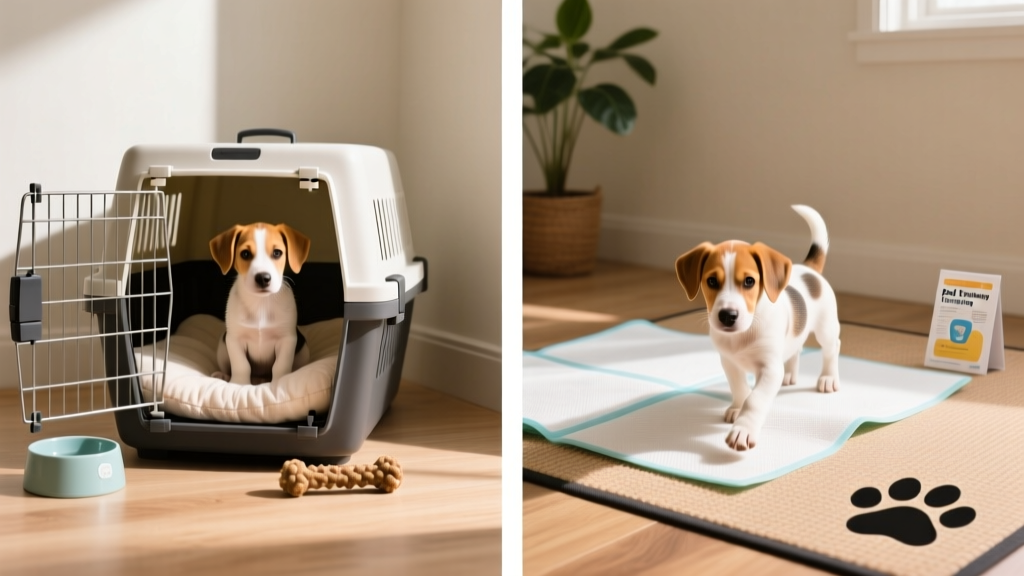
Crate training serves dual purposes for Italian Greyhounds: it aids housebreaking by leveraging a dog's natural instinct not to soil their sleeping area, and it provides a safe den that prevents destructive chewing and furniture-jumping injuries when you can't supervise.
Choose a crate sized for your puppy's expected adult dimensions (approximately 24"L × 18"W × 21"H for most Iggies) with a divider panel to reduce the interior space as they grow. Wire crates with a soft bed work well, but many Iggy owners prefer enclosed plastic crates or covered wire crates because the breed tends to feel more secure in den-like spaces.
| Puppy Age | Maximum Daytime Crate Time | Nighttime Expectations |
|---|---|---|
| 8–10 weeks | 1–2 hours | Expect 1-2 overnight potty breaks; crate beside your bed |
| 10–14 weeks | 2–3 hours | 1 overnight break; begin moving crate to permanent location |
| 14–18 weeks | 3–4 hours | May sleep 5-6 hours; still offer one break if needed |
| 4–6 months | 4–5 hours | Most can hold overnight (7-8 hours) |
| 6–12 months | 5–6 hours maximum | Full overnight sleep expected |
Important: No puppy of any breed should be crated for more than their age in months plus one hour during the day. An 8-week-old puppy crated for 5 hours while you work will develop anxiety, learn to soil the crate (destroying its housebreaking utility), and may begin self-harming behaviors like excessive licking or crate-bar chewing.
If you work full-time, arrange for a midday visit from a pet sitter or dog walker. For Italian Greyhounds specifically, consider a pet sitter who can let the puppy out into a safe, enclosed area — Iggies can reach speeds of 25 mph and should never be allowed off-leash in unfenced areas due to their prey drive.
Teething Timeline and Relief Strategies
Italian Greyhound puppies have 28 deciduous (baby) teeth that begin erupting at 3-4 weeks and are fully in place by 6-8 weeks. The teething process — when adult teeth push out baby teeth — typically runs from 3 to 6 months of age.
Because Iggies have narrow jaws and relatively crowded dentation, retained baby teeth (where the adult tooth erupts alongside rather than pushing out the baby tooth) is common. Check your puppy's mouth weekly starting at 4 months. If you see two teeth occupying the same position (a "double tooth"), schedule a veterinary visit — retained deciduous teeth must be surgically extracted to prevent malocclusion and periodontal disease.
Safe chew options for Iggy puppies:
- KONG Puppy (XS or Small, $8-12): Fill with softened kibble mixed with plain pumpkin puree and freeze — provides 15-20 minutes of soothing chewing
- Nylabone Puppy Chew (Petite size, $5-8): Designed for dogs under 15 lb; soft enough for developing teeth
- Wet washcloth method: Dampen a clean washcloth, twist into a rope, freeze for 2 hours, and let your puppy chew under supervision — discard once threads begin to fray
- Benebone Puppy (Small, $14-18): Nylon chew shaped for small jaws; the wishbone shape allows Iggies to grip with their front paws
Avoid: Rawhide (choking and intestinal blockage risk), antlers and hooves (too hard — can fracture the thin teeth of toy breeds), and any chew toy larger than your puppy's muzzle width.
Common Italian Greyhound Puppy Problems and Solutions
Every breed has its characteristic puppy challenges. Here are the issues that Iggy owners bring up most frequently, with practical solutions rooted in positive reinforcement training.
Puppy Biting and Nipping
Italian Greyhound puppies are mouthy — they explore the world with their teeth, and their needle-sharp baby teeth can make this painful. Biting peaks between 8-16 weeks and gradually diminishes as adult teeth come in and bite inhibition is learned.
Solution: Use the "redirect and reward" method. When teeth touch skin, say "Oops!" in a neutral tone (not a loud yelp, which can overstimulate Iggies), immediately offer a chew toy, and praise enthusiastically when they bite the toy instead. If nipping persists, end the play session by standing up and turning away for 15-30 seconds — this teaches that teeth on skin means fun stops. Consistency from every household member is essential; mixed signals (sometimes allowing mouthing, sometimes not) will extend the behavior by months.
Whining and Crying (Especially at Night)
Iggy puppies are velcro dogs — they want physical contact with their people at all times, and separation distress is common in the first weeks home. Nighttime crate whining is nearly universal.
Solution: Place the crate in your bedroom for the first 2-3 weeks so your puppy can hear and smell you. A Snuggle Puppy (a plush toy with a heartbeat simulator and heat pack, ~$30-40) can dramatically reduce nighttime anxiety. Cover the crate with a light blanket to create a den-like feel. If your puppy whines after a recent potty break and you're confident they don't need to eliminate, wait 5-10 minutes before responding — rewarding silence rather than noise teaches them that quiet gets attention.
Destructive Chewing
Italian Greyhounds aren't typically power chewers like Labrador Retrievers, but they will destroy soft items: shoes, remote controls, pillows, and anything that smells like you.
Solution: Puppy-proof by removing access (baby gates, closed doors, items elevated above 3 feet — Iggies can jump surprisingly high). Provide 4-5 approved chew options in rotation to maintain novelty. A stuffed, frozen KONG given at predictable "chew times" (after exercise, during your work calls) creates a chewing routine.
Furniture Jumping and Leg Fractures
This is the single most dangerous puppy behavior for Italian Greyhounds. Their long, thin leg bones are vulnerable to spiral fractures from jumping off couches, beds, or even stepping off a high porch. Veterinary orthopedic surgeons see Iggy leg fractures at a rate far higher than their population share.
Solution: Provide pet stairs or ramps (the PetSafe Cozy Up Folding Pet Steps, ~$35-45, work well for Iggies) to every piece of furniture your puppy is allowed on. For the first 6 months, consider restricting furniture access entirely by using baby gates around couch areas. If your puppy does jump and lands awkwardly — limping, holding a leg up, or crying — contact your vet immediately. Do not wait to "see if it gets better."
First-Year Cost Breakdown for an Italian Greyhound Puppy
Italian Greyhounds are not the most expensive breed to maintain, but their first year carries predictable costs that new owners should budget for. Here's a realistic breakdown based on 2025-2026 pricing:
| Category | Item | Estimated Cost |
|---|---|---|
| Veterinary | Vaccinations (full puppy series + rabies) | $85–$160 |
| Wellness exams (3-4 visits in year one) | $150–$300 | |
| Spay/neuter (if done in year one) | $300–$600 | |
| Preventive Medications | Heartworm prevention (12 months, e.g., Heartgard Plus) | $75–$110 |
| Flea/tick prevention (12 months, e.g., NexGard or Bravecto) | $150–$250 | |
| Food | Puppy food (12 months, quality small-breed formula) | $200–$350 |
| Treats (training and dental) | $50–$100 | |
| Supplies | Crate (24" with divider) | $40–$70 |
| Harness (escape-proof, e.g., Ruffwear Web Master XS) | $40–$65 | |
| Winter coats (2-3 for rotation, fleece + waterproof) | $50–$120 | |
| Pet stairs/ramp | $35–$60 | |
| Bed, bowls, leash, collar, ID tags, toys | $80–$150 | |
| Training | Puppy kindergarten class (6-8 weeks) | $120–$250 |
| Pet sitter/dog walker (if working full-time) | $2,000–$4,000 | |
| Total Estimated First-Year Cost | $3,375–$6,585 | |
Emergency fund recommendation: Set aside $500–$1,500 for unexpected veterinary costs. Italian Greyhound puppies are prone to leg fractures (repair costs $1,500–$4,000) and foreign body ingestion (surgery $2,000–$5,000). Pet insurance for an Iggy puppy typically runs $35–$60/month and can be cost-effective given the breed's fracture risk.
Frequently Asked Questions
When should I bring my Italian Greyhound puppy home?
Between 10 and 12 weeks of age. Reputable Italian Greyhound breeders keep puppies longer than the 8-week standard used for larger breeds because Iggies benefit from extended littermate socialization and need at least two DHPP vaccinations before leaving. Bringing a puppy home at 8 weeks is possible but increases the risk of behavioral issues like excessive timidity and poor bite inhibition.
How often should I feed my puppy at 10 weeks old?
Four meals per day, spaced roughly 4 hours apart during waking hours (for example: 7 AM, 11 AM, 3 PM, and 7 PM). Each meal should be approximately ¼ cup of high-quality small-breed puppy kibble moistened with warm water. Never skip meals in a puppy under 4 months — toy breeds are susceptible to hypoglycemia, and Italian Greyhounds' low body fat provides minimal glucose reserves.
When will my Italian Greyhound puppy be fully potty trained?
Realistically, expect 8 to 12 months for reliable housebreaking, and even then, many Iggies will regress in cold or rainy weather. This is a breed-wide trait, not a training deficiency. Consistency, a regular schedule, and positive reinforcement will get you there — but patience is non-negotiable. Many owners successfully supplement with indoor potty systems (UGODOG or Fresh Patch) for bad-weather days.
What vaccines does my Italian Greyhound puppy need and when?
The core protocol is three doses of DHPP (Distemper, Hepatitis/Adenovirus, Parainfluenza, Parvovirus) given at 6-8 weeks, 10-12 weeks, and 14-16 weeks, plus a Rabies vaccine at 14-16 weeks. Bordetella (Kennel Cough) is commonly added at the 10-12 week visit. Your veterinarian may also recommend Leptospirosis or Lyme disease vaccines depending on your region. Always consult your veterinarian for a vaccination plan tailored to your puppy's health status and local disease risks.
How do I stop my Italian Greyhound puppy from biting and nipping?
Use positive redirection: when teeth touch skin, say a neutral marker word ("Oops"), immediately offer an approved chew toy, and praise when they bite the toy. If the puppy continues nipping, end the interaction by standing up and walking away for 15-30 seconds. This teaches that gentle play continues but biting ends the fun. Never use physical punishment, alpha rolls, or shock collars — these damage trust and can increase fear-based aggression in sensitive breeds like the Italian Greyhound. Expect biting to peak between 8-16 weeks and gradually diminish as adult teeth erupt and bite inhibition develops.
When can my Italian Greyhound puppy go outside and meet other dogs?
Your puppy can explore your own yard (if enclosed and not frequented by unknown dogs) immediately upon coming home. For public areas and interactions with other dogs, wait until at least one week after the second DHPP vaccine (typically around 11-13 weeks) for controlled settings like puppy classes or vaccinated friends' homes. Full access to dog parks, pet stores, and high-traffic public areas should wait until one week after the final DHPP dose at 14-16 weeks. During the restricted period, carry your puppy in a sling or carrier for outdoor socialization — they get exposure to sights and sounds without disease risk.
Raising an Italian Greyhound puppy is a unique experience that doesn't map neatly onto generic puppy advice. Their sensitivity, fragility, housebreaking challenges, and cold intolerance require breed-specific strategies — but the payoff is a devoted, elegant companion who will bond with you for 12-15 years. Prepare for the first year's challenges, invest in preventive veterinary care, and give your Iggy the patience they need to mature into the remarkable dogs they become.
Anouk Beaumont
All our authors care for dogs every day — read more of their work on the authors page.