Is Puppies.com Legit? A 2026 Buyer's Guide & Puppy Care Roadmap
Is Puppies.com legit? We investigate the platform's reputation, red flags to watch for, and provide a complete puppy care roadmap for your new dog's first year.

Is Puppies.com Legit? What Prospective Puppy Buyers Need to Know
If you've been browsing for a puppy online, you've likely encountered Puppies.com and wondered: is Puppies.com legit? The short answer is nuanced. Puppies.com operates as a listing aggregator — a marketplace that connects prospective buyers with breeders who post available litters. It is a real, functioning website, but its legitimacy as a platform doesn't automatically guarantee that every breeder listed on it is reputable or ethical.
Unlike the AKC Marketplace, which requires breeders to have AKC-registerable litters and agree to certain terms, Puppies.com has historically operated with varying levels of breeder vetting. In 2026, the site continues to host listings from a wide range of sources — some from responsible hobby breeders who health-test their dogs, and others from commercial breeding operations that may prioritize volume over welfare.
- Breeder has multiple litters available simultaneously year-round
- No health testing documentation (OFA, PennHIP, genetic panels) provided
- Puppies are advertised as ready to go home before 8 weeks of age
- No option to visit the breeding facility or meet the dam
- Payment requested via wire transfer, gift cards, or cryptocurrency only
- Prices significantly below breed average (e.g., a French Bulldog for $800)
Before committing to any puppy — whether from Puppies.com, a local breeder, or a rescue — you need a solid plan for that dog's first year. Below is a comprehensive, age-specific puppy care roadmap that applies across breeds and will prepare you for every milestone ahead.
When Should I Bring My Puppy Home? The 8-Week Rule
The AVMA and most veterinary behaviorists agree: puppies should remain with their littermates and dam until at minimum 8 weeks of age, with 10-12 weeks being preferable for small and toy breeds.
During weeks 4-8, puppies learn critical bite inhibition, canine social signals, and stress coping mechanisms from their mother and siblings. Removing a puppy before this window closes is associated with higher rates of fear-based aggression, separation anxiety, and resource guarding later in life, according to research published in the Journal of Veterinary Behavior.
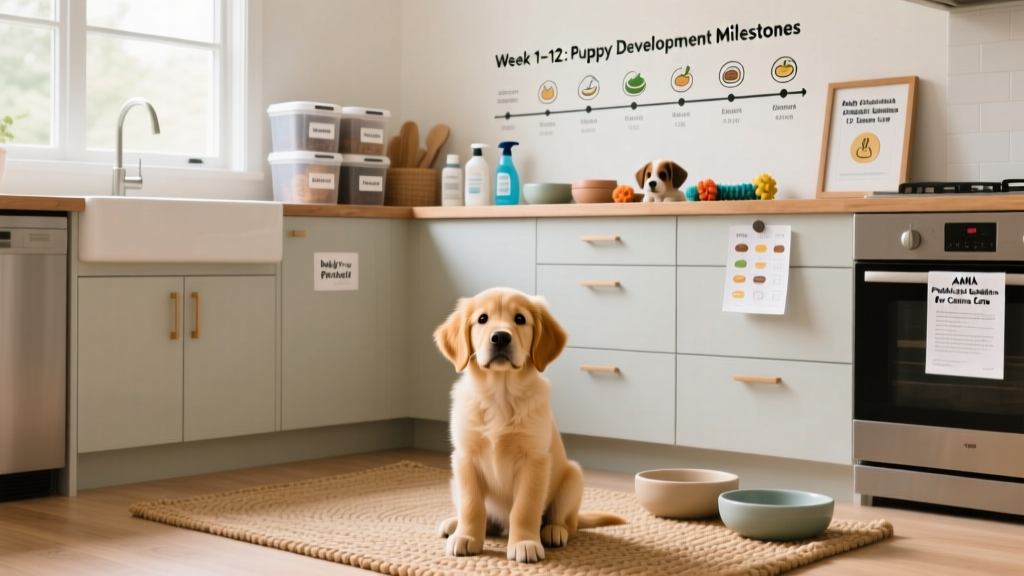
Age-Specific Milestones: What to Expect
| Age Range | Developmental Stage | Key Milestones | What You Should Do |
|---|---|---|---|
| Weeks 4-8 | Socialization Period (with breeder) | Weaning, littermate play, bite inhibition learning, first deworming | Verify breeder is following early neurological stimulation (ENS) protocols; ask for socialization logs |
| Weeks 8-12 | Human Socialization Window Opens | Peak learning period, fear periods begin, bonding with new family | Begin gentle handling exercises, introduce crate, start name recognition, first vet visit within 72 hours of homecoming |
| Weeks 12-16 | Rank & Testing Period | Puppy tests boundaries, may challenge authority, second fear period possible around 12 weeks | Establish consistent rules, enroll in positive-reinforcement puppy class, avoid punishing fear responses |
| Weeks 16-24 | Flight Instinct & Independence | Increased independence, recall may deteriorate, teething peaks, sexual maturity approaches | Reinforce recall with high-value rewards, manage chewing proactively, discuss spay/neuter timing with vet |
| 6-12 Months | Adolescence | Hormonal changes (if intact), testing limits, energy peaks, possible regression in training | Increase physical and mental exercise, maintain training consistency, consider advanced classes, finalize vaccination series |
Feeding Schedule: Exact Portions by Age and Weight
Puppy nutritional needs change rapidly during the first year. The feeding schedule below uses a general framework based on AAFCO guidelines for growth-stage diets. Always check your specific food's feeding chart, as caloric density varies significantly between brands — a cup of Purina Pro Plan Puppy contains roughly 427 kcal, while a cup of Royal Canin Puppy averages about 389 kcal.
| Puppy Age | Meals Per Day | Small Breed (10-25 lb adult) Cups/Day | Medium Breed (25-50 lb adult) Cups/Day | Large Breed (50-90 lb adult) Cups/Day | Giant Breed (90+ lb adult) Cups/Day |
|---|---|---|---|---|---|
| 8-12 weeks | 4 | ¾ – 1 | 1 – 1½ | 1½ – 2 | 2 – 3 |
| 12-16 weeks | 3 | ¾ – 1¼ | 1¼ – 2 | 2 – 3 | 3 – 4½ |
| 16-24 weeks | 3 | 1 – 1½ | 1½ – 2½ | 2½ – 4 | 4 – 6 |
| 6-9 months | 2 | 1 – 1½ | 2 – 3 | 3 – 5 | 5 – 7 |
| 9-12 months | 2 | Transition to adult food | 2½ – 3½ | 3½ – 5½ | 6 – 8 |
Critical note for large and giant breeds: Use a food specifically formulated for large-breed growth (AAFCO statement should read "growth" or "all life stages" and include language about large-breed puppies). These formulas maintain a calcium-to-phosphorus ratio of 1.1:1 to 1.4:1 and restrict caloric density to prevent rapid skeletal growth linked to hip dysplasia and osteochondrosis. Consult your veterinarian about your specific puppy's dietary needs.
How Often Should I Feed My Puppy?
At 8-12 weeks, feed 4 meals daily spaced roughly 4 hours apart during waking hours (e.g., 7 AM, 11 AM, 3 PM, 7 PM). At 12-16 weeks, drop to 3 meals. By 6 months, most puppies transition comfortably to 2 meals per day. Never free-feed a puppy — measured meals help with potty training predictability and allow you to monitor appetite changes that could signal illness.
Vaccination Schedule: What Your Puppy Needs and When
The AKC and the American Animal Hospital Association (AAHA) recommend the following core vaccination timeline. Your veterinarian may adjust based on regional disease prevalence and individual risk factors.
| Age | Vaccines Administered | What It Protects Against | Estimated Cost (per visit) |
|---|---|---|---|
| 6-8 weeks | DHPP (1st dose) — Distemper, Hepatitis (Adenovirus-2), Parainfluenza, Parvovirus | Core viral diseases; parvovirus is especially lethal to puppies with ~80% mortality if untreated | $75 – $100 |
| 10-12 weeks | DHPP (2nd dose), Bordetella (intranasal or injectable), Leptospirosis (1st dose, if recommended) | Boosters core immunity; Bordetella for kennel cough; Lepto for bacterial kidney/liver disease | $85 – $120 |
| 14-16 weeks | DHPP (3rd dose), Rabies (required by law), Leptospirosis (2nd dose), Lyme (if in endemic area) | Final core puppy series; Rabies legally mandated; Lyme for tick-borne borreliosis | $90 – $150 |
| 12-16 months | DHPP booster, Rabies booster (1-year or 3-year depending on local law), Bordetella (annual) | Adult booster establishing long-term immunity | $100 – $160 |
When Can My Puppy Go Outside and Meet Other Dogs?
This is one of the most misunderstood aspects of puppy care. The AVMA and the American Veterinary Society of Animal Behavior (AVSAB) recommend that puppies begin controlled socialization outings one week after their first DHPP vaccine — typically around 7-8 weeks of age. Waiting until the full series is complete (16+ weeks) means missing the critical socialization window that closes around 12-14 weeks.
Safe outings before full vaccination:
- Carrying your puppy through pet-friendly stores (Home Depot, garden centers)
- Visiting fully vaccinated adult dogs in private, clean yards
- Sitting on a blanket at outdoor cafés (puppy on blanket, not on public ground)
- Puppy kindergarten classes that require proof of first DHPP and maintain sanitized floors
Avoid until fully vaccinated (1 week after 16-week DHPP):
- Dog parks, public dog beaches, and off-leash areas
- Pet store floors where unvaccinated dogs may have walked
- Unknown dogs whose vaccination status you cannot verify
- Areas with visible dog feces
Socialization Window (Weeks 3-14): Your Exposure Checklist
The primary socialization window — when a puppy's brain is most receptive to new experiences without defaulting to fear — runs from approximately 3 to 14 weeks of age. After this window narrows, novel stimuli are more likely to trigger fear responses. This makes your actions during weeks 8-14 (your time with the puppy) critically important.
- People: Men with beards, people wearing hats/sunglasses, children (supervised), people in wheelchairs, tall people, people carrying umbrellas
- Surfaces: Grass, gravel, metal grates, wet floors, carpet, tile, wooden bridges
- Sounds: Vacuum cleaner (start at distance), thunderstorms (play recordings at low volume), doorbells, traffic, construction noise, clapping
- Handling: Paw touching, ear inspection, mouth opening, nail clipping practice, being held in different positions, towel wrapping
- Objects: Bicycles, skateboards, trash cans, plastic bags fluttering, balloons, bouncing balls
- Environments: Car rides, elevators, automatic doors, grooming tables, vet exam rooms, friends' houses
- Other animals: Vaccinated adult dogs, cats (if household has them), livestock (if rural)
Rule of thumb: 100 new positive experiences before 16 weeks. Pair every novel stimulus with high-value treats (boiled chicken, cheese, commercial training treats like Zuke's Mini Naturals at 3.5 kcal each).
Potty Training Timeline and Troubleshooting
Realistic expectation: most puppies achieve reliable house training between 4 and 6 months of age, though some small breeds (with proportionally smaller bladders) may take up to 8-10 months. Any source promising "potty trained in 3 days" is misleading you.
When Will My Puppy Be Fully Potty Trained?
A puppy's bladder capacity increases roughly one hour per month of age. A 2-month-old puppy can hold it for approximately 2 hours; a 4-month-old for about 4 hours. Overnight, puppies can typically hold 1-2 hours longer due to reduced activity and water intake.
| Puppy Age | Max Daytime Hold | Max Overnight Hold | Expected Accidents Per Week | Outing Frequency |
|---|---|---|---|---|
| 8-10 weeks | 1-2 hours | 3-4 hours | 3-5 | Every 1-2 hours + after meals, naps, play |
| 10-14 weeks | 2-3 hours | 4-5 hours | 1-3 | Every 2-3 hours + key trigger times |
| 14-20 weeks | 3-4 hours | 5-7 hours | 0-2 | Every 3-4 hours |
| 5-6 months | 4-6 hours | 7-8 hours | 0-1 | Every 4-6 hours |
| 6-12 months | 6-8 hours | 8-10 hours | 0 (rare regression possible) | 3-5 outings per day |
Troubleshooting common potty problems:
- Submissive/excitement urination: Not a house training failure — it's involuntary. Greet your puppy calmly at their level, avoid leaning over them, and take them outside immediately after greetings.
- Regression at 4-5 months: Common during developmental transitions. Return to more frequent outings for 1-2 weeks. Rule out urinary tract infection with your vet if accidents suddenly increase.
- Surface preference: If puppy was raised on pee pads, transitioning to outdoor grass can take 2-3 weeks of consistent pairing. Place a grass-textured pad near the door as a bridge.
- Marking behavior (6+ months): More common in intact males. Spay/neuter reduces but doesn't always eliminate marking. Manage with supervision and interrupt-redirect.
Crate Training Progression and Time Limits
A crate should be your puppy's safe den, never a punishment space. Use a wire crate (MidWest iCrate or Frisco Double Door are reliable options in the $40-$70 range) sized so your puppy can stand, turn around, and lie down — but not so large that they can soil one end and sleep at the other. Many crates come with divider panels for growing puppies.
| Puppy Age | Max Daytime Crate Duration | Max Overnight Crate Duration | Training Focus |
|---|---|---|---|
| 8-10 weeks | 30-60 minutes | 3-4 hours (expect one overnight potty break) | Build positive association: feed meals in crate, use stuffed Kong, keep door open initially |
| 10-14 weeks | 1-2 hours | 4-5 hours (may still need one break) | Practice short absences from room; don't release puppy while whining |
| 14-20 weeks | 2-3 hours | 6-7 hours | Extend duration gradually; begin leaving house for short periods |
| 5-6 months | 3-4 hours | 7-8 hours | Most puppies can sleep through the night; transition to longer daytime stretches |
| 6+ months | 4-5 hours max | 8 hours | Consider dog walker for midday break if you work full-time; no dog should be crated more than 5 hours during the day |
Nighttime protocol for 8-12 week puppies: Set an alarm for 3-4 hours after bedtime. Carry puppy outside (don't let them walk — movement stimulates bladder), place on potty spot, wait quietly, reward with a calm treat, return to crate. Keep lights low and interaction minimal. By 14-16 weeks, most puppies can stretch to 5-6 hours overnight.
Teething Timeline (3-6 Months): Relief Strategies and Safe Chews
Puppies have 28 deciduous (baby) teeth that begin erupting at 3-4 weeks and are fully in by 6-8 weeks. The teething replacement process begins around 12-16 weeks, when incisors start loosening, and continues through approximately 6-7 months, when all 42 adult teeth should be in place.
Teething Phases and What to Expect
- 12-16 weeks: Incisors shed first. You may find tiny teeth in bedding or toys (many puppies swallow them — this is harmless). Increased mouthing and chewing begins.
- 16-20 weeks: Canines and premolars loosen. Chewing intensity peaks. Gums may appear red or slightly bloody — this is normal.
- 20-28 weeks: Molars erupt. Final adult teeth settling in. Schedule a veterinary dental check at your 6-month visit to confirm no retained deciduous teeth (common in small breeds like Chihuahuas, Yorkshire Terriers, and Pomeranians).
Safe chew recommendations by stage:
- 12-16 weeks: Frozen damp washcloths (twist and freeze), Nylabone Puppy Chew (soft flex material), Benebone Puppy (softer rubber formula)
- 16-24 weeks: Kong Classic Puppy (pink/blue rubber, softer than adult version) stuffed with soaked kibble and frozen, Earth Animal No-Hide chews (digestible, size-appropriate)
- 5-7 months: Transition to adult Kong Classic (red rubber), West Paw Zogoflex Hurley, carrot sticks, and apple slices (core and seeds removed)
Common Puppy Problems and Solutions
How Do I Stop Puppy Biting and Nipping?
Puppy mouthing is normal developmental behavior, not aggression. Puppies explore the world with their mouths and are still learning bite inhibition. Here's a force-free protocol:
- Redirect: When teeth touch skin, calmly say "oops" and immediately offer an appropriate chew toy. Reward chewing on the toy with praise.
- Withdraw attention: If redirecting doesn't work within 2-3 attempts, stand up, fold your arms, and become boring for 10-15 seconds. Resume interaction only when puppy is calm.
- Manage arousal: Puppies bite most when overtired or overstimulated. If nipping escalates, your puppy likely needs a nap — put them in their crate with a chew for a 1-2 hour rest.
- Teach "leave it": Start with treats in a closed fist. When puppy stops nosing at your hand, mark with "yes" and reward from your other hand. Progress to open palm, then floor items.
Never hold a puppy's mouth shut, yell, use alpha rolls, or physically punish biting. These methods increase fear and can escalate to defensive biting. Research from the University of Pennsylvania's School of Veterinary Medicine found that confrontational training methods are associated with increased aggression in dogs.
Whining in the Crate
Distinguish between protest whining (puppy is fine but wants out) and distress whining (puppy is panicking — high-pitched, frantic, with panting and scratching). For protest whining: wait for 3-5 seconds of silence before opening the crate. For distress: the crate training progression may be moving too fast. Go back a step — shorten durations, increase positive associations, and consider covering the crate with a breathable blanket to create a den feel.
Destructive Chewing
Puppies chew to explore, relieve teething discomfort, and burn energy. Management is key: puppy-proof your home by removing shoes, cords, and small objects from floor level. Provide 5-8 appropriate chew toys rotated weekly to maintain novelty. When you catch puppy chewing something inappropriate, redirect to an approved chew and reward enthusiastically. Ensure your puppy gets adequate physical exercise (5 minutes per month of age, twice daily is a common guideline) and mental stimulation (snuffle mats, food puzzles, training sessions).
First-Year Cost Breakdown: Budgeting for Your Puppy
Understanding the real costs of puppy ownership prevents surrender to shelters due to financial surprise. Below is a realistic 2026 cost breakdown for a medium-breed puppy (25-50 lb adult weight). Costs vary by region — expect 15-30% higher in major metro areas.
| Category | Items | Estimated First-Year Cost |
|---|---|---|
| Veterinary Care | Initial exam, 3-4 puppy vaccine visits, fecal tests, deworming, heartworm prevention (12 months), flea/tick prevention (12 months), spay/neuter surgery, microchip | $800 – $1,500 |
| Food & Treats | Puppy-formula kibble (approximately 60-80 lb total over first year), training treats, occasional dental chews | $400 – $800 |
| Supplies | Crate ($40-70), bed ($25-60), leash/harness set ($20-45), collar with ID tags ($15-25), food/water bowls ($10-20), puppy gates ($30-60), enzymatic cleaner ($12-18), poop bags, grooming tools | $200 – $400 |
| Training | Puppy kindergarten class (6-8 weeks, $120-200), optional private sessions for specific issues ($75-150/session) | $120 – $400 |
| Pet Insurance | Monthly premium ($30-70/month for accident + illness plan), deductible ($250-500/year) | $610 – $1,340 |
| Emergency Fund | Unplanned vet visits (ear infections, GI upset, foreign body ingestion are common in puppies) | $200 – $1,000+ |
| TOTAL FIRST-YEAR ESTIMATE | $2,330 – $5,440 | |
This does not include the purchase or adoption fee for the puppy itself, which ranges from $50-$500 for shelter/rescue adoption to $1,500-$5,000+ for a responsibly bred puppy from health-tested parents.
Frequently Asked Questions
Is Puppies.com a scam?
Puppies.com is a legitimate business — it's a real website that connects buyers with breeders. However, "legitimate business" and "guaranteed ethical breeder" are not the same thing. Always independently verify any breeder you find on Puppies.com (or any listing site) by requesting health testing documentation, asking for references from previous buyers, and insisting on a facility visit. If a breeder refuses these requests, walk away.
Should I buy from Puppies.com or adopt from a shelter?
Both are valid paths to a wonderful dog. Adoption gives a dog a second chance and typically costs $50-$500 (often including spay/neuter, first vaccines, and microchip). Buying from a responsible breeder gives you predictability regarding adult size, temperament, and health history. Avoid any platform where you cannot verify the breeder's practices. Consider AKC Marketplace for breed-specific searches with registered litters, or breed-specific rescue organizations if you have a particular breed in mind.
How do I verify a breeder is responsible?
A responsible breeder will: (1) provide OFA or PennHIP hip/elbow scores and breed-relevant genetic test results for both parents, (2) allow you to visit and meet the dam, (3) ask you detailed questions about your home and lifestyle, (4) have a contract requiring you to return the dog if you can no longer care for it, (5) raise puppies in their home with early socialization protocols, and (6) never have puppies available before 8 weeks. They typically breed 1-3 litters per year, not continuously.
What should I do in the first 72 hours of bringing my puppy home?
Schedule a wellness exam with your veterinarian within the first 3 days. Bring any records the breeder provided. Your vet will perform a physical exam, check for congenital issues (heart murmurs, umbilical hernias, retained testicles), run a fecal test for parasites, and establish your vaccination plan. Keep your puppy's routine as consistent as possible during these first days — same food the breeder was feeding, limited visitors, and a predictable schedule of meals, potty breaks, play, and sleep.
When should I start training classes?
Enroll in a positive-reinforcement puppy kindergarten class as soon as your puppy has received their first DHPP vaccine (usually by 8 weeks) and has been home for at least one week. Look for classes certified by the AKC S.T.A.R. Puppy program or taught by a trainer credentialed through CCPDT (Certification Council for Professional Dog Trainers) or IAABC (International Association of Animal Behavior Consultants). Classes typically run 6-8 weeks and cost $120-$200.
- Your veterinarian's office and after-hours emergency line
- ASPCA Animal Poison Control: (888) 426-4435 (24/7, consultation fee applies)
- Pet Poison Helpline: (855) 764-7661
- Local emergency veterinary hospital address and phone
- Your puppy's breeder contact (responsible breeders remain available for the dog's lifetime)
Raising a puppy is one of the most rewarding — and most demanding — experiences in dog ownership. Whether you find your puppy through Puppies.com, a local responsible breeder, or a rescue organization, the preparation you do before and during those first critical months will shape the dog you live with for the next decade or more. Invest in early socialization, consistent positive-reinforcement training, and preventive veterinary care, and you'll set the foundation for a confident, healthy, well-adjusted adult dog.
Jonas Cole
All our authors care for dogs every day — read more of their work on the authors page.