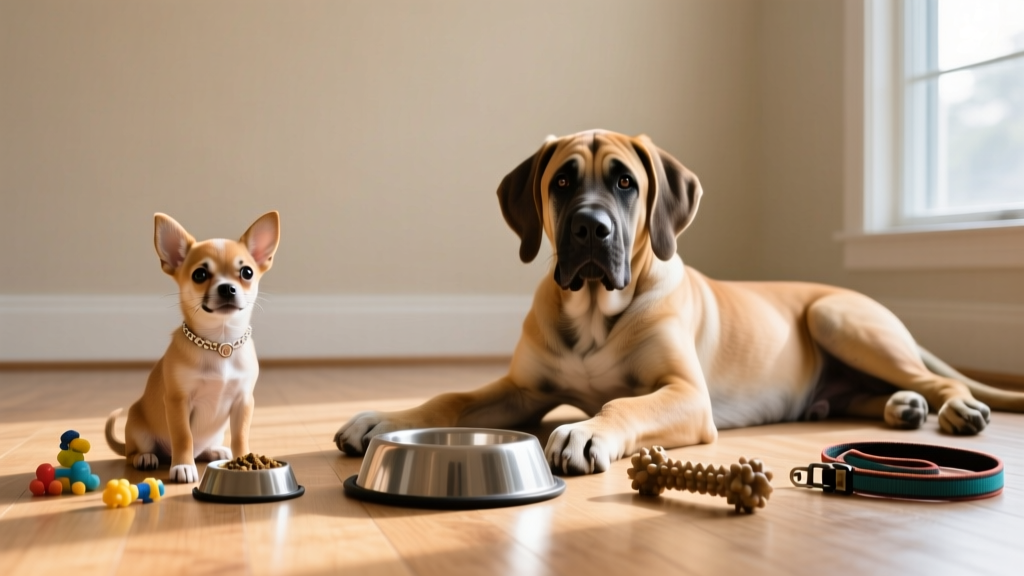
Irish Wolfhound Puppy Care: Growth, Feeding & Training Guide
Complete Irish Wolfhound puppy guide covering growth milestones, feeding schedules, potty training, socialization, vaccinations, and first-year costs.

Bringing Home an Irish Wolfhound Puppy: What Makes This Breed Different
An Irish Wolfhound puppy will weigh roughly 1-2 pounds at birth and can reach 100+ pounds by six months of age. This explosive growth rate — among the fastest in the canine world — means that every feeding decision, exercise restriction, and training choice carries amplified consequences compared to raising a smaller breed. What works for a Labrador puppy can actively harm an Irish Wolfhound puppy.
The American Kennel Club breed standard describes adult males at a minimum of 32 inches at the shoulder and 120 pounds, with females at least 30 inches and 105 pounds. Reaching those dimensions safely requires a carefully managed growth trajectory — not maximum calorie intake. Rapid growth in giant breeds directly correlates with developmental orthopedic diseases including hypertrophic osteodystrophy (HOD), osteochondrosis dissecans (OCD), and panosteitis.
This guide covers every critical stage from your puppy's first weeks through their first birthday, with breed-specific feeding portions, training timelines, and realistic cost expectations for 2026.
| Adult Weight Range | Males: 120-180 lb (54-82 kg) / Females: 105-140 lb (48-64 kg) |
| Adult Height | Males: 32-35 in / Females: 30-33 in at shoulder |
| Time to Full Size | 18-24 months (height by 12 months, filling out through 24) |
| Coat Type | Wiry, rough, medium-length; minimal shedding |
| Energy Level | Low-moderate (sprint-and-sleep pattern, not endurance) |
| Lifespan | 6-8 years (one of the shortest among all breeds) |
When Should I Bring My Irish Wolfhound Puppy Home?
The optimal window for bringing an Irish Wolfhound puppy home is 8-10 weeks of age. While some breeders of giant breeds retain puppies until 10-12 weeks for additional socialization and monitoring, the primary socialization window (weeks 3-14) means you want your puppy settled into your home by week 10 at the latest to maximize controlled exposure opportunities.
Responsible Irish Wolfhound breeders typically will not release puppies before 8 weeks. The AVMA recommends that puppies remain with their littermates through at least 7 weeks for critical bite-inhibition learning and canine communication development. For a breed that matures into a 150-pound animal, bite inhibition learned from siblings is irreplaceable.
Before pickup day, your breeder should provide:
- Health records showing at least one DHPP vaccination (typically given at 6-8 weeks)
- Deworming history (typically pyrantel pamoate at 2, 4, and 6 weeks)
- Results of parental health screenings — specifically cardiac evaluation (echocardiogram for dilated cardiomyopathy), and OFA or PennHIP certification for hip dysplasia
- A written contract with a health guarantee and return clause
- Documentation of the puppy's current diet (brand, formula, and portion size)
Age-Specific Growth Milestones: What to Expect Week by Week
Irish Wolfhound puppies grow at a rate that surprises even experienced giant-breed owners. The following timeline sets concrete expectations for each developmental stage.
Weeks 4-8 (Still With Breeder)
- Weight: 5-15 lb (2.3-6.8 kg)
- Milestones: Eyes and ears fully functional; littermate play intensifies; deciduous teeth erupting; transition from mother's milk to gruel/kibble soaked in water
- What the breeder handles: Early neurological stimulation (ENS), introduction to novel surfaces, initial crate exposure, first DHPP vaccine, first deworming series
Weeks 8-12 (Home Adjustment Period)
- Weight: 15-30 lb (6.8-13.6 kg) — gaining roughly 2-3 lb per week
- Milestones: Fear imprint period (weeks 8-11) — negative experiences during this window can create lasting phobias. Bonding with new family, learning name recognition, beginning house-training routines
- Exercise limit: No forced exercise; free play on soft surfaces only. 5 minutes of structured leash walking per month of age (so 10-15 minutes max)
- Sleep: 18-20 hours per day — this is normal, not lethargy
Weeks 12-16
- Weight: 30-50 lb (13.6-22.7 kg)
- Milestones: Second fear period may emerge around week 12; teething discomfort begins; coordination improves but "clumsy giant" phase is in full effect; attention span lengthens to 5-10 minute training sessions
- Exercise limit: 15-20 minutes of leash walking twice daily; still no running on hard surfaces, no jumping from heights, no stairs without supervision
Weeks 16-24 (4-6 Months)
- Weight: 50-85 lb (22.7-38.6 kg)
- Milestones: Peak teething (adult canines and premolars erupting); sexual maturity onset (discuss spay/neuter timing with your vet — many giant-breed specialists recommend waiting until 12-18 months); adolescent testing of boundaries begins
- Exercise limit: 20-30 minutes of leash walking twice daily; can begin gentle, controlled off-leash play in fenced areas on grass; still avoid repetitive high-impact activity (fetch on hard ground, agility equipment)
Months 6-12
- Weight: 85-130+ lb (38.6-59+ kg) — growth rate begins to slow after month 9
- Milestones: Adult coat replaces puppy coat; near-adult height reached by 10-12 months; chest and muscle mass continue filling out through 24 months; second fear period may recur around 6-14 months
- Exercise: 30-45 minutes of structured walks twice daily by month 9; free play remains important but controlled; can begin very light, low-impact activities like swimming
Feeding Your Irish Wolfhound Puppy: Exact Portions and Schedule
Feeding a giant-breed puppy is one of the most consequential decisions you will make. The goal is slow, steady growth — not maximum size as quickly as possible. Research published in veterinary nutrition journals consistently demonstrates that overfeeding giant-breed puppies increases the incidence of developmental orthopedic disease by as much as 50%.
Use a food specifically formulated for large or giant-breed puppies. These formulas contain controlled calcium (1.0-1.5% on a dry matter basis) and reduced caloric density compared to standard puppy food. The FDA recommends checking that any food you choose meets AAFCO nutrient profiles for growth.
| Puppy Age | Meals Per Day | Approximate Daily Amount (Giant-Breed Puppy Kibble) | Estimated Puppy Weight |
|---|---|---|---|
| 8-12 weeks | 3-4 meals | 2-3 cups/day | 15-30 lb |
| 3-4 months | 3 meals | 3-4.5 cups/day | 30-50 lb |
| 4-6 months | 2-3 meals | 4.5-6 cups/day | 50-85 lb |
| 6-9 months | 2 meals | 6-8 cups/day | 85-110 lb |
| 9-12 months | 2 meals | 7-9 cups/day | 110-140 lb |
Note: These are starting-point guidelines for a kibble with approximately 350-400 kcal/cup. Adjust based on your puppy's body condition score (BCS) — you should be able to feel ribs easily without pressing, and see a defined waist when viewed from above. Your veterinarian should evaluate BCS at every visit.
Irish Wolfhounds are among the breeds at highest risk for gastric dilatation-volvulus (GDV), commonly called bloat. To reduce risk:
- Use a slow-feeder bowl or scatter-feed on a mat
- Never allow vigorous exercise for 60 minutes before or after meals
- Divide daily food into 2+ meals rather than one large feeding
- Do not elevate food bowls — research has linked elevated feeders to increased bloat risk in giant breeds
- Discuss prophylactic gastropexy (stomach tacking) with your veterinarian
Vaccination Schedule for Your Irish Wolfhound Puppy
Your puppy's vaccination timeline follows the standard core vaccine protocol, but because Irish Wolfhound puppies may have a more sensitive immune response than some breeds, monitor closely for post-vaccine lethargy, facial swelling, or hives — and contact your vet immediately if these occur.
| Age | Vaccines Administered | Notes |
|---|---|---|
| 6-8 weeks | DHPP (Distemper, Hepatitis/Adenovirus, Parainfluenza, Parvovirus) — 1st dose | Typically given by breeder before pickup |
| 10-12 weeks | DHPP — 2nd dose; Bordetella (optional based on lifestyle); Leptospirosis (1st dose, recommended in many areas) | First vet visit after bringing puppy home |
| 14-16 weeks | DHPP — 3rd dose; Rabies (required by law in most US states); Leptospirosis (2nd dose) | Final puppy series; full immunity develops ~2 weeks after last DHPP |
| 12-16 months | DHPP booster; Rabies booster; Bordetella booster (if applicable) | Then follow 3-year DHPP/Rabies protocol per AVMA guidelines |
Always consult your veterinarian to customize this schedule based on your geographic region, lifestyle, and local disease prevalence. Non-core vaccines (Lyme, canine influenza, leptospirosis) depend on your area and your puppy's exposure risk.
Socialization Window (Weeks 3-14): Your Critical Checklist
The primary socialization period — weeks 3 through approximately 14 — is the single most important developmental window in your Irish Wolfhound puppy's life. Research from the Merck Veterinary Manual confirms that puppies inadequately socialized during this period are significantly more likely to develop fear-based behavioral problems, which in a 150-pound dog can become a serious management challenge.
Before your puppy completes their vaccination series (around 16 weeks), you must balance socialization with disease risk. The AVMA and the American Veterinary Society of Animal Behavior (AVSAB) both state that the risk of behavioral problems from inadequate socialization exceeds the risk of disease exposure in controlled settings.
Irish Wolfhound Puppy Socialization Checklist
Surfaces (walk on or stand on):
- ☐ Grass, gravel, mulch, sand, wet pavement, metal grates, tarps, bubble wrap, wobble boards
People (positive, treat-paired encounters):
- ☐ Children (supervised, calm), elderly individuals, people in hats/sunglasses, people carrying bags or umbrellas, people of different heights and builds, delivery workers
Environments:
- ☐ Car rides (short, positive trips), pet store (carried in arms before vaccinations complete), outdoor café patio, friend's house, parking lot, quiet neighborhood street, veterinary clinic (happy visits with no procedures)
Sounds (play at low volume, pair with treats):
- ☐ Thunderstorms, fireworks, vacuum cleaners, doorbells, clapping, sirens, construction noise, children shouting
Handling exercises (daily, 2-3 minutes):
- ☐ Paw handling (all four feet), ear inspection, mouth opening, nail clipping simulation, gentle restraint, brushing, towel drying
Other animals (only with fully vaccinated, known-healthy dogs):
- ☐ Small dogs, large dogs, calm adult dogs, puppies of similar vaccination status, cats (if applicable to your household)
Rule of thumb: Aim for 3-5 novel positive experiences per day during the socialization window. Every new experience should be paired with high-value treats (small pieces of boiled chicken, cheese, or commercial training treats). If your puppy shows fear, increase distance, reduce intensity, and let them approach at their own pace — never force an interaction.
Potty Training: Realistic Timelines and Troubleshooting
Irish Wolfhound puppies are generally willing to please and can learn house-training routines relatively quickly, but their physical bladder capacity and immature sphincter control set hard limits on what's possible at each age.
| Puppy Age | Maximum Bladder Hold Time | Outdoor Trips Per Day | What to Expect |
|---|---|---|---|
| 8-10 weeks | 1-1.5 hours | 12-15 | Accidents are the norm; take out after every meal, nap, and play session |
| 10-14 weeks | 2-3 hours | 8-12 | Beginning to signal (sniffing, circling); accidents decrease if schedule is consistent |
| 14-20 weeks | 3-4 hours | 6-8 | Reliable during the day with a schedule; overnight hold of 5-6 hours developing |
| 20-28 weeks | 4-6 hours | 4-6 | Mostly reliable; occasional regression possible during teething or routine changes |
| 6-12 months | 6-8 hours | 3-5 | Fully reliable for most puppies; marking behavior may emerge in intact males |
When will my puppy be fully potty trained? Most Irish Wolfhound puppies achieve reliable house-training between 5-7 months of age, provided you maintain a consistent schedule. Some individuals — particularly males — may have occasional accidents through 9-10 months. If your puppy is still having frequent accidents past 6 months, consult your veterinarian to rule out urinary tract infections or anatomical issues.
Troubleshooting common potty problems:
- Submissive urination when greeted: Common in young Wolfhounds. Ignore the puppy for the first 2-3 minutes when arriving home; greet calmly at their level; never scold for submissive urination as it worsens the behavior.
- Nighttime accidents: Remove water 2 hours before bedtime; set a phone alarm for a 2 AM potty break until the puppy consistently holds through the night.
- Excitement urination: Keep greetings low-key; practice "sit" before any interaction; reward calm behavior.
Crate Training Progression and Time Limits
Crate training is essential for an Irish Wolfhound puppy — both for house-training and for preventing destructive behavior during the long puppyhood of a giant breed. However, crate time limits are non-negotiable for growing joints and bladder health.
| Puppy Age | Maximum Continuous Crate Time | Crate Size Guidance |
|---|---|---|
| 8-12 weeks | 1-2 hours (daytime); 3-4 hours (overnight with a potty break) | Medium crate (36 in) with divider panel — only enough room to stand, turn, and lie down |
| 3-4 months | 2-3 hours (daytime); 5-6 hours (overnight) | Expand divider as puppy grows |
| 4-6 months | 3-4 hours (daytime); 7-8 hours (overnight) | Transition to large crate (42-48 in) as needed |
| 6-12 months | 4-5 hours (daytime); 8 hours (overnight) | Final adult crate: 48-54 inches long for most Wolfhounds |
Crate training steps:
- Week 1: Leave the crate door open; feed all meals inside; toss high-value treats inside; never use the crate as punishment.
- Week 2: Close the door for 1-2 minutes while you sit nearby; gradually increase to 10-15 minutes with you in the room.
- Week 3: Leave the room for 1-5 minutes; return before the puppy becomes distressed; build duration in small increments.
- Week 4+: Begin short absences (15-30 minutes); always exercise and potty the puppy before crating; provide a stuffed Kong or safe chew toy.
Expect whining and protest during the first 1-2 weeks — this is normal. If the puppy has been exercised, fed, pottied, and has a chew toy, brief whining can be ignored. Never let the puppy out while actively crying, as this teaches that crying opens the door. Wait for a 3-5 second pause in vocalization before opening the crate.
Teething Timeline and Relief Strategies
Irish Wolfhound puppies begin losing their 28 deciduous (baby) teeth between 12-16 weeks, with the full set of 42 adult teeth typically in place by 6-7 months. Because Wolfhound puppies have powerful jaws even at a young age, appropriate chew outlets are essential to protect your furniture — and your hands.
| Age | Teething Stage | What to Expect |
|---|---|---|
| 3-4 months | Incisors loosen and fall out | Increased mouthing; you may find tiny teeth on the floor; mild gum bleeding is normal |
| 4-5 months | Canines and premolars erupt | Peak chewing intensity; puppy seeks hard objects to relieve gum pressure |
| 5-6 months | Molars erupt; adult dentition completes | Chewing gradually decreases; retained baby teeth may need veterinary extraction |
| 6-7 months | All adult teeth in place | If any baby teeth remain (especially canines), consult your vet — retained deciduous teeth are common in giant breeds |
Safe chew recommendations for Irish Wolfhound puppies:
- Kong Classic (red or black rubber, size XL or XXL): Stuff with plain yogurt mixed with pumpkin puree and freeze for 2-4 hours — provides 20-30 minutes of soothing, cold relief.
- Benebone Wishbone (puppy formula, softer nylon): The angled shape allows Wolfhound puppies to grip with their front paws.
- Frozen wet washcloths: Wet a clean washcloth, twist into a rope, freeze for 2 hours — excellent for gum soothing. Supervise to prevent ingestion of fabric.
- Whimzees Puppy Chews: Edible, digestible, and appropriately sized for growing mouths.
- Rawhide (choking and intestinal blockage risk — Wolfhound puppies can swallow large pieces)
- Antlers and weight-bearing bones from large animals (too hard — can fracture developing teeth)
- Nylabone products labeled "power chewer" (too hard for puppy teeth; use only puppy-formula versions)
- Any chew small enough to be swallowed whole — always size up for this breed
Common Irish Wolfhound Puppy Problems and Solutions
Puppy Biting and Nipping
Irish Wolfhound puppies mouth and nip during play — a normal behavior that becomes problematic when a 40-pound puppy uses adult-dog jaw pressure. Solutions:
- Redirect: When teeth touch skin, immediately offer a chew toy. Reward chewing the toy with calm praise.
- "Ouch" method: Say "ouch" in a calm, slightly surprised tone (not a yell) and withdraw attention for 10-15 seconds. Resume play when the puppy is calm.
- Time-outs: If biting persists after 2-3 redirects, calmly place the puppy in a pen or crate for 30-60 seconds to reset. This is not punishment — it's a brief cool-down.
- Ensure adequate exercise and enrichment: Overtired and under-stimulated puppies bite more. A 15-minute sniffing session on a long line can be more tiring than a walk.
Whining and Crying (Especially at Night)
- Rule out physical needs first: potty, hunger, temperature (Wolfhound puppies have thin coats and feel cold easily — ensure a warm sleeping area).
- If needs are met, wait for a pause in vocalization before interacting. Rewarding silence teaches that quiet gets attention.
- Place a ticking clock or heartbeat toy (like the Snuggle Puppy) in the crate during the first week to simulate littermate presence.
Destructive Chewing
- Puppy-proof your home before bringing the puppy inside — remove shoes, electrical cords, and low-hanging items.
- Provide a rotating selection of 4-5 approved chew toys; novelty maintains interest.
- Supervise or confine — an unsupervised puppy will find something to destroy. Use exercise pens (X-pens) for safe containment when you cannot watch directly.
"Zoomies" and Clumsiness
Irish Wolfhound puppies are famously uncoordinated. They trip over their own feet, bump into furniture, and have sudden bursts of frantic running (zoomies). This is normal. Clear a safe space for zoomies (a carpeted room or fenced grass yard), and do not attempt to physically stop a zooming puppy — you risk injury to both of you.
When Can My Puppy Go Outside and Meet Other Dogs?
Your Irish Wolfhound puppy can go outside in your own private yard immediately upon coming home — provided no unvaccinated dogs have access to that space. However, public areas (dog parks, pet stores, sidewalks with unknown dog traffic) should be avoided until 2 weeks after the final DHPP vaccination, typically around 18 weeks of age.
For controlled socialization before full vaccination:
- Safe: Carrying your puppy through public spaces (pet stores, outdoor markets) without letting them walk on ground where unknown dogs have been; playdates in private yards with fully vaccinated, healthy dogs whose vaccination status you've confirmed.
- Unsafe: Dog parks, pet store floors (before vaccination completion), rest areas at highway stops, any area with visible dog feces, boarding facilities without proof of vaccination requirements.
Once fully vaccinated (around 18 weeks), begin gradual introductions to new dogs in controlled settings. Irish Wolfhounds are typically gentle and sociable, but their large size and play style can overwhelm smaller dogs — and smaller dogs' reactive responses can startle a young Wolfhound. Start with calm, well-socialized adult dogs who can model appropriate behavior.
First-Year Cost Breakdown: Budgeting for Your Irish Wolfhound Puppy
Raising an Irish Wolfhound puppy is a significant financial commitment. Giant-breed puppies eat more, require larger supplies, and have higher medication costs (most preventives are dosed by weight). Here is a realistic 2026 budget breakdown:
| Category | Low Estimate | High Estimate | Notes |
|---|---|---|---|
| Puppy Purchase | $2,000 | $3,500 | From a responsible breeder with health-tested parents; rescue/adoption typically $300-$600 |
| Food (12 months) | $1,800 | $3,000 | Giant-breed puppy formula; $150-$250/month as puppy grows |
| Veterinary Care (Year 1) | $800 | $1,500 | Vaccines, wellness exams (3-4 visits), spay/neuter, fecal tests, heartworm test |
| Preventives (12 months) | $400 | $700 | Heartworm, flea/tick prevention — giant-breed doses cost more |
| Supplies | $600 | $1,200 | XL crate ($150-$250), raised bed ($80-$200), X-pen, leash/harness, bowls, grooming tools, chew toys |
| Training | $200 | $800 | Puppy socialization class ($150-$300); private sessions if needed ($75-$150/session) |
| Pet Insurance (annual) | $600 | $1,200 | Enroll at 8 weeks for best rates and pre-existing condition coverage; Wolfhounds have high illness risk |
| Emergency Fund Reserve | $500 | $2,000 | GDV surgery alone costs $3,000-$7,000; set aside funds or ensure insurance covers emergencies |
| TOTAL FIRST YEAR | $6,900 | $13,900 | Including puppy purchase; annual ongoing costs (after year 1): $3,500-$6,500 |
Cost-saving tips that do not compromise health:
- Buy kibble in bulk from Chewy or Chewy Autoship for 5-10% savings on a $200+/month food budget.
- Enroll in pet insurance during the first month — premiums are lowest at 8 weeks, and no pre-existing conditions exist yet.
- Ask your breeder about puppy vaccination packages — some include the first round, saving $50-$100.
- Use a 48-inch crate with a divider panel rather than buying progressively larger crates.
Frequently Asked Questions
How often should I feed my Irish Wolfhound puppy at 10 weeks old?
Feed 3-4 meals per day, totaling approximately 2-3 cups of giant-breed puppy kibble daily. Divide evenly across meals (roughly ½ to ¾ cup per meal). Feed at consistent times — for example, 7 AM, 12 PM, 5 PM, and optionally 9 PM. Remove uneaten food after 15-20 minutes to establish a routine.
How do I stop my Irish Wolfhound puppy from biting my hands?
Use a three-step approach: (1) Redirect to an appropriate chew toy the instant teeth touch skin. (2) If the puppy continues, say "ouch" calmly and withdraw all attention for 10-15 seconds — stand up, cross your arms, look away. (3) If biting persists after 2-3 redirects, implement a 30-60 second cool-down in a pen or crate. Consistency across all family members is essential — if one person allows mouthing and another doesn't, the puppy will be confused and the behavior will persist longer. Never use physical punishment, alpha rolls, or muzzle-grabbing, as these damage trust and can escalate fear-based biting.
When can my Irish Wolfhound puppy go to the dog park?
Wait until at least 2 weeks after the final DHPP vaccination — typically around 18 weeks of age. Even then, choose dog parks carefully. Irish Wolfhound puppies are large but physically immature; rough play with adult dogs can injure developing joints. Prefer small, controlled playgroups over crowded, chaotic dog parks. Avoid dog parks entirely until your puppy has mastered reliable recall and can disengage from play when called.
Should I spay or neuter my Irish Wolfhound puppy early?
Current veterinary research on giant breeds suggests delaying spay/neuter until skeletal maturity — typically 12-18 months for Irish Wolfhounds. Early gonadectomy (before 6 months) has been associated with increased risk of certain orthopedic conditions and certain cancers in large breeds. Discuss timing with your veterinarian based on your individual puppy's development, your household situation, and current research. If you have an intact male and female in the same household, management during heat cycles (which begin around 6-12 months) requires strict separation.
My puppy seems to eat less some days — should I worry?
Appetite fluctuation of 10-20% day to day is normal for growing giant-breed puppies, especially during teething (when sore gums reduce interest in hard kibble) or on very hot days. However, if your puppy refuses food entirely for more than 24 hours, shows signs of vomiting, diarrhea, lethargy, or a distended abdomen, contact your veterinarian immediately — these can be signs of serious conditions including bloat or infectious disease.
Do I need pet insurance for an Irish Wolfhound puppy?
While not legally required, pet insurance is strongly recommended for this breed. Irish Wolfhounds have a short lifespan (6-8 years) and elevated risk for expensive conditions including dilated cardiomyopathy (DCM), osteosarcoma, GDV (bloat), and hip dysplasia. A single emergency surgery can cost $5,000-$10,000. Enrolling at 8 weeks locks in the lowest premium and ensures no pre-existing condition exclusions. Compare providers that cover giant breeds without breed-specific exclusions.
If your Irish Wolfhound puppy ingests a toxic substance, contact the ASPCA Animal Poison Control Center at (888) 426-4435 (24/7, consultation fee applies) or the Pet Poison Helpline at (855) 764-7661. For symptoms of bloat (distended abdomen, unproductive retching, restlessness, rapid breathing), go to the nearest emergency veterinary clinic immediately — GDV is fatal without surgical intervention within hours.
Beth Carrasco
All our authors care for dogs every day — read more of their work on the authors page.