Irish Deerhound Puppies: Complete Week-by-Week Care Guide
Everything you need to raise Irish Deerhound puppies: feeding schedules, potty training, vaccinations, socialization milestones, and first-year costs.
When to Bring Your Irish Deerhound Puppy Home
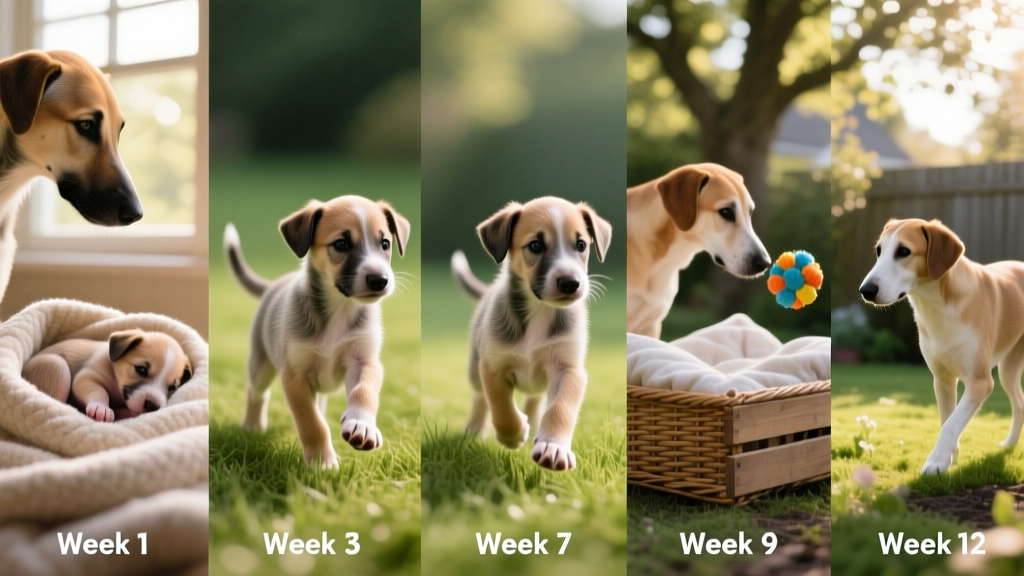
The American Kennel Club recommends that giant-breed puppies remain with their littermates and dam until at least 10 weeks of age, though many responsible Irish Deerhound (Irish Wolfhound) breeders prefer to send puppies home between 10–12 weeks. This extended period allows critical socialization with siblings, bite-inhibition learning, and early exposure to household sounds in a controlled environment.
Bringing a puppy home before 8 weeks increases the risk of fear-based behaviors and poor social skills. Giant breeds mature slowly — an Irish Deerhound puppy at 8 weeks typically weighs 15–20 lb (7–9 kg), but their musculoskeletal system is far from mature. The extra weeks with the breeder allow monitored play that protects developing joints.
Irish Deerhound Puppy Milestones: Weeks 4–8 Through 6–12 Months
Weeks 4–8: The Transitional and Socialization Window Opens
During this breeder-managed period, puppies transition from mother's milk to softened kibble. Eyes and ears are fully functional by week 4. The primary socialization window (weeks 3–14) is already underway. Puppies learn bite inhibition through littermate play and begin exploring solid food. Expected weight at 8 weeks: 15–22 lb (7–10 kg).
Weeks 8–12: Home Adjustment and Bonding
Your puppy will sleep 18–20 hours per day. Expect clingy behavior, nighttime whining, and frequent potty accidents. Growth is rapid — roughly 2–3 lb (1–1.5 kg) per week. Coordination is still clumsy. Begin leash introduction indoors with a lightweight harness. Keep exercise to 5 minutes per month of age (so roughly 10 minutes of structured walking at 8 weeks).
Weeks 12–16: Confidence Building and Fear Periods
The first fear period (8–11 weeks) may be ending, and a second fear period typically begins around 12–16 weeks. Puppies may suddenly become cautious about previously familiar stimuli. Weight at 16 weeks: approximately 45–60 lb (20–27 kg). Baby teeth begin loosening. Increase structured walks to 15–20 minutes. Begin basic obedience: sit, down, name recognition, and recall foundations.
Weeks 16–24: Rapid Growth and Teething Peak
This is the most physically dramatic phase. Weight climbs from roughly 55 lb to 90–110 lb (25–50 kg) by 6 months. Adult teeth erupt fully by 6 months. Growth plate closure has not occurred — avoid forced running, jumping from heights, and slippery floors. The exercise rule remains 5 minutes per month of age for structured walks, though free play in a fenced yard is generally unrestricted on soft ground.
Months 6–12: Adolescence and Slowing Growth
Height growth slows significantly after 9 months, but the dog continues to fill out and gain muscle mass until 18–24 months. Sexual maturity occurs: males may begin marking, females may enter their first estrus cycle (typically 6–12 months). Discuss spay/neuter timing with your veterinarian — many giant-breed specialists recommend waiting until 12–18 months to allow growth plate closure. Weight at 12 months: males 95–120 lb (43–54 kg), females 85–105 lb (39–48 kg).
Feeding Schedule for Irish Deerhound Puppies
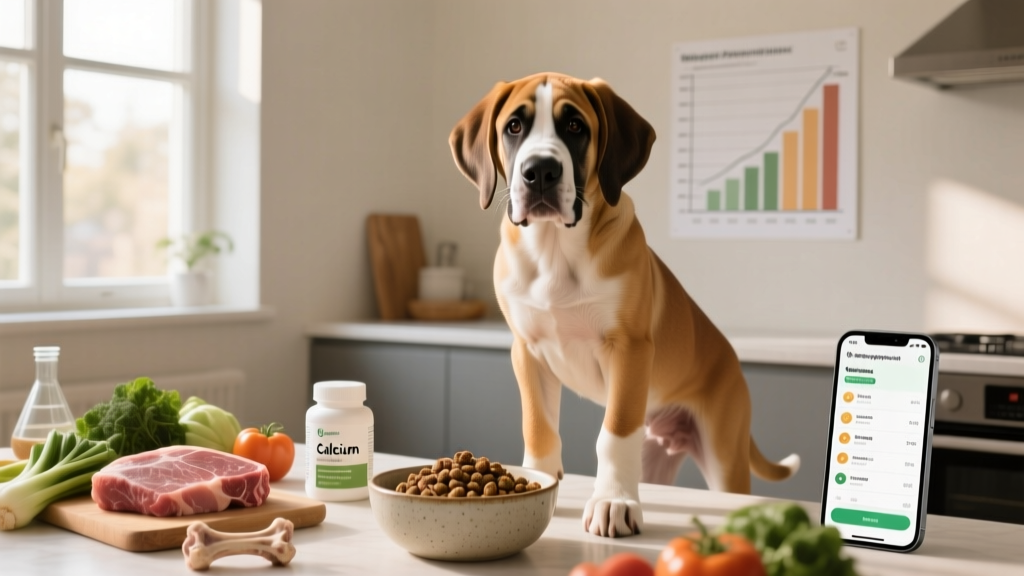
Giant-breed puppies require a diet formulated specifically for large/giant breeds to prevent excessively rapid growth, which is linked to developmental orthopedic diseases like hypertrophic osteodystrophy (HOD) and osteochondrosis. Look for an AAFCO statement confirming the food is appropriate for "growth" or "all life stages" and meets the nutrient profiles established for large-breed puppies. Target calcium levels between 1.0–1.5% on a dry matter basis, and avoid calorie-dense formulas.
| Age | Meals Per Day | Approximate Daily Amount (Giant-Breed Puppy Kibble) | Notes |
|---|---|---|---|
| 8–12 weeks | 3–4 meals | 2.5–3.5 cups/day | Soften kibble with warm water if needed |
| 12–16 weeks | 3 meals | 3.5–5 cups/day | Transition to dry kibble |
| 4–6 months | 2–3 meals | 5–7 cups/day | Monitor body condition score weekly |
| 6–9 months | 2 meals | 6–9 cups/day | Ribs should be easily felt but not prominently visible |
| 9–12 months | 2 meals | 7–10 cups/day | Begin transition to adult giant-breed formula around 12 months |
How often should I feed my puppy at each age? At 8–12 weeks, feed 3–4 evenly spaced meals to prevent hypoglycemia and bloat risk. By 4 months, reduce to 3 meals. By 6 months, 2 meals per day is standard for the rest of the dog's life. Never feed one large meal daily — this is a significant risk factor for gastric dilatation-volvulus (GDV/bloat), a life-threatening condition common in deep-chested giant breeds.
Estimated food cost: A quality giant-breed puppy formula (e.g., Purina Pro Plan Giant Breed Puppy, Royal Canin Giant Puppy, or Orijen Large Breed Puppy) costs approximately $60–$100 per 30-lb bag. Expect to spend $120–$180/month on food during peak growth (4–10 months).
Vaccination Schedule for Irish Deerhound Puppies
The American Veterinary Medical Association recommends core vaccines for all puppies. Giant breeds follow the same schedule as other dogs, but their larger body mass does not change dosing — vaccines are administered as a single dose regardless of weight.
| Age | Vaccine(s) | Notes |
|---|---|---|
| 6–8 weeks | DHPP (Distemper, Hepatitis/Adenovirus, Parainfluenza, Parvovirus) — 1st dose | Often administered by breeder before pickup |
| 10–12 weeks | DHPP — 2nd dose; Bordetella (optional, recommended if attending puppy classes) | First vet visit if not already done |
| 14–16 weeks | DHPP — 3rd (final puppy) dose; Rabies (required by law in most states) | Full parvo protection typically achieved 1–2 weeks after this dose |
| 12–16 months | DHPP booster; Rabies booster | Then every 1–3 years depending on local regulations and vaccine type |
What vaccines does my puppy need and when? The core DHPP series protects against canine distemper, adenovirus (hepatitis), parainfluenza, and parvovirus — all potentially fatal in puppies. Rabies is legally required. Non-core vaccines (Leptospirosis, Lyme, Canine Influenza) should be discussed with your veterinarian based on your geographic location and lifestyle exposure.
When can my puppy go outside and meet other dogs? Until the final DHPP dose at 14–16 weeks (plus 1–2 weeks for immunity to develop), your puppy is vulnerable to parvovirus. You can carry your puppy in public spaces for socialization exposure, but avoid dog parks, pet store floors, and areas where unknown dogs have defecated. Controlled playdates with fully vaccinated, healthy adult dogs in private yards are generally safe. Puppy kindergarten classes that require proof of at least one DHPP dose and maintain sanitized facilities are recommended by the American Veterinary Society of Animal Behavior, which emphasizes that the risk of behavioral problems from inadequate socialization exceeds the disease risk in managed settings.
Socialization Checklist: The Critical Window (Weeks 3–14)
The primary socialization window closes between 12–14 weeks of age. For giant breeds like the Irish Deerhound, early positive exposure is particularly important because an unsocialized 120-lb adult dog is far more difficult to manage than an unsocialized small dog. Every exposure should be paired with high-value treats (small pieces of boiled chicken, cheese, or commercial training treats) to build positive associations.
People Exposure Checklist
- Children of various ages (supervised, calm interactions)
- People wearing hats, sunglasses, hoodies, and helmets
- People using wheelchairs, crutches, or walkers
- People of different heights, builds, and skin tones
- Delivery workers and uniformed visitors
- People who are loud, quiet, fast-moving, and slow-moving
Environmental Exposure Checklist
- Car rides (start with 5-minute trips, build duration)
- Vacuum cleaners, blenders, doorbells, and thunderstorm recordings
- Different floor surfaces: tile, hardwood, gravel, grass, metal grates
- Umbrellas opening, plastic bags rustling, flags flapping
- Elevator rides and automatic doors
- Being handled: paws touched, ears examined, mouth opened, nails clipped
Animal Exposure Checklist
- Fully vaccinated, temperament-tested adult dogs (various sizes)
- Calm cats (if household includes cats)
- Livestock at a distance (Irish Deerhounds have a strong sighthound prey drive — early exposure to cats and small animals is critical for cohabitation)
Target: Aim for 5–10 new positive exposures per day during the 8–14 week window. Quality over quantity — one positive experience is better than five overwhelming ones. If your puppy shows fear, increase distance from the stimulus and toss treats. Never force interaction.
Potty Training Timeline and Troubleshooting
Irish Deerhound puppies have large bladders relative to small breeds, but their physical immaturity still limits control. Here is a realistic timeline:
| Age | Bladder Capacity (Approximate) | Expected Accidents | Outing Frequency |
|---|---|---|---|
| 8–10 weeks | 30–45 minutes | Multiple daily accidents are normal | Every 30–45 min while awake, plus after every meal, nap, and play session |
| 10–14 weeks | 1–1.5 hours | 1–3 accidents per week with consistent routine | Every 1–1.5 hours while awake |
| 3–4 months | 2–3 hours | Occasional accidents (1–2 per week) | Every 2 hours, plus overnight outing may still be needed |
| 4–6 months | 4–5 hours | Rare accidents | Every 3–4 hours; overnight hold of 6–7 hours is achievable |
| 6+ months | 6–8 hours | Fully reliable for most puppies | 3–4 outings per day |
When will my puppy be fully potty trained? Most Irish Deerhound puppies achieve reliable house training between 4–6 months of age with consistent management. "Fully reliable" means fewer than one accident per month. Some individuals take up to 8 months, particularly males who begin marking behavior during adolescence.
Troubleshooting common issues:
- Regression at 4–5 months: Often coincides with teething discomfort or a fear period. Return to more frequent outings and increase praise/reward intensity.
- Nighttime accidents after previously holding through: Increase daytime water intake, remove water 1.5 hours before bedtime, and add a late-night potty outing.
- Submissive urination when greeted: Ignore the puppy for the first 60 seconds upon entering. Crouch sideways rather than leaning over. This is common in sighthound breeds and typically resolves by 8–12 months.
- Marking indoors (adolescent males): Supervise closely, interrupt with a neutral "oops" and redirect outside. Neutering may reduce but not always eliminate marking.
Crate Training Progression and Time Limits
A crate is essential for an Irish Deerhound — not only for house training but for safety. These puppies chew extensively, and a 60-lb puppy can destroy baseboards, electrical cords, and furniture in minutes. Purchase a 48-inch or 54-inch wire crate with a divider panel from day one, adjusting the internal space as the puppy grows. The crate should be large enough for the adult dog to stand, turn around, and lie down stretched out.
| Age | Maximum Crate Time (Daytime) | Maximum Crate Time (Overnight) |
|---|---|---|
| 8–10 weeks | 30–45 minutes | 2–3 hours (set alarm for potty break) |
| 10–14 weeks | 1–1.5 hours | 3–4 hours |
| 3–4 months | 2–3 hours | 5–6 hours |
| 4–6 months | 3–4 hours | 7–8 hours |
| 6+ months | 4–5 hours (with midday break) | 8 hours |
Crate training steps:
- Leave the crate door open with a soft bed and stuffed Kong inside. Feed meals near, then inside, the crate for the first week.
- Begin closing the door for 1–2 minutes while you sit nearby. Gradually increase to 10 minutes, then 30 minutes.
- Leave the room for short periods (5 minutes, then 15, then 30). Return before the puppy becomes distressed.
- If the puppy whines after being settled for 10+ minutes, wait for a 3-second pause in vocalization before opening the door. This teaches that silence, not noise, opens the crate.
Never use the crate as punishment. For giant breeds, add an orthopedic foam pad — Irish Deerhounds are prone to developing pressure sores ( hygromas) on their elbows from lying on hard surfaces.
Teething Timeline and Relief Strategies
Irish Deerhound puppies have powerful jaws even during teething, and their chewing can be destructive and painful. Here is what to expect:
- 3–4 months: Baby incisors begin falling out. You may find tiny teeth on the floor or notice minor gum bleeding on chew toys. Increased chewing urgency begins.
- 4–5 months: Peak teething discomfort. Canines and premolars erupt. Puppies will seek hard, cool surfaces to chew. This is when furniture legs, shoes, and hands are most at risk.
- 5–6 months: Adult teeth fully erupt. By 6–7 months, all 42 adult teeth should be in place. Ask your veterinarian to check for retained baby teeth (common in some lines) during the spay/neuter exam.
Safe chew recommendations:
- Frozen Kong Classic (size XL or XXL): Stuff with plain yogurt and banana, freeze overnight. The cold soothes gums and the rubber is durable enough for giant-breed jaw strength.
- Benebone Wishbone (Giant size): Nylon chew designed for aggressive chewers over 100 lb. Replace when worn down significantly.
- Frozen carrots or apple slices: Natural, low-calorie, and soothing. Supervise to prevent choking on large pieces.
- Wet washcloth twisted and frozen: A budget-friendly option. Supervise and discard if threads begin to unravel.
Avoid: Rawhide (choking and intestinal blockage risk), real antlers (tooth fracture risk in giant breeds), and any chew smaller than the puppy's fist.
Common Irish Deerhound Puppy Problems and Solutions
Puppy Biting and Nipping
How do I stop puppy biting/nipping? Irish Deerhound puppies explore the world with their mouths, and their size makes even playful mouthing painful. Use the following force-free protocol:
- When teeth touch skin, say "oops" in a calm, neutral tone and immediately withdraw attention — stand up, turn away, and cross your arms for 10–15 seconds.
- Redirect to an appropriate chew toy. Praise enthusiastically when the puppy chews the toy.
- If biting persists, implement a "three strikes" system: strike one is a redirect, strike two is a 30-second time-out in a playpen (not the crate), strike three ends the play session entirely.
- Ensure the puppy is getting adequate sleep — overtired puppies bite more. An 8–12 week old puppy needs enforced naps every 60–90 minutes.
Mouthing typically decreases significantly by 5–6 months as adult teeth settle and impulse control improves. Consistency from every household member is critical.
Nighttime Whining and Separation Distress
Irish Deerhounds are social dogs that bond deeply with their families. Nighttime whining in the first 2–3 weeks is normal. Place the crate in your bedroom initially, then gradually move it to the desired permanent location over 2–3 weeks. A Snuggle Puppy (a plush toy with a heartbeat simulator and heat pack) can ease the transition. Avoid responding to whining with attention — this reinforces the behavior.
Destructive Chewing
Giant-breed puppies chew intensely through 4–8 months. Puppy-proof every room: use bitter apple spray on baseboards, install cord covers, and keep shoes behind closed doors. Provide a rotation of 5–7 approved chew toys to maintain novelty. If you catch the puppy chewing something inappropriate, interrupt calmly with "leave it," redirect to an approved toy, and reward the correct choice.
Jumping Up
A 6-month-old Irish Deerhound weighing 80 lb that jumps on guests is not cute. Begin addressing this at 8 weeks. The protocol: when the puppy jumps, turn your back and fold your arms. The moment all four paws are on the floor, turn around and reward with a treat and calm praise. Teach guests to do the same. Consistency from every person the puppy encounters is essential.
First-Year Cost Breakdown for an Irish Deerhound
Giant breeds cost significantly more than average dogs in nearly every category. Here is a realistic first-year budget based on 2026 pricing:
| Category | Low Estimate | High Estimate | Notes |
|---|---|---|---|
| Purchase/Adoption | $1,500 | $3,500 | From a responsible breeder with health testing; rescue/adoption fees $300–$600 |
| Veterinary (routine) | $600 | $1,200 | Vaccines, wellness exams, fecal tests, heartworm prevention, spay/neuter |
| Food | $1,200 | $2,000 | Giant-breed puppy formula, then adult formula; treats included |
| Supplies | $500 | $1,000 | XL crate, orthopedic bed, harness, leash, bowls, grooming tools, chew toys |
| Training | $200 | $600 | Puppy kindergarten + basic obedience group classes; private sessions cost more |
| Pet Insurance | $600 | $1,200 | $50–$100/month; strongly recommended for giant breeds due to emergency costs |
| Emergency Fund Buffer | $500 | $2,000 | GDV surgery alone can cost $3,000–$7,000 without insurance |
| TOTAL FIRST YEAR | $5,100 | $11,500 |
The single most impactful financial decision you can make is enrolling in pet insurance before any conditions are diagnosed. Giant breeds are predisposed to costly conditions including osteosarcoma, cardiac disease, and GDV — all of which can generate $5,000–$15,000+ in treatment costs.
Frequently Asked Questions About Irish Deerhound Puppies
When should I bring my Irish Deerhound puppy home?
Between 10–12 weeks of age. This allows the breeder to complete early socialization, the first DHPP vaccination, and littermate bite-inhibition learning. Giant-breed puppies benefit from the additional weeks more than smaller breeds do because their physical and behavioral development is slower.
How often should I feed my 12-week-old Irish Deerhound puppy?
Three meals per day, spaced approximately 6–8 hours apart. Total daily intake at 12 weeks is typically 3.5–5 cups of giant-breed puppy kibble, divided across those three meals. Adjust based on body condition score — you should be able to feel ribs easily without pressing hard, and the puppy should have a visible waist when viewed from above.
When will my Irish Deerhound puppy be fully potty trained?
Most are reliably house trained by 4–6 months with consistent management. A few individuals, particularly males entering adolescence, may have occasional marking incidents through 8–10 months. Consistency in schedule, supervision, and positive reinforcement for outdoor elimination is the determining factor — not the puppy's intelligence.
What vaccines does my Irish Deerhound puppy need and when?
Core vaccines include DHPP at 6–8 weeks, 10–12 weeks, and 14–16 weeks, plus a rabies vaccine at 14–16 weeks. Bordetella is recommended if attending group classes. Non-core vaccines (Leptospirosis, Lyme, Canine Influenza) depend on regional risk. Always discuss the complete schedule with your veterinarian at the first wellness visit.
How do I stop my Irish Deerhound puppy from biting and nipping?
Use a consistent three-step approach: (1) say "oops" calmly and withdraw attention for 10–15 seconds when teeth touch skin, (2) redirect to an appropriate chew toy and praise, (3) if biting continues, end the play session with a brief time-out. Ensure the puppy gets 18–20 hours of sleep per day (8–12 weeks) with enforced naps, as overtired puppies bite significantly more. Never use physical punishment, which damages trust and can escalate aggression.
When can my Irish Deerhound puppy go outside and meet other dogs?
You can begin carrying your puppy in public spaces immediately for socialization exposure. However, avoid high-risk areas (dog parks, pet stores, public sidewalks with heavy dog traffic) until 1–2 weeks after the final DHPP vaccine at 14–16 weeks. Controlled playdates with known, fully vaccinated dogs in private settings are safe earlier. Puppy classes that require proof of vaccination are recommended starting at 10–12 weeks.
How much exercise does an Irish Deerhound puppy need?
Follow the 5-minutes-per-month-of-age rule for structured leash walks: 10 minutes at 8 weeks, 20 minutes at 4 months, 30 minutes at 6 months. Free play in a secure, fenced area on soft ground is generally unrestricted. Avoid forced running (jogging, biking), repetitive jumping, and long stair climbs until growth plates close (typically 14–18 months, confirmed by veterinary X-ray). Irish Deerhounds are sprinters, not endurance athletes — even adults typically need only 30–60 minutes of moderate exercise daily.
Are Irish Deerhound puppies good with children?
Generally yes — the breed is known for a gentle, patient temperament. However, a 50-lb puppy can accidentally knock over a toddler, and puppy teeth are sharp. Always supervise interactions, teach children not to pull ears or tail, and provide the puppy with a child-free retreat space (crate or gated room). Enroll in a puppy class that includes children in socialization exercises if possible.
Jonas Cole
All our authors care for dogs every day — read more of their work on the authors page.