How to Introduce a Puppy to an Older Dog: A Complete Puppy Care Guide
How to introduce a puppy to an older dog with age-specific milestones, feeding schedules, vaccination timelines, and expert tips for a smooth multi-dog

Bringing Home a New Puppy When You Already Have a Senior or Adult Dog
If you're reading this, you're probably staring at a wiggly puppy and a side-eyeing older dog, wondering how to bridge the gap. Introducing a puppy to an older dog is one of the most common challenges multi-dog households face — and doing it right from day one prevents months of resource guarding, stress, and behavioral fallout.
This guide walks you through every developmental stage of your puppy's first year, with specific strategies for managing the older dog's comfort, energy preservation, and territory throughout the process. Whether your senior dog is a mellow 10-year-old Labrador or a spry but particular 6-year-old Border Collie, these frameworks apply.
Before you proceed: Always consult your veterinarian before introducing a new puppy, especially if your older dog has chronic pain, arthritis, cognitive decline, or anxiety. A veterinary behaviorist can provide a tailored introduction protocol for dogs with known reactivity.
When Should I Bring My Puppy Home?
The American Kennel Club and veterinary behaviorists agree: puppies should remain with their littermates and dam until at least 8 weeks of age. Many responsible breeders of larger breeds (German Shepherds, Golden Retrievers, Rottweilers) keep puppies until 10–12 weeks to allow additional socialization within the litter.
Bringing a puppy home before 8 weeks increases the risk of:
- Excessive nipping and bite inhibition problems (littermates teach bite pressure)
- Separation anxiety and difficulty self-soothing
- Poor dog-to-dog communication skills later in life
For households with an older dog, an 8–10 week puppy is ideal. Younger than 8 weeks, and the puppy lacks the social skills to read your older dog's "back off" signals. Older than 14 weeks, and you've missed part of the critical socialization window, making introductions potentially more challenging.
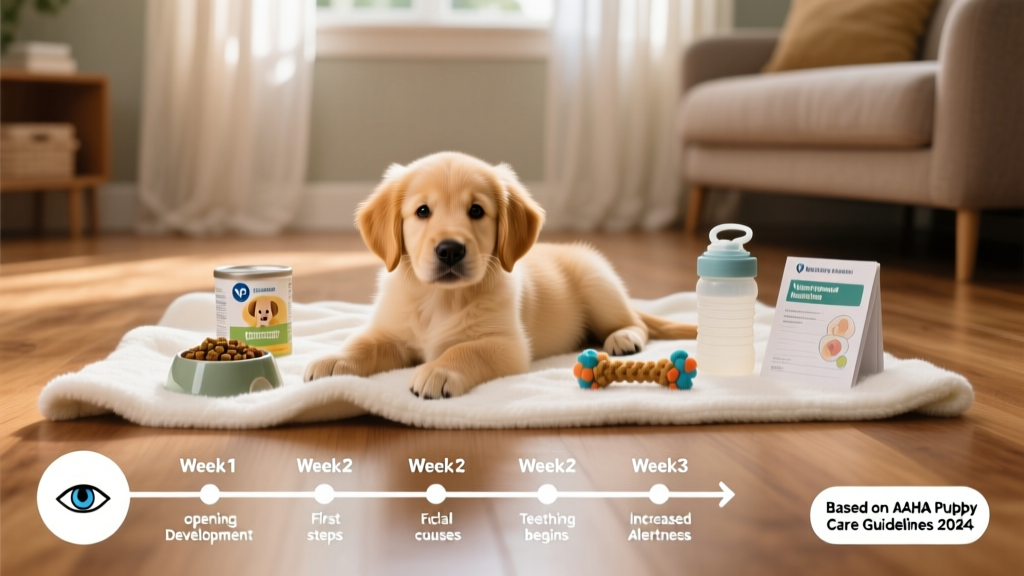
Puppy Development Milestones: What to Expect Week by Week
Understanding your puppy's developmental stage is essential for setting realistic expectations — both for your puppy's behavior and your older dog's tolerance.
Weeks 4–8: Neonatal to Early Socialization (At the Breeder)
Your puppy is learning bite inhibition, canine body language, and hierarchy from littermates. You should not have the puppy yet. During this stage, ask your breeder to expose the puppy to calm, vaccinated adult dogs — this early positive exposure to mature dogs pays enormous dividends when you bring the puppy home.
Weeks 8–12: Primary Socialization Window (Home Transition)
This is the most impressionable period. Your puppy will:
- Sleep 18–20 hours per day
- Have a bladder capacity of roughly 1 hour per month of age (so ~2 hours max at 8 weeks)
- Test boundaries through mouthing and nipping
- Begin forming lasting associations — positive or negative — with your older dog
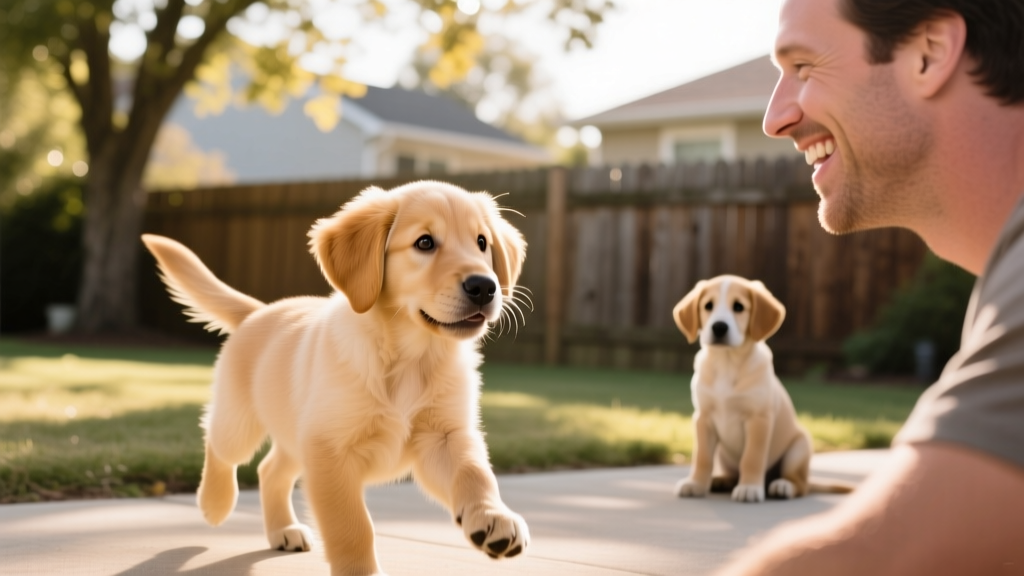
Older dog strategy: Keep initial interactions to 5–10 minutes, supervised, with the older dog on leash if needed. Allow the older dog to retreat freely. Never force proximity.
Weeks 12–16: Fear Impact Period Begins
Between 12–14 weeks, puppies enter a fear imprinting stage. Negative experiences during this window (being snapped at, chased, or pinned by the older dog) can create lasting fear responses. This is when careful management matters most.
Weeks 16–24: Growing Confidence and Testing Limits
Your puppy's coordination improves dramatically. They'll start initiating play more boldly, which can irritate an older dog who previously tolerated a clumsy, predictable baby. Expect to manage interactions more actively during this stage, not less.
6–12 Months: Adolescence and Social Maturity
Hormonal changes (if not yet spayed/neutered), increased independence, and boundary-testing define this stage. Your puppy is now physically capable of annoying or even injuring a frail senior dog through sheer exuberance. Structured exercise and continued supervised interaction are non-negotiable.
Feeding Schedule: Exact Portions by Age and Weight
Feeding management is one of the most overlooked aspects of introducing a puppy to an older dog. Food is a primary resource-guarding trigger. Always feed the puppy and older dog in completely separate locations — separate rooms, crates, or baby-gated areas — until both dogs are reliably comfortable together (typically 3–6 months).
| Age | Meals Per Day | Portion Per Meal (Dry Kibble) | Total Daily Amount | Notes |
|---|---|---|---|---|
| 8–12 weeks | 4 | ½ – ¾ cup | 2 – 3 cups | Soften kibble with warm water if needed |
| 12–16 weeks | 3 | ¾ – 1 cup | 2¼ – 3 cups | Transition to dry kibble fully |
| 4–6 months | 3 | 1 – 1¼ cups | 3 – 3¾ cups | Peak growth phase; monitor body condition score |
| 6–9 months | 2 | 1½ – 2 cups | 3 – 4 cups | Reduce to 2 meals; adjust for activity level |
| 9–12 months | 2 | 1½ – 2 cups | 3 – 4 cups | Begin transitioning to adult formula at 10–12 months |
These amounts assume an AAFCO-approved puppy formula with approximately 350–400 kcal per cup. Always check the feeding chart on your specific food brand and adjust based on your puppy's body condition score (BCS) — you should be able to feel ribs without pressing hard, and see a visible waist from above.
Vaccination Schedule: Protecting Your Puppy (and Your Older Dog)
Your puppy's immune system is immature, and your older dog — especially if senior — may have a weakened immune response. Following a strict vaccination protocol protects both dogs.
| Age | Vaccine | Notes |
|---|---|---|
| 6–8 weeks | DHPP (Distemper, Hepatitis/Adenovirus, Parainfluenza, Parvovirus) — Dose 1 | Often given by breeder or shelter before pickup |
| 10–12 weeks | DHPP — Dose 2; Bordetella (optional, recommended for multi-dog homes) | Bordetella reduces kennel cough transmission between dogs |
| 14–16 weeks | DHPP — Dose 3 (final puppy booster); Rabies (required by law in most US states) | Final DHPP must be given at or after 16 weeks for adequate immunity |
| 12–16 months | DHPP booster; Rabies booster | Establishes long-term immunity; subsequent boosters every 1–3 years per vet guidance |
When can the puppy meet the older dog? If your older dog is fully vaccinated and healthy, supervised home introductions can begin immediately when the puppy arrives at 8 weeks. However, the puppy should NOT visit dog parks, pet stores, or high-traffic dog areas until 7 days after the final DHPP booster at 16 weeks, per AVMA vaccination guidelines.
Socialization Window (Weeks 3–14): Your Checklist for a Well-Adjusted Puppy
The primary socialization period — weeks 3 through approximately 14 — is when your puppy's brain is most receptive to new experiences. After this window closes, unfamiliar stimuli trigger fear rather than curiosity. The Merck Veterinary Manual identifies this as the single most important factor in preventing behavioral problems.
For multi-dog households, socialization specifically includes teaching the puppy to read and respect your older dog's communication.
Puppy Socialization Exposure Checklist (Weeks 8–14)
- Calmer adult dogs: 3–5 positive, supervised interactions with vaccinated adult dogs of varying sizes
- Older dog's spaces: Allow puppy to sniff the older dog's bed, toys, and crate (when older dog is in another room) to build familiarity with scent
- Handling exercises: Touch puppy's ears, paws, mouth, and tail daily — this helps the older dog's grooming or veterinary interactions later
- Surface variety: Walk puppy on tile, carpet, grass, gravel, and wood floors
- Sound exposure: Vacuum cleaner, doorbell, thunderstorm recordings (start at low volume), kitchen clatter
- People: Minimum 20 different people (various ages, sizes, ethnicities, wearing hats/glasses/coats)
- Alone time: Practice 5–15 minutes of crate-alone time daily to prevent over-attachment to the older dog
- Resource sharing scenarios: Practice trading a toy for a treat so the puppy learns "giving up" is rewarding — critical before the puppy tries to steal the older dog's toy
Potty Training Timeline: Realistic Expectations for Multi-Dog Homes
Here's the truth most puppy guides won't tell you: potty training in a multi-dog household often takes longer than in a single-dog home. Why? Puppies learn by mimicking the older dog. If your older dog uses indoor pee pads, your puppy will too. If your older dog has occasional accidents, your puppy will see those spots as acceptable elimination zones.
Realistic Potty Training Timeline
| Age | Expected Bladder Control | Accident Frequency | What to Do |
|---|---|---|---|
| 8–10 weeks | 1.5–2 hours max | Multiple accidents per day are normal | Take outside every 1–2 hours, after every meal, nap, and play session |
| 10–14 weeks | 2–3 hours | 1–2 accidents per day | Establish a consistent outdoor spot; reward immediately with treats |
| 14–20 weeks | 3–4 hours | 0–1 accidents per week | Begin extending time between outings; watch for circling/sniffing cues |
| 5–6 months | 4–6 hours | Rare (usually regression from stress or schedule change) | If accidents resume, rule out UTI with your vet |
| 6–12 months | 6–8 hours | Fully trained for most puppies | Some small breeds may take up to 12 months for full reliability |
Multi-dog specific tip: Take both dogs outside together for potty breaks once the puppy has completed its vaccination series (after 16 weeks). The puppy will often eliminate more readily by copying the older dog. However, always reward the puppy individually so it learns the behavior, not just the mimicry.
When will my puppy be fully potty trained? Most puppies achieve reliable house training between 5–7 months with consistent scheduling. Small breeds (Chihuahuas, Yorkshire Terriers) may take 8–12 months due to smaller bladder capacity. If your puppy is still having daily accidents past 7 months, consult your veterinarian to rule out urinary tract infections, anatomical issues, or anxiety.
Teething Timeline and Managing Puppy Chewing Around Your Older Dog
Puppy teething is one of the biggest friction points in multi-dog introductions. A teething puppy seeks relief by chewing — and unfortunately, your older dog's ears, tail, and legs are enticing targets.
Teething Stages
- 3–4 weeks: Deciduous (baby) teeth begin erupting — still at the breeder
- 8–12 weeks: Full set of 28 baby teeth in; puppy explores everything with its mouth
- 12–16 weeks: Baby teeth begin loosening; adult teeth start pushing through
- 4–6 months: Peak teething discomfort; all 42 adult teeth should erupt by 6–7 months
- 6–7 months: Teething largely complete; retained baby teeth should be evaluated by your vet
Safe Chew Recommendations During Teething
- Kong Classic (puppy rubber, pink/blue): Stuff with frozen plain yogurt or soaked kibble — the cold soothes inflamed gums. Sizes: Small for puppies under 20 lb, Medium for 20–40 lb.
- Benebone Puppy Wishbone: Nylon chew designed for puppies under 6 months; softer than adult versions to protect developing teeth.
- Frozen washcloth: Wet a clean washcloth, twist into a rope, freeze for 2 hours. Supervise use and discard if pieces tear off.
- Nylabone Puppy Chew Keys: Textured surfaces massage gums; replace once nubs are worn smooth.
Crate Training Progression: Time Limits and Multi-Dog Management
A crate is your most valuable tool for managing a puppy-older dog introduction. It gives the older dog guaranteed puppy-free rest periods and prevents the puppy from rehearsing unwanted behaviors when unsupervised.
Crate Time Limits by Age
| Puppy Age | Maximum Daytime Crate Duration | Overnight Duration | Notes |
|---|---|---|---|
| 8–10 weeks | 1–2 hours | 3–4 hours (expect overnight potty breaks) | Place crate near your bed to reduce crying |
| 10–14 weeks | 2–3 hours | 4–5 hours | Begin moving crate to a designated area if desired |
| 14–18 weeks | 3–4 hours | 6–7 hours | Most puppies sleep through the night by 14–16 weeks |
| 4–6 months | 4–5 hours | 7–8 hours | Provide a frozen Kong for longer crated periods |
| 6+ months | 5–6 hours | 8 hours | Consider a puppy-proofed pen area for longer daytime absences |
Older dog management: Your older dog should have its own retreat space — a separate room, crate, or gated area — that the puppy cannot access. This is not optional. Senior dogs need 14–16 hours of undisturbed rest, and a persistent puppy will erode that, leading to irritability, pain flare-ups in arthritic dogs, and potential aggression.
Common Puppy Problems and Breed-Specific Solutions
Puppy Biting and Nipping at the Older Dog
This is the number one complaint from owners introducing a puppy to an older dog. Puppies explore with their mouths, and an older dog's moving tail or ears are irresistible.
Solution: Redirect with a toy every time the puppy mouths the older dog. If the puppy persists, calmly separate them for a 2–3 minute "timeout" in the puppy's crate or pen — this is not punishment, it's a reset. The older dog should never be expected to "correct" the puppy through growling or snapping, as this can escalate. Use positive reinforcement: reward the puppy with high-value treats (small pieces of boiled chicken, freeze-dried liver) every time it is near the older dog without mouthing.
Whining and Crying at Night
Puppies cry for the first 1–3 nights in a new home. In multi-dog homes, this can disrupt the older dog's sleep, which is especially problematic for senior dogs with cognitive dysfunction or anxiety.
Solution: Place the puppy's crate in your bedroom for the first 2 weeks. A Snuggle Puppy (a plush toy with a simulated heartbeat and heat pack, approximately $35–$45) reduces crying in most puppies within 2–3 nights. Do not move the crate to a distant room until the puppy sleeps quietly for 3 consecutive nights.
Destructive Chewing of the Older Dog's Belongings
Puppies are drawn to items that carry the older dog's scent — beds, blankets, favorite toys.
Solution: Manage the environment. Use baby gates to restrict the puppy's access to the older dog's resting areas when unsupervised. Provide the puppy with its own scent item: a worn t-shirt of yours placed in the crate. Rotate the puppy's own toys every 3 days to maintain novelty.
First-Year Cost Breakdown: Budgeting for a Puppy in a Multi-Dog Home
Adding a puppy to a household that already has a dog increases costs beyond what single-dog owners face. Here's a realistic first-year budget based on 2026 US averages:
| Category | Estimated Cost Range | Notes |
|---|---|---|
| Puppy purchase/adoption | $500 – $3,500 | Responsible breeder: $1,500–$3,500; Shelter/rescue: $200–$500 |
| Veterinary (first year) | $600 – $1,200 | Includes initial exam, 3 DHPP rounds, rabies, spay/neuter ($300–$700), fecal tests, heartworm prevention |
| Food (puppy formula, 12 months) | $360 – $720 | $30–$60/month for quality AAFCO-approved puppy food |
| Supplies (crate, gate, bed, bowls, leash, collar, toys) | $250 – $500 | Baby gates ($40–$80 each, you'll likely need 2–3) are essential for multi-dog management |
| Training (group classes or private) | $200 – $800 | Group puppy class: $150–$250 for 6 weeks; Private sessions: $80–$150/hour if behavior issues arise |
| Pet insurance (optional but recommended) | $360 – $720 | $30–$60/month; enroll before pre-existing conditions develop |
| Emergency fund buffer | $500 – $1,500 | Puppies ingest foreign objects frequently; GI obstruction surgery averages $2,000–$5,000 |
Total estimated first-year cost: $2,770 – $8,940, depending on breed source, veterinary needs, and whether complications arise.
Frequently Asked Questions
How do I stop my puppy from biting and nipping?
Redirect to an appropriate chew toy every single time. If the puppy continues, implement a brief 2–3 minute timeout in the crate. Never yell, hit, or hold the puppy's mouth shut — these methods increase fear and can worsen biting. Consistent redirection combined with rewarding calm behavior near the older dog typically reduces nipping significantly by 16–20 weeks as bite inhibition develops.
When can my puppy go outside and meet other dogs?
Your puppy can explore your own private yard immediately after coming home (assuming no parvovirus exposure risk in the area). For public spaces and unfamiliar dogs, wait until 7 days after the final DHPP vaccine at 16 weeks. However, controlled playdates with fully vaccinated, healthy dogs in private homes can begin as early as 8–10 weeks — this is valuable for socialization.
My older dog growls at the puppy — is this normal?
A low growl is normal canine communication — your older dog is saying "give me space." Do not punish the growl, as this suppresses a warning signal and can lead to a bite without warning next time. Instead, calmly redirect the puppy away and give the older dog space. If growling escalates to snapping, lunging, or pinning the puppy down, separate the dogs immediately and consult a certified professional dog trainer (CPDT) or veterinary behaviorist.
How often should I feed my puppy at 10 weeks old?
At 10 weeks, feed 4 meals per day, spaced roughly 4 hours apart during waking hours (e.g., 7 AM, 11 AM, 3 PM, 7 PM). Each meal should be approximately ½ to ¾ cup of high-quality puppy kibble for a medium-breed puppy, adjusted based on body condition score and your veterinarian's recommendation.
Should I let my older dog "establish dominance" over the puppy?
No. The dominance theory framework (alpha rolls, letting the older dog "put the puppy in its place") is outdated and potentially dangerous. According to the American Veterinary Society of Animal Behavior, dominance-based interventions increase aggression risk. Instead, manage the environment so both dogs succeed: use baby gates, separate feeding areas, individual attention sessions, and reward calm coexistence.
Anouk Beaumont
All our authors care for dogs every day — read more of their work on the authors page.