How Much Do Puppies Sleep? A Complete Week-by-Week Puppy Care Guide
How much do puppies sleep at each age? This week-by-week guide covers sleep needs, feeding, potty training, vaccines, and costs for your puppy's first year.

Bringing a new puppy home is equal parts thrilling and exhausting. One of the most common questions I hear from new puppy parents is: "How much do puppies sleep, and is mine sleeping too much — or not enough?" The short answer is that puppies sleep far more than adult dogs, and their sleep needs change dramatically as they grow. But sleep is just one piece of the puzzle. This guide maps out every critical milestone from weeks 4 through 12 months so you know exactly what to expect — and when to call your vet.
Age-Specific Milestones: What to Expect Week by Week
Every puppy develops on a continuum. Here's what's happening across the major developmental windows — including how sleep patterns shift alongside physical and behavioral changes.
Weeks 4–8: The Transitional Period (Still With Breeder)
- Sleep: 18–20 hours per day. Puppies nap in short bursts between nursing, playing, and eliminating.
- Physical: Baby teeth erupting (incisors first, then canines). Eyes fully open. Beginning to walk steadily.
- Behavioral: Littermate play teaches bite inhibition basics. Puppies start learning canine body language from their mother.
- Owner action: If you're evaluating breeders, ask about early neurological stimulation (ENS) protocols and whether the dam is present.
Weeks 8–12: Homecoming and Bonding
- Sleep: 18–20 hours per day, but your puppy will fight it. Expect "puppy zoomies" followed by sudden crashes mid-play.
- Physical: Rapid growth. Small breeds may gain 5+ oz per week; large breeds can gain 2+ lb per week.
- Behavioral: Fear imprint period begins around 8–10 weeks. Negative experiences can create lasting phobias. Keep introductions positive.
- Owner action: Establish a consistent daily routine. Begin short (5-minute) training sessions using food lures and a clicker or marker word.
Weeks 12–16: Building Confidence
- Sleep: 16–18 hours per day. Naps become slightly more predictable, often after meals and play sessions.
- Physical: Coordination improves dramatically. Puppy can navigate stairs (with supervision) and begins testing physical boundaries.
- Behavioral: Biting and mouthing peak. Puppy is exploring the world with its mouth. Redirect, don't punish.
- Owner action: Increase mental enrichment — snuffle mats, frozen Kongs (Classic model, size-appropriate), and short scent games tire puppies faster than physical exercise alone.
Weeks 16–24: The "Teenage" Window
- Sleep: 15–16 hours per day. Your puppy may start sleeping through the night consistently (6–8 uninterrupted hours).
- Physical: Baby teeth begin falling out around 12–16 weeks. Adult teeth emerge through 6 months. You may find tiny teeth on the floor.
- Behavioral: Second fear period often hits around 6–8 months. Previously confident puppies may suddenly fear familiar objects or sounds.
- Owner action: Increase structured exercise. Begin leash manners training. Consider a group puppy class for continued socialization.
6–12 Months: Approaching Adulthood
- Sleep: 12–14 hours per day, closer to adult patterns. Most sleep happens overnight with 1–2 daytime naps.
- Physical: Small breeds reach near-adult size by 9–10 months. Large and giant breeds continue growing until 18–24 months.
- Behavioral: Energy remains high but impulse control improves with consistent training. Sexual maturity drives roaming and marking if not yet spayed/neutered.
- Owner action: Transition to adult food timing varies by breed size — small breeds around 9–12 months, large breeds at 12–18 months. Consult your veterinarian for breed-specific timing.
How Often Should I Feed My Puppy at Each Age?
Puppies have small stomachs and high metabolic demands. Feeding frequency must decrease gradually as they mature. The table below uses a 20 lb (9 kg) expected adult weight puppy fed a standard AAFCO-approved growth formula kibble (~380 kcal/cup) as a baseline. Adjust portions based on your puppy's body condition score (BCS) — you should feel ribs without excess fat covering, and see a visible waist from above.
| Age | Meals Per Day | Approx. Cups Per Day | Calories/Day | Notes |
|---|---|---|---|---|
| 8–12 weeks | 4 | 1.0–1.5 cups | 380–570 | Puppy-specific kibble; moisten with warm water if needed |
| 12–16 weeks | 3 | 1.5–2.0 cups | 570–760 | Transition to 3 meals by removing mid-afternoon feeding last |
| 4–6 months | 3 | 2.0–2.5 cups | 760–950 | Monitor BCS weekly; adjust up/down by 10% |
| 6–12 months | 2 | 2.0–2.5 cups | 760–950 | Drop to 2 meals; total calories stabilize as growth slows |
Giant breed note: If your puppy's expected adult weight exceeds 70 lb (32 kg), choose a food labeled for "large breed growth" or "all life stages including large breed puppies." These formulas restrict calcium and phosphorus to reduce the risk of developmental orthopedic diseases like hypertrophic osteodystrophy (HOD) and osteochondritis dissecans (OCD). The AKC recommends keeping large breed puppies lean — slightly on the thin side of ideal — during rapid growth phases.
Vaccination Schedule: Protecting Your Puppy's First Year
Puppies receive maternal antibodies through colostrum (first milk), but these antibodies wane between 6 and 16 weeks. Vaccinations are timed to bridge the gap as maternal immunity fades. The American Veterinary Medical Association (AVMA) and the American Animal Hospital Association (AAHA) recommend the following core protocol:
| Age | Vaccine | What It Protects Against | Booster Needed? |
|---|---|---|---|
| 6–8 weeks | DHPP (1st dose) | Distemper, Hepatitis (Adenovirus-2), Parainfluenza, Parvovirus | Yes — every 2–4 weeks until 16 weeks |
| 10–12 weeks | DHPP (2nd dose) + Bordetella (optional) | Same core viruses + kennel cough | Yes — DHPP booster in 2–4 weeks |
| 14–16 weeks | DHPP (3rd dose) + Rabies | Core viruses + Rabies (legally required in most US states) | DHPP booster at 1 year; Rabies booster at 1 year, then every 1–3 years per local law |
| 12–16 months | DHPP + Rabies booster | Full immunity confirmation | Then every 1–3 years per vet recommendation |
Lifestyle vaccines to discuss with your vet: Leptospirosis (4-serovar), Lyme disease (in tick-endemic areas), and Canine Influenza (H3N2/H3N8) may be recommended based on your geographic location and your dog's exposure risk. Bordetella is strongly recommended if your puppy will attend group classes, daycare, or boarding facilities.
The Critical Socialization Window: Weeks 3–14
The Merck Veterinary Manual identifies weeks 3–14 as the primary socialization period — a neurologically defined window when puppies form positive or negative associations most readily. After this window closes, unfamiliar stimuli trigger fear responses rather than curiosity. Missing this window is one of the most costly mistakes new owners make, as under-socialized dogs are significantly more likely to develop fear-based aggression, separation anxiety, and noise phobias.
Below is a structured exposure checklist. The goal is positive, brief encounters — not overwhelming your puppy. Watch for stress signals (lip licking, yawning, tucked tail, whale eye) and increase distance or end the session immediately if you see them.
Socialization Exposure Checklist
People (aim for 50+ positive encounters before week 14):
- Children of various ages (supervised, calm interactions)
- People wearing hats, sunglasses, hoodies, uniforms
- People using mobility aids (wheelchairs, crutches, walkers)
- People of different heights, body types, and skin tones
- People with beards, facial piercings, or loud voices
Surfaces and environments:
- Gravel, mulch, metal grates, wet grass, sand
- Elevated surfaces (grooming table, park bench — with support)
- Car rides (start with 5-minute trips to pleasant destinations)
- Automatic doors, elevators, escalators (observed from safe distance)
- Vet clinic waiting room ("happy visits" with treats, no procedures)
Sounds (pair with high-value treats like boiled chicken or cheese):
- Thunderstorm recordings (start at very low volume)
- Vacuum cleaners, blenders, hair dryers
- Fireworks recordings, doorbells, car horns
- Crowd noise, children screaming on playgrounds
Handling and body awareness:
- Paw handling (preps for nail trims)
- Ear inspection, mouth opening, tail touching
- Gentle restraint in various positions
- Brush and comb introduction
- Wearing a harness, collar, and eventually a muzzle (positive association)
Potty Training Timeline: Realistic Expectations
Let's be direct: no puppy is reliably house trained in three days. Bladder control develops physically over months, not weeks. The general rule is that a puppy can hold its bladder for approximately one hour per month of age, plus one — so a 3-month-old puppy can hold for about 4 hours maximum. Here's a realistic progression:
- 8–12 weeks: Accidents every day are normal. Take puppy out every 1–2 hours, immediately after meals, after naps, and after play sessions. Use a consistent door and verbal cue ("go potty" or "do your business").
- 12–16 weeks: Accidents drop to a few per week with consistent scheduling. Puppy begins to show pre-elimination signals (circling, sniffing, sudden stillness).
- 4–6 months: Most puppies can hold for 4–6 hours during the day. Nighttime control improves. Occasional accidents still happen, especially during excitement or schedule disruptions.
- 6–9 months: Majority of puppies are reliably house trained. Male dogs may begin leg-lifting and marking — this is hormonal and behavioral, not a training failure. Spaying/neutering reduces but doesn't always eliminate marking.
- 9–12 months: Full reliability for most dogs. If accidents persist beyond this point, rule out medical causes (urinary tract infection, ectopic ureters, diabetes) with your veterinarian before assuming it's a behavioral issue.
Troubleshooting Common Potty Problems
Submissive/excitement urination: Common in puppies under 6 months. Don't punish — it worsens the problem. Greet your puppy calmly, take them outside immediately upon arriving home, and avoid direct eye contact during greetings until the behavior resolves with maturity.
Crate soiling: If your puppy is eliminating in the crate, the crate may be too large (they're designating one corner as a bathroom). Use a divider to size it so they can stand, turn around, and lie down — no more. Also rule out insufficient potty breaks or a medical issue.
Surface preference: Puppies trained on pee pads often generalize to all soft surfaces (rugs, towels, laundry piles). If your end goal is outdoor elimination, transition away from pads by 12 weeks. Move the pad closer to the door each day, then outside, then remove it.
Teething Timeline and Relief Strategies
Puppies have 28 deciduous (baby) teeth that begin erupting at 3–4 weeks and are fully in place by 6–8 weeks. The teething process — when adult teeth push out baby teeth — runs from approximately 3 to 6 months of age. During this window, your puppy will chew relentlessly, may drool more than usual, and you might notice small amounts of blood on chew toys. This is all normal.
Safe teething relief options:
- Frozen washcloth: Wet a clean washcloth, twist it into a rope, freeze for 2 hours. Supervise use and remove when it starts shredding.
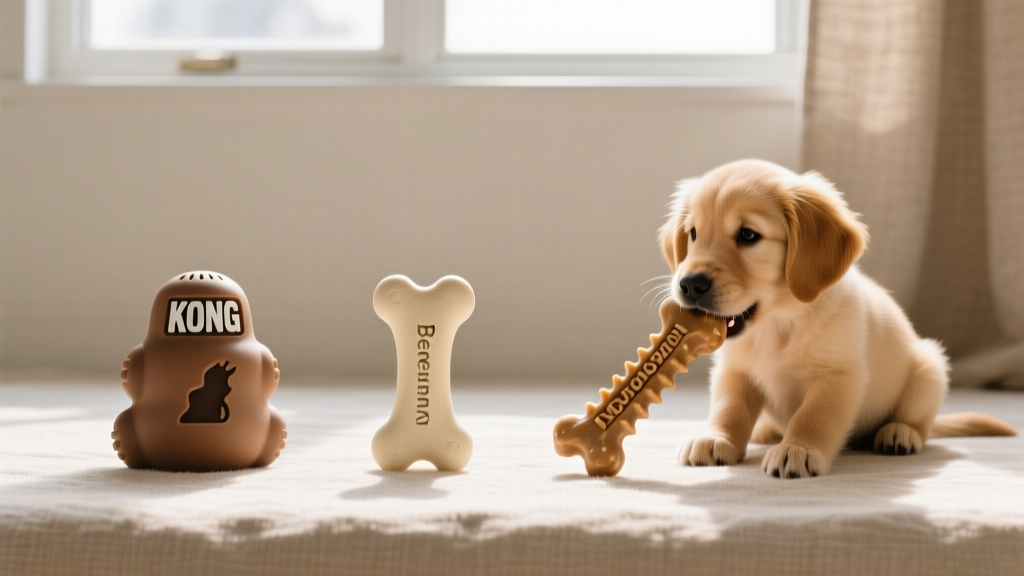
- Kong Classic (rubber, size-appropriate): Fill with plain yogurt mixed with kibble and freeze overnight. The rubber is durable enough for puppy teeth.
- Benebone Puppy Wishbone: Made from softer nylon designed for developing teeth. Available in sizes for puppies under 30 lb and under 60 lb.
- Carrots (whole, raw, large): A large cold carrot provides crunch and gum relief. Supervise to prevent choking on broken pieces.
Avoid: Ice cubes (can crack developing teeth), rawhide (choking and blockage risk), hard antlers or weight-bearing bones (fracture risk for puppy teeth), and any chew toy small enough to swallow whole.
Retained baby teeth: By 7 months, all 42 adult teeth should be in place. If you see a baby tooth still present alongside its adult replacement (common in small breeds like Chihuahuas, Yorkies, and toy Poodles), your veterinarian should extract it to prevent malocclusion and dental crowding. Extraction typically costs $50–$200 per tooth depending on whether sedation is needed.
Crate Training Progression and Time Limits
A crate is a management tool and a safe den — not a punishment space. When introduced properly using positive reinforcement, most puppies learn to settle in their crate within 2–4 weeks. Here's a progressive timeline with maximum time limits that respect your puppy's physical and emotional needs:
| Age | Maximum Crate Time (Daytime) | Overnight Expectation | Training Focus |
|---|---|---|---|
| 8–10 weeks | 30–60 minutes | 2–3 hours, then potty break | Feed meals in crate; toss treats inside; keep door open initially |
| 10–12 weeks | 1–2 hours | 3–4 hours, then potty break | Close door for short periods while you're in the room |
| 12–16 weeks | 2–3 hours | 4–5 hours | Step out of room briefly; return before puppy panics |
| 4–6 months | 3–4 hours | 6–7 hours | Build duration with a frozen Kong or chew; practice departures |
| 6+ months | 4–5 hours maximum | 7–8 hours | Crate should not be primary daytime confinement — arrange midday potty break |
Important: No dog of any age should be crated for more than 8 hours total in a 24-hour period. Puppies who are crated excessively develop behavioral problems including crate anxiety, self-mutilation, and barrier frustration. If you work full-time, arrange a midday dog walker or come home during lunch for the first 6 months.
Common Puppy Problems and Solutions
Biting and Nipping
Puppy biting is normal — they explore with their mouths and haven't learned that human skin is entirely off-limits. The goal is to teach bite inhibition (soft mouth) before eliminating mouthing entirely.
- Redirect: When teeth touch skin, say "ouch" in a calm voice, withdraw attention for 10–15 seconds, then offer an appropriate chew toy.
- Trade up: Always have a toy available. Praise enthusiastically when they chew the toy instead of your hand.
- Manage arousal: Biting spikes when puppies are overtired. If your puppy won't stop biting, they likely need a nap. Place them in their crate with a chew toy — most will fall asleep within 5 minutes.
- Never: Hold the puppy's mouth shut, alpha roll them, or yank your hand away rapidly (this triggers a chase-and-bite instinct). These aversive methods damage trust and can escalate aggression.
Whining and Crying (Especially at Night)
Nighttime whining in the first 1–2 weeks home is expected — your puppy has been separated from its mother and littermates. Place the crate near your bed initially so they can hear and smell you. Cover the crate with a breathable blanket to create a den feel. If whining continues after a potty break and comfort, wait for a brief pause in the noise before opening the crate — this prevents reinforcing the crying. Most puppies adjust within 5–10 nights.
Destructive Chewing
Puppies chew to relieve teething discomfort and to explore. Management is key: puppy-proof your home by removing shoes, cables, remote controls, and anything at puppy-height. Provide 5–10 appropriate chew toys of varying textures and rotate them every few days to maintain novelty. If your puppy chews something inappropriate, trade for a toy and praise — don't chase them, which they interpret as a game.
First-Year Cost Breakdown: Budgeting Realistically
New puppy owners are often surprised by the true cost of the first year. Below is a realistic breakdown based on 2025–2026 US pricing. Costs vary significantly by region, breed size, and whether you use private-practice or low-cost veterinary services.
| Category | Low Estimate | Medium Estimate | High Estimate |
|---|---|---|---|
| Puppy purchase/adoption fee | $200 (rescue) | $1,500 (responsible breeder) | $3,500+ (popular breeds) |
| Veterinary (vaccines, spay/neuter, wellness) | $500 | $900 | $1,500 |
| Food (12 months, size-dependent) | $300 | $600 | $1,000 |
| Supplies (crate, bed, leash, harness, bowls, toys) | $150 | $350 | $600 |
| Preventive medications (flea/tick, heartworm) | $200 | $400 | $600 |
| Training (group classes or private sessions) | $100 | $350 | $800 |
| Pet insurance (annual premium) | $350 | $600 | $900 |
| Emergency fund / unexpected vet visits | $0 | $500 | $2,000+ |
| TOTAL (excluding purchase price) | $1,600 | $3,700 | $7,400+ |
These figures don't include the puppy's purchase or adoption price, which varies enormously. A well-bred puppy from a health-tested, AKC-registered breeder typically costs $1,500–$3,500 depending on breed and region. Rescue adoption fees range from $150–$500 and often include initial vaccines and spay/neuter. Both are valid paths to a wonderful companion.
When Should I Bring My Puppy Home?
The consensus among veterinary behaviorists and responsible breeders is that puppies should remain with their mother and littermates until at least 8 weeks of age. Many breeders of toy and small breeds prefer to keep puppies until 10–12 weeks because these breeds mature more slowly and are more fragile during the transition. Puppies separated from their litter before 7 weeks show higher rates of fear, aggression, and anxiety-related behaviors throughout life, according to research published in the Journal of Veterinary Behavior.
If a breeder offers you a puppy at 5 or 6 weeks, that's a significant red flag. Responsible breeders understand the importance of the littermate socialization period and will not release puppies early. The one exception is orphaned or single-puppy litters, which require specialized early socialization protocols.
Frequently Asked Questions
Is it normal for my 8-week-old puppy to sleep 20 hours a day?
Yes. Puppies at 8 weeks are growing rapidly, and growth hormone is primarily released during sleep. Expect 18–20 hours of sleep in a 24-hour period, broken into multiple naps. Your puppy will typically play hard for 20–30 minutes, then crash. This is healthy and expected. However, if your puppy is difficult to rouse for meals, seems weak or wobbly when awake, or has pale gums, seek veterinary care immediately — these can be signs of hypoglycemia (especially in toy breeds), infection, or parasitic anemia.
How do I stop puppy biting that's getting worse, not better?
If biting intensifies after 12 weeks despite consistent redirection, evaluate three factors: (1) Is your puppy getting enough sleep? Overtired puppies bite more. Enforce nap times in the crate every 1–2 hours. (2) Is your puppy getting enough appropriate chewing outlets? Provide at least 5 different textures of chew toys. (3) Are you accidentally reinforcing biting by reacting dramatically? Keep your response calm and boring — stand up, cross your arms, and wait 15 seconds before redirecting to a toy. If biting breaks skin consistently past 16 weeks, consult a certified professional dog trainer (CPDT-KA) or veterinary behaviorist.
Can my puppy sleep in my bed instead of a crate?
While some adult dogs sleep safely on beds, puppies under 6 months present fall risks (especially toy and small breeds), and bed-sleeping can undermine house training because you can't control where they eliminate overnight. Establish crate sleeping first. If you eventually choose to allow bed privileges, wait until your puppy is reliably house trained, can get on and off the bed safely, and responds to an "off" cue. Many owners use a dog bed placed next to their own bed as a compromise.
My puppy won't eat the recommended amount — should I worry?
Appetite fluctuation is normal, especially during teething (3–6 months) and after vaccination days. However, a puppy who refuses food for more than 12–18 hours, or who shows vomiting, diarrhea, or lethargy alongside poor appetite, needs veterinary evaluation. Puppies — especially those under 4 months — can develop hypoglycemia rapidly. If your puppy is simply picky, avoid adding toppers or switching foods repeatedly, which trains them to hold out for better options. Offer the meal for 15 minutes, remove it, and offer again at the next scheduled feeding.
Raising a puppy is a marathon, not a sprint. The sleep deprivation, the chewed shoes, the 5 AM potty runs — they're temporary. The structure, patience, and positive reinforcement you invest during these first 12 months build the foundation for a confident, well-adjusted adult dog. When in doubt, consult your veterinarian — they're your best resource for breed-specific guidance tailored to your individual puppy.
Dr. Hannah Wickes
All our authors care for dogs every day — read more of their work on the authors page.