How Do Mother Dogs Teach Puppies to Potty Train?
Learn how do mother dogs teach puppies to potty train and how to continue their work at home with our week-by-week potty, feeding, and socialization guide.

Most new puppy owners assume potty training starts the day they bring their dog home. In reality, the foundation is laid weeks earlier — by the mother dog. Understanding how do mother dogs teach puppies to potty train gives you a massive advantage when it's your turn to take over. This guide walks you through every developmental milestone from weeks 4 through 12 months, with concrete timelines, feeding schedules, vaccination dates, and a realistic potty training progression you can actually follow.
How Mother Dogs Teach Puppies to Potty Train: The First 8 Weeks
The answer to "how do mother dogs teach puppies to potty train" starts with biology, not instruction. During the first two to three weeks of life, puppies cannot eliminate on their own. The mother dog licks their genital area to stimulate urination and defecation, then consumes the waste to keep the den clean. This is an evolutionary survival behavior — it eliminates scent that could attract predators.
Around week 3 to 4, puppies develop the neuromuscular control to eliminate independently. This is when the mother's real teaching begins:
- Den hygiene instinct: The mother naturally encourages puppies to move away from their sleeping area to eliminate. She may nudge or carry them toward the edge of the whelping area.
- Social modeling: By week 5-6, puppies follow the mother outside and observe her eliminating in a specific area. Canine social learning is powerful — puppies mimic what they see.
- Substrate preference formation: Between weeks 4-7, puppies develop a preference for the surface texture they most frequently eliminate on. If the whelping area has newspaper, they'll seek newspaper. If they go outside on grass, grass becomes their preferred substrate. This is why puppies from outdoor-accessible breeders often potty train faster on grass.
- Correction signaling: Some mother dogs will give a low growl or move away if a puppy eliminates too close to the resting area, teaching spatial awareness about appropriate elimination zones.
According to the Merck Veterinary Manual, the sensitive period for socialization and environmental learning peaks between weeks 3 and 12, making this window critical for establishing lifelong habits.
Age-Specific Developmental Milestones
Weeks 4-8: The Foundation Period (With Breeder/Mother)
- Potty awareness: Puppies begin moving away from sleeping area to eliminate (weeks 4-5)
- Substrate preference: Surface preference solidifies by week 7
- Bladder capacity: Approximately 1 hour of control per month of age (so ~1 hour at 4 weeks, ~2 hours at 8 weeks)
- Social skills: Bite inhibition learned from littermates — yelping siblings teach puppies to soften their mouth
- Sensory development: Eyes fully open by week 3; hearing functional by week 4; coordinated walking by week 5
Weeks 8-12: Primary Socialization Window (New Home Transition)
- Potty training: Begin consistent outdoor trips every 1-2 hours; expect 2-4 accidents per day as normal
- Crate introduction: Puppy should view crate as safe den; begin with 10-15 minute sessions
- Command learning: Can learn "sit," name recognition, and "come" with positive reinforcement
- Fear period: Weeks 8-11 include a natural fear imprint period — avoid traumatic experiences
- Bite inhibition: Redirect nipping to chew toys; never use physical punishment
Weeks 12-16: Building Reliability
- Bladder control: Extending to 3-4 hours during the day
- Potty signaling: Puppy may begin going to the door or whining to indicate need to go out
- Basic commands: Can reliably respond to sit, down, come with consistent training
- Chewing escalation: Early teething discomfort begins; puppy explores world through mouth
- Second fear period: Some puppies experience heightened sensitivity around week 14
Weeks 16-24: Adolescence Begins
- Potty reliability: Most puppies are 80-90% reliable by 16-20 weeks with consistent training
- Teething peak: Adult teeth erupting (months 4-6); intense chewing needs
- Testing boundaries: Adolescent regression in previously learned commands is normal
- Energy surge: Exercise needs increase significantly; structured play and training sessions critical
- Spay/neuter window: Many veterinarians recommend between 4-6 months (breed-dependent)
Months 6-12: Adolescent Maturation
- Full potty reliability: Most dogs are fully house-trained by 6-8 months, though small breeds may take up to 12 months
- Adult teeth: All 42 adult teeth should be in by month 7
- Sexual maturity: Intact dogs may begin marking behavior; females may experience first heat cycle (breed-dependent, 6-18 months)
- Social maturity: Continued impulse control training; dog-dog social skills refinement
- Growth plateau: Small breeds near adult size by 10-12 months; large/giant breeds continue growing to 18-24 months
Feeding Schedule by Age and Weight
Puppies need more calories per pound of body weight than adult dogs, but their stomachs are small. This means frequent, measured meals — which also directly supports potty training predictability. A consistent feeding schedule produces a predictable elimination schedule.
| Age | Meals Per Day | Small Breed (5-20 lb adult) | Medium Breed (21-50 lb adult) | Large Breed (51-100 lb adult) |
|---|---|---|---|---|
| 8-12 weeks | 4 meals/day | ¼ – ½ cup per meal | ½ – ¾ cup per meal | ¾ – 1¼ cups per meal |
| 3-6 months | 3 meals/day | ⅓ – ⅔ cup per meal | ¾ – 1 cup per meal | 1 – 2 cups per meal |
| 6-12 months | 2 meals/day | ½ – ¾ cup per meal | 1 – 1½ cups per meal | 1½ – 3 cups per meal |
Important feeding rules for potty training success:
- Remove uneaten food after 15-20 minutes — free-feeding makes elimination unpredictable
- Take puppy outside within 15-30 minutes after every meal
- Choose a food with an AAFCO statement confirming "complete and balanced" nutrition for growth
- Large/giant breed puppies should eat food specifically formulated for large breed growth to prevent orthopedic issues like hip dysplasia
- Always provide fresh water, but consider removing water 2 hours before bedtime to reduce overnight accidents
Potty Training Timeline and Troubleshooting
Now that you understand how do mother dogs teach puppies to potty train through den hygiene and substrate preference, here's how to continue that work. The single biggest mistake new owners make is expecting too much too soon. Bladder control is physiological — no amount of training can override a puppy's physical limitations.
Realistic Potty Training Expectations
| Age | Max Hold Time | Expected Accidents/Week | Training Focus |
|---|---|---|---|
| 8-10 weeks | 1-2 hours | 10-15 (yes, really) | Establish outdoor routine; reward immediately |
| 10-14 weeks | 2-3 hours | 5-8 | Introduce verbal cue ("go potty"); bell training |
| 14-20 weeks | 3-5 hours | 2-4 | Puppy begins self-initiating; reinforce signaling |
| 5-8 months | 5-8 hours | 0-2 | Reliability building; regression management |
| 8-12 months | 8+ hours | 0-1 | Fully reliable; occasional marking behavior |
Potty Training Troubleshooting
Problem: Puppy pees in crate.
Cause: Crate is too large (puppy eliminates in one corner, sleeps in another) or puppy was left in too long. Solution: Use a divider to size the crate so puppy can stand, turn, and lie down — no more. Never leave a puppy crated longer than their hold capacity.
Problem: Puppy has accidents after being reliable.
Cause: Adolescent regression (normal at 4-7 months), urinary tract infection, or routine change. Solution: Rule out UTI with a vet visit first. If behavioral, return to more frequent outdoor trips and higher-value treats for 2 weeks.
Problem: Puppy only pees on pee pads, won't go outside.
Cause: Substrate preference formed on pad texture. Solution: Gradually move the pad closer to the door over several days, then place it outside, then remove it. Transition to grass/outdoor surface gradually.
Vaccination Schedule
Your puppy's immune system is immature, and maternal antibodies from the mother's colostrum gradually wane between weeks 6 and 16. The vaccination series is timed to cover this gap. Always consult your veterinarian for a schedule tailored to your puppy's risk factors and local disease prevalence.
| Age | Vaccines | What It Protects Against | Est. Cost |
|---|---|---|---|
| 6-8 weeks | DHPP (1st dose) | Distemper, Hepatitis (Adenovirus), Parainfluenza, Parvovirus | $20-$40 |
| 10-12 weeks | DHPP (2nd dose), Bordetella (optional), Leptospirosis (risk-based) | Booster for core diseases; kennel cough; leptospirosis | $30-$60 |
| 14-16 weeks | DHPP (3rd dose), Rabies | Final core booster; rabies (legally required in most US states) | $35-$70 |
| 12-16 months | DHPP booster, Rabies booster | 1-year or 3-year boosters depending on vaccine type | $40-$80 |
The AVMA vaccination guidelines classify DHPP and Rabies as "core" vaccines recommended for all dogs. Bordetella, Leptospirosis, Lyme, and Canine Influenza are "non-core" and depend on your puppy's lifestyle and geographic risk.
The Critical Socialization Window (Weeks 3-14)
Veterinary behaviorists consider weeks 3 through 14 the primary socialization period. What your puppy experiences — positively — during this window shapes their lifelong responses to people, animals, environments, and stimuli. Under-socialized puppies are significantly more likely to develop fear-based aggression and anxiety as adults.
The challenge: your puppy isn't fully vaccinated until week 16. The AVMA and the American Veterinary Society of Animal Behavior (AVSAB) both recommend that socialization begin before full vaccination, with appropriate precautions.
Socialization Exposure Checklist
Safety rules for pre-vaccination socialization: Carry your puppy in public spaces. Arrange playdates only with known, fully vaccinated dogs. Avoid dog parks, pet store floors, and high-traffic dog areas until 1 week after the final DHPP booster (typically week 17). Puppy classes that require proof of first vaccination and sanitize floors are generally considered safe and highly recommended.
Crate Training Progression and Time Limits
A crate mimics the den environment the mother dog maintained — a clean, safe resting space. Dogs naturally avoid soiling their sleeping area, which makes crate training one of the most effective potty training tools available.
| Age | Max Daytime Crate Time | Max Overnight Crate Time | Training Notes |
|---|---|---|---|
| 8-10 weeks | 30-60 minutes | 2-3 hours (expect overnight waking) | Feed meals in crate; cover with light blanket |
| 11-14 weeks | 1-2 hours | 4-5 hours | Begin short absences from room |
| 15-16 weeks | 2-3 hours | 5-6 hours | Puppy should enter crate willingly |
| 4-6 months | 3-4 hours | 7-8 hours | Can sleep through the night reliably |
| 6+ months | 4-6 hours | 8 hours | Consider transitioning to open-door den access |
Never use the crate as punishment. The crate must remain a positive space. If your puppy whines in the crate, wait for a brief moment of silence before releasing — releasing during whining teaches that whining opens the door. However, always rule out a potty need first: take puppy outside immediately upon release.
Teething Timeline and Relief Strategies
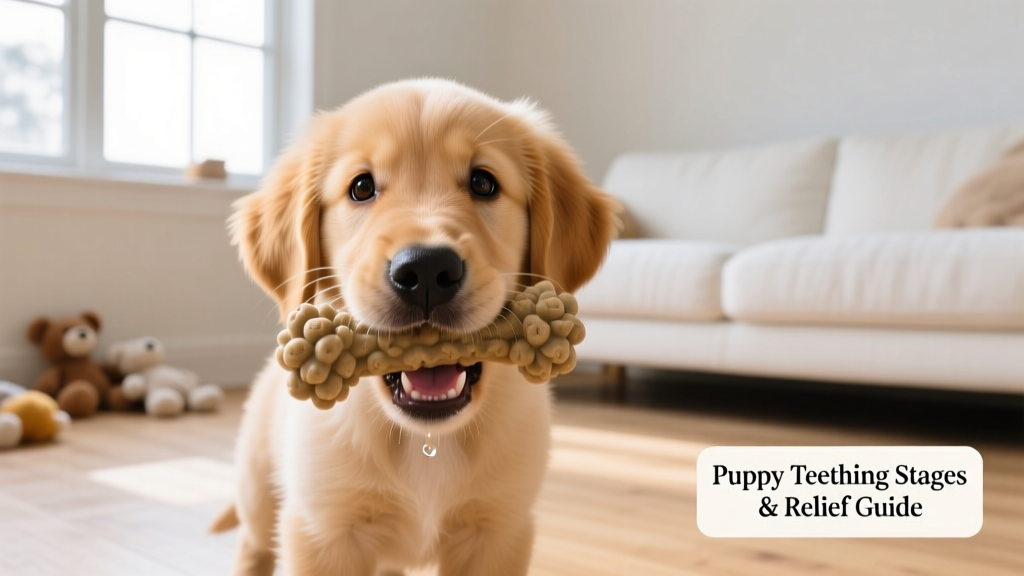
Puppies have 28 deciduous (baby) teeth that begin erupting at 3-4 weeks and are fully in by 6-8 weeks. Starting around 12-16 weeks, these baby teeth are pushed out by 42 permanent adult teeth. The teething process typically causes discomfort from 3 to 6 months of age.
Teething signs: Increased chewing, drooling, mild gum bleeding, reluctance to eat hard kibble, finding small teeth on the floor (puppies often swallow them — this is harmless).
Safe relief strategies:
- Frozen washcloth: Wet a clean washcloth, twist into a rope, freeze for 2 hours. The cold numbs gums and the texture satisfies chewing. Supervise to prevent swallowing fabric.
- KONG Classic (puppy size): Fill with plain yogurt or canned pumpkin (not pie filling — check that the only ingredient is pumpkin), freeze overnight. The KONG Puppy model in pink/blue is softer for developing teeth.
- Benebone Wishbone (puppy size): Nylon chew with bacon or chicken flavor infusion; designed for puppies under 6 months. Replace when worn down significantly.
- Chilled carrots: Whole baby carrots, refrigerated (not frozen). Low calorie, safe, and satisfying crunch. Supervise to prevent choking in small breeds.
- Nylabone Puppy Chew: Softer formula designed for developing teeth. Choose the appropriate size for your puppy's weight.
Avoid: Ice cubes (too hard for puppy teeth, risk of fracture), rawhide (choking and digestive blockage risk), cooked bones (splinter hazard), and any chew toy harder than a puppy's tooth enamel. The thumbnail test: if you can't make an indent in the toy with your thumbnail, it's too hard.
Common Puppy Problems and Solutions
Puppy Biting and Nipping
When littermates play, they bite each other and learn bite inhibition — when one yelps, the other backs off. Your puppy will continue this behavior with you. Here's the protocol:
- Redirect: When teeth touch skin, immediately offer an appropriate chew toy. Praise enthusiastically when they chew the toy.
- Withdraw attention: If redirecting doesn't work, say "ouch" in a calm voice, stand up, and turn away for 10-15 seconds. This mimics littermate behavior.
- Time-out: If nipping persists, calmly place puppy in their crate or a pen for a 30-second cool-down (not as punishment — as a reset).
- Exercise check: Overtired puppies bite more. An 8-week-old puppy needs 16-20 hours of sleep per day. Enforce nap times.
Never hold the puppy's mouth shut, alpha roll, or use physical punishment. These methods damage trust and can escalate aggression. The AVSAB position statement on dominance theory explicitly advises against these techniques.
Whining and Crying
Puppies whine to communicate: they need to potty, they're lonely, they're cold, or they're overstimulated. At night, a puppy newly separated from littermates will almost certainly cry. Place the crate near your bed initially so they can hear and smell you. A soft ticking clock or a warm (not hot) heating pad wrapped in a towel can simulate littermate warmth. Gradually move the crate to its permanent location over 1-2 weeks.
Destructive Chewing
Puppies explore the world through their mouths. Destructive chewing peaks between 3-6 months (teething) and again during adolescence (6-12 months). Management is key:
- Puppy-proof your home: remove shoes, cords, and small objects from floor level
- Provide 5-8 appropriate chew toys of varying textures, rotated weekly to maintain novelty
- Supervise or confine — a puppy should never have unsupervised free-roam access until reliably trained (typically 12-18 months)
- Use bitter apple spray (e.g., Grannick's Bitter Apple, ~$8 for 16 oz) on furniture legs and baseboards as a deterrent
First-Year Cost Breakdown
Budgeting for a puppy requires realistic numbers. Here's what to expect for a typical puppy's first year in 2026, with ranges reflecting geographic variation and breed size differences.
| Category | Low End | Mid Range | High End |
|---|---|---|---|
| Puppy purchase/adoption | $150 (rescue) | $1,500 (responsible breeder) | $3,500+ (specialty breeds) |
| Veterinary (vaccines, spay/neuter, exams) | $400 | $800 | $1,500 |
| Food (quality puppy food, 12 months) | $240 | $500 | $900 (large breed/fresh food) |
| Supplies (crate, bed, leash, bowls, toys, gate) | $150 | $350 | $600 |
| Training (group classes or private sessions) | $100 | $300 | $800 |
| Flea/tick/heartworm prevention (12 months) | $120 | $250 | $400 |
| Pet insurance (annual premium) | $300 | $500 | $800 |
| Total First Year | $1,460 | $4,200 | $8,500+ |
Budget tip: Pet insurance premiums are lowest when enrolled at 8 weeks (before any pre-existing conditions develop). Policies from providers like Trupanion, Healthy Paws, or Lemonade typically range from $25-$65/month for accident-and-illness coverage. An emergency fund of $1,000-$2,000 is also recommended — a single emergency vet visit for parvovirus treatment can cost $2,000-$5,000.
Frequently Asked Questions
When should I bring my puppy home?
The ideal window is between 8 and 12 weeks of age. Puppies younger than 8 weeks miss critical bite inhibition and social lessons from their mother and littermates. The primary socialization window closes around 14 weeks, so bringing a puppy home after 12 weeks leaves a very narrow window for socialization. Some breeders of toy breeds keep puppies until 10-12 weeks due to their fragility and slower development.
How often should I feed my puppy at 10 weeks old?
At 10 weeks, feed 4 meals per day, spaced roughly 4-5 hours apart during waking hours. Example schedule: 7:00 AM, 11:30 AM, 4:00 PM, and 7:30 PM. Take your puppy outside within 15-30 minutes after each meal. Remove uneaten food after 15-20 minutes to establish a routine and prevent free-feeding, which makes potty training unpredictable.
When will my puppy be fully potty trained?
Most puppies achieve 80-90% reliability by 16-20 weeks with consistent training, and full reliability (fewer than one accident per month) by 6-8 months. Small and toy breeds may take up to 12 months due to smaller bladder capacity. If your puppy is still having frequent accidents after 6 months of consistent training, consult your veterinarian to rule out medical causes.
What vaccines does my puppy need and when?
Core vaccines for all puppies: DHPP (Distemper, Hepatitis, Parainfluenza, Parvovirus) at 6-8 weeks, 10-12 weeks, and 14-16 weeks, plus Rabies at 14-16 weeks. Non-core vaccines (Bordetella, Leptospirosis, Lyme, Canine Influenza) depend on your puppy's lifestyle and geographic risk. Your veterinarian will recommend based on your area's disease prevalence. Never vaccinate a sick puppy — wait until they are healthy.
How do I stop puppy biting and nipping?
Use the redirect-and-withdraw method: when teeth touch skin, immediately offer a chew toy. If biting continues, calmly say "ouch" and turn away or leave the room for 10-15 seconds. This mimics how littermates teach bite inhibition. Ensure your puppy gets 16-20 hours of sleep per day — overtired puppies bite significantly more. Never use physical punishment, which damages trust and can increase aggression.
When can my puppy go outside and meet other dogs?
Your puppy can go outside in your own yard immediately. For public spaces and meeting other dogs, wait until 1 week after the final DHPP booster (typically around 17 weeks). However, controlled socialization with known, fully vaccinated dogs in clean, private environments can begin as early as 1-2 weeks after the first DHPP dose. Avoid dog parks, pet stores, and high-traffic areas until fully vaccinated. Puppy socialization classes that require proof of first vaccination are generally safe and strongly recommended.
Dr. Hannah Wickes
All our authors care for dogs every day — read more of their work on the authors page.