How Long Do Dogs Carry Puppies? Gestation Timeline & Puppy Care Guide
How long do dogs carry puppies? Learn the 63-day gestation timeline, whelping signs, and a complete week-by-week puppy care schedule from birth to adulthood.

If you're expecting a litter — or just picked up a new puppy and want to understand where they are in their development — you probably started with one question: how long do dogs carry puppies? The short answer is roughly 63 days, but canine gestation is far more nuanced than a single number. And once those puppies arrive, the real work begins.
This guide walks you through the full journey — from conception through the first year of your puppy's life — with breed-aware milestones, feeding schedules, vaccination timelines, and realistic cost expectations. Whether you're managing a planned breeding or preparing for a new addition, you'll find actionable specifics here, not vague platitudes.
Canine Gestation: How Long Do Dogs Actually Carry Puppies?
The average canine gestation period is 63 days from ovulation, but because pinpointing ovulation is difficult without veterinary testing, most breeders and vets use a broader window of 58 to 68 days from the first breeding. According to the American Kennel Club, gestation length can vary by breed size, litter size, and individual physiology.
| Breed Size Category | Typical Gestation Range | Average Litter Size |
|---|---|---|
| Toy/Small (under 22 lb / 10 kg) | 58–64 days | 1–4 puppies |
| Medium (22–55 lb / 10–25 kg) | 60–65 days | 4–8 puppies |
| Large (55–90 lb / 25–41 kg) | 61–66 days | 6–10 puppies |
| Giant (over 90 lb / 41 kg) | 62–68 days | 7–12 puppies |
Your veterinarian can narrow the due date using progesterone testing (blood draws at specific intervals) or abdominal ultrasound (reliable from day 25–35 onward). Radiographs (X-rays) become useful after day 45 to count fetal skeletons and confirm litter size — critical information for anticipating dystocia (difficult birth).
Signs of Approaching Labor
Within 24 hours of whelping, your dog's rectal temperature will typically drop below 99°F (37.2°C) from a normal range of 101–102.5°F (38.3–39.2°C). Other pre-labor indicators include nesting behavior, appetite loss, restlessness, and visible abdominal contractions. If active straining lasts more than 30–60 minutes without producing a puppy, contact your veterinarian or emergency clinic immediately.
When Should I Bring My Puppy Home?
The consensus among veterinary behaviorists and the AVMA is clear: puppies should remain with their mother and littermates until at least 8 weeks of age, with many breeders and behaviorists recommending 10–12 weeks for optimal social development.
Here's why the timing matters:
- Weeks 3–5: Puppies develop primary social bonds with littermates. Bite inhibition learning begins.
- Weeks 5–7: Critical fear imprint period. Negative experiences can create lasting phobias. Littermate interaction teaches canine communication.
- Weeks 8–12: Human socialization window peaks. This is the ideal homing window for most breeds.
- Weeks 12–14: Second fear period begins. Puppies separated too early may show increased reactivity and poor impulse control.
For toy breeds (Chihuahuas, Yorkshire Terriers, Pomeranians), many responsible breeders retain puppies until 12–16 weeks due to fragility and hypoglycemia risk. For large and giant breeds, 8–10 weeks is standard.
Week-by-Week Puppy Milestone Timeline
Weeks 4–8: The Litter Phase
Development: Eyes and ears fully functional. Deciduous (baby) teeth erupting. First solid food introduced (gruel consistency). Social hierarchy forming within litter.
What to expect: Puppies begin play-fighting, vocalizing, and exploring beyond the whelping box. Deworming typically occurs at weeks 2, 4, 6, and 8 per the Merck Veterinary Manual protocol.
Your role: If you're the breeder, begin gentle human handling from day 3 (Early Neurological Stimulation protocols). Introduce novel textures, sounds, and mild environmental challenges.
Weeks 8–12: The Homecoming Window
Development: Brain development at 80% of adult capacity. Peak socialization receptivity. Bladder control limited (approximately 1 hour per month of age).
What to expect: Rapid bonding with new family. Fear responses may appear suddenly. Sleep needs are 18–20 hours per day. Mouthing and nipping are normal and intense.
Your role: Begin structured socialization immediately. Establish consistent feeding, potty, and sleep routines. Keep training sessions to 3–5 minutes maximum.
Weeks 12–16: Foundation Building
Development: Second fear period (weeks 12–14). Baby teeth begin loosening. Increased independence and environmental curiosity. Bladder control extending to 2–3 hours.
What to expect: Previously confident puppies may suddenly show fear of familiar objects or people. Regression in potty training is common. Basic cue comprehension improves significantly.
Your role: Avoid forcing scary experiences — let the puppy approach at their own pace using treats. Increase socialization variety. Begin leash walking practice in low-distraction areas.
Weeks 16–24: The Adolescent Transition
Development: Adult teeth erupting (teething peak at 4–5 months). Sexual maturity approaching in small breeds. Growth rate slowing. Attention span increasing.
What to expect: Destructive chewing peaks. Recall reliability may decrease. Puppy begins testing boundaries. Energy levels surge in working and sporting breeds.
Your role: Provide appropriate chew outlets. Increase physical exercise appropriate to breed (avoid forced running or repetitive jumping until growth plates close). Enroll in group training classes if not already started.
Months 6–12: Adolescence
Development: Growth plates closing (varies by breed — toy breeds by 8–10 months, giant breeds not until 18–24 months). Adult coat replacing puppy coat. Full set of 42 adult teeth. Spay/neuter timing discussion with your vet.
What to expect: "Selective hearing" — your puppy knows the cues but chooses to ignore them. Increased same-sex aggression possible in intact dogs. Counter-surfing and scavenging behaviors may emerge.
Your role: Maintain training consistency. Consider intermediate obedience classes. Discuss spay/neuter timing with your veterinarian — recent research suggests waiting until growth plates close for large breeds may reduce orthopedic disease risk.
Feeding Schedule: Exact Portions by Age and Weight
Puppy nutritional needs change rapidly. The table below assumes a complete and balanced AAFCO-approved puppy formula (look for the AAFCO nutritional adequacy statement on the label specifying "growth" or "all life stages"). Portions are starting points — adjust based on body condition score (BCS), which your vet can assess.
| Age | Meals Per Day | Small Breed (10–25 lb adult) | Medium Breed (25–55 lb adult) | Large Breed (55–90 lb adult) |
|---|---|---|---|---|
| 6–8 weeks | 4 (gruel/softened) | ¼–½ cup/day total | ½–1 cup/day total | 1–1½ cups/day total |
| 8–12 weeks | 4 | ½–¾ cup/day | 1–1½ cups/day | 2–3 cups/day |
| 12–16 weeks | 3 | ¾–1 cup/day | 1½–2½ cups/day | 3–4½ cups/day |
| 4–6 months | 3 | 1–1¼ cups/day | 2–3 cups/day | 4–5½ cups/day |
| 6–12 months | 2 | 1–1½ cups/day | 2½–3½ cups/day | 4–6 cups/day |
Large breed note: Use a formula specifically labeled for large-breed puppies. These contain controlled calcium and phosphorus ratios (Ca:P ratio of 1.1:1 to 1.4:1) to support slower skeletal growth and reduce hip dysplasia risk. Feeding adult food or all-life-stages formulas to large-breed puppies can accelerate growth too rapidly.
How often should I feed my puppy at each age? Four meals daily until 12 weeks, three meals until 6 months, then transition to two meals per day. Free-feeding (leaving food out all day) is discouraged — it makes potty training unpredictable and can contribute to obesity.
Vaccination Schedule: What Your Puppy Needs and When
Core vaccines protect against life-threatening diseases. The schedule below follows the AAHA Canine Vaccination Guidelines, which most veterinarians adopt. Your vet may adjust based on regional disease prevalence and individual risk factors.
| Age | Vaccine | Disease Protection | Estimated Cost |
|---|---|---|---|
| 6–8 weeks | DHPP (1st dose) | Distemper, Hepatitis (Adenovirus), Parainfluenza, Parvovirus | $20–$40 |
| 10–12 weeks | DHPP (2nd dose) + Bordetella (optional) | Same as above + Kennel Cough | $25–$50 |
| 14–16 weeks | DHPP (3rd dose) + Rabies | Full core protection + Rabies (legally required) | $35–$65 |
| 12–16 months | DHPP booster + Rabies booster | Extended immunity (then every 1–3 years) | $40–$75 |
When can my puppy go outside and meet other dogs? After the final DHPP dose at 14–16 weeks, your puppy has adequate protection for public spaces, dog parks, and group classes. Before that, socialization is still critical — carry your puppy in a sling or stroller to expose them to sights and sounds without ground contact. Avoid areas with unknown dog traffic (dog parks, pet store floors) until fully vaccinated. Puppy socialization classes that require proof of first vaccination are generally considered safe per the AVMA's position.
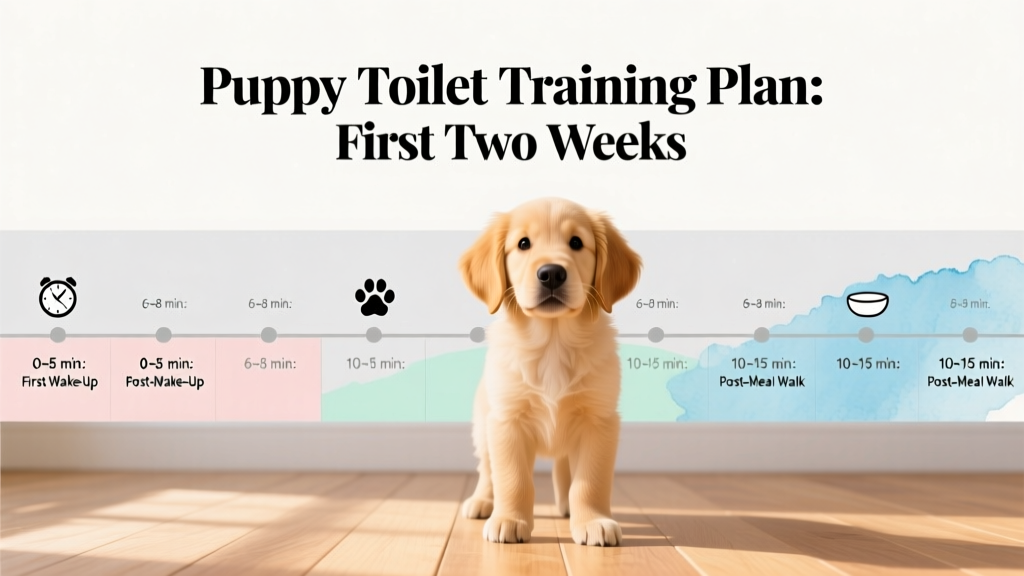
Potty Training Timeline and Troubleshooting
Let's set realistic expectations: most puppies achieve reliable house training between 4 and 6 months of age, though some small breeds take until 8–10 months due to smaller bladder capacity and higher metabolic rates. Claims of "potty trained in 3 days" are marketing fiction.
The general rule for bladder control: a puppy can hold it approximately one hour per month of age, plus one. So an 8-week-old puppy (2 months) can hold for roughly 3 hours maximum — and that's during rest, not active play.
Potty Training Log Template
Track these data points for the first 4 weeks home to identify your puppy's natural rhythm:
- Time of outing (e.g., 7:15 AM)
- Trigger (woke up, after eating, after play, scheduled)
- Result (urinated, defecated, both, nothing)
- Accidents (time, location, possible trigger)
- Reward given (treat type, praise)
After 2 weeks of logging, you'll see clear patterns — most puppies need to eliminate within 15–30 minutes of eating, immediately upon waking, and after vigorous play. Schedule outings around these triggers.
Common troubleshooting:
- Submissive/excitement urination: Not a potty training failure. Avoid greeting your puppy with high energy. Crouch sideways, speak softly, and ignore until calm.
- Regression at 4–5 months: Normal. Hormonal changes and increased independence cause temporary setbacks. Return to higher-frequency outings.
- Crate accidents: The crate may be too large (puppy eliminates in one corner, sleeps in another). Use a divider to size it so the puppy can stand, turn, and lie down — nothing more.
- Nighttime waking: Set an alarm for 3–4 hours after bedtime for 8–12 week puppies. Gradually extend the interval as bladder capacity increases.
The Socialization Window: Weeks 3–14
This is the single most impactful period in your puppy's behavioral development. According to the AVMA, the primary socialization window closes around 12–14 weeks, after which unfamiliar stimuli are more likely to trigger fear rather than curiosity. Missing this window doesn't mean your dog is doomed — but remedial socialization in adulthood requires significantly more time and professional support.
Socialization Exposure Checklist
Aim for positive, treat-paired exposure to each category before 14 weeks:
- Surfaces: Grass, gravel, metal grates, wet pavement, carpet, tile, tarps
- Sounds: Vacuum cleaner, thunder (play recordings at low volume), doorbell, traffic, children shouting, fireworks recordings
- People: Children (supervised), elderly individuals, people in hats/sunglasses/uniforms, people using mobility aids, various skin tones and body types
- Animals: Vaccinated friendly adult dogs, cats (if household has them), livestock (if rural)
- Handling: Paw touching, ear inspection, mouth opening, nail clipping simulation, being held on side, gentle restraint
- Environments: Car rides, veterinary clinic (happy visits only), outdoor café patio, parking lot, friend's house
- Objects: Umbrellas opening, plastic bags rustling, bicycles, skateboards, strollers, balloons
Rule of thumb: If your puppy shows fear (tucked tail, flattened ears, refusing treats), increase distance from the stimulus and lower intensity. Never force exposure — that creates sensitization, not desensitization.
Crate Training Progression and Time Limits
A crate is a management tool and safe space — not a punishment device. The goal is for your puppy to voluntarily enter and relax in the crate. Here's a progressive timeline:
| Puppy Age | Max Daytime Confinement | Max Nighttime Confinement | Training Focus |
|---|---|---|---|
| 8–10 weeks | 30–60 minutes | 3–4 hours (set alarm) | Door open, feed meals inside, short naps |
| 10–12 weeks | 1–2 hours | 4–5 hours | Door closed, treat for calm, brief absences |
| 3–4 months | 2–3 hours | 6–7 hours | Leaving house briefly, chew toys provided |
| 4–6 months | 3–4 hours | 7–8 hours | Extended absences, settling independently |
| 6+ months | 4–5 hours max | 8 hours | Transition to open-door access when reliable |
No puppy or adult dog should be crated for more than 5 hours during the day without a break. Extended confinement leads to frustration, anxiety, and physical discomfort. If your work schedule requires longer absences, arrange a midday dog walker or use an exercise pen (x-pen) connected to the crate with a potty area included.
Teething Timeline and Relief Strategies
Puppies have 28 deciduous teeth that begin erupting at 3–4 weeks and are fully in by 6–8 weeks. The transition to 42 permanent teeth begins around 3.5–4 months and is typically complete by 6–7 months. During this window, your puppy's urge to chew will be intense and relentless.
Teething Phase Breakdown
- 3–4 months: Incisors loosen first. You may find tiny teeth on the floor (many puppies swallow them — harmless).
- 4–5 months: Canines and premolars erupt. This is peak chewing intensity. Gums may appear red or slightly bloody.
- 5–6 months: Molars come in. Chewing frequency may decrease slightly but remains significant.
- 6–7 months: Full adult set. Your vet should check for retained deciduous teeth at the next visit — common in toy breeds and may require extraction.
Safe chew recommendations:
- Kong Classic (rubber, stuffable): Fill with wet puppy food and freeze for 2–4 hours. The cold numbs sore gums. Size appropriately — if the puppy can fit the entire toy in their mouth, it's too small.
- Benebone Wishbone (nylon): Durable and ergonomic. Replace when worn down more than 25% of original size.
- Frozen washcloth: Wet a clean washcloth, twist into a rope, freeze. Supervise use — remove if threads begin to tear off.
- Yak cheese chews: High-protein, long-lasting. Supervise to prevent choking on large broken pieces. Microwave the end piece into a puff to use it fully.
Avoid: Rawhide (choking and GI blockage risk), cooked bones (splinter easily), antlers (tooth fracture risk — the hardness exceeds canine tooth enamel), and any chew smaller than your puppy's mouth.
Common Puppy Problems and Solutions
Problem: Puppy Biting and Nipping
Why it happens: Puppies explore the world with their mouths. Littermates teach bite inhibition through yelping feedback — your puppy needs the same from you.
Solution: When teeth touch skin, emit a high-pitched "ouch" or yelp, then redirect to an appropriate chew toy. If nipping continues, calmly end the interaction (step over a baby gate for 30 seconds). This teaches that biting ends play — the same consequence littermates deliver.
Timeline: Mouthing typically decreases significantly by 5–6 months as adult teeth settle. Consistent redirection from day one shortens this phase.
Problem: Nighttime Whining in Crate
Why it happens: Separation from littermates, need to eliminate, or learned attention-seeking.
Solution: Place the crate in your bedroom for the first 2–3 weeks. Ensure a potty break right before bed. If whining occurs after 2–3 hours, take puppy out on leash for a boring, no-play potty trip, then return to crate. If whining occurs within 30 minutes of being crated, wait for a brief pause in vocalization before approaching — this prevents reinforcing the whining itself.
Problem: Destructive Chewing
Why it happens: Teething discomfort, boredom, insufficient exercise, or anxiety.
Solution: Management first — puppy-proof rooms by removing shoes, cords, and remote controls. Provide 4–5 approved chew options of varying textures. Rotate chews every 2–3 days to maintain novelty. Ensure adequate physical exercise (breed-appropriate) and mental enrichment (snuffle mats, puzzle feeders, frozen Kongs).
First-Year Cost Breakdown
Budgeting realistically prevents surrender — financial stress is a leading cause of pet relinquishment. Below is an estimated first-year cost range based on 2025–2026 US averages:
| Category | Low Estimate | Mid Estimate | High Estimate |
|---|---|---|---|
| Puppy purchase/adoption fee | $50 (rescue) | $1,500 (responsible breeder) | $4,000+ (rare/specialty breed) |
| Veterinary (vaccines, spay/neuter, wellness) | $400 | $800 | $1,500 |
| Food (quality puppy formula) | $300 | $600 | $1,200 (giant breed/raw diet) |
| Supplies (crate, bed, leash, bowls, toys) | $200 | $400 | $800 |
| Training (group classes, private sessions) | $100 | $350 | $1,200 (private behaviorist) |
| Preventive medications (flea/tick, heartworm) | $150 | $300 | $500 |
| Pet insurance (optional but recommended) | $360/yr | $600/yr | $960/yr |
| TOTAL (excluding purchase price) | $1,510 | $3,050 | $6,160 |
Emergency fund recommendation: Set aside an additional $1,000–$3,000 for unexpected veterinary costs. Puppies are prone to foreign body ingestion, parvovirus exposure (if under-vaccinated), and orthopedic injuries. Pet insurance purchased before any conditions develop offers the best coverage — pre-existing condition exclusions are universal across providers.
Frequently Asked Questions
How long do dogs carry puppies — and can you feel them move?
Dogs carry puppies for approximately 58–68 days (average 63 days). You may be able to feel fetal movement by placing your hand gently on the mother's abdomen after day 50, but this is not a reliable way to assess pregnancy or count puppies. Ultrasound or radiography performed by your veterinarian is necessary for accurate assessment.
When should I bring my puppy home from the breeder?
No earlier than 8 weeks. For toy breeds, 12 weeks is often preferable. Puppies removed before 8 weeks miss critical littermate socialization that teaches bite inhibition, canine body language, and emotional regulation.
How often should I feed my puppy at 10 weeks old?
Four meals per day, spaced approximately 4 hours apart during waking hours (e.g., 7 AM, 11 AM, 3 PM, 7 PM). Use the feeding table above for portion guidance based on your puppy's expected adult weight.
When will my puppy be fully potty trained?
Most puppies achieve reliable house training between 4 and 6 months, with some small breeds taking 8–10 months. "Reliable" means fewer than 1–2 accidents per month with consistent management. Full reliability (zero accidents) typically occurs by 12 months.
What vaccines does my puppy need and when?
Core vaccines: DHPP at 6–8, 10–12, and 14–16 weeks, plus Rabies at 14–16 weeks. Non-core vaccines (Bordetella, Leptospirosis, Lyme, Canine Influenza) depend on your geographic area and lifestyle. Your veterinarian will recommend based on individual risk assessment.
How do I stop puppy biting and nipping?
Use redirection: yelp when teeth touch skin, then immediately offer an appropriate chew toy. End play if biting continues (30-second time-out behind a baby gate). Never use physical punishment — it increases fear-based aggression. Consistency from all household members is essential. Expect mouthing to decrease significantly by 5–6 months.
When can my puppy go outside and meet other dogs?
After the final DHPP vaccination at 14–16 weeks, your puppy can safely visit public spaces and interact with known, vaccinated dogs. Before full vaccination, carry your puppy in public for socialization exposure without ground contact. Avoid dog parks and high-traffic pet areas until the vaccine series is complete.
Tom Renshaw
All our authors care for dogs every day — read more of their work on the authors page.