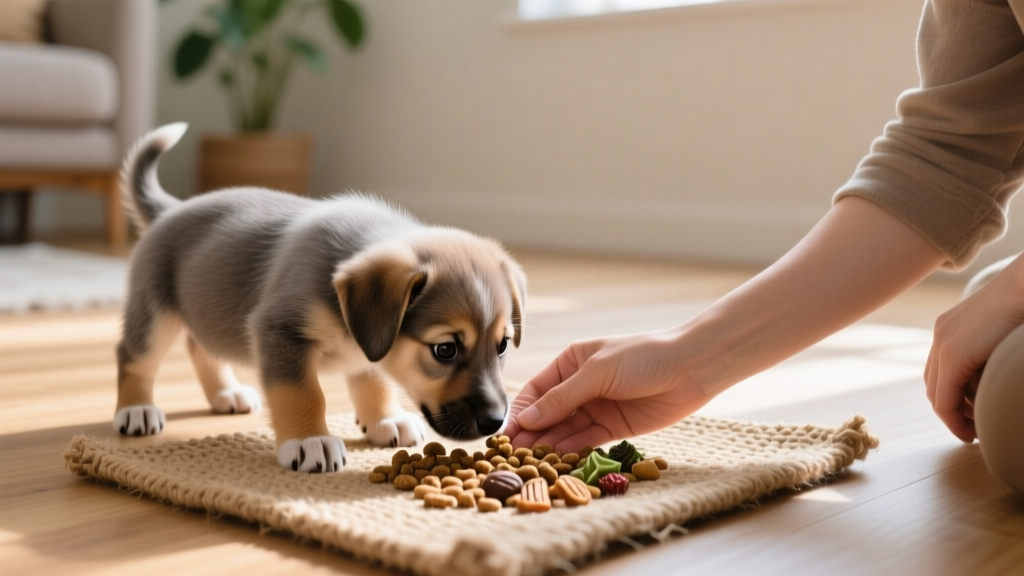
Best Puppy Training Books for Golden Retrievers
Best puppy training books for Golden Retrievers alongside a complete week-by-week puppy care guide covering feeding, vaccines, potty training, and

Bringing a Golden Retriever puppy home is equal parts thrilling and overwhelming. Between the midnight potty runs, the needle-sharp puppy teeth, and the avalanche of conflicting advice online, new owners often turn to puppy training books for a lifeline. But not every training guide accounts for what makes Golden Retrievers unique: their mouthy breed heritage, their soft-tempered sensitivity to correction, and their extended adolescent phase that can test even the most patient household.
This guide pairs the most recommended puppy training books for Golden Retriever owners with a breed-specific, week-by-week roadmap so you know exactly what to expect — and what to do — from week 4 through month 12.
When Should I Bring My Golden Retriever Puppy Home?
Reputable Golden Retriever breeders typically release puppies between 8 and 10 weeks of age. While some states legally permit sale at 6 weeks, the American Kennel Club and veterinary behaviorists strongly recommend waiting until at least 8 weeks. During weeks 6–8, littermates learn bite inhibition, canine communication, and social hierarchy from their mother and siblings — lessons no human can replicate.
If your breeder offers a "puppy curriculum" (early neurological stimulation, crate introduction, sound desensitization), this is a strong indicator of a responsible program. Golden Retrievers from enriched early environments tend to show fewer fear-based behaviors during the critical socialization window.
Golden Retriever Puppy Training Books Worth Your Time
Not all puppy training books are created equal — especially for a breed that retrieves, mouths everything, and responds poorly to harsh corrections. Here are the titles Golden Retriever owners and certified trainers consistently recommend:
| Book Title | Author | Why It Works for Goldens | Price Range (2026) |
|---|---|---|---|
| The Puppy Primer | Patricia McConnell & Brenda Scidmore | Force-free methods; excellent bite inhibition chapter tailored to mouthy breeds | $14–$18 |
| Zak George's Guide to a Well-Trained Dog | Zak George | Video-paired approach; strong on recall training for high-distraction retrievers | $16–$22 |
| Before and After Getting Your Puppy | Dr. Ian Dunbar | Veterinarian-authored; detailed socialization checklists and bite inhibition timelines | $12–$17 |
| The Art of Raising a Puppy | The Monks of New Skete | Developmental stage breakdowns; good for structured households | $15–$20 |
| Perfect Puppy in 7 Days | Dr. Sophia Yin | Science-based; excellent "Learn to Earn" protocol for pushy adolescent Goldens | $20–$28 |
Pair any of these books with a positive-reinforcement group class (typically $150–$250 for a 6-week session) starting at 10–12 weeks, once your puppy has had at least one DHPP vaccine.
Week-by-Week Puppy Milestones: What to Expect
Weeks 4–8: The Breeder's Domain
Your puppy is still with the breeder during this window. Key developmental events include transition to solid food, first deworming (pyrantel pamoate, typically at 2, 4, 6, and 8 weeks), first DHPP vaccine at 6–8 weeks, and the beginning of littermate play-fighting that teaches bite inhibition. If you're visiting, focus on handling exercises: touching paws, ears, and mouth to build tolerance.
Weeks 8–12: The Homecoming & Bonding Phase
This is when your Golden Retriever puppy learns who you are and what your household rules look like. Expect 18–20 hours of sleep per day, frequent potty accidents (bladder capacity is roughly 1 hour per month of age, so a 2-month-old puppy can hold it for about 2 hours maximum), and intense mouthing behavior. Golden Retrievers are genetically wired to carry things in their mouths — redirect biting to appropriate chews rather than punishing the instinct.
Weeks 12–16: The Prime Learning Window
Cognitive development accelerates. Your puppy can now learn sit, down, stay (brief durations), recall, and loose-leash walking foundations. Keep training sessions to 3–5 minutes, 2–3 times daily. The socialization window is closing fast — see the checklist below.
Weeks 16–24: Adolescence Begins
Expect selective hearing, renewed chewing (adult teeth are erupting), and testing of boundaries. Golden Retrievers mature slowly — many remain "puppy-minded" until 18–24 months. Consistency now prevents ingrained bad habits. Increase physical exercise to 25–40 minutes of structured activity daily (avoid forced running or repetitive jumping to protect developing joints).
Months 6–12: The Teenage Stretch
Sexual maturity arrives (spay/neuter is typically recommended between 6–12 months for Golden Retrievers — consult your veterinarian on timing specific to your dog, as some orthopedic research suggests waiting until growth plates close for large breeds). Training plateaus are normal. Maintain structured classes and increase mental enrichment: puzzle feeders, scent work, and controlled retrieve games.
Feeding Schedule: Exact Portions by Age and Weight
Golden Retriever puppies should be fed a large-breed puppy formula (look for the AAFCO statement "complete and balanced for growth, including large-breed puppies"). Overfeeding accelerates growth rate and increases hip dysplasia risk — a condition affecting an estimated 20% of Golden Retrievers.
| Age | Meals Per Day | Approximate Daily Amount (Large-Breed Puppy Kibble) | Notes |
|---|---|---|---|
| 8–12 weeks | 3–4 | 1.5–2 cups total (divided across meals) | Soak kibble in warm water if transitioning from breeder's food |
| 12–16 weeks | 3 | 2–2.5 cups total | Monitor body condition score — ribs should be palpable but not visible |
| 4–6 months | 2–3 | 2.5–3.5 cups total | Growth spurts increase appetite; do not free-feed |
| 6–12 months | 2 | 3–4 cups total | Transition to adult food between 12–18 months (large-breed formula) |
These are starting points. Adjust based on your puppy's body condition score (BCS): on a 1–9 scale, aim for a 4–5. If your puppy's waist is not visible from above or ribs require firm pressure to feel, reduce portions by 10%. Always consult your veterinarian for individualized feeding guidance.
Vaccination Schedule for Golden Retriever Puppies
The American Veterinary Medical Association outlines core vaccine protocols that your veterinarian will customize based on regional disease prevalence and your puppy's risk profile.
| Age | Vaccines Administered | Notes |
|---|---|---|
| 6–8 weeks | DHPP (Distemper, Hepatitis, Parainfluenza, Parvovirus) — 1st dose | Usually given by breeder; obtain records |
| 10–12 weeks | DHPP — 2nd dose; Bordetella (optional, recommended for group classes) | Leptospirosis may be started in endemic areas |
| 14–16 weeks | DHPP — 3rd dose; Rabies (required by law in most states) | Final puppy series; antibody titers can be checked at 20 weeks |
| 12–16 months | DHPP booster; Rabies booster (1-year or 3-year depending on local law) | Annual wellness visit; discuss Lyme and Lepto based on lifestyle |
The Socialization Window (Weeks 3–14): Your Checklist
Veterinary behaviorists identify weeks 3–14 as the primary socialization period for puppies. After 14 weeks, novel stimuli increasingly trigger fear responses rather than curiosity. For Golden Retrievers — a breed prized for stable temperament — maximizing this window is critical.
Before full vaccination, carry your puppy or use a stroller/wagon for outdoor exposure. Arrange playdates only with fully vaccinated, temperament-tested adult dogs.
Golden Retriever Socialization Checklist
- Surfaces: Gravel, grass, wet pavement, metal grates, carpet, tile, sand
- Sounds: Vacuum, thunderstorm recordings (start at low volume), doorbell, traffic, children screaming, clippers, fireworks (low volume)
- People: Men with beards, people wearing hats/sunglasses, children under 5, elderly individuals with walkers, people in uniforms, delivery drivers
- Handling: Paw touching, ear inspection, mouth opening, nail clipping practice, towel drying, harness/collar fitting
- Objects: Umbrellas opening, balloons, plastic bags blowing, bicycles, skateboards, wheelchairs
- Environments: Car rides (short trips ending positively), outdoor café patios, school playgrounds (perimeter), veterinary clinic (happy visits with treats, no procedures)
- Animals: Cats (controlled introduction), vaccinated adult dogs, livestock if rural
Aim for 5–10 new positive experiences per day. Pair every novel stimulus with high-value treats (boiled chicken, freeze-dried liver). If your puppy shows fear, increase distance and let them observe — never force interaction.
Potty Training Timeline & Troubleshooting
Golden Retrievers are generally quick to house-train compared to smaller breeds, but "fully reliable" typically means 4–6 months of age — not 3 days, despite what some training books promise. Here's a realistic progression:
| Age | Expected Bladder Hold Time | Accident Frequency | Training Focus |
|---|---|---|---|
| 8–10 weeks | 1.5–2 hours (awake) | Multiple per day | Take out every 30–60 min during active periods; after every meal, nap, and play session |
| 10–14 weeks | 2–3 hours | 1–2 per day | Introduce verbal cue ("go potty"); reward immediately outdoors with high-value treat |
| 14–20 weeks | 3–4 hours | Rare (0–1 per week) | Begin extending time between trips; bell-training for door signaling works well for Goldens |
| 5–6 months | 5–6 hours | Very rare | Reliable in familiar environments; may regress during moves or schedule changes |
Troubleshooting: If accidents increase suddenly at any age, rule out a urinary tract infection (common in female Golden puppies) with a veterinary urinalysis ($45–$85). Submissive urination — common in soft-tempered breeds like Goldens — is not a housetraining failure. Avoid greeting your puppy with high energy; crouch sideways and ignore until calm.
Crate Training Progression & Time Limits
A crate is your Golden Retriever puppy's den and your management tool for potty training and safe confinement. Introduce it on day one with the door open, meals inside, and high-value chews (frozen Kong stuffed with puppy-safe peanut butter).
| Age | Maximum Daytime Crate Duration | Overnight Expectation |
|---|---|---|
| 8–10 weeks | 1–2 hours between potty breaks | 2–3 hours; expect 1–2 overnight wake-ups |
| 10–14 weeks | 2–3 hours | 3–4 hours; most puppies sleep 5–6 hour stretches by 12 weeks |
| 14–20 weeks | 3–4 hours | 5–7 hours overnight is achievable |
| 5–6 months | 4–5 hours | 7–8 hours overnight |
Never use the crate as punishment. If your Golden puppy whines, distinguish between "needs to potty" whining (take out immediately, no play) and "I want out" whining (wait for a 3-second pause before opening the door to avoid reinforcing the noise).
Teething Timeline & Safe Relief Strategies
Golden Retriever puppies begin losing deciduous (baby) teeth around 12–16 weeks, with the full set of 42 adult teeth typically erupted by 6–7 months. During this period, chewing intensity increases dramatically.
- 3–4 months: Incisors loosen first. Offer frozen carrots, chilled rubber Kongs, and damp frozen washcloths.
- 4–5 months: Canines and premolars erupt. Provide bully sticks (supervised), Benebone puppy chews, and Nylabone puppy-specific teething keys.
- 5–7 months: Molars come in; chewing peaks. Rotate 3–4 approved chew toys to maintain novelty. Puppy-proof by removing shoes, cords, and remote controls from reach.
If you notice a retained baby tooth (double row of canines or incisors past 6 months), consult your veterinarian — retained deciduous teeth are common in Golden Retrievers and may require extraction to prevent malocclusion.
Stopping Puppy Biting & Nipping
Golden Retrievers are a mouth-oriented breed — they were developed to carry waterfowl. Biting is not aggression; it's breed-typical exploration. Here's a force-free protocol:
- Redirect: When teeth touch skin, say "ouch" in a calm, flat tone (not a high-pitched yelp, which can excite some puppies), then immediately offer an appropriate chew toy.
- Withdraw attention: If redirecting fails, stand up and turn away for 10–15 seconds. This teaches that biting ends play.
- Manage arousal: Puppies bite most when overtired. If biting escalates after 45+ minutes of activity, your puppy likely needs a crate nap, not more training.
- Reward soft mouth: When your puppy licks or mouths gently without pressure, praise calmly and continue interaction.
Most Golden Retriever puppies show significant bite inhibition improvement by 16–20 weeks if this protocol is applied consistently. Avoid any technique involving muzzle grabbing, alpha rolls, or physical punishment — these damage the trust-based bond Goldens thrive on and can create fear-based aggression.
First-Year Cost Breakdown for a Golden Retriever
Budgeting accurately prevents sticker shock. These 2026 estimates reflect national averages; costs are higher in major metropolitan areas.
| Category | Estimated Cost | Details |
|---|---|---|
| Puppy purchase (responsible breeder) | $2,000–$3,500 | Health-tested parents, AKC registration, take-back clause |
| Adoption (breed-specific rescue) | $300–$600 | Often includes spay/neuter, initial vaccines, microchip |
| Veterinary (Year 1) | $600–$1,200 | Wellness exams, vaccine series, fecal tests, heartworm prevention, spay/neuter ($300–$700) |
| Food (Year 1) | $400–$700 | Large-breed puppy formula; premium brands like Purina Pro Plan, Royal Canin, or Hill's |
| Supplies | $300–$500 | Crate ($60–$120), bed, leash/harness, bowls, chew toys, grooming tools |
| Training classes | $200–$500 | Puppy kindergarten + intermediate obedience (6-week sessions) |
| Preventive medications | $200–$400 | Monthly heartworm, flea/tick prevention (e.g., Simparica Trio, NexGard) |
| Pet insurance (optional) | $40–$80/month | Golden Retrievers are high-claim breeds; consider accident + illness plan |
| Total Year 1 (breeder puppy) | $3,700–$7,480 | Excluding emergency veterinary care |
Golden Retrievers are predisposed to hip dysplasia, elbow dysplasia, certain cancers (hemangiosarcoma, lymphoma), and hypothyroidism. An emergency fund of $1,000–$2,000 or a pet insurance policy provides critical financial protection.
When Can My Puppy Go Outside & Meet Other Dogs?
You can carry your Golden Retriever puppy outside immediately for socialization exposure. For ground-level walks and dog-to-dog interaction, follow this timeline:
- 8–10 weeks: Carry or use a stroller in low-risk outdoor areas. No dog parks. Playdates only with known, fully vaccinated adult dogs in private yards.
- 10–12 weeks: Short leash walks on low-traffic sidewalks (5 minutes per month of age, so 10–15 minutes max). Puppy kindergarten classes are acceptable per the AVMA — the socialization benefit outweighs disease risk in controlled, sanitized class environments.
- 16+ weeks (after final DHPP): Public parks, supervised dog-to-dog play, and group walks are now safe. Dog parks remain a calculated risk — assess vaccination compliance and dog behavior before entering.
Frequently Asked Questions
How often should I feed my 10-week-old Golden Retriever puppy?
At 10 weeks, feed 3–4 meals per day, totaling approximately 1.5–2 cups of large-breed puppy kibble daily. Divide evenly across meals. Remove uneaten food after 15–20 minutes to establish a feeding routine that aids potty training predictability.
When will my Golden Retriever puppy be fully potty trained?
Most Golden Retrievers are reliably house-trained by 4–6 months of age with consistent scheduling. Occasional accidents during excitement or schedule disruptions are normal up to 8–10 months. Male puppies may lift-leg mark starting around 6–8 months — neutering before this behavior is established can reduce marking.
Are online puppy training courses as effective as books?
They complement each other well. Books like Dr. Dunbar's Before and After Getting Your Puppy provide developmental theory, while video-based courses (Zak George's YouTube channel, Fenzi Dog Sports Academy) demonstrate mechanics. For Golden Retrievers specifically, combining a structured book with weekly in-person positive-reinforcement classes yields the best results.
My Golden puppy cries in the crate at night — should I let them out?
If it has been 2+ hours since the last potty break, take them out on-leash to the designated potty spot, wait up to 5 minutes, reward if they eliminate, then return to the crate with minimal interaction. If it has been less than 2 hours, wait for a brief pause in crying (even 3 seconds) before opening the crate, so you don't reinforce continuous whining.
Should I get pet insurance for my Golden Retriever puppy?
Strongly consider it. Golden Retrievers rank among the top breeds for veterinary claims due to cancer prevalence (estimated 60% lifetime cancer rate per the AKC), hip/elbow dysplasia, and allergies. Enrolling at 8–10 weeks locks in the lowest premium and avoids pre-existing condition exclusions.
Beth Carrasco
All our authors care for dogs every day — read more of their work on the authors page.