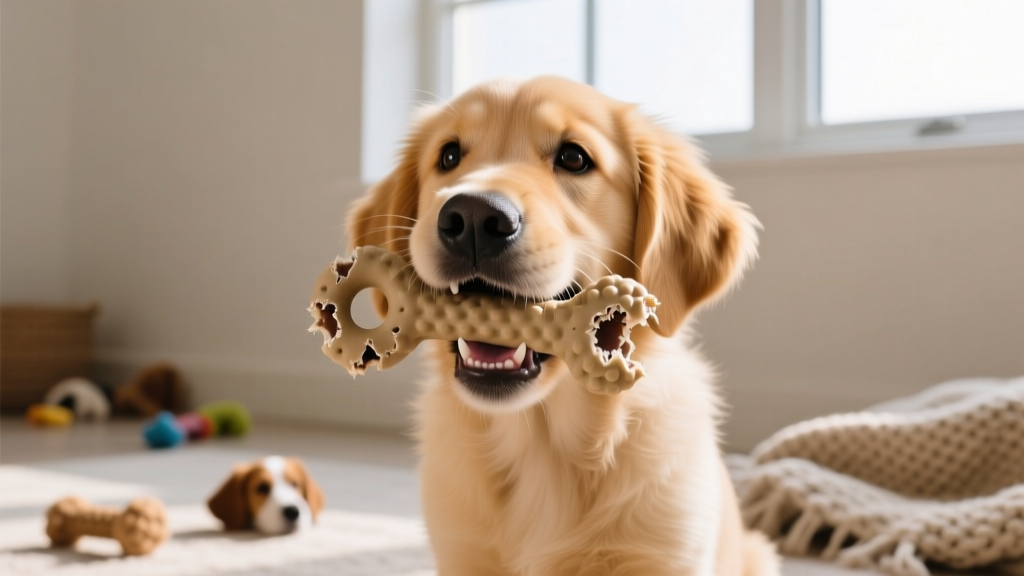
Golden Retriever Puppy Care Guide
Complete Golden Retriever puppy care guide covering teething toys, feeding schedules, vaccination timelines, potty training, and first-year costs.

The First 24 Weeks: Your Golden Retriever Puppy Development Timeline
Golden Retrievers are among the most popular breeds in the United States for good reason — their gentle temperament, intelligence, and eagerness to please make them exceptional family dogs. But raising a Golden Retriever puppy requires precise planning, especially during the critical first six months when teething, socialization, and foundational training converge.
This guide maps every major milestone from weeks 4 through 12 months, with specific attention to the teething phase (3–6 months) when selecting the right puppy toy for teething relief becomes essential for protecting your furniture — and your hands.
When Should I Bring My Golden Retriever Puppy Home?
The American Kennel Club and most veterinary behaviorists recommend bringing your Golden Retriever puppy home between 8 and 10 weeks of age. This timing aligns with the end of the primary socialization period's first phase and allows the puppy to have received critical early nutrition from the dam, initial maternal antibodies, and early littermate socialization.
Responsible Golden Retriever breeders typically retain puppies until at least 8 weeks. Some breeders specializing in service or therapy dog lines may keep puppies until 10–12 weeks for additional structured socialization programs. Avoid any breeder offering puppies younger than 7 weeks — early separation correlates with increased behavioral problems including resource guarding, separation anxiety, and bite inhibition deficits.
Age-Specific Milestones: What to Expect Week by Week
Golden Retrievers mature more slowly than many smaller breeds. Expect puppy behaviors — including mouthing, chewing, and bursts of energy — to persist well into the second year. Here is what each developmental window looks like for this breed specifically:
Weeks 4–8 (With the Breeder)
- Weight: 4–10 lb (1.8–4.5 kg)
- Key developments: Deciduous (baby) teeth fully erupted; eyes and ears fully functional; start of solid food transition; littermate play teaches early bite inhibition
- What you should receive: First deworming (typically pyrantel pamoate at 2, 4, and 6 weeks), initial DHPP vaccine at 6–8 weeks, health records, and early neurological stimulation documentation
- Socialization: Exposure to varied floor textures, household sounds, gentle handling by multiple people
Weeks 8–12 (Home Adjustment)
- Weight: 10–20 lb (4.5–9 kg)
- Key developments: Peak fear imprinting period (8–11 weeks) — traumatic experiences during this window can create lasting phobias; bladder capacity approximately 1 hour per month of age plus one
- Behavior: Follows owners room to room; may cry in crate at night; explores everything orally; begins recognizing name
- Crate training: Maximum 1–2 hours during the day; crate should be just large enough for puppy to stand, turn, and lie down
Weeks 12–16 (Foundation Training)
- Weight: 20–35 lb (9–16 kg)
- Key developments: First socialization window closes around 14 weeks; attention span lengthens to 5–10 minutes; can learn sit, down, come, and loose-leash basics
- Behavior: Increased independence; may test boundaries; chewing intensifies as adult teeth begin shifting below gums
- Crate training: Maximum 2–3 hours during the day; puppy may sleep 6–7 hours overnight in crate
Weeks 16–24 (Teething Peak)
- Weight: 35–55 lb (16–25 kg)
- Key developments: Adult teeth erupting (see teething section below); second fear period may emerge around 6 months; sexual maturity begins in intact puppies
- Behavior: Destructive chewing peaks; mouthing of hands and clothing may worsen before improving; increased distractibility outdoors
- Crate training: Maximum 3–4 hours during the day
Months 6–12 (Adolescent Phase)
- Weight: 55–70 lb (25–32 kg) — males typically 65–75 lb (29–34 kg); females 55–65 lb (25–29 kg) by 12 months
- Key developments: All 42 adult teeth in place by 7 months; growth plates still open; spay/neuter typically recommended between 6–12 months (discuss timing with your vet, as some Golden Retriever research suggests delayed sterilization may reduce joint disorder risk)
- Behavior: Regression in previously reliable commands; increased interest in other dogs and environmental stimuli; may challenge household rules
- Crate training: 4–6 hours maximum; many Goldens can transition to free-roaming by 12–18 months if training is consistent
Golden Retriever Puppy Feeding Schedule by Age
Golden Retrievers are large-breed dogs, and overfeeding during puppyhood is a documented risk factor for developmental orthopedic diseases including hip dysplasia and elbow dysplasia. According to research cited in the Merck Veterinary Manual, large-breed puppies should be fed a diet formulated for large-breed growth (AAFCO statement specifying "growth" or "all life stages" with controlled calcium at 1.0–1.5% on a dry matter basis).
| Age | Meals Per Day | Daily Amount (approximate) | Expected Weight Range |
|---|---|---|---|
| 8–12 weeks | 3–4 meals | 1.5–2.5 cups/day | 10–20 lb (4.5–9 kg) |
| 3–4 months | 3 meals | 2–3 cups/day | 20–35 lb (9–16 kg) |
| 4–6 months | 2–3 meals | 2.5–3.5 cups/day | 35–55 lb (16–25 kg) |
| 6–12 months | 2 meals | 3–4 cups/day | 55–75 lb (25–34 kg) |
Important note: These amounts are starting points. Caloric density varies significantly between brands (e.g., Royal Canin Golden Retriever Puppy provides approximately 373 kcal/cup, while Purina Pro Plan Large Breed Puppy provides approximately 427 kcal/cup). Use your puppy's body condition score (BCS) — you should be able to feel ribs without pressing hard, and see a visible waist from above — as your primary guide. Adjust portions up or down by 10–15% based on weekly weigh-ins.
Vaccination Schedule for Golden Retriever Puppies
The American Veterinary Medical Association recommends core vaccines for all puppies. Golden Retrievers follow the standard large-breed puppy vaccination protocol. Maternal antibodies interfere with vaccine response in early weeks, which is why boosters are administered in series.
| Age | Vaccine(s) | Type | Notes |
|---|---|---|---|
| 6–8 weeks | DHPP (Distemper, Hepatitis/Adenovirus, Parainfluenza, Parvovirus) | Core | Often given by breeder; first dose in series |
| 10–12 weeks | DHPP booster + Bordetella (optional) + Leptospirosis (risk-dependent) | Core + Non-core | Bordetella recommended if attending puppy classes; Lepto if in endemic area |
| 14–16 weeks | DHPP final booster + Rabies | Core | Rabies required by law in most US states; DHPP series complete after this dose |
| 12–16 months | DHPP booster + Rabies booster + Leptospirosis (annual if risk) | Core + Non-core | First annual boosters; subsequent DHPP may transition to 3-year intervals per AAHA guidelines |
Lyme disease vaccine: Golden Retrievers in the Northeast, Upper Midwest, and Pacific Coast may benefit from the Lyme vaccine starting at 12 weeks (two-dose series, 2–4 weeks apart). Discuss with your veterinarian based on your geographic risk and outdoor exposure.
Teething Timeline: Choosing the Right Puppy Toy for Teething Relief
Golden Retriever puppies begin losing their 28 deciduous teeth around 12–16 weeks of age, with all 42 adult teeth typically erupted by 6–7 months. This four-month teething window is when destructive chewing peaks and selecting appropriate puppy toys for teething becomes a management necessity, not a luxury.
Teething Phase Breakdown
| Phase | Age Range | What's Happening | Best Toy Types |
|---|---|---|---|
| Pre-teething mouthing | 8–12 weeks | Exploring world orally; baby teeth intact; learning bite inhibition | Soft rubber (Kong Classic Puppy), braided fleece tug toys, chilled wet washcloth |
| Incisor eruption | 12–16 weeks | Baby incisors loosen; adult incisors push through; gums inflamed and sore | Kong Puppy Teething Stick, Nylabone Puppy Chew (softer formula), frozen carrot sticks |
| Canine and premolar eruption | 16–24 weeks | Peak discomfort; most destructive chewing; baby canines may temporarily coexist with adult canines ("shark teeth") | Kong Classic (red, stuffed and frozen), Benebone Puppy, Goughnuts Ring (puppy version), frozen Kong with peanut butter |
| Molar completion | 24–28 weeks | Final molars erupting; chewing gradually decreases as all teeth settle | Transition to medium-firm rubber (Kong Classic red or black based on chew strength), West Paw Zogoflex Hurley |
Specific Puppy Toy for Teething Recommendations (2026 Tested Picks)
Golden Retriever puppies are powerful chewers even at 12 weeks. Avoid toys rated only for small breeds — they will be destroyed within hours and may pose choking or intestinal obstruction risks. Here are five proven options across price points:
Pros
- Kong Classic Puppy (pink/blue): Softer rubber formula designed for developing teeth; stuffable for extended engagement; dishwasher safe; $12–$16
- Benebone Puppy Wishbone: Bacon-infused nylon softer than adult version; angled for puppy grip; $14–$18
- West Paw Zogoflex Toppl: Interlocking treat toy; floats; recyclable; made in USA; $18–$24
Cons to Watch For
- Kong Classic Puppy: Power chewers may destroy the puppy formula before outgrowing it; supervise and upgrade to red Classic when teeth marks appear
- Benebone Puppy: Harder than some puppy gums tolerate; check for gum bleeding after first sessions; discontinue if puppy avoids it
- Any plush "teething" toy: Golden Retriever puppies will extract squeakers and stuffing within minutes; ingestion risk makes plush toys unsuitable for unsupervised teething
Freezing strategy: Soak a Kong Puppy in water (or fill with plain pumpkin puree, not pie filling), freeze for 4 hours, and offer during peak chewing times (typically late afternoon and evening). The cold constricts gum blood vessels and provides 15–30 minutes of relief. Never freeze toys solid — partial freezing is safer for puppy teeth.
Potty Training Timeline: Realistic Expectations for Golden Retrievers
Golden Retrievers are generally easier to house-train than many breeds due to their responsiveness and desire to please. However, "fully potty trained" for a Golden Retriever puppy realistically means reliably signaling to go outside and having fewer than 1–2 accidents per month by 5–6 months of age. True reliability — zero accidents for 30+ consecutive days — typically occurs between 6 and 9 months.
Bladder Capacity and Potty Break Schedule
A puppy's bladder control follows a general formula: age in months + 1 = maximum hours between potty breaks. This means a 3-month-old Golden can hold for approximately 4 hours maximum, but this applies only to crate-rest or sleeping puppies. Active, playing puppies need more frequent breaks.
| Age | Daytime Breaks | Overnight Breaks | Common Accident Triggers |
|---|---|---|---|
| 8–10 weeks | Every 30–60 minutes + after every meal, nap, and play session | 1–2 overnight trips (set alarm for 2 AM and 5 AM) | Excitement on owner arrival; post-play overstimulation; new environment stress |
| 10–14 weeks | Every 60–90 minutes | 1 overnight trip (3–4 AM) | Submissive urination when greeted; door-darting before reaching yard |
| 14–20 weeks | Every 90–120 minutes | May sleep through night (6–7 hours) | Marking behavior onset (especially males); incomplete emptying on previous trip |
| 5–6 months | Every 2–3 hours | Sleeps through night reliably | Regression during adolescent phase; schedule disruption |
Potty Training Troubleshooting for Golden Retrievers
Submissive urination: Golden Retrievers are particularly prone to this behavior, where the puppy leaks small amounts when greeting people. This is involuntary and typically resolves by 12 months. Management: greet puppy outdoors or on easy-clean surfaces; avoid leaning over or making direct eye contact during greetings; keep greetings low-key.
Not signaling: Teach a bell-ring signal by hanging a bell (Potty Bells brand or similar, $8–$12) on the door handle at puppy nose height. Every time you take puppy out, gently guide their nose to ring the bell first. Most Goldens learn this within 2–3 weeks of consistent practice.
Accident cleanup: Use an enzymatic cleaner (Nature's Miracle or Rocco & Roxie, $12–$18) rather than ammonia-based products. Ammonia smells similar to urine to dogs and can attract repeat soiling. Enzymatic cleaners break down uric acid crystals that standard cleaners leave behind.
Socialization Window: The Critical Weeks 3–14 Checklist
The primary socialization period for puppies closes between 12 and 14 weeks of age. Research published in the Journal of Veterinary Behavior demonstrates that puppies with inadequate socialization during this window are significantly more likely to develop fear-based aggression, noise phobias, and separation anxiety. For Golden Retrievers — a breed valued for its stable temperament — structured socialization is essential to fulfilling their genetic potential.
Before full vaccination is complete, the AVMA and the American Veterinary Society of Animal Behavior (AVSAB) recommend controlled socialization in low-risk environments rather than waiting until all vaccines are administered. The risk of behavioral problems from inadequate socialization outweighs the disease risk in controlled settings.
Golden Retriever Puppy Socialization Checklist (Weeks 8–14)
People (goal: 50+ different people by 14 weeks):
- Children ages 3–12 (supervised, calm interactions)
- People wearing hats, sunglasses, hoodies, uniforms
- People using wheelchairs, crutches, walkers
- People of different heights, builds, skin tones, and vocal tones
- People carrying bags, umbrellas, or packages
Surfaces and environments:
- Gravel, mulch, sand, wet grass, metal grates, shiny floors
- Elevator rides, car rides (short trips ending positively)
- Open fields, wooded paths, urban sidewalks, parking lots
Sounds (pair each with treats to build positive association):
- Vacuum cleaner, blender, hair dryer, doorbell
- Thunderstorm recordings (start at very low volume)
- Fireworks recordings, construction noise, sirens
- Other dogs barking (recordings or distant real dogs)
Handling and body manipulation (practice daily):
- Paw handling (prepare for nail trims)
- Ear inspection and gentle cleaning
- Mouth opening (prepare for dental exams)
- Being held on side, back, and in towel wrap
- Collar grabs and gentle restraint
Safe dog-to-dog exposure (after first DHPP at minimum):
- Playdates with fully vaccinated, known-temperament adult dogs
- Puppy kindergarten classes (vaccination required for entry)
- Avoid dog parks, pet store floors, and unknown dogs until full vaccination series complete (after 16-week DHPP)
Stopping Puppy Biting and Nipping: Golden Retriever-Specific Strategies
Golden Retrievers are a "mouthy" breed — they were developed to carry game birds gently, and this genetic predisposition means they explore the world through their mouths more than many breeds. Puppy nipping is normal through 5–6 months, but it must be shaped into appropriate behavior before adult teeth and jaw strength make mouthing painful.
The redirection method (force-free, positive reinforcement based):
- When puppy teeth touch skin, immediately stop all movement and withdraw attention for 3–5 seconds (stand still, look away, fold arms).
- Once puppy disengages, redirect to an appropriate chew toy (the puppy toy for teething you've selected from the recommendations above).
- When puppy chews the toy enthusiastically, praise calmly and resume play.
- Repeat consistently — every person in the household must follow the same protocol.
What does NOT work for Golden Retrievers:
- Yelling or physical punishment: Goldens are soft-tempered and shut down with harsh corrections, leading to fear-based avoidance rather than learning.
- Alpha rolls or muzzle grabs: These aversive techniques damage the trust relationship and can trigger defensive aggression.
- Bitter apple spray on hands: Ineffective for determined mouthy breeds and does not teach an alternative behavior.
Bite inhibition training: Allow gentle mouthing (no pressure) during play, but yelp or say "ouch" and withdraw when pressure is applied. This mimics littermate feedback and teaches the puppy to control jaw force. By 5 months, even gentle mouthing should be redirected to toys exclusively.
Crate Training Progression and Time Limits
Golden Retrievers generally adapt to crate training more readily than many breeds, but exceeding safe confinement times causes distress, learned helplessness, and sometimes crate-soiling that becomes habitual.
| Age | Maximum Daytime Crate Time | Overnight Crate Time | Crate Size Recommendation |
|---|---|---|---|
| 8–10 weeks | 1–2 hours | 3–4 hours (with potty break) | 24-inch crate with divider panel |
| 10–14 weeks | 2 hours | 4–5 hours (with potty break) | 30-inch crate with divider |
| 14–20 weeks | 2–3 hours | 6–7 hours | 36-inch crate with divider |
| 5–6 months | 3–4 hours | 7–8 hours | 42-inch crate (adult size, divider removed) |
| 7–12 months | 4–6 hours | 8 hours | 42-inch crate (Midwest iCrate or Frisco double-door, $65–$95) |
Golden Retriever crate tip: This breed is prone to "teenage crate protests" between 6–9 months, where a previously crate-comfortable dog begins whining or destroying bedding. This is typically adolescent boundary-testing rather than separation anxiety. Maintain the crate routine, provide a frozen Kong upon crating, and do not release the puppy while whining is occurring — wait for 10 seconds of silence before opening the door.
First-Year Cost Breakdown: Budgeting for Your Golden Retriever
Golden Retrievers are large dogs with correspondingly large expenses. Here is a realistic first-year budget based on 2026 pricing from major US veterinary chains and pet supply retailers:
| Category | Low Estimate | Mid Estimate | High Estimate |
|---|---|---|---|
| Puppy purchase (responsible breeder) | $2,000 | $3,000 | $5,000+ |
| Adoption (rescue/shelter alternative) | $300 | $500 | $800 |
| Veterinary care (vaccines, spay/neuter, wellness exams, heartworm prevention) | $800 | $1,200 | $2,000 |
| Food (large-breed puppy formula, 12 months) | $480 | $720 | $1,100 |
| Supplies (crate, bed, leash, collar, bowls, grooming tools, puppy toys for teething) | $300 | $500 | $800 |
| Training (puppy kindergarten + basic obedience) | $200 | $400 | $800 |
| Pet insurance (annual premium) | $480 | $720 | $1,200 |
| Grooming (professional, every 8–12 weeks) | $200 | $400 | $600 |
| TOTAL (breeder puppy) | $4,460 | $6,940 | $11,500+ |
Emergency fund recommendation: Golden Retrievers have a higher-than-average risk of emergency veterinary visits during puppyhood due to foreign body ingestion (socks, toys, rocks, mulch — Goldens will eat almost anything). Set aside $1,000–$2,000 or maintain active pet insurance with a low deductible. A foreign body surgery typically costs $2,500–$7,000.
Frequently Asked Questions
When can my Golden Retriever puppy go outside and meet other dogs?
Your puppy can go outside in controlled, low-risk environments (your yard, quiet sidewalks, carrying in public spaces) immediately after coming home. However, avoid high-traffic dog areas — dog parks, pet stores, communal apartment yards — until 7 days after the final DHPP booster at 14–16 weeks. Puppy kindergarten classes that require proof of first vaccination are generally considered safe and are strongly recommended starting at 8–10 weeks for socialization purposes.
How often should I feed my Golden Retriever puppy at 3 months old?
At 3 months (12 weeks), feed three meals per day spaced approximately 5–6 hours apart during waking hours. A typical schedule: 7 AM, 12 PM, and 5–6 PM. Consistent meal timing supports predictable potty schedules — most puppies need to eliminate within 15–30 minutes of eating.
When will my Golden Retriever puppy be fully potty trained?
Most Golden Retrievers achieve reliable house training between 5 and 7 months, meaning fewer than one accident per month with consistent scheduling. Some individuals — particularly males — may have occasional marking-related accidents through 9–12 months. Neutering between 6–12 months often reduces marking behavior.
My Golden Retriever puppy won't stop chewing furniture. What do I do?
During peak teething (16–24 weeks), manage the environment: confine puppy to puppy-proofed areas using baby gates when unsupervised; provide 4–5 appropriate chew toys rotated every 2 days to maintain novelty; offer frozen Kongs during high-risk chewing times (typically 4–7 PM when puppies are most active); and apply bitter apple spray (Grannick's Bitter Apple, $10–$14) to furniture legs as a deterrent — though this works only when combined with providing appealing alternatives.
Should I be concerned if my puppy's baby tooth hasn't fallen out but the adult tooth is visible?
Retained deciduous teeth ("shark teeth") are common in Golden Retrievers, particularly the canine teeth. If the adult tooth is more than 50% erupted and the baby tooth shows no sign of loosening, schedule a veterinary visit. Retained baby teeth can deflect adult teeth into abnormal positions, causing bite misalignment and periodontal disease. Extraction is a simple procedure typically performed during spay/neuter surgery if timed appropriately.
Beth Carrasco
All our authors care for dogs every day — read more of their work on the authors page.