Best Puppy Teething Rings & Complete Golden Retriever Puppy Guide
Complete Golden Retriever puppy guide covering teething rings, feeding schedules, potty training timelines, vaccines, and first-year costs for 2026.

Bringing Home Your Golden Retriever Puppy: Week-by-Week Milestones
Golden Retrievers are one of America's most beloved breeds for good reason — their gentle mouths (originally bred for retrieving waterfowl without damaging game) make them excellent family dogs. But those same soft mouths go through an intense teething phase that catches many first-time owners off guard. This guide walks you through every critical stage of your Golden Retriever puppy's first year, from the moment you bring them home through full maturity.
Age-Specific Development Milestones
| Age Range | Weight Range (lb/kg) | Key Milestones | What to Expect |
|---|---|---|---|
| Weeks 4-8 | 5-10 lb / 2.3-4.5 kg | Weaning complete, first socialization window opens, deciduous teeth erupting | Puppy learns bite inhibition from littermates; eyes and ears fully functional; curiosity peaks |
| Weeks 8-12 | 10-20 lb / 4.5-9 kg | Primary fear imprint period (8-11 weeks), first DHPP vaccine, crate training begins | Puppy is highly impressionable; negative experiences can create lasting fears; bonding with new family intensifies |
| Weeks 12-16 | 20-35 lb / 9-16 kg | Secondary socialization window closing, potty training consistency expected, chewing escalates | Golden pups test boundaries; mouthing intensifies as adult teeth begin shifting beneath gums; attention span lengthens to 5-10 minutes |
| Weeks 16-24 | 35-55 lb / 16-25 kg | Peak teething period, adult teeth erupt, fear period #2 (6-8 months possible) | Most intense chewing phase — this is where puppy teething rings become essential; may regress on previously learned commands |
| 6-12 Months | 55-75 lb / 25-34 kg | Sexual maturity, adult coat replaces puppy coat, growth rate slows | Energy remains high; Golden-specific mouthiness can persist through 18 months; spay/neuter typically scheduled around 6-12 months per veterinary recommendation |
Feeding Your Golden Retriever Puppy: Portions by Age and Weight
Golden Retrievers are prone to rapid growth-related orthopedic diseases including hip dysplasia and elbow dysplasia. Research published in the Journal of the American Veterinary Medical Association shows that keeping Golden puppies lean (body condition score 4-5/9) significantly reduces hip dysplasia incidence. This means feeding measured portions — never free-feeding.
Choose a large-breed puppy formula that meets AAFCO standards for growth. Look for guaranteed analysis showing 22-28% protein and 12-17% fat, with calcium at 1.0-1.5% on a dry matter basis.
Golden Retriever Puppy Feeding Schedule
| Age | Meals Per Day | Estimated Cups Per Day (large-breed kibble) | Portion Per Meal | Notes |
|---|---|---|---|---|
| 8-12 weeks | 3-4 | 1.5-2.5 cups | ⅓ to ½ cup | Soak kibble in warm water for first 2 weeks home if puppy struggles with hard pieces |
| 12-16 weeks | 3 | 2.5-3.5 cups | ¾ to 1¼ cups | Transition to dry kibble fully; begin using portion as training treats |
| 4-6 months | 3 | 3-4.5 cups | 1 to 1.5 cups | Monitor body condition weekly — ribs should be easily felt but not visible |
| 6-9 months | 2 | 3.5-5 cups | 1.75 to 2.5 cups | Reduce to 2 meals; males will eat more than females typically |
| 9-12 months | 2 | 3.5-5 cups | 1.75 to 2.5 cups | Begin transitioning to adult food around 12 months (large-breed adult formula) |
Vaccination Schedule for Golden Retriever Puppies
Your puppy's immune system needs a carefully timed series of vaccinations to build protection. Maternal antibodies (received through colostrum) gradually wane between 6-16 weeks, which is why boosters are given at specific intervals. The AVMA vaccination guidelines outline core and non-core vaccines based on your puppy's lifestyle and regional disease risk.
Core Vaccination Timeline
| Age | Vaccine | What It Protects Against | Typical Cost |
|---|---|---|---|
| 6-8 weeks | DHPP (1st dose) | Distemper, Hepatitis (Adenovirus), Parainfluenza, Parvovirus | $20-$40 |
| 10-12 weeks | DHPP (2nd dose) + Bordetella | Same as above (booster) + Kennel cough | $35-$55 |
| 14-16 weeks | DHPP (3rd dose) + Rabies | Same as above (booster) + Rabies (legally required) | $40-$70 |
| 12-16 weeks | Leptospirosis (optional, recommended for outdoor dogs) | Leptospira bacteria — zoonotic disease from wildlife urine | $25-$40 |
| 16+ weeks | Lyme (optional, regional) | Borrelia burgdorferi from tick bites | $25-$40 |
Important: Until your puppy has received their final DHPP booster at 14-16 weeks (plus 5-7 days for immunity to develop), avoid high-traffic dog areas like dog parks and pet store floors. Parvovirus can survive in soil for months and is frequently fatal in unvaccinated puppies.
The Socialization Window: Weeks 3-14 (Don't Miss It)
Canine behavioral research establishes the primary socialization period between 3 and 14 weeks of age. During this window, puppies form their baseline understanding of what is "safe" versus "threatening" in their environment. Golden Retrievers are generally confident and outgoing, but without deliberate exposure during this period, even genetically sound pups can develop fear-based reactivity.
The goal isn't just meeting people and dogs — it's exposure to surfaces, sounds, objects, and handling experiences in a positive context.
Golden Retriever Puppy Socialization Checklist
- Surfaces: Grass, gravel, metal grates, wet pavement, sand, carpet, tile, wood floors, wobbly surfaces (balance disc, pillow)
- People: Children (supervised), elderly individuals, people in hats/sunglasses/uniforms, tall people, people using mobility aids, delivery workers
- Other animals: Vaccinated adult dogs (known health status), cats (controlled introduction), livestock if rural
- Sounds: Vacuum cleaner, thunderstorm recordings (start at low volume), doorbell, car horns, construction noise, hair dryer, fireworks recordings
- Handling: Paw touching, ear examination, mouth opening, nail clipping practice, collar/harness pressure, being lifted, towel drying
- Objects: Umbrellas opening, plastic bags rustling, bicycles, skateboards, trash cans, hoses, sprinklers
- Environments: Car rides, outdoor café patios, friend's houses, veterinary clinic (positive visits only — no shots on socialization visits if possible)
Potty Training Timeline: Realistic Expectations for Golden Retrievers
Golden Retrievers typically achieve reliable house training between 4-6 months of age, though some individuals take until 8 months. The general rule: puppies can hold their bladder for approximately one hour per month of age (a 3-month-old puppy holds for about 3 hours maximum). This is a maximum, not a target — more frequent outings accelerate training.
When will my puppy be fully potty trained? Expect consistent reliability by 5-6 months with a structured schedule. "Fully trained" means zero accidents for 4+ consecutive weeks. Males may take slightly longer due to developing marking behaviors around sexual maturity.
Potty Training Schedule by Age
| Age | Outdoor Trips Per Day | Maximum Hold Time | Crate Time Limit | Expected Accident Frequency |
|---|---|---|---|---|
| 8-10 weeks | 12-15 | 1-1.5 hours | 1-2 hours (while home) | 2-4 per week (normal) |
| 10-14 weeks | 8-12 | 2-3 hours | 2-3 hours | 1-2 per week |
| 14-20 weeks | 6-8 | 3-4 hours | 3-4 hours | 0-1 per week |
| 5-6 months | 5-6 | 5-6 hours | 5-6 hours | Occasional (regression possible) |
| 7-12 months | 4-5 | 7-8 hours (adult) | 8 hours max (adult crating) | Rare — consult vet if accidents return |
Troubleshooting common potty training issues:
- Puppy pees inside immediately after coming in: They haven't learned that outside = potty place. Go back to basics: leash them to the exact spot, use a cue word ("go potty"), reward heavily with treats immediately upon elimination.
- Submissive urination when greeted: Common in Golden puppies. Ignore puppy for first 2 minutes when arriving home; greet calmly at their level; avoid direct eye contact and overhead petting.
- Regression at 6-8 months: Often coincides with fear period #2 or sexual maturity. Maintain schedule consistency; rule out UTI with a vet visit if accidents suddenly increase.
Puppy Teething Timeline and the Best Teething Rings for Golden Retrievers
Golden Retriever puppies begin teething around 3-4 weeks of age, with all 28 deciduous (baby) teeth erupted by 6-8 weeks. The adult tooth eruption — the phase that drives owners to seek relief solutions — begins around 12-16 weeks and continues through 6-7 months. By 7 months, your Golden should have all 42 permanent teeth in place.
Why Golden Retrievers seem to chew more than other breeds: Goldens were selectively bred for "soft mouth" retrieving, meaning their oral fixation is genetically reinforced. Combine this breed trait with teething discomfort and you get a puppy that will chew relentlessly from 3-8 months. This is normal — but it requires management.
Teething Phases and Relief Strategies
| Phase | Age | What's Happening | Best Puppy Teething Rings & Relief |
|---|---|---|---|
| Baby teeth erupt | 3-6 weeks | 28 needle-sharp deciduous teeth push through gums | Typically managed by breeder; soft teething toys available if puppy is weaning early |
| Pre-eruption discomfort | 12-16 weeks | Adult teeth developing under gums, pressure building | Chilled (not frozen) rubber teething rings, wet washcloth twisted and frozen, carrot sticks |
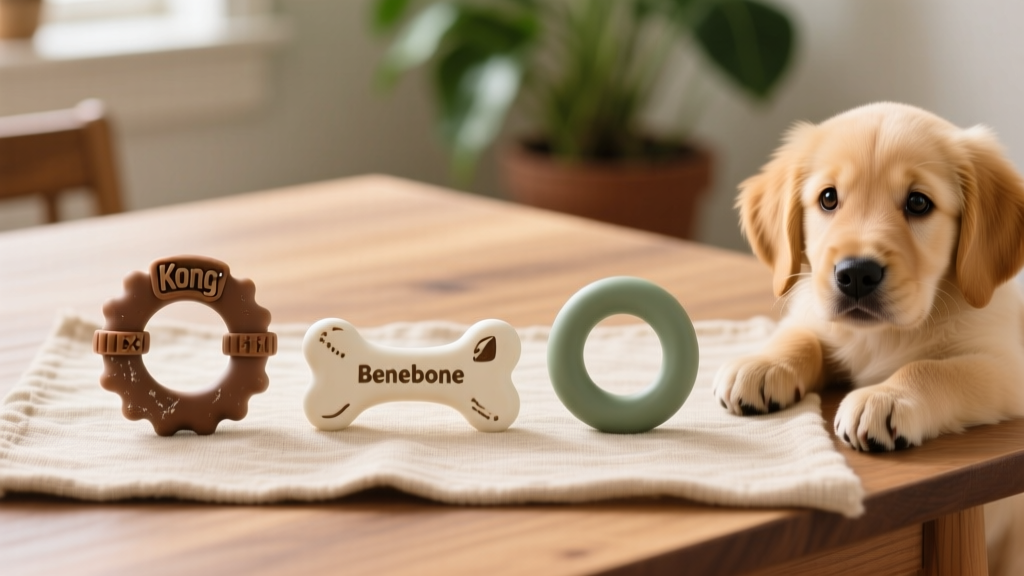
| Peak teething | 16-24 weeks | Incisors and canines erupting, baby teeth loosening, gums inflamed | Kong Classic (puppy size, stuffed and frozen), Nylabone Puppy Chew rings, Benebone Wishbone (puppy formula) |
| Late teething | 24-28 weeks | Premolars and molars erupting, retained baby teeth may need extraction | Durable rubber rings, rope toys (supervised), bully sticks (10-min sessions, supervised) |
| Post-teething settling | 7-12 months | All adult teeth in, chewing shifts from pain relief to boredom/energy management | Transition to adult chew toys; maintain rotation of 4-5 toys to prevent boredom |
Recommended Puppy Teething Rings for Golden Retrievers (2026 Tested Picks)
Golden Retriever puppies are powerful chewers even at young ages. Avoid cheap vinyl or thin plastic rings — they'll be destroyed in minutes and create choking hazards. Here's what holds up:
- Kong Puppy Teething Ring ($8-$12): Soft rubber formula designed for developing teeth. Can be stuffed with peanut butter (xylitol-free) and frozen for extended relief. The ring shape allows puppies to grip with paws. Replace when surface becomes deeply scored.
- Nylabone Puppy Chew Ring ($6-$10): Made from softer polymer than adult Nylabones. Textured surface massages gums. Choose the "Puppy" line specifically — adult formula is too hard for developing teeth and can fracture premolars.
- Benebone Puppy Wishbone ($13-$18): Bacon-infused nylon, ergonomic shape. Designed for puppies under 40 lb — switch to adult Benebone once your Golden exceeds this weight. Excellent durability for the price point.
- Chilly Penguin Treat Toy ($10-$14): Freezable rubber toy with a hollow center for treats. The cold surface numbs inflamed gums. Smaller than Kong, good for 8-16 week puppies.
- Never leave your puppy unsupervised with any chew toy — Golden Retrievers are enthusiastic enough to break off and swallow large pieces
- Discard any toy that can be bitten into pieces small enough to swallow whole
- Avoid rawhide chews for puppies under 6 months — they pose intestinal blockage risk and are difficult to digest
- Never use ice cubes directly — they can fracture developing teeth. Use frozen wet washcloths or chilled rubber toys instead
- If your puppy swallows a foreign object, contact ASPCA Animal Poison Control: (888) 426-4435 (24/7, consultation fee applies) or your emergency vet immediately
Retained baby teeth — when to call your vet: If you see an adult tooth erupting alongside a baby tooth that hasn't fallen out (common with canine teeth in Golden Retrievers), schedule a veterinary exam. Retained deciduous teeth can cause permanent teeth to erupt at abnormal angles, leading to bite misalignment and periodontal disease. Extraction is a quick procedure typically done during spay/neuter if timed appropriately.
Crate Training Progression: Building Confidence, Not Confinement
Crate training leverages a dog's natural den instinct. For Golden Retriever puppies, the crate becomes their safe retreat — essential for potty training, preventing destructive chewing during teething, and establishing alone-time comfort. The key is progressive duration, never using the crate as punishment.
Crate Training Timeline and Time Limits
| Age | Maximum Daytime Crate Duration | Overnight Duration | Training Focus |
|---|---|---|---|
| 8-10 weeks | 1-2 hours | 3-4 hours (set alarm for potty break) | Positive association only — meals in crate, door open naps, treat-dispensing toys inside |
| 10-14 weeks | 2-3 hours | 4-5 hours | Begin closing door during meals; practice short departures (leave room for 2-5 minutes) |
| 14-20 weeks | 3-4 hours | 6-7 hours | Extend alone time gradually; provide frozen Kong for occupancy; ignore protest barking (after confirming no potty need) |
| 5-6 months | 4-5 hours | 7-8 hours | Puppy should enter crate voluntarily; begin transitioning to longer absences |
| 7-12 months | 5-6 hours max | 8 hours (overnight) | Consider leaving crate door open during day; many Goldens continue using crate as bed through adulthood |
Common crate training mistakes with Golden puppies:
- Skipping acclimation: Placing puppy in crate and leaving immediately triggers panic. Spend 1-2 weeks building positive associations before any real confinement.
- Crate too large: Use a divider in a 42-inch crate (adult Golden size) to limit space. Too much room allows puppy to eliminate in one corner and sleep in another, undermining potty training.
- Responding to whining by releasing: This teaches that whining = freedom. Wait for 3-5 seconds of silence before opening the door. If puppy needs to eliminate, take them out silently and return to crate immediately.
Common Golden Retriever Puppy Problems and Solutions
Puppy Biting and Nipping
How do I stop puppy biting/nipping? Golden Retriever puppies use their mouths to explore and communicate — this is breed-typical behavior, not aggression. However, it must be managed before adult teeth arrive.
Protocol for bite inhibition training:
- Redirect: When puppy mouths skin, immediately offer an appropriate chew (puppy teething ring, frozen washcloth). Praise when they bite the toy instead.
- Withdraw attention: If redirecting doesn't work, stand up and cross your arms for 10-15 seconds. No talking, no eye contact. Resume play only when puppy is calm.
- Time-out: For persistent hard biting, calmly place puppy in their crate or a small pen for 30-60 seconds. This isn't punishment — it's a reset. Release and try again.
- Satisfy the urge: Puppies that bite excessively are often under-stimulated. Ensure 15-20 minutes of structured play (tug, fetch) and mental enrichment (snuffle mat, training sessions) daily.
Expect biting to decrease significantly by 5-6 months as adult teeth settle. If hard biting persists past 6 months, consult a certified positive-reinforcement trainer or veterinary behaviorist.
Excessive Whining and Vocalization
Golden Retrievers are vocal dogs. Puppy whining typically stems from one of four causes: need to eliminate, loneliness/boredom, overstimulation, or learned attention-seeking.
- Nighttime whining: Place crate near your bed initially. A Snuggle Puppy (heartbeat toy) can ease the transition. Gradually move crate to desired permanent location over 1-2 weeks.
- Attention-seeking whining: Ignore completely — no eye contact, no verbal response. Reward the moment they're quiet for 5+ seconds.
- Overstimulation whining: Common after busy days. Enforce nap time in crate with a chew toy; puppies need 18-20 hours of sleep per day and often can't self-regulate.
Destructive Chewing Beyond Normal Teething
If your Golden puppy is destroying furniture, shoes, or baseboards, assess three factors:
- Access: Is the puppy unsupervised with tempting items? Use baby gates and crate confinement when you can't actively watch them.
- Alternatives: Do they have 4-5 appropriate chew options of varying textures? Rotate toys every 2-3 days to maintain novelty.
- Exercise: Golden puppies need 5 minutes of structured exercise per month of age, twice daily (a 4-month-old gets ~20 minutes per session). Under-exercised puppies channel energy into destruction.
When Can My Puppy Go Outside and Meet Other Dogs?
This question balances disease risk against the critical socialization window. Current veterinary consensus (supported by the AVMA) favors controlled early socialization:
- Immediately (8+ weeks): Carry puppy to outdoor environments. Let them observe traffic, people, and sounds from your arms or a blanket on the ground in low-traffic areas.
- After first DHPP (6-8 weeks + 5 days): Walk on your own property, visit homes of known-vaccinated dogs, attend structured puppy classes that require vaccination proof and sanitize floors.
- After final DHPP (14-16 weeks + 5-7 days): Full access to dog parks, pet stores, hiking trails, and group walks. This typically falls around 15-17 weeks of age.
- Dog-to-dog meetings: Safe with known, vaccinated, healthy adult dogs from day one (in controlled home environments). Avoid unknown dogs and high-traffic areas until fully vaccinated.
First-Year Cost Breakdown for a Golden Retriever
Budgeting accurately prevents financial stress during your puppy's first year. Costs below reflect 2026 national averages and vary by region (urban areas typically run 20-40% higher).
| Category | Items | Estimated Cost Range |
|---|---|---|
| Veterinary — Preventive | Vaccine series (3 visits), rabies, microchip, deworming (3 rounds), flea/tick/heartworm prevention (12 months) | $500-$900 |
| Veterinary — Spay/Neuter | Surgical sterilization (6-12 months, pre-anesthetic bloodwork included) | $300-$800 |
| Veterinary — Unexpected | Ear infections (common in Goldens), GI upset, retained baby teeth, minor injuries | $200-$600 |
| Food | Large-breed puppy formula (12 months) + training treats | $400-$700 |
| Supplies | Crate (42"), bed, leash, harness, collar, ID tags, bowls, puppy teething rings (4-6), grooming tools, baby gates, enzymatic cleaner | $250-$500 |
| Training | Puppy kindergarten class (6-8 weeks) + optional intermediate class | $150-$400 |
| Pet Insurance | Annual premium (accident + illness plan, $250 deductible) | $500-$900 |
| Grooming | Golden Retrievers are moderate-maintenance; professional grooming 2-4x/year optional | $0-$300 |
Total estimated first-year cost: $2,300-$5,100 (excluding the initial puppy purchase price of $1,500-$3,500 from a responsible breeder, or $300-$600 adoption fee from a breed rescue).
Pet insurance is strongly recommended for Golden Retrievers. This breed has predisposition to hip dysplasia (prevalence approximately 20% per OFA data), elbow dysplasia, and certain cancers that manifest later in life. Enrolling during puppyhood avoids pre-existing condition exclusions.
Frequently Asked Questions
When should I bring my Golden Retriever puppy home?
Between 8-10 weeks of age. Earlier removal from the litter impairs bite inhibition development and social skills. Some breeders keep puppies until 10 weeks for additional socialization — this benefits the puppy and shouldn't concern you.
How often should I feed my puppy at 10 weeks old?
Three to four meals per day, totaling approximately 1.5-2.5 cups of large-breed puppy kibble. Divide evenly across meals. Consistent meal timing also aids potty training, as puppies typically need to eliminate 15-30 minutes after eating.
When will my puppy be fully potty trained?
Most Golden Retriever puppies achieve reliable house training between 4-6 months with a consistent schedule. Some individuals take until 8 months. If accidents persist or increase suddenly at any age, consult your veterinarian to rule out urinary tract infection or other medical causes.
What vaccines does my puppy need and when?
Core vaccines include DHPP at 6-8, 10-12, and 14-16 weeks, plus rabies at 14-16 weeks. Non-core vaccines (Bordetella, Leptospirosis, Lyme) depend on your puppy's lifestyle and regional risk. Your veterinarian will determine the appropriate protocol based on your location and planned activities.
How do I stop my Golden Retriever puppy from biting?
Redirect every mouth-to-skin contact to an appropriate puppy teething ring or chew toy. Withdraw attention (stand up, cross arms, 10-15 seconds of ignoring) for persistent nipping. Ensure adequate physical exercise and mental stimulation. Never use physical punishment — it damages trust and can escalate to fear-based aggression. Expect improvement by 5-6 months as adult teeth settle.
When can my puppy go outside and meet other dogs?
Controlled outdoor exposure (carrying puppy, low-traffic areas) can begin immediately. Meetings with known-vaccinated dogs in clean home environments are safe from 8 weeks. Full access to dog parks and high-traffic areas should wait until 5-7 days after the final DHPP booster at 14-16 weeks — typically around 15-17 weeks of age.
Are frozen puppy teething rings safe?
Chilled (refrigerated) rubber teething rings are safe and recommended. Fully frozen solid toys can be too hard and risk tooth fractures. The best approach: freeze a stuffed Kong or wet twisted washcloth, which provides cold relief with some give. Always supervise chewing sessions and discard damaged toys immediately.
Tom Renshaw
All our authors care for dogs every day — read more of their work on the authors page.