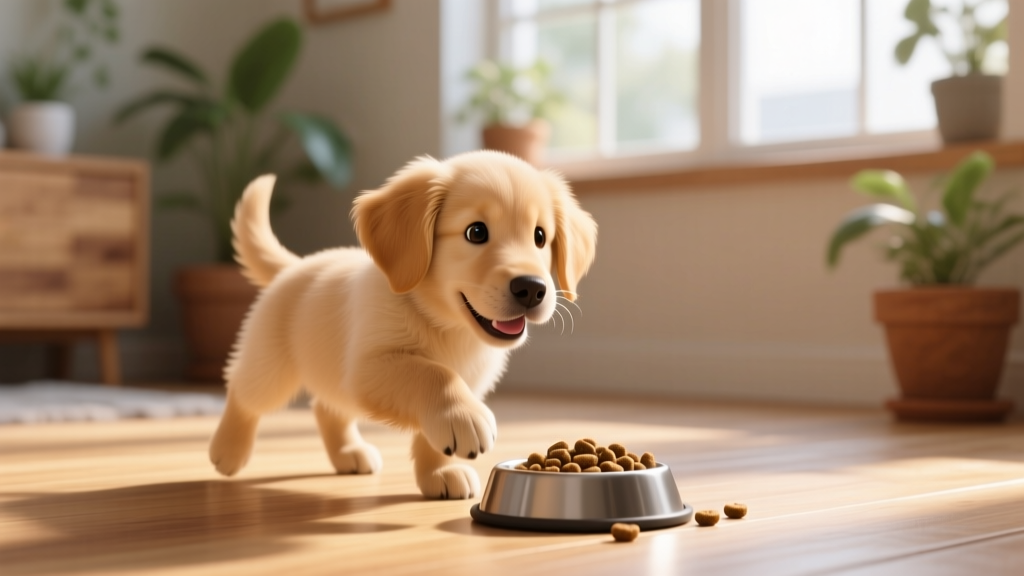
Golden Retriever Puppy Potty Training Timeline & First-Year Care Guide
Complete Golden Retriever puppy potty training timeline with week-by-week milestones, feeding schedules, vaccination dates, and first-year cost breakdown.

Bringing Home a Golden Retriever: What to Expect in the First Year
Golden Retrievers are one of America's most beloved breeds for good reason — they're intelligent, eager to please, and highly trainable. But a Golden Retriever puppy still needs structured guidance, especially when it comes to house training. If you've been searching for a realistic puppy potty training timeline, you're in the right place. This guide breaks down every critical milestone from 8 weeks through 12 months, with breed-specific expectations for Goldens.
Goldens mature slower than many breeds. While a Border Collie might be reliably house trained by 4 months, Golden Retrievers often need until 5–6 months before accidents become rare. Their playful, easily distracted nature means they sometimes forget to signal they need to go outside — even when they know the routine. Understanding this breed-specific pace prevents frustration and sets you both up for success.
When Should I Bring My Golden Retriever Puppy Home?
The American Kennel Club and most veterinary behaviorists agree: 8 weeks is the earliest appropriate age to bring a Golden Retriever puppy home. Responsible breeders will not release puppies before this point.
Here's why timing matters:
- Weeks 4–7: Puppies learn bite inhibition, social cues, and canine communication from their littermates and mother. Removing a puppy too early correlates with higher rates of fear-based aggression and separation anxiety later in life.
- Weeks 7–8: The first fear imprint period begins around 8 weeks. Transitioning to a new home during this window requires a calm, predictable environment to avoid creating lasting negative associations.
- Weeks 8–9 (ideal): Most responsible Golden Retriever breeders release puppies between 8–9 weeks, after the first DHPP vaccine and initial deworming protocol.
Some breeders of show-line Goldens keep puppies until 10–12 weeks to better evaluate temperament and structure. This is not a red flag — it often indicates a more thorough breeding program. These puppies may arrive partially crate trained and with better bite inhibition, giving you a head start.
Golden Retriever Puppy Milestones: Week by Week
Understanding developmental stages helps you set realistic expectations. Here's what to expect across your Golden's first year.
Weeks 4–8 (At the Breeder)
During this period, your puppy is still with the breeder. Key developments include:
- Transitioning from mother's milk to gruel, then to softened kibble (typically a large-breed puppy formula)
- First socialization with littermates — learning play boundaries and bite inhibition
- First deworming (pyrantel pamoate) at 2, 4, and 6 weeks
- First DHPP vaccine at 6–8 weeks
- Introduction to novel surfaces, sounds, and human handling
What you can do: Ask your breeder about their Early Neurological Stimulation (ENS) program and request photos/videos of the puppy's environment. A well-socialized Golden pup should approach new people confidently, not cower.
Weeks 8–12 (The Homecoming Phase)
This is the prime bonding window, but also the most demanding period for new owners.
- Potty training: Take puppy outside every 1–2 hours, plus immediately after meals, naps, and play. Expect 2–4 accidents per week — this is normal.
- Sleep: Puppies this age sleep 18–20 hours per day. Overtired puppies bite more and struggle to learn.
- Crate training: Begin with 30–60 minute sessions while you're home. Nighttime crate sessions will be 3–4 hours before the puppy needs a potty break.
- Bite inhibition: Mouthing is peak at this age. Redirect to appropriate chews every single time.
Weeks 12–16 (Building Foundations)
Your Golden is now more physically capable and mentally engaged.
- Potty training: Bladder control improves. Accidents should drop to 1–2 per week if you're consistent. Start extending outdoor intervals to every 2–3 hours.
- Training: Begin short (5-minute) formal training sessions for sit, down, recall, and name recognition using positive reinforcement with small treat rewards.
- Socialization urgency: The critical socialization window closes around 14–16 weeks. This is your last chance to create positive associations with novel experiences before fear responses become harder to modify.
- Chewing escalation: Baby teeth begin loosening. Provide frozen Kong toys stuffed with puppy-safe peanut butter (xylitol-free) and puppy-specific chew toys.
Weeks 16–24 (The Adolescent Transition)
This is where many Golden owners feel they're making progress — then hit a regression wall.
- Potty training: Most Goldens are reliably house trained by 5–6 months. "Reliably" means fewer than one accident per month with normal routine.
- Teething peak: Adult teeth erupt between 4–6 months. Chewing intensity increases dramatically. Protect furniture and provide structured chew outlets.
- Fear periods: A second fear imprint period occurs around 6–10 months. Your previously confident puppy may suddenly react fearfully to familiar objects or people. Respond with calm reassurance, never force exposure.
- Exercise: Limit structured exercise to 5 minutes per month of age, twice daily (e.g., a 4-month-old gets 20-minute walks). Free play in a yard is fine. Avoid repetitive jumping or forced running to protect developing joints.
Months 6–12 (Adolescence and Refinement)
Your Golden is now a teenager — physically large but mentally still maturing.
- Potty training: Should be fully reliable. If accidents persist past 6 months, consult your veterinarian to rule out urinary tract infections, diabetes, or other medical causes.
- Spay/neuter: For Golden Retrievers, current veterinary research (including studies from UC Davis) suggests delaying spay/neuter until 12–18 months may reduce risks of hip dysplasia, cranial cruciate ligament tears, and certain cancers. Discuss timing with your veterinarian.
- Training regression: Adolescent Goldens may "forget" commands. This is hormonal and developmental — maintain consistent training expectations and increase reward value.
- Adult food transition: Begin transitioning from large-breed puppy food to adult maintenance formula around 11–12 months. Do this gradually over 7–10 days.
Feeding Schedule: Exact Portions for Your Golden Retriever Puppy
Golden Retrievers are prone to rapid growth-related orthopedic diseases, including hip dysplasia and elbow dysplasia. Feeding a large-breed puppy formula (with calcium content between 1.2%–1.5% on a dry matter basis) is essential. Overfeeding accelerates growth and increases joint disease risk.
| Age | Meals Per Day | Daily Amount (cups)* | Expected Weight Range |
|---|---|---|---|
| 8–12 weeks | 3–4 meals | 1.5–2 cups | 10–22 lb / 4.5–10 kg |
| 3–4 months | 3 meals | 2–2.5 cups | 22–35 lb / 10–16 kg |
| 5–6 months | 2–3 meals | 2.5–3.5 cups | 35–50 lb / 16–23 kg |
| 7–9 months | 2 meals | 3–4 cups | 50–65 lb / 23–29 kg |
| 10–12 months | 2 meals | 3.5–4.5 cups | 55–75 lb / 25–34 kg |
*Cup measurements are based on a standard large-breed puppy kibble at approximately 350–400 kcal/cup (e.g., Royal Canin Golden Retriever Puppy, Purina Pro Plan Large Breed Puppy, or Hill's Science Diet Large Breed Puppy). Always check the feeding guide on your specific food and adjust based on your puppy's body condition score (BCS). You should be able to feel ribs without pressing hard, and see a visible waist from above.
Feeding tips for potty training success: Remove food bowls 2–3 hours before bedtime. Take your puppy outside within 15–30 minutes after every meal — Goldens have a strong gastrocolic reflex, meaning eating triggers the urge to defecate quickly.
The Realistic Puppy Potty Training Timeline for Golden Retrievers
Let's address the question directly: When will my Golden Retriever puppy be fully potty trained?
For most Golden Retrievers with consistent training, you can expect:
| Age | Expected Progress | Accident Frequency |
|---|---|---|
| 8–10 weeks | Learning the routine; no real "training" yet | 3–6 per week (normal) |
| 10–14 weeks | Beginning to go to the door or signal | 1–3 per week |
| 14–20 weeks | Reliable signaling; can hold 3–4 hours | 0–2 per week |
| 5–6 months | Mostly reliable; can hold 4–5 hours | 0–1 per month |
| 7–12 months | Fully reliable; can hold 6–8 hours (adult) | Rare (stress/excitement only) |
Potty Training Troubleshooting: Common Golden Retriever Issues
Problem: "My Golden pees inside 10 minutes after coming back in from outside."
This is extremely common in Goldens. They're easily distracted outdoors and may not fully empty their bladder. Solution: Stay outside for 10–15 minutes in a boring, designated potty spot. Use a consistent cue word like "go potty." Reward with a high-value treat (small pieces of boiled chicken or freeze-dried liver) immediately after elimination — not after you re-enter the house.
Problem: "My puppy only has accidents when I'm not watching."
If you can't actively supervise, your puppy must be in a crate or a puppy-proofed exercise pen. Golden Retrievers are mouthy explorers — unsupervised freedom before 6 months leads to accidents and destructive chewing. This isn't punishment; it's management.
Problem: "My 5-month-old was doing great and suddenly regressed."
Regression between 4–6 months is so common it's almost expected. Causes include teething discomfort (which increases water intake), adolescent hormonal shifts, and fear periods. Return to more frequent outdoor trips and higher-value rewards for 2–3 weeks. If accidents are frequent and accompanied by straining, blood in urine, or increased thirst, consult your veterinarian to rule out a UTI.
Potty Training Log Template
Track these data points daily for the first 4 weeks to identify patterns:
- Time outside: Record each trip (e.g., 7:00 AM, 8:30 AM, 10:00 AM)
- Result: Pee, poop, both, or nothing
- Accidents: Time, location, and what happened 30 minutes prior
- Water intake: Note if puppy drank heavily (common after play sessions)
- Meal times: Correlate feeding with elimination timing
After 2 weeks of logging, you'll see clear patterns that let you proactively take your puppy out before accidents happen.
Crate Training Progression: Time Limits by Age
Golden Retrievers generally adapt to crates well — they're den-oriented dogs who appreciate having their own space. But crating too long causes distress and actually undermines potty training by forcing the puppy to eliminate in the crate.
| Puppy Age | Maximum Crate Time (Day) | Maximum Crate Time (Night) | Recommended Crate Size |
|---|---|---|---|
| 8–10 weeks | 30–60 minutes | 3–4 hours (then potty break) | 36" with divider panel |
| 11–14 weeks | 1–2 hours | 4–5 hours | 36" with divider panel |
| 15–16 weeks | 2–3 hours | 5–6 hours | 42" (remove divider) |
| 4–6 months | 3–4 hours | 7–8 hours | 42" crate |
| 6+ months | 4–5 hours | 8 hours (overnight) | 42" crate (adult size) |
Crate sizing tip: Buy a 42-inch wire crate (MidWest iCrate or Frisco double-door are reliable options, $50–$80) with an adjustable divider panel. The crate should be just large enough for your puppy to stand, turn around, and lie down. Too much space allows them to eliminate in one corner and sleep in another, which sabotages potty training.
Crate training progression:
- Days 1–3: Leave crate door open. Feed meals inside. Toss treats in. Let puppy enter and exit freely.
- Days 4–7: Close door for 5 minutes while you sit nearby. Gradually extend to 15 minutes.
- Week 2: Close door and step out of sight for 1–5 minutes. Return before puppy becomes distressed.
- Week 3+: Build duration in 15-minute increments. Always provide a stuffed Kong or safe chew toy when crating.
If your Golden whines in the crate at night, first determine if it's a potty need or attention-seeking. Take puppy outside on-leash, stand still for 3–5 minutes. If they eliminate, reward and return to crate. If they don't, return to crate without interaction. Consistency here is critical — one rewarded whine can create weeks of nighttime vocalization.
Vaccination Schedule: What Your Golden Retriever Puppy Needs and When
The American Veterinary Medical Association outlines core and non-core vaccines for puppies. Golden Retrievers follow the standard canine vaccination protocol, with timing adjusted to ensure maternal antibodies don't interfere with vaccine efficacy.
| Age | Vaccine(s) | Type | Estimated Cost |
|---|---|---|---|
| 6–8 weeks | DHPP (Distemper, Hepatitis/Adenovirus, Parainfluenza, Parvovirus) — 1st dose | Core | $20–$40 |
| 8–9 weeks | Bordetella (intranasal or injectable) | Non-core (recommended for Goldens attending puppy classes) | $20–$35 |
| 10–12 weeks | DHPP — 2nd dose; Leptospirosis (1st dose, if recommended in your area) | Core + Non-core | $35–$60 |
| 12–14 weeks | Lyme disease vaccine (1st dose, if in endemic area); Leptospirosis (2nd dose) | Non-core | $30–$50 |
| 14–16 weeks | DHPP — 3rd (final puppy) dose; Rabies (required by law) | Core | $40–$70 |
| 14–16 weeks (if applicable) | Lyme disease (2nd dose) | Non-core | $25–$40 |
| 12 months | DHPP booster; Rabies booster (1-year or 3-year depending on local law) | Core | $40–$75 |
When can my puppy go outside and meet other dogs? According to the Merck Veterinary Manual, puppies are not fully protected until approximately 2 weeks after their final DHPP dose at 14–16 weeks — meaning around 16–18 weeks of age. However, the critical socialization window closes around 14–16 weeks, creating a tension between safety and behavioral development.
The American Veterinary Society of Animal Behavior (AVSAB) recommends that puppies attend well-managed puppy socialization classes (where all attendees have had at least their first DHPP vaccine) starting 7 days after the first vaccine. Avoid dog parks, pet store floors, and areas with unknown vaccination histories until the full series is complete.
Socialization Checklist: The Critical Window (Weeks 3–14)
Golden Retrievers are generally outgoing, but without deliberate socialization during the critical period (3–14 weeks), even naturally friendly breeds can develop fear-based reactivity. The goal isn't just exposure — it's positive associations with novel experiences.
Key rule: Every new experience should be paired with high-value treats or play. If your puppy shows fear (cowering, tail tucking, freezing), increase distance from the stimulus and toss treats. Never force a frightened puppy closer to something scary — this creates lasting negative associations.
Teething Timeline and Relief Strategies (3–6 Months)
Golden Retrievers are notorious chewers, and teething amplifies this breed trait significantly. Here's the eruption timeline:
- 3–4 weeks: Deciduous (baby) incisors erupt
- 4–6 weeks: Deciduous canines and premolars erupt (28 baby teeth total)
- 12–16 weeks: Baby incisors begin falling out; adult incisors emerge
- 4–5 months: Adult canines and premolars erupt (most intense chewing phase)
- 5–7 months: Adult molars emerge; full set of 42 adult teeth by 7 months
Safe chew recommendations for teething Golden puppies:
- Kong Classic (puppy rubber, pink/blue): Stuff with a mix of plain yogurt and mashed banana, then freeze for 2–4 hours. The cold soothes inflamed gums. Size: Medium for 8–16 week Goldens, Large for 4+ months.
- Benebone Puppy Wishbone: Made from softer nylon designed for developing teeth. Replace once significant wear appears.
- Frozen carrots: Whole large carrots (never baby carrots — choking hazard), frozen overnight. Supervise and remove when small enough to swallow whole.
- West Paw Zogoflex Toppl: Interlocking treat toy that can be frozen. Dishwasher safe.
- Wet washcloth: Dampen a clean washcloth, twist into a rope, freeze for 2 hours. Supervise to prevent ingestion of fabric.
Common Golden Retriever Puppy Problems and Solutions
Puppy Biting and Nipping
How do I stop my Golden Retriever puppy from biting? Goldens are a mouth-oriented breed — they were developed to carry waterfowl gently, and that retrieve instinct manifests as constant mouthing in puppies. This is not aggression.
Solution framework:
- Redirect: Every time puppy teeth touch skin, say "oops" calmly and immediately present an appropriate chew toy. When puppy bites the toy, praise and engage in play.
- Withdraw attention: If redirecting fails, stand up, cross your arms, and be still for 10–15 seconds. This teaches that biting ends play — the opposite of what the puppy wants.
- Manage arousal: Biting escalates when puppies are overtired or overstimulated. If biting is intense and constant, your puppy likely needs a nap, not more training. Put them in their crate with a chew for a 1–2 hour enforced rest.
- Provide appropriate outlets: Tug games with clear rules ("drop it" on cue) satisfy the mouth-orientation drive. Use a long fleece tug toy to keep teeth away from hands.
Biting typically peaks between 10–16 weeks and decreases noticeably by 5–6 months as adult teeth fully erupt and impulse control improves. If biting is accompanied by stiffening, growling, or guarding of food/toys, consult a certified professional dog trainer (CPDT-KA) or veterinary behaviorist — this may indicate resource guarding that requires professional intervention.
Whining and Vocalization
Golden puppies are vocal. Common triggers include crate confinement, separation, boredom, and excitement. Address the root cause:
- Crate whining: Ensure puppy has been exercised, has eliminated, and has a food-stuffed toy. If whining persists beyond 10–15 minutes of initial fussing, wait for a brief pause in vocalization before opening the crate — never open during active whining.
- Attention whining: Ignore completely (no eye contact, no talking). Reward silence with attention. This requires patience — extinction bursts (temporary increase in whining) are normal before the behavior decreases.
- Excitement whining: Common when you come home. Wait for calm before greeting. Toss treats on the floor to redirect energy downward.
Destructive Chewing
Golden Retrievers chew. This is a breed trait, not a flaw. Management strategies:
- Rotate chew toys every 3–4 days to maintain novelty
- Puppy-proof your home: use bitter apple spray on furniture legs, block access to shoes and cords with baby gates
- Provide at least 3 different chew textures available at all times (rubber, nylon, edible)
- Ensure adequate physical exercise (age-appropriate walks) and mental enrichment (snuffle mats, training sessions, food puzzles)
First-Year Cost Breakdown: Budgeting for Your Golden Retriever
Golden Retrievers are large dogs with significant care costs. Here's a realistic first-year budget based on 2026 pricing data:
| Category | Low Estimate | Medium Estimate | High Estimate |
|---|---|---|---|
| Purchase/Adoption | $500 (rescue) | $2,500 (responsible breeder) | $4,000+ (show-line breeder) |
| Veterinary (vaccines, exams, preventives) | $600 | $900 | $1,400 (includes spay/neuter) |
| Food (large-breed puppy + adult transition) | $480 ($40/mo) | $720 ($60/mo) | $1,080 ($90/mo, premium brands) |
| Supplies (crate, bed, toys, leash, bowls, gate) | $200 | $400 | $700 |
| Training (puppy class + basic obedience) | $150 (group class) | $400 (multiple group sessions) | $1,500+ (private trainer) |
| Grooming (brushes, shampoo, professional baths) | $100 (home grooming) | $300 (occasional professional) | $600 (monthly professional) |
| Pet Insurance (optional but recommended) | $360 ($30/mo) | $600 ($50/mo) | $960 ($80/mo, comprehensive) |
| Emergency Fund (recommended reserve) | $500 | $1,000 | $2,000 |
| TOTAL FIRST YEAR | $2,890 | $6,820 | $12,240 |
Golden-specific financial considerations: Goldens have a high lifetime cancer rate (approximately 60% according to the AKC Golden Retriever Health Foundation). Pet insurance purchased during puppyhood (before any pre-existing conditions develop) is one of the wisest financial decisions you can make for this breed. Look for policies that cover hereditary conditions, cancer treatment, and have no breed-specific exclusions.
Frequently Asked Questions
When should I bring my Golden Retriever puppy home?
Between 8–9 weeks is ideal. Puppies younger than 8 weeks miss critical littermate socialization. Some responsible breeders keep puppies until 10–12 weeks for temperament evaluation, which is perfectly fine and may give you a training head start.
How often should I feed my Golden Retriever puppy?
Feed 3–4 meals per day from 8–12 weeks, 3 meals from 3–4 months, then transition to 2 meals per day from 5 months onward. Use a large-breed puppy formula and follow the portion guidelines in the feeding table above, adjusting for your individual puppy's body condition score.
When will my Golden Retriever be fully potty trained?
Most Golden Retrievers are reliably house trained by 5–6 months with consistent management. "Reliably" means fewer than one accident per month. Full bladder control (holding 8 hours overnight) typically develops by 7–8 months. Some Goldens, particularly males, may take slightly longer.
What vaccines does my Golden Retriever puppy need and when?
Core vaccines include DHPP (given at 6–8, 10–12, and 14–16 weeks) and Rabies (at 14–16 weeks). Non-core vaccines recommended for many Goldens include Bordetella (8–9 weeks, before puppy class), Leptospirosis, and Lyme disease depending on your geographic area. Your veterinarian will tailor the protocol to your puppy's risk factors.
How do I stop my Golden Retriever puppy from biting?
Redirect every bite to an appropriate chew toy. If biting continues, withdraw attention by standing still for 10–15 seconds. Ensure your puppy is getting adequate sleep (18–20 hours/day for young puppies) — overtired puppies bite more. Biting naturally decreases as adult teeth fully erupt around 5–6 months. Never use physical punishment, which damages your bond and can create fear-based aggression.
When can my Golden Retriever puppy go outside and meet other dogs?
Your puppy can explore your private yard immediately. For public spaces and dog-to-dog contact, the AVSAB recommends starting structured puppy classes 7 days after the first DHPP vaccine (around 9–10 weeks), provided all puppies in class are vaccinated. Avoid dog parks and high-traffic dog areas until 2 weeks after the final DHPP dose (approximately 16–18 weeks of age).
Raising a Golden Retriever puppy requires patience, consistency, and realistic expectations. Their potty training timeline may be slightly longer than smaller breeds, but their intelligence and eagerness to please make them one of the most rewarding breeds to train. Track your progress, celebrate small wins, and remember that every phase — the biting, the accidents, the 3 AM whining — is temporary.
Aaron Whyte
All our authors care for dogs every day — read more of their work on the authors page.