Golden Retriever Puppy Nap Video Guide: Sleep, Milestones & Care
Watch your golden retriever puppy nap video and learn what's normal for sleep, milestones, feeding, potty training, and teething by age.

Why Your Golden Retriever Puppy Nap Video Looks Like 18 Hours of Sleep (And Why That's Perfect)
If you've been filming a golden retriever puppy nap video expecting to capture adorable twitching paws and soft snores, you're not alone — and what you're seeing is biologically exactly right. Golden retriever puppies between 8 and 12 weeks old sleep 18 to 20 hours per day, broken into 30-minute to 2-hour bursts. By 6 months, that drops to roughly 14 to 16 hours. Sleep is when growth hormone surges, neural pathways consolidate training, and the immune system rebuilds after vaccination.
This guide maps every developmental milestone from week 4 through month 12, with exact feeding portions, vaccination dates, crate-time limits, and the socialization window that closes faster than most new owners realize. Bookmark it — you'll reference it weekly.
Golden Retriever Puppy Milestones: Week by Week, Month by Month
Golden retrievers mature slower than many breeds, often retaining puppy behavior until 2 to 3 years. Here's what to expect at each stage.
| Age Range | Weight (lb / kg) | Key Milestones | Owner Action Items |
|---|---|---|---|
| Weeks 4–8 | 5–15 lb / 2.3–6.8 kg | Eyes/ears fully functional; littermate play teaches bite inhibition; first deworming; start weaning onto gruel | If still with breeder: request early neurological stimulation (ENS) records. Begin handling exercises daily. |
| Weeks 8–12 | 15–25 lb / 6.8–11.3 kg | Peak socialization window; first DHPP vaccine; can learn sit, name recognition; fear imprint period begins (~8–11 weeks) | Bring home (ideally 8–10 weeks). Start crate training. Enroll in puppy kindergarten (after first vaccine + 5–7 days). |
| Weeks 12–16 | 25–40 lb / 11.3–18.1 kg | Second and third DHPP boosters; rabies vaccine at 12–16 weeks; teething discomfort begins; attention span increases to 5–10 minutes | Introduce frozen Kongs for teething. Begin leash walking in low-distraction areas. Increase socialization outings. |
| Weeks 16–24 | 40–55 lb / 18.1–24.9 kg | Final puppy vaccines complete; adult teeth erupt; chewing intensity peaks; second fear period (~6–8 months possible) | Upgrade to larger crate. Rotate chew toys weekly. Begin structured recall training with long line. |
| Months 6–12 | 50–70 lb / 22.7–31.8 kg (males); 45–60 lb / 20.4–27.2 kg (females) | Sexual maturity (spay/neuter window); growth plates still open; adolescent regression in training common | Discuss spay/neuter timing with vet (many recommend waiting until 12–18 months for large breeds per AKC guidance). Transition to adult food at 12 months. |
When Should I Bring My Golden Retriever Puppy Home?
The ideal age is 8 to 10 weeks. Puppies removed before 8 weeks miss critical littermate interactions that teach bite inhibition and canine social cues. The AKC recommends 8 weeks minimum, and many responsible golden retriever breeders hold puppies until 9 or 10 weeks to ensure better emotional stability.
If you're adopting from a rescue where the puppy was separated early, compensate with structured puppy socialization classes and supervised play dates with vaccinated, temperament-tested adult dogs.
Feeding Schedule: Exact Portions by Age and Weight
Golden retrievers are prone to rapid growth-related orthopedic issues including hip dysplasia. Research published in the Journal of the American Veterinary Medical Association shows that keeping golden retriever puppies lean (body condition score 4–5 out of 9) significantly reduces hip dysplasia incidence. Feed measured meals — never free-feed.
| Age | Meals per Day | Daily Amount (large-breed puppy kibble, ~350 kcal/cup) | Notes |
|---|---|---|---|
| 8–12 weeks | 4 | 1.5–2 cups total (divide into 4 meals of ~⅜–½ cup each) | Soften kibble with warm water for first 1–2 weeks home if transitioning. |
| 12–16 weeks | 3 | 2–2.5 cups total (~⅔–¾ cup per meal) | Begin phasing out softened food. Monitor body condition weekly. |
| 16–24 weeks | 3 → 2 | 2.5–3.5 cups total | Drop to 2 meals/day around 6 months. Increase portion slightly if ribs become palpable without fat cover. |
| 6–12 months | 2 | 3–4 cups total (1.5–2 cups per meal) | Adjust based on activity. Working/field-line goldens may need 4+ cups; show-line dogs often do well on 3 cups. |
Food selection: Choose an AAFCO-certified large-breed puppy formula with calcium between 1.0–1.5% on a dry matter basis and a calcium-to-phosphorus ratio of 1.1:1 to 1.4:1. Brands consistently meeting these criteria include Purina Pro Plan Large Breed Puppy, Royal Canin Golden Retriever Puppy, and Hill's Science Diet Large Breed Puppy.
Vaccination Schedule: Exact Weeks and Vaccine Names
Your veterinarian will customize this based on regional disease prevalence, but the core schedule follows AVMA and AAHA guidelines.
| Age | Vaccine | Type | Notes |
|---|---|---|---|
| 6–8 weeks | DHPP (Distemper, Hepatitis/Adenovirus-2, Parainfluenza, Parvovirus) | Core | Often given by breeder. Maternal antibodies may interfere — this is why boosters are critical. |
| 10–12 weeks | DHPP booster | Core | Second dose. Some vets add Bordetella (kennel cough) at this visit if puppy will attend group classes. |
| 14–16 weeks | DHPP final booster + Rabies | Core | This final DHPP is the most important — it overcomes remaining maternal antibodies. Rabies is legally required in most US states. |
| 12–16 weeks (optional) | Leptospirosis (2-dose series, 2–4 weeks apart) | Non-core / Lifestyle | Recommended for goldens who hike, swim in lakes, or live in areas with wildlife exposure. |
| 16+ weeks | Lyme disease (2-dose series) | Non-core / Lifestyle | Recommended in tick-endemic regions (Northeast, Upper Midwest, Pacific Coast). |
Expected cost per visit: $75–$150 depending on region and whether fecal testing/heartworm prevention is bundled. Full puppy vaccine series: $250–$500 total.
When Can My Puppy Go Outside and Meet Other Dogs?
This is the tension every golden retriever owner faces: the socialization window peaks between 3 and 14 weeks and closes significantly by 16 weeks, but your puppy isn't fully vaccinated until 16 weeks. The AVMA and the American Veterinary Society of Animal Behavior (AVSAB) both recommend controlled socialization starting 5–7 days after the first DHPP vaccine (around 8–9 weeks).
Potty Training Timeline: Realistic Expectations for Golden Retrievers
Golden retrievers typically achieve reliable house training between 4 and 6 months — not 3 days, not 3 weeks. Some individuals, especially males, may have occasional accidents until 8–9 months. Here's the realistic progression:
| Age | Bladder Capacity | Outing Frequency | What to Expect |
|---|---|---|---|
| 8–10 weeks | ~30–45 minutes | Every 30–45 min while awake; immediately after eating, playing, waking from nap | Multiple accidents daily are normal. You are learning their schedule, not the other way around. |
| 10–14 weeks | ~1–1.5 hours | Every 1–1.5 hours while awake | Accidents decrease to 1–2 per week if consistent. Begin associating a cue word ("go potty"). |
| 14–20 weeks | ~2–3 hours | Every 2–3 hours; overnight stretch of 4–5 hours possible | Most puppies can sleep 5–6 hours overnight without an accident by 16 weeks. |
| 5–6 months | ~4–5 hours | Every 3–4 hours during day | Reliably trained for most households. Regression possible during fear periods. |
Troubleshooting frequent accidents: If your 14+ week golden is still having 3+ accidents daily, rule out a urinary tract infection (common in puppies; vet visit cost ~$50–$100 for urinalysis). Also audit your routine — inconsistent outing times and insufficient post-meal trips are the #1 cause of delayed training.
Crate Training Progression: Time Limits by Age
A crate should be your golden's safe den — never punishment. Golden retrievers generally adapt to crates well due to their den-seeking instincts, but over-crating causes anxiety and setbacks.
| Age | Maximum Continuous Crate Time (Daytime) | Overnight | Crate Size Recommendation |
|---|---|---|---|
| 8–10 weeks | 30–60 minutes | 2–3 hours (set alarm for potty break) | 36" crate with divider panel — block off to ~24" space |
| 10–14 weeks | 1–2 hours | 3–4 hours | Expand divider to ~30" |
| 14–20 weeks | 2–3 hours | 5–6 hours | Expand to ~36" |
| 5–6 months | 3–4 hours | 7–8 hours | Full 42" crate (standard for adult golden retriever) |
| 6–12 months | 4–5 hours max | 8 hours | Full 42" crate; many goldens voluntarily nap in open crates by this age |
Products that work well for golden retriever puppies: MidWest iCrate (42" double-door, ~$65–$85), Ruff Land Performance Kennel (intermediate, ~$250 for crash-tested travel), Snuggle Puppy heartbeat toy (~$35) for the first 2 weeks to reduce nighttime whining.
Teething Timeline and Relief Strategies (3–6 Months)
Golden retriever puppies begin losing deciduous (baby) teeth around 12–16 weeks, with adult teeth fully erupted by 6–7 months. The peak chewing intensity period is 4 to 6 months — this is when your baseboards, shoes, and furniture are at greatest risk.
Safe chew options by age:
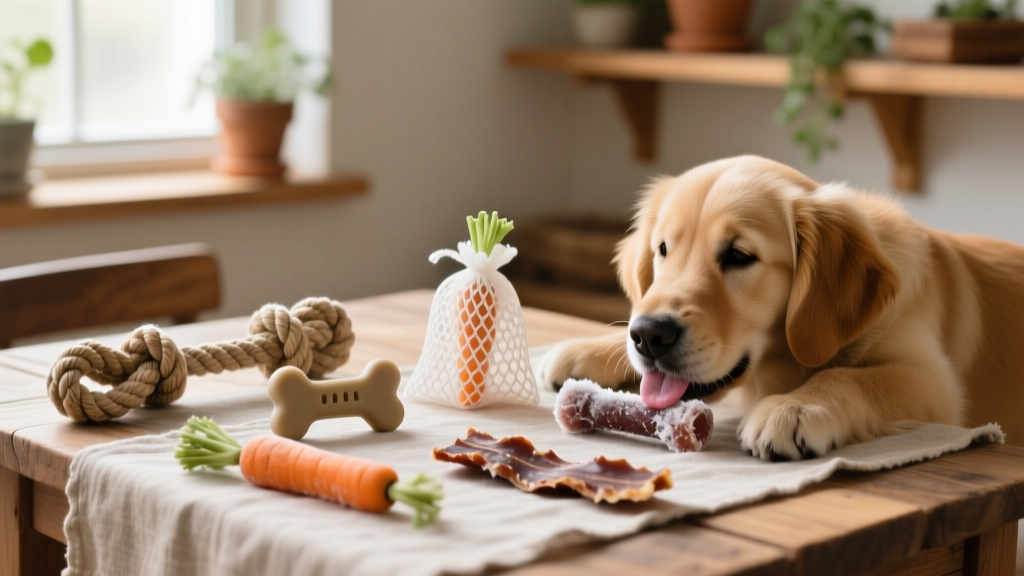
- 8–12 weeks: Nylabone Puppy Chew (soft flex material), frozen wet washcloth twisted into a rope, Benebone Puppy (softer rubber formula)
- 12–20 weeks: Frozen Kong Classic stuffed with puppy-safe peanut butter (xylitol-free) and kibble, BullyMax Jr. bully sticks (thin, supervised only), West Paw Toppl (frozen)
- 5–7 months: Standard Kong Classic (medium or large), antler alternatives like EcoKind Yak Chews (softer than raw antlers, less fracture risk), Nylabone Dura Chew textured
Avoid: rawhide (choking and GI blockage risk), cooked bones (splintering), ice cubes for puppies under 4 months (tooth fracture risk on developing enamel), tennis balls left unsupervised (abrasive felt wears teeth and can be swallowed).
Common Golden Retriever Puppy Problems and Solutions
Puppy Biting and Nipping
Golden retrievers are mouthy by nature — they were bred to carry game. Biting peaks between 8 and 16 weeks. How to stop it using positive reinforcement:
- When teeth touch skin, immediately say "ouch" in a calm tone and freeze (no jerking away — that triggers chase instinct).
- Wait 2–3 seconds. If puppy backs off, mark with "yes" and redirect to a chew toy.
- If puppy continues biting, calmly stand up and leave the interaction for 10–15 seconds (negative punishment — removing attention).
- Return and offer a toy. Praise calm chewing.
- Ensure 15–20 minutes of structured training and 30+ minutes of physical exercise daily — overtired puppies bite more, not less.
Never use alpha rolls, muzzle grabbing, or holding the mouth shut. These create fear-based responses and damage trust. If biting is severe (breaking skin, not responding to redirection after 2+ weeks of consistent work), consult a certified professional dog trainer (CPDT-KA or IAABC-certified).
Nighttime Whining in the Crate
Expect 3 to 7 nights of whining when first crate training. Strategies that work:
- Place crate in your bedroom for the first 2–3 weeks (proximity reduces separation distress)
- Use a Snuggle Puppy or warm water bottle wrapped in a towel
- Cover the crate with a breathable blanket on 3 sides
- Take puppy out for a boring, no-play potty break if whining persists past 30 minutes (prevents associating whining with play)
- Do NOT let puppy out of crate while actively whining — wait for 3–5 seconds of silence first
Destructive Chewing Beyond Teething
If your 6+ month golden is still destroying furniture, audit these three factors: (1) Is the dog getting 60+ minutes of physical exercise daily? (2) Is there 15–20 minutes of mental stimulation (training, puzzle toys, snuffle mats)? (3) Are appropriate chews available and rotated weekly to maintain novelty? Golden retrievers are working dogs — an under-stimulated golden will create their own entertainment, and you won't like their choices.
First-Year Cost Breakdown for a Golden Retriever Puppy
Budget realistically. These are 2026 US averages based on data from veterinary industry reports and owner surveys:
| Category | Low Estimate | Mid Estimate | High Estimate | Notes |
|---|---|---|---|---|
| Puppy purchase / adoption fee | $500 (rescue) | $2,000 (responsible breeder) | $3,500+ (show/field-line breeder) | Reputable breeders health-test parents (OFA hips/elbows, heart, eyes) — ask for documentation. |
| Veterinary care (vaccines, spay/neuter, wellness) | $800 | $1,500 | $2,500 | Includes initial series, rabies, spay/neuter ($400–$800), microchip, fecal tests, heartworm prevention. |
| Food (large-breed puppy formula) | $400 | $600 | $900 | Based on 3–4 cups/day of premium kibble at $1.50–$2.50/lb. |
| Supplies (crate, bed, leash, harness, bowls, toys) | $250 | $500 | $800 | Crate ($65–$250), orthopedic bed ($80–$200), Ruffwear Front Range harness ($40), Kongs ($15–$25 each). |
| Training (puppy kindergarten + basic obedience) | $150 | $400 | $800 | Group classes: $150–$300 per 6-week session. Private sessions: $80–$150/hour. |
| Pet insurance (optional but recommended) | $400/year | $700/year | $1,200/year | Policies from Trupanion, Healthy Paws, or Lemonade. Enroll before pre-existing conditions develop. |
| First-year total | $2,500 | $5,700 | $9,700+ | Excludes emergency vet visits (golden retrievers are prone to foreign body ingestion — emergency surgery averages $2,000–$5,000). |
Frequently Asked Questions
How often should I feed my golden retriever puppy at 10 weeks old?
Four meals per day, totaling approximately 1.5 to 2 cups of large-breed puppy kibble. Space meals roughly 3.5 to 4 hours apart during waking hours (e.g., 7 AM, 11 AM, 3 PM, 7 PM). Always provide fresh water. Remove uneaten food after 15–20 minutes to establish meal-time routines that support potty training predictability.
When will my golden retriever puppy be fully potty trained?
Most golden retrievers are reliably house-trained between 4 and 6 months of age with consistent scheduling. "Reliably" means fewer than one accident per month. Some males take until 8–9 months. If you're still having daily accidents past 5 months, consult your veterinarian to rule out medical causes (UTI, anatomical issues) and consider a session with a certified trainer.
What vaccines does my golden retriever puppy need and when?
Core vaccines: DHPP at 6–8 weeks, 10–12 weeks, and 14–16 weeks. Rabies at 12–16 weeks (legally required). Non-core vaccines based on lifestyle: Bordetella (if attending group classes or boarding), Leptospirosis (if hiking/swimming), and Lyme (if in tick-endemic areas). Your veterinarian will determine the exact schedule based on your puppy's health status and regional risk factors.
How do I stop my golden retriever puppy from biting and nipping?
Use a three-step positive reinforcement protocol: (1) Say "ouch" calmly and freeze when teeth touch skin. (2) Redirect to an appropriate chew toy and praise calm chewing. (3) If biting continues, remove your attention for 10–15 seconds by leaving the area. Consistency from every household member is critical — if one person allows mouthing and another punishes it, the puppy becomes confused and bites more. Expect 2–4 weeks of consistent work before seeing significant improvement.
Is it normal for my golden retriever puppy to sleep this much?
Yes. An 8-to-12-week-old golden retriever puppy sleeping 18–20 hours per day is completely normal. Sleep supports growth hormone release, immune function, and learning consolidation. If your puppy is lethargic when awake (not just sleepy between play sessions), refusing food, or has pale gums, contact your veterinarian — those can be signs of anemia, infection, or hypoglycemia rather than normal puppy sleep.
When can my puppy go to the dog park?
Wait until at least 7 days after the final DHPP booster at 14–16 weeks — so approximately 16–17 weeks minimum. Even then, dog parks carry risk because you cannot verify other dogs' vaccination status or temperament. Many trainers recommend structured play dates with known, vaccinated dogs as a safer alternative for the first year. Golden retrievers are generally dog-friendly, but a single negative encounter during the fear imprint period (8–11 weeks or 6–8 months) can create lasting reactivity.
This guide provides general educational information. Always consult your veterinarian for advice specific to your puppy's health, vaccination needs, and nutritional requirements. If you suspect your puppy has ingested a toxic substance, contact the ASPCA Animal Poison Control Center at (888) 426-4435 (24/7, consultation fee applies) or the Pet Poison Helpline at (855) 764-7661.
Anouk Beaumont
All our authors care for dogs every day — read more of their work on the authors page.