Golden Retriever Puppy Names & Complete First-Year Care Guide
Browse top Golden Retriever puppy names and get a week-by-week care guide covering feeding, potty training, vaccines, socialization, and first-year costs.

The Best Golden Retriever Puppy Names for 2026
Choosing from hundreds of Golden Retriever puppy names is one of the first real decisions you'll make as a new owner — and it sticks for 10 to 12 years. Golden Retrievers have a warm, goofy, sun-drenched personality that tends to steer naming in a few predictable directions: nature-inspired names, food names, and classic human names that feel friendly rather than formal. Based on AKC registration trends and shelter intake data, here are the names Golden Retriever owners reach for most.
Top Male Golden Retriever Puppy Names
| Rank | Name | Why It Fits |
|---|---|---|
| 1 | Cooper | Friendly, outdoorsy — matches the breed's sporting heritage |
| 2 | Buddy | The quintessential Golden name; approachable and warm |
| 3 | Charlie | Classic, gentle, works from puppyhood through senior years |
| 4 | Max | Short, punchy, easy to call at a dog park |
| 5 | Tucker | Slightly Southern, suits the breed's easygoing temperament |
| 6 | Bailey | Gender-neutral, soft-sounding, very popular with Goldens |
| 7 | Scout | Adventure-oriented; fits the breed's love of hiking and fetching |
| 8 | Winston | Distinguished, slightly British; contrasts humorously with Golden goofiness |
| 9 | Beau | Southern charm; two syllables, ideal for recall training |
| 10 | Duke | Noble, strong; a classic choice for larger male Goldens |
Top Female Golden Retriever Puppy Names
| Rank | Name | Why It Fits |
|---|---|---|
| 1 | Daisy | Cheerful, floral — mirrors the breed's sunny disposition |
| 2 | Lucy | Warm, familiar, one of the most popular female dog names nationally |
| 3 | Sadie | Sweet, slightly vintage; suits a gentle-natured Golden |
| 4 | Maggie | Playful, approachable; easy to call across a field |
| 5 | Bella | Italian for "beautiful" — a natural for this photogenic breed |
| 6 | Goldie | On-the-nose but timeless; embraces the breed's iconic color |
| 7 | Honey | References coat color and sweet temperament simultaneously |
| 8 | Willow | Nature-inspired, graceful; popular among outdoor-oriented owners |
| 9 | Penny | Copper-toned, cheerful; a nod to the breed's reddish-gold shades |
| 10 | Stella | Means "star"; works well for a dog that will be the center of your life |
Unique & Nature-Inspired Golden Retriever Puppy Names
If the top-10 lists feel too common, these less-frequent options still suit the breed's character:
- Aspen — golden-leaved mountain tree; gender-neutral
- River — references the breed's love of water retrieval
- Maple — warm autumn tones matching the Golden coat spectrum
- Ember — for darker red-gold coated puppies
- Sunny — straightforward; captures the breed's personality in a word
- Harvest — unusual, seasonal, suits the golden color palette
- Clover — field-oriented; nods to the breed's gundog roots
- Birch — subtle nature reference; works for lighter cream-coated Goldens
When Should I Bring My Golden Retriever Puppy Home?
The ideal age to bring a Golden Retriever puppy home is 8 weeks (56 days). The American Veterinary Medical Association (AVMA) and the American Kennel Club both recommend that puppies remain with their littermates and dam until at least 8 weeks of age. During weeks 6 through 8, puppies learn bite inhibition, canine social cues, and stress coping from their siblings — skills that are nearly impossible to replicate in a human household.
Some responsible Golden Retriever breeders hold puppies until 9 to 10 weeks, particularly if they are evaluating puppies for show or service-dog potential. This is not a red flag; it often signals a breeder who is invested in proper development. However, puppies removed before 7 weeks show higher rates of fear-based behaviors, separation anxiety, and difficulty with bite inhibition later in life.
If you are adopting from a rescue, you may encounter puppies available at 6 to 7 weeks due to shelter intake circumstances. In these cases, prioritize intensive socialization and arrange playdates with vaccinated, temperament-stable adult dogs to compensate for missed littermate time.
Golden Retriever Puppy Milestones: Week by Week
Weeks 4–8: The Litter Phase (Before You Bring Them Home)
During this period, your puppy is still with the breeder. Here's what's happening developmentally:
- Week 4: Eyes and ears fully functional; puppy begins exploring beyond the whelping box. Deciduous (baby) teeth erupting.
- Week 5: Play-fighting with littermates intensifies — this is where bite inhibition foundations are laid.
- Week 6: First dewclaw trimming, first deworming (pyrantel pamoate), and initial socialization with humans beyond the breeder.
- Week 7: Fear imprint period begins — negative experiences during this week can have lasting effects. A good breeder keeps the environment calm and introduces novel stimuli gently.
- Week 8: First DHPP vaccine administered by the breeder's vet. Puppy is ready to transition to a new home.
Weeks 8–12: The Homecoming & Bonding Window
This is the most impressionable period in your Golden's life. Expect:
- Sleep: 18–20 hours per day. Puppies this age need enforced naps in a crate; overtired puppies become mouthy and hyperactive.
- Attention span: 3–5 minutes per training session, maximum.
- Weight gain: Golden puppies typically gain about 1–1.5 lb per week during this stage. A healthy 8-week-old Golden weighs 10–15 lb; by 12 weeks, expect 20–30 lb.
- Behavior: Following you room to room, crying when crated, exploring everything with their mouth. Mouthing and nipping peak around weeks 10–12.
Weeks 12–16: Confidence Building & Foundation Training
- Second fear imprint period may occur around week 12–14. Your puppy may suddenly seem fearful of objects or situations they previously handled fine. Respond with calm confidence; do not force interactions.
- Training: Sit, down, come, and leash walking can be reliably taught now. Keep sessions under 10 minutes.
- Bladder control: Improving, but still expect accidents. A 12-week-old puppy can hold it roughly 2–3 hours during the day.
- Teething prep: Baby teeth are fully in; adult teeth begin pushing through around 14–16 weeks.
Weeks 16–24 (4–6 Months): The Adolescent Transition
- Teething peak: Adult teeth erupt rapidly between 4–6 months. Chewing intensity increases significantly. Provide appropriate outlets (see teething section below).
- Energy surge: Your Golden will need 45–60 minutes of structured exercise daily, split into multiple sessions to protect developing joints.
- Training regression: Common and normal. Commands your puppy "knew" may temporarily fall apart. Stay consistent; this passes.
- Growth rate: Males may reach 40–55 lb by 6 months; females 35–45 lb. Golden Retrievers reach roughly 75% of adult weight by 6 months.
6–12 Months: Adolescence & Maturation
- Sexual maturity: Females may enter first estrus (heat) between 6–10 months; males begin lifting leg and showing interest in females. Discuss spay/neuter timing with your veterinarian — current evidence from the Merck Veterinary Manual and UC Davis breed-specific studies suggests delaying gonadectomy until after 12 months for Golden Retrievers may reduce risk of hip dysplasia, cranial cruciate ligament tears, and certain cancers.
- Adult coat transition: The soft puppy coat is replaced by the longer, coarser adult double coat. Shedding increases noticeably.
- Exercise: 60–90 minutes daily by 12 months, but avoid high-impact activities (agility jumping, long-distance running on hard surfaces) until growth plates close around 18–24 months.
- Weight target: Adult males typically reach 65–75 lb; females 55–65 lb by 12–15 months.
Golden Retriever Feeding Schedule by Age and Weight
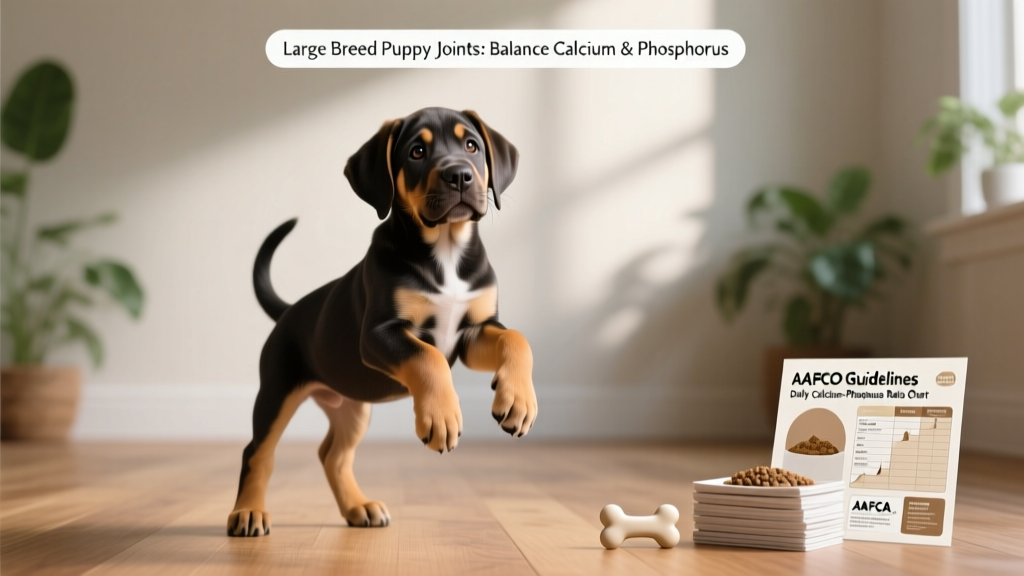
Golden Retrievers are prone to rapid growth, which increases risk of hip and elbow dysplasia. Feed a diet specifically formulated for large-breed puppies — these diets contain controlled calcium and phosphorus ratios (calcium at 1.0–1.5% on a dry matter basis) to support slower, healthier skeletal development. Look for an AAFCO statement confirming the food meets nutritional requirements for "growth" or "all life stages."
| Age | Weight Range | Meals per Day | Daily Amount (kibble) | Notes |
|---|---|---|---|---|
| 8–12 weeks | 10–25 lb (4.5–11 kg) | 3–4 | 1.5–2 cups (355–473 mL) | Soften kibble with warm water if baby teeth are still emerging |
| 3–4 months | 25–40 lb (11–18 kg) | 3 | 2–2.5 cups (473–591 mL) | Transition to dry kibble; monitor body condition score (BCS) |
| 4–6 months | 35–55 lb (16–25 kg) | 2–3 | 2.5–3.5 cups (591–828 mL) | Can reduce to 2 meals/day at 6 months |
| 6–9 months | 45–65 lb (20–29 kg) | 2 | 3–4 cups (709–946 mL) | Monitor for rapid weight gain; adjust based on BCS, not label alone |
| 9–12 months | 55–75 lb (25–34 kg) | 2 | 3.5–4.5 cups (828–1065 mL) | Begin transitioning to adult large-breed formula at 12 months |
Cup measurements assume a standard large-breed puppy kibble at approximately 350–400 kcal/cup. Brands commonly recommended by veterinary nutritionists for large-breed puppies include Purina Pro Plan Large Breed Puppy, Royal Canin Golden Retriever Puppy, and Hill's Science Diet Large Breed Puppy. Always adjust portions based on your individual puppy's body condition — you should be able to feel ribs without pressing hard, and the puppy should have a visible waist when viewed from above.
Potty Training Your Golden Retriever: Timeline and Troubleshooting
Golden Retrievers are generally among the easier breeds to house train due to their eagerness to please and food motivation. However, "easy" still means 4–6 months of consistent management before reliable bladder control.
Realistic Potty Training Timeline
| Age | Expected Bladder Hold Time (Daytime) | Accident Frequency | Milestone |
|---|---|---|---|
| 8–10 weeks | 30–60 minutes | Multiple daily | Learning where to go; entirely owner-managed |
| 10–14 weeks | 1–2 hours | 1–2 per day | Beginning to signal (sniffing, circling, whining at door) |
| 3–4 months | 2–3 hours | 0–1 per day | Developing preference for outdoor surface |
| 4–6 months | 3–4 hours | Rare (regression possible during teething) | Near-reliable with consistent schedule |
| 6–8 months | 4–6 hours | Very rare | Fully reliable for most puppies; overnight hold of 7–8 hours |
Core Potty Training Protocol
- Take puppy out immediately upon waking, after every meal, after every play session, and before crating.
- Use a consistent cue word ("go potty," "do your business") said while the puppy is in the act — not before.
- Reward immediately with a high-value treat (small piece of boiled chicken or commercial training treat) within 2 seconds of finishing.
- Supervise or confine. When you cannot watch your puppy, they are in a crate or exercise pen. Unsupervised roaming is the #1 cause of potty training setbacks.
- Clean accidents with enzymatic cleaner (Nature's Miracle or Rocco & Roxie) — standard household cleaners do not eliminate the uric acid crystals that attract puppies back to the same spot.
Vaccination Schedule for Golden Retriever Puppies
Your Golden Retriever puppy needs a series of core vaccines to build immunity against life-threatening diseases. Maternal antibodies from the dam's colostrum gradually wane between 6 and 16 weeks, which is why vaccines are given in a series — each booster catches the window when maternal antibodies drop low enough for the vaccine to take effect but before the puppy is vulnerable to infection.
| Age | Vaccine(s) | What It Protects Against | Typical Cost per Visit |
|---|---|---|---|
| 6–8 weeks | DHPP (1st dose) | Distemper, Hepatitis (Adenovirus-2), Parainfluenza, Parvovirus | $75–$100 (often done by breeder) |
| 10–12 weeks | DHPP (2nd dose), Bordetella, Leptospirosis (1st dose) | Boosts core immunity; kennel cough; leptospirosis (zoonotic bacterial infection) | $100–$150 |
| 14–16 weeks | DHPP (3rd dose), Rabies, Leptospirosis (2nd dose) | Final core booster; rabies (legally required); leptospirosis booster | $100–$150 |
| 12–16 months | DHPP booster, Rabies booster | First adult boosters; subsequent rabies boosters per local law (1- or 3-year) | $80–$120 |
Golden Retrievers are not at elevated risk for vaccine reactions compared to other breeds, but monitor your puppy for 24 hours after each vaccination. Mild lethargy and soreness at the injection site are normal. Hives, facial swelling, vomiting, or collapse within hours of vaccination constitute a medical emergency — contact your veterinarian or an emergency clinic immediately.
The Socialization Window: Weeks 3–14
The primary socialization period for puppies closes between 12 and 14 weeks of age. This is a biologically fixed developmental window — once it closes, novel stimuli trigger caution or fear rather than curiosity. According to the AVMA's position on early puppy socialization, the risk of behavioral problems from inadequate socialization exceeds the risk of infectious disease in properly managed puppies.
Golden Retriever Socialization Checklist
Aim for positive exposure to as many of the following as possible before 14 weeks. Each exposure should be paired with treats and praise. If your puppy shows fear, increase distance and let them observe from a comfortable range — never force interaction.
| Category | Specific Exposures |
|---|---|
| People | Children (supervised), elderly individuals, people wearing hats/sunglasses/masks, people using wheelchairs or crutches, tall men, delivery workers |
| Animals | Vaccinated adult dogs (known temperament), cats (controlled introduction), livestock at a distance |
| Surfaces | Gravel, metal grates, wet grass, sand, stairs, elevator floors, car interiors |
| Sounds | Vacuum cleaner, thunderstorm recordings (low volume, treat-paired), fireworks recordings, doorbells, car horns, construction noise |
| Handling | Paw handling, ear inspection, mouth opening, nail clipping practice, collar/harness touching, towel drying, being lifted |
| Environments | Pet store (carried if not fully vaccinated), outdoor café patio, parking lot, friend's house, groomer's lobby (just to visit, not for a full groom yet) |
Safe Socialization Before Vaccines Are Complete
Until your puppy has received their final DHPP at 14–16 weeks, avoid high-risk areas: dog parks, pet store floors (carry your puppy instead), and areas with unknown dog traffic. Safe socialization options include:
- Puppy kindergarten classes that require proof of at least one DHPP dose (many veterinary behaviorists endorse this)
- Inviting vaccinated, healthy dogs to your home
- Carrying your puppy through public spaces for visual and auditory exposure
- Setting up in a folding chair outside a grocery store and rewarding your puppy for watching people pass
Teething Timeline and Relief Strategies (3–6 Months)
Golden Retrievers go through an intense teething phase. The 28 deciduous (baby) teeth are replaced by 42 permanent teeth, and the process is uncomfortable. Puppies chew to relieve gum pressure, and Goldens — already a mouth-oriented breed — can become destructive during this window.
Teething Progression
- 3–4 months: Incisors (front teeth) begin loosening. You may find tiny teeth in bedding or toys — many puppies swallow them, which is harmless.
- 4–5 months: Canines and premolars erupt. This is peak chewing intensity. Gums may appear red or slightly bloody.
- 5–6 months: Molars come in (back of mouth). Most baby teeth should be shed by 6 months. Retained baby teeth (especially canines) are somewhat common in Goldens — if a baby tooth hasn't fallen out within 2 weeks of the adult tooth appearing, your vet should extract it during spay/neuter surgery to prevent crowding and dental disease.
Safe Chew Recommendations
- Kong Classic (red or black rubber, size-appropriate): Fill with a mixture of plain yogurt and mashed banana, then freeze for 2–4 hours. Provides 20–40 minutes of soothing, cold chewing.
- Benebone Wishbone (puppy formula, softer nylon): Specifically designed for puppies under 6 months; softer than adult versions to protect developing teeth.
- Frozen carrot sticks: Whole large carrots (not baby carrots, which are a choking hazard), frozen overnight. Cheap, edible, and effective.
- Wet washcloth twist: Soak a clean washcloth in low-sodium chicken broth, twist into a rope, freeze. Supervise to prevent ingestion of fabric.
Crate Training Progression and Time Limits
Crate training serves three purposes for your Golden: safe confinement when unsupervised, potty training assistance (dogs instinctively avoid soiling their sleeping area), and a secure retreat your dog will seek out voluntarily as an adult. Done correctly, the crate becomes your dog's den — not a punishment.
Crate Time Limits by Age
| Age | Maximum Daytime Crate Time | Overnight Crate Time | Notes |
|---|---|---|---|
| 8–10 weeks | 30–60 minutes | 2–3 hours (will need a potty break) | Set an alarm for a midnight potty trip |
| 10–14 weeks | 1–2 hours | 3–4 hours | May still need one overnight break |
| 3–4 months | 2–3 hours | 5–6 hours | Most puppies can hold overnight by 14–16 weeks |
| 4–6 months | 3–4 hours | 7–8 hours | Transition to longer daytime freedom if potty training is reliable |
| 6+ months | 4–5 hours max | 8 hours | Adult Goldens should not be crated more than 5 hours during the day regularly |
Crate Training Steps
- Week 1: Leave the crate door open. Feed all meals inside the crate. Toss high-value treats (freeze-dried liver, small cheese pieces) inside for your puppy to retrieve. Never close the door yet.
- Week 2: Close the door during meals. Open it immediately when puppy finishes. Begin closing for 1–2 minutes while you sit beside the crate, tossing treats through the bars.
- Week 3: Close the door and step away for 5 minutes. Return before puppy becomes distressed. Gradually increase absence duration.
- Week 4+: Leave the room for 15–30 minutes. Do not make departures or arrivals dramatic — crate time should be boring and routine.
Expected whining: Some crying during the first 3–5 nights is normal. If you've confirmed the puppy has been fed, watered, exercised, and has eliminated recently, allow them to self-soothe. Responding to whining by letting the puppy out teaches that whining opens the door. If crying escalates to panic (screaming, self-injury, prolonged distress beyond 20 minutes), consult a certified positive-reinforcement trainer or veterinary behaviorist — this may indicate separation anxiety rather than normal adjustment.
Common Golden Retriever Puppy Problems and Solutions
Mouthing and Nipping
Golden Retrievers are a "mouthy" breed — they were bred to carry game birds gently, and their instinct is to put everything in their mouths. Puppy nipping peaks between 8–14 weeks and can persist through teething.
Solution: When teeth touch skin, say "ouch" in a calm, medium-pitch voice and immediately withdraw attention for 10–15 seconds (stand up, turn away, or step behind a baby gate). Redirect to an appropriate chew toy and reward enthusiastically when they chew the toy instead. Never hold the puppy's mouth shut, slap the muzzle, or use physical punishment — these methods increase fear and can escalate biting. Consistency from every household member is essential; if one person allows mouthing and another punishes it, the puppy cannot learn the rule.
Jumping on People
Goldens are enthusiastic greeters and will jump to reach faces. This is cute at 15 lb and problematic at 70 lb.
Solution: Teach an incompatible behavior — "sit to greet." Before anyone pets the puppy, ask for a sit. If the puppy jumps, the person turns away with arms crossed. Only when all four paws are on the floor (or the puppy sits) does the greeting happen. Practice with family members first, then with cooperative visitors.
Destructive Chewing
Between 3–8 months, Golden puppies can destroy shoes, furniture corners, baseboards, and remote controls with alarming speed.
Solution: Management first — puppy-proof the house by keeping all chewable items elevated or behind closed doors. Provide a rotation of 5–7 appropriate chew toys (rotate every 2–3 days to maintain novelty). Ensure adequate physical exercise (45–60 minutes daily by 4 months) and mental enrichment (snuffle mats, frozen Kongs, training sessions). Destructive chewing is almost always a symptom of insufficient exercise, boredom, or teething discomfort — not spite.
Resource Guarding (Emerging in Adolescence)
Some Golden puppies begin showing food or toy guarding between 4–8 months — stiffening, growling, or snapping when approached while eating or chewing.
Solution: Do not punish growling (this suppresses the warning signal without addressing the underlying anxiety). Instead, practice "trading up" — approach while the puppy has a lower-value item and offer a higher-value treat in exchange. Make approaching the food bowl a positive event by adding tasty items to the bowl while the puppy eats. If guarding escalates to snapping or biting, consult a certified professional dog trainer or veterinary behaviorist immediately.
First-Year Cost Breakdown for a Golden Retriever
Golden Retrievers are a large breed with above-average veterinary and food costs. Here's a realistic first-year budget based on 2026 pricing from veterinary clinics, pet supply retailers, and service providers across the United States.
| Category | Low Estimate | Mid Estimate | High Estimate | Details |
|---|---|---|---|---|
| Puppy purchase/adoption | $300 (rescue) | $2,000 (responsible breeder) | $4,500 (show-line breeder) | Avoid breeders charging under $1,500 — likely not health-testing parents |
| Veterinary care (first year) | $600 | $900 | $1,400 | Vaccines, spay/neuter, fecal tests, heartworm prevention, microchip |
| Food (large-breed puppy formula) | $480 ($40/mo) | $720 ($60/mo) | $960 ($80/mo) | Varies by brand; premium brands cost more per bag but may require less volume |
| Supplies (crate, bed, bowls, leash, harness, toys, grooming tools) | $250 | $400 | $650 | 42-inch wire crate needed for adult Golden; don't buy a small puppy crate you'll outgrow |
| Training (puppy kindergarten + basic obedience) | $200 | $400 | $700 | Group classes $150–$250 per 6-week course; private sessions $80–$150/hr |
| Grooming | $0 (home grooming) | $300 ($50/session × 6) | $600 ($50/session × 12) | Goldens need brushing 3–4×/week; professional bath/brush-out every 6–8 weeks if you prefer |
| Pet insurance (optional but recommended) | $480 ($40/mo) | $660 ($55/mo) | $960 ($80/mo) | Enroll at 8 weeks before any conditions are documented; Golden Retrievers have high claim rates for hip/elbow dysplasia and cancer |
| Total first year | $2,310 | $5,380 | $9,770 | Excludes emergency veterinary care (budget an additional $500–$2,000 emergency fund) |
Frequently Asked Questions
How often should I feed my Golden Retriever puppy at each age?
Feed 3–4 meals per day from 8–12 weeks, 3 meals per day from 3–4 months, and transition to 2 meals per day at 6 months. Free-feeding (leaving food out all day) is not recommended for Goldens, as the breed is prone to overeating and obesity. Measured meals also make potty training more predictable, since puppies typically need to eliminate 15–30 minutes after eating.
When will my Golden Retriever be fully potty trained?
Most Golden Retrievers achieve reliable house training between 5–7 months of age with consistent management. "Fully trained" means fewer than one accident per month. Some individuals — particularly males — may take up to 9 months. If your puppy is having frequent accidents past 6 months despite consistent training, request a urinalysis from your veterinarian to rule out urinary tract infection, crystals, or anatomical issues.
When can my Golden Retriever puppy go outside and meet other dogs?
Your puppy can go into your own fenced yard immediately. For public spaces, carry your puppy in a sling or your arms for socialization exposure starting at 8 weeks. Walking on public ground (sidewalks, parks) is safer after the second DHPP at 10–12 weeks, and full freedom in areas with unknown dogs should wait until 1–2 weeks after the final DHPP at 14–16 weeks. Puppy socialization classes that require proof of first vaccination are generally considered safe from 8 weeks onward, per the AVMA's guidance.
How do I stop my Golden Retriever puppy from biting and nipping?
Use the "ouch + withdraw + redirect" method described in the Common Problems section above. Key points: every person in the household must respond identically, sessions must be short (puppies bite more when overtired — enforce a nap), and you must provide abundant appropriate chewing outlets. Expect nipping to diminish significantly by 16 weeks with consistent application, though teething-related chewing will continue through 6 months. If biting breaks skin or seems aggressive (rather than playful), consult a certified professional dog trainer or veterinary behaviorist.
What vaccines does my Golden Retriever puppy need and when?
Core vaccines include DHPP (distemper, hepatitis, parainfluenza, parvovirus) given at 6–8 weeks, 10–12 weeks, and 14–16 weeks, plus rabies at 14–16 weeks. Non-core vaccines recommended for most Golden Retrievers include Bordetella (kennel cough, at 10–12 weeks if attending puppy classes) and Leptospirosis (2-dose series starting at 10–12 weeks). Your veterinarian will tailor the vaccine protocol based on your region's disease prevalence and your puppy's lifestyle. Always consult your veterinarian to determine the appropriate vaccination plan for your individual puppy.
Priya Sutaria
All our authors care for dogs every day — read more of their work on the authors page.