Golden Retriever Puppy Class Guide
Complete Golden Retriever puppy class and care guide covering milestones, feeding, potty training, vaccination schedules, and first-year costs for 2026.

Golden Retrievers are among the most trainable breeds in the world, but that intelligence doesn't mean your puppy will arrive pre-programmed. Between the critical socialization window closing around 14 weeks and the teething chaos of months 3 through 6, timing every training decision correctly makes the difference between a confident, well-mannered adult dog and a fearful jumper who mouths everything in sight. This guide maps out exactly what to expect — week by week — so you can enroll in the right puppy class at the right time and stay ahead of each developmental phase.
When to Bring Your Golden Retriever Puppy Home
The American Kennel Club recommends waiting until a puppy is at least 8 weeks old before separating them from their litter. For Golden Retrievers specifically, many responsible breeders hold puppies until 9 or even 10 weeks. The extra week or two with littermates teaches bite inhibition through play — Goldens are mouthy dogs by nature, and those early sibling interactions lay the groundwork for softer mouthing later.
If your breeder offers an 8-week pickup, ask whether they've begun early neurological stimulation (ENS) and introduced novel surfaces, sounds, and people during weeks 3–7. A puppy raised in a kennel with minimal exposure will need a much more aggressive socialization plan once home than one raised in a busy household.
Golden Retriever Puppy Milestones: Week-by-Week Timeline
| Age Range | Developmental Stage | What to Expect | Your Action Items |
|---|---|---|---|
| Weeks 4–8 | Socialization period begins; weaning onto solid food | Puppy learns bite inhibition from littermates, begins exploring textures, startle responses develop | If still with breeder: request exposure to hardwood floors, vacuum sounds, children, car rides |
| Weeks 8–12 | Fear imprint period (8–11 weeks); peak learning window | Extreme receptivity to new experiences; negative events can create lasting phobias; bladder control ~1 hour per month of age | Begin positive-reinforcement training at home; enroll in puppy class (after first vet clearance); expose to 30+ novel stimuli |
| Weeks 12–16 | Socialization window narrowing; testing boundaries | Increased independence; may seem to "forget" commands; chewing intensifies as adult teeth begin loosening baby teeth | Continue puppy class; introduce leash walking in low-distraction areas; rotate chew toys daily |
| Weeks 16–24 | Juvenile period; teething peak; second fear period possible around 6 months | Adult teeth erupting (expect bloody chew toys); energy surges; may suddenly fear previously familiar objects | Transition to intermediate training class; increase structured exercise to 30–40 min/day; do NOT force interaction with feared objects |
| 6–12 Months | Adolescence; sexual maturity; growth plate closure approaching | "Rebellious" phase — known commands may be ignored; males may begin marking; females typically reach first heat between 6–12 months | Maintain training consistency; discuss spay/neuter timing with your vet (many Golden specialists recommend waiting until 12–18 months for joint health); introduce advanced recall work |
Feeding Schedule: Exact Portions by Age and Weight
Golden Retriever puppies grow rapidly — a 10-week-old may weigh 10–15 lb, while a 6-month-old can hit 40–55 lb. Overfeeding during growth increases the risk of hip dysplasia, a condition affecting an estimated 20% of Golden Retrievers according to the Orthopedic Foundation for Animals. Use a large-breed puppy formula (AAFCO-compliant, with calcium levels between 1.0–1.8% on a dry matter basis) and measure portions rather than free-feeding.
| Puppy Age | Expected Weight (lb/kg) | Meals Per Day | Total Daily Kibble (cups)* | Calories/Day (approx.) |
|---|---|---|---|---|
| 8–12 weeks | 10–20 lb / 4.5–9 kg | 4 meals | 1.5–2.5 cups | 500–800 kcal |
| 3–4 months | 20–35 lb / 9–16 kg | 3 meals | 2.5–3.5 cups | 800–1,200 kcal |
| 5–6 months | 35–55 lb / 16–25 kg | 3 meals | 3.5–4.5 cups | 1,200–1,600 kcal |
| 7–12 months | 55–70 lb / 25–32 kg | 2 meals | 3.5–5 cups | 1,400–1,800 kcal |
*Cup measurements assume a large-breed puppy kibble at approximately 350–400 kcal/cup (e.g., Purina Pro Plan Large Breed Puppy, Royal Canin Golden Retriever Puppy, or Hill's Science Diet Large Breed Puppy). Always adjust based on your individual puppy's body condition score — you should be able to feel ribs without pressing hard, and see a visible waist tuck from above.
Transition from 3 meals to 2 meals around 6 months. Reduce calories immediately if your puppy's BCS exceeds 5/9 — excess weight during the first year is the single most controllable risk factor for developmental orthopedic disease.
Vaccination Schedule and When Your Puppy Can Go Outside
The question of when a puppy can safely go outside and meet other dogs is directly tied to vaccination status. The American Veterinary Medical Association and the AAHA canine vaccination guidelines recommend a series of DHPP (distemper, hepatitis/adenovirus, parainfluenza, parvovirus) vaccines at specific intervals:
| Age | Vaccine | Notes |
|---|---|---|
| 6–8 weeks | DHPP (1st dose) | Often administered by breeder; may include Bordetella intranasal |
| 10–12 weeks | DHPP (2nd dose); Leptospirosis (1st dose, optional based on risk); Lyme (1st dose if in endemic area) | Puppy can attend indoor puppy classes on sanitized surfaces after this visit, per most veterinary behaviorists |
| 14–16 weeks | DHPP (3rd dose); Rabies (required by law); Leptospirosis (2nd dose) | Full outdoor access generally safe 1 week after this final puppy DHPP dose |
| 12–16 months | DHPP booster; Rabies booster; Leptospirosis annual | After this, DHPP moves to a 3-year protocol for most dogs |
After the second DHPP (around 12 weeks), your puppy can attend structured puppy classes held on sanitized indoor surfaces with other vaccinated puppies. Avoid public dog parks, pet store floors, and high-traffic sidewalks until 1 week after the final DHPP at 14–16 weeks. Parvovirus can survive in soil for months and is the primary risk during this vulnerable window. For controlled socialization before full vaccination, carry your puppy to outdoor seating areas, invite healthy vaccinated adult dogs to your home, and use a stroller or sling for neighborhood exposure.
The Socialization Window (Weeks 3–14): Your Exposure Checklist
Board-certified veterinary behaviorist Dr. Ian Dunbar popularized the concept of meeting 100 people before 12 weeks — and for Golden Retrievers, whose breed standard calls for a friendly, reliable temperament, this window is non-negotiable. Research published in the Journal of Veterinary Behavior shows that puppies with inadequate socialization before 14 weeks are significantly more likely to develop fear-based aggression and separation anxiety as adults.
Use this checklist to track exposures. Each item should be paired with high-value treats (boiled chicken, freeze-dried liver) to create positive associations:
- ☐ Men wearing hats
- ☐ Children ages 3–12 (supervised)
- ☐ Wheelchairs/walkers/strollers
- ☐ Vacuum cleaner (running)
- ☐ Thunderstorm sounds (played at low volume)
- ☐ Car rides (short trips, positive destination)
- ☐ Nail trimming (handling paws daily)
- ☐ Different floor surfaces (tile, gravel, grass, metal grates)
- ☐ People in uniforms/costumes
- ☐ Other vaccinated, friendly dogs (various sizes)
- ☐ Cats (if available, controlled introduction)
- ☐ Being left alone for 5–15 minutes (crate)
- ☐ Elevators and automatic doors
- ☐ Umbrellas opening
- ☐ Grooming table handling (ears, mouth, tail)
- ☐ Bicycles and skateboards passing nearby
Critical rule: If your puppy shows fear (cowering, tail tucking, freezing), do NOT force the interaction. Increase distance, toss treats toward the scary object, and let your puppy approach voluntarily. Flooding — forcing prolonged exposure — creates deeper fear, not confidence.
Potty Training Timeline: Realistic Expectations for Golden Retrievers
Golden Retrievers are generally faster to housetrain than many breeds thanks to their eagerness to please, but "faster" still means months, not days. Here is what a realistic timeline looks like:
- 8–10 weeks: Accidents every 1–2 hours. Bladder capacity is approximately 1 hour per month of age plus 1. Take puppy out after every meal, nap, play session, and crate release.
- 10–14 weeks: Accidents drop to 1–2 per week with consistent scheduling. Puppy begins going to the door or whining to signal need.
- 4–6 months: Mostly reliable with occasional accidents after schedule disruptions, excitement, or illness. Can hold for 4–5 hours during the day.
- 6–8 months: Considered reliably housetrained if consistent routine has been maintained. Males may begin lifting leg and marking — interrupt and redirect to appropriate outdoor spot.
- Submissive urination when greeting: This is NOT a housetraining failure. Ignore the puppy upon entry, greet outside, and avoid direct eye contact until calm. Most Goldens outgrow this by 8–12 months.
- Excitement peeing during play: Schedule play sessions immediately after outdoor potty breaks. Keep greetings low-key.
- Nighttime accidents: Set an alarm for 2–3 AM for puppies under 14 weeks. Remove water 2 hours before bedtime. Place the crate near your bedroom so you can hear stirring.
Use an enzymatic cleaner (Nature's Miracle or Rocco & Roxie Professional Strength) for every accident — standard household cleaners leave residual ammonia that draws puppies back to the same spot.
Crate Training Progression and Time Limits
A crate is essential for potty training, preventing destructive chewing, and giving your Golden a safe retreat. Golden Retrievers are social dogs and should never be crated excessively, but age-appropriate crate time builds independence and prevents separation anxiety.
| Puppy Age | Maximum Continuous Crate Time | Crate Size Recommendation |
|---|---|---|
| 8–10 weeks | 1–2 hours (daytime); 3–4 hours (nighttime with one potty break) | 36-inch wire crate with divider panel (MidWest iCrate or Variocage) |
| 11–14 weeks | 2–3 hours (daytime); 5–6 hours (nighttime) | Expand divider as puppy grows |
| 4–6 months | 3–4 hours (daytime); 7–8 hours (nighttime) | Full 42-inch crate for adult Golden (most males need 42-inch; some females fit 36-inch) |
| 6–12 months | 4–5 hours maximum (daytime); overnight as needed | Begin transitioning to open-door or puppy-proofed room if chewing has subsided |
Golden-specific crate training tip: Goldens are prone to separation anxiety more than some breeds. Practice "crate and stay" while you are still home — put puppy in crate with a stuffed Kong, walk to another room for 5 minutes, then return calmly. Gradually extend duration before ever leaving the house. This prevents the crate from becoming a predictor of your absence.
Teething Timeline (3–6 Months) and Safe Chew Recommendations
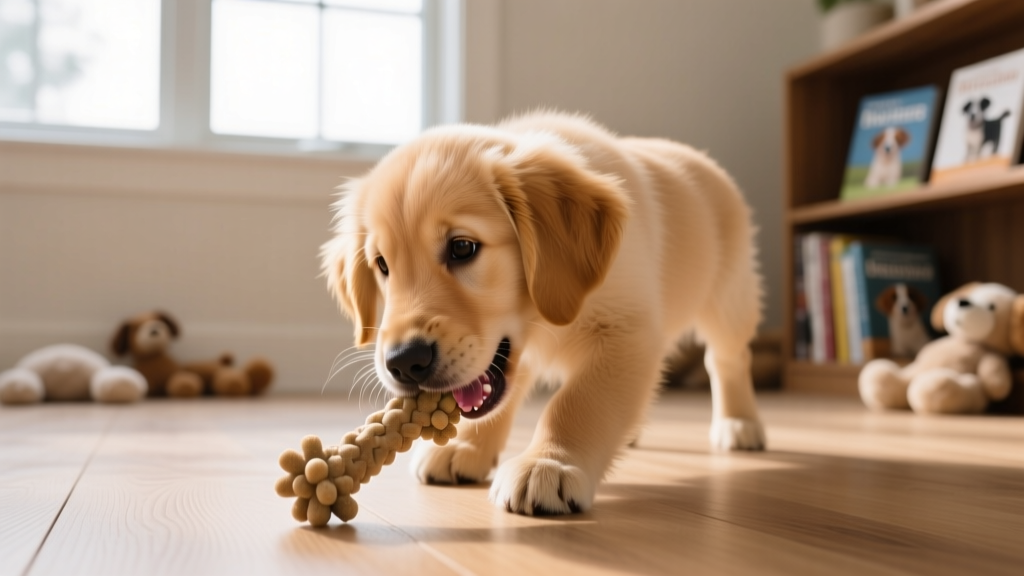
Golden Retriever puppies begin losing their 28 deciduous teeth around 12–16 weeks, with all 42 adult teeth typically erupted by 6–7 months. During this window, chewing is not optional — it is a physiological need. Expect:
- 12–16 weeks: Incisors loosen first. You may find tiny teeth in bedding or toys. Increased mouthing of hands and clothing.
- 16–24 weeks: Canines and premolars erupt. Peak chewing intensity. Gums may appear red or bleed slightly — this is normal.
- 5–7 months: Molars come in. Chewing begins to taper as adult dentition completes.
Safe chew options by age:
- 8–16 weeks: Frozen wet washcloths (twist and soak in water, then freeze), Nylabone Puppy Chew (soft flex material), KONG Puppy (pink/blue rubber — softer formula)
- 4–6 months: Classic KONG (red, medium size) stuffed with pumpkin and kibble then frozen, Benebone Puppy Wishbone, bully sticks (supervised only — remove when small enough to swallow)
- 6+ months: KONG Classic (red or black, large size), Yak cheese chews, West Paw Zogoflex Hurley
Avoid: Rawhide (choking and blockage risk), cooked bones (splinter), antlers (tooth fractures are common in enthusiastic Golden chewers), and any chew small enough to fit entirely inside your puppy's mouth.
Stopping Puppy Biting and Nipping
Golden Retrievers are a retrieving breed — their mouths are their primary tool for interacting with the world. Puppy nipping is normal, but it must be shaped into gentle behavior before adult teeth arrive. Here is a force-free protocol:
- Redirect (8–16 weeks): When puppy mouths skin, immediately offer an appropriate chew toy. Praise and reward chewing on the toy. Never yell or physically punish — this damages trust and can trigger fear-based biting.
- Reverse time-out (8+ weeks): If teeth touch skin, say "oops" in a calm tone, stand up, and turn away or step behind a baby gate for 10–15 seconds. Return and re-engage with a toy. This teaches that biting ends play — the exact lesson littermates teach each other.
- Teach "leave it" and "drop it" (10+ weeks): Start with low-value items and trade up. These cues give you a verbal alternative to physically removing objects from your puppy's mouth.
- Satisfy the oral fixation: A Golden puppy who has access to 5–8 appropriate chew toys rotated throughout the day will mouth people significantly less than one with a single toy left out permanently.
If biting intensifies rather than decreases after 16 weeks, or if you observe growling combined with hard biting over resources, consult a certified professional dog trainer (CPDT-KA) or veterinary behaviorist. Early intervention prevents escalation.
When and Why to Enroll in Puppy Class
A well-run puppy class is the single highest-return investment you can make in your Golden Retriever's behavioral health. Here is how to time enrollment and what to look for:
| Class Type | Ideal Puppy Age | Focus Areas | Typical Cost (6–8 week course) |
|---|---|---|---|
| Puppy Socialization / Play Class | 8–14 weeks | Off-leash play, confidence building, handling exercises, basic sit/down | $120–$200 |
| Puppy Basic Manners | 12–20 weeks | Sit, down, stay, recall, loose-leash walking, leave it, polite greetings | $150–$300 |
| Intermediate / Teen Class | 5–10 months | Proofing commands with distractions, distance stays, recall under temptation | $180–$350 |
| AKC S.T.A.R. Puppy Test Prep | 4–8 months | 20-item evaluation covering socialization, training, activity, responsibility | $80–$150 (test fee often included) |
What to look for in a puppy class: Only positive reinforcement methods (treats, toys, praise). No prong collars, shock collars, or alpha rolls. Class size should be 6–8 puppies maximum. The instructor should hold a CPDT-KA, KPA-CTP, or equivalent certification. Observe a class before enrolling — puppies should look engaged, not stressed or shut down.
First-Year Cost Breakdown for a Golden Retriever
| Category | Low Estimate | Mid-Range | High Estimate |
|---|---|---|---|
| Puppy purchase (responsible breeder) | $1,500 | $2,500 | $4,000+ |
| Veterinary care (vaccines, spay/neuter, wellness exams, fecal tests) | $600 | $1,000 | $1,800 |
| Food (large-breed puppy formula, 12 months) | $500 | $750 | $1,100 |
| Supplies (crate, bed, leash, harness, bowls, gates, toys, chews) | $300 | $500 | $900 |
| Training classes (puppy + intermediate) | $250 | $450 | $800 |
| Preventive medications (heartworm, flea/tick — 12 months) | $200 | $350 | $500 |
| Pet insurance (annual premium) | $400 | $700 | $1,200 |
| TOTAL FIRST YEAR | $3,750 | $6,250 | $10,300+ |
Note: These figures do not include emergency veterinary care. Golden Retrievers are predisposed to conditions like bloat (GDV), which can cost $3,000–$7,000 in emergency surgery. Pet insurance or a dedicated emergency fund of at least $3,000 is strongly recommended.
Frequently Asked Questions
When should I bring my Golden Retriever puppy home?
Ideally between 8 and 10 weeks. Some Golden breeders prefer to hold until 10 weeks to allow additional littermate socialization, which helps reduce mouthing intensity. Never accept a puppy younger than 8 weeks — early separation is linked to increased fear, reactivity, and difficulty learning bite inhibition.
How often should I feed my Golden puppy at 10 weeks old?
Four meals per day, spaced roughly 4 hours apart (e.g., 7 AM, 11 AM, 3 PM, 7 PM). Total daily portion for a 12–15 lb puppy is approximately 1.5–2.5 cups of large-breed puppy kibble divided across those four meals. Reduce to 3 meals at 12 weeks and 2 meals at 6 months.
When will my Golden Retriever be fully potty trained?
Most Golden Retrievers are reliably housetrained between 5 and 7 months with consistent scheduling. "Fully" trained means fewer than one accident per month. Submissive and excitement urination may persist until 12 months — these are emotional responses, not training failures, and typically resolve with maturity.
What vaccines does my Golden puppy need and when?
Core vaccines include DHPP at 6–8, 10–12, and 14–16 weeks, plus a Rabies vaccine at 14–16 weeks (timing varies by state law). Non-core vaccines your vet may recommend based on your area include Leptospirosis, Lyme, Bordetella, and Canine Influenza. Consult your veterinarian to build a protocol tailored to your puppy's risk profile.
How do I stop my Golden Retriever puppy from biting?
Use a redirect-and-withdraw protocol: when teeth touch skin, calmly offer a chew toy instead, or briefly withdraw attention for 10–15 seconds. Never hit, hold the mouth shut, or use aversive techniques. Provide 5–8 rotated chew toys daily to satisfy the breed's natural oral fixation. If hard biting persists past 16 weeks, consult a certified positive-reinforcement trainer.
When can my Golden puppy go to the park or meet other dogs?
Structured indoor puppy classes with vaccinated puppies are safe after the second DHPP (around 12 weeks). Public dog parks and high-traffic outdoor areas should wait until 1 week after the final DHPP at 14–16 weeks. For socialization before full vaccination, carry your puppy to outdoor environments, invite healthy vaccinated dogs to your home, and avoid areas where unknown dogs have defecated.
Marcus Aldridge
All our authors care for dogs every day — read more of their work on the authors page.