Cute Golden Retriever Puppies: Week-by-Week Growth, Training & Care Guide
Everything you need to raise cute Golden Retriever puppies: age milestones, feeding schedules, potty training timelines, vaccines, and first-year costs.

Bringing Home Your Golden Retriever Puppy: What to Expect
Those photos of cute Golden Retriever puppies tumbling over each other in a whelping box are irresistible — but the leap from breeder visit to real-life puppy parenting is significant. Golden Retrievers are consistently one of the most popular breeds in the US, and for good reason: they're eager to please, highly trainable, and famously gentle with children. But a Golden puppy between 8 weeks and 12 months requires a structured plan covering nutrition, socialization, veterinary care, and consistent training.
This guide walks you through every developmental stage from week 4 through the first birthday, with exact feeding portions, vaccination dates, crate training time limits, and realistic cost expectations. Whether you're picking up your puppy next weekend or still researching responsible breeders, you'll find actionable specifics here — not vague "feed high-quality food" advice.
When should I bring my puppy home?
The American Kennel Club and most veterinary behaviorists recommend bringing a Golden Retriever puppy home between 8 and 10 weeks of age. Puppies separated before 8 weeks miss critical littermate socialization and bite-inhibition learning. Some breeders of Golden Retrievers hold puppies until 10-12 weeks to complete early socialization protocols, which can actually benefit first-time owners.
Golden Retriever Puppy Milestones: Weeks 4 Through 12 Months
Golden Retrievers mature more slowly than smaller breeds, and you should expect puppy-like behavior through 18-24 months. Here's what each developmental window looks like in practice:
Weeks 4–8: The Litter Phase (At the Breeder)
During this period, your future puppy is learning canine communication from their mother and littermates. Teeth begin erupting around week 3-4, and weaning onto solid food starts. Responsible breeders begin early neurological stimulation (ENS) and introduce novel textures, sounds, and gentle handling. Puppies at this stage weigh roughly 5-10 lb (2.3-4.5 kg) and sleep 18-20 hours per day.
Weeks 8–12: Homecoming and Bonding
This is the peak socialization sensitivity period. Your puppy will form lasting impressions of new experiences — positive or negative. Expect frequent napping (puppies this age can only stay awake 1-2 hours between naps), mouthing and nipping during play, and short attention spans of 5-10 minutes for training. Weight typically ranges from 10-22 lb (4.5-10 kg). Fear periods can occur around 8-10 weeks, where previously confident puppies may suddenly seem startled by ordinary objects.
Weeks 12–16: Building Confidence
Your Golden puppy's coordination improves dramatically. They begin to understand basic cues like "sit" and "come" with consistent repetition. The second fear period may emerge around 14-16 weeks. Bladder control extends to approximately 3-4 hours during the day. Weight reaches 25-40 lb (11-18 kg).
Weeks 16–24 (4–6 Months): The Adolescent Shift
This is when many owners feel their puppy "forgot everything they learned." Adolescent Golden Retrievers test boundaries, exhibit selective hearing, and may develop temporary fear responses to previously familiar stimuli. Teething intensifies between 4-6 months. Weight ranges from 35-55 lb (16-25 kg).
6–12 Months: The "Teenage" Golden
Your puppy will approach adult size (55-75 lb / 25-34 kg depending on sex and lineage) but retain puppy energy and mouthiness. Sexual maturity occurs — females may enter their first estrus cycle between 6-12 months, and males begin marking behaviors. This is the window where consistent training pays off or falls apart. Many owners enroll in intermediate obedience classes during this stage.
Feeding Your Golden Retriever Puppy: Portions and Schedule
Golden Retrievers are prone to rapid growth and obesity, both of which increase the risk of hip dysplasia and other orthopedic conditions. Research published in the Journal of the American Veterinary Medical Association demonstrates that keeping growing large-breed puppies lean reduces the incidence of hip dysplasia significantly. Feed a food specifically formulated for large-breed puppies — it will have controlled calcium-to-phosphorus ratios and moderate caloric density.
| Age | Meals Per Day | Approximate Daily Portion* | Notes |
|---|---|---|---|
| 8–12 weeks | 3–4 | 1.5–2 cups/day (split across meals) | Soften kibble with warm water if needed; feed large-breed puppy formula |
| 3–6 months | 3 | 2–3 cups/day | Monitor body condition score (BCS); you should feel ribs without pressing hard |
| 6–12 months | 2 | 3–4 cups/day | Transition to adult food around 12 months; reduce portions if BCS exceeds 5/9 |
| 12+ months | 2 | 2.5–3.5 cups/day (adult maintenance) | Active males may need up to 4 cups; sedentary females may need as little as 2 cups |
*Portions are approximate and based on a typical large-breed puppy kibble at ~370 kcal/cup. Always check the feeding chart on your specific food brand and adjust based on your puppy's body condition score. Your veterinarian can help you determine the ideal portion at each wellness visit.
How often should I feed my puppy at each age? The standard recommendation is 3-4 meals daily from 8-12 weeks, dropping to 3 meals from 3-6 months, and transitioning to 2 meals from 6 months onward. Never free-feed a Golden Retriever puppy — they will overeat, and excess weight stresses developing joints.
Vaccination Schedule for Golden Retriever Puppies
The American Veterinary Medical Association outlines core vaccines that every puppy needs regardless of lifestyle. Golden Retrievers follow the standard large-breed puppy vaccination protocol:
| Age | Vaccines Administered | Notes |
|---|---|---|
| 6–8 weeks | DHPP (Distemper, Hepatitis/Adenovirus, Parainfluenza, Parvovirus) — 1st dose | Often given by the breeder; confirm with documentation |
| 10–12 weeks | DHPP — 2nd dose; Bordetella (optional, recommended if attending puppy classes) | Bordetella protects against kennel cough; intranasal or injectable |
| 14–16 weeks | DHPP — 3rd (final) dose; Rabies (required by law in most states) | Puppy is NOT fully protected until 2 weeks after this final DHPP dose |
| 12–16 months | DHPP booster; Rabies booster; Leptospirosis (recommended for outdoor dogs) | Then DHPP every 3 years; Rabies per local law (1 or 3 year); Lepto annually |
What vaccines does my puppy need and when? The core DHPP series at 6-8, 10-12, and 14-16 weeks is non-negotiable. Parvovirus is nearly 100% fatal in untreated puppies and survives in soil for over a year. Rabies is legally required. Your veterinarian may also recommend Leptospirosis (especially in areas with wildlife exposure) and Lyme disease vaccine if you live in a tick-endemic region. Always consult your veterinarian to tailor the schedule to your local risk factors.
When can my puppy go outside and meet other dogs?
Until your puppy has received their final DHPP booster at 14-16 weeks plus 2 additional weeks for immunity to develop, avoid high-risk areas like dog parks, pet store floors, and unknown dog environments. However, the critical socialization window closes around 14-16 weeks — so you must socialize during this vulnerable period. The American Veterinary Society of Animal Behavior recommends controlled exposure to vaccinated, known-healthy dogs in private yards or structured puppy classes. Carry your puppy into public spaces for exposure without ground contact until fully vaccinated.
Socialization: The 3–14 Week Window You Cannot Afford to Miss
Behavioral euthanasia kills more dogs than infectious disease. The primary socialization period for puppies closes around 14 weeks, and Golden Retrievers — despite their naturally friendly temperament — still require deliberate, positive exposure to develop into well-adjusted adults. A poorly socialized Golden can develop fear-based reactivity, separation anxiety, or resource guarding.
Socialization exposure checklist (aim for positive experiences with each category before 14 weeks):
- People: At least 7-10 different individuals — men with beards, children under 10, people wearing hats/sunglasses, people in wheelchairs, tall people, delivery workers
- Surfaces: Grass, gravel, metal grates, wet pavement, wooden floors, carpet, stairs
- Sounds: Vacuum cleaner, thunderstorms (play recordings at low volume), doorbells, car horns, clapping, power tools at a distance
- Handling: Paw touching, ear inspection, mouth opening, nail trimming practice, being held gently, collar/harness grabbing
- Environments: Car rides, parking lots, outdoor cafés (carried), friend's houses, veterinary clinic (happy visits with treats only)
- Other animals: Fully vaccinated adult dogs, cats (supervised), livestock at a distance if accessible
- Objects: Umbrellas opening, plastic bags rustling, brooms, bicycles, skateboards
Each exposure must be positive — pair new experiences with high-value treats (small pieces of boiled chicken, cheese, or commercial training treats). If your puppy shows fear, increase distance and let them observe without forcing interaction. Never flood a puppy by forcing them to "get over it."
Potty Training Timeline and Troubleshooting
When will my puppy be fully potty trained? For Golden Retrievers, realistic expectations are 4-6 months for reliable daytime house training and up to 8-12 months for full overnight bladder control. Some individuals achieve reliability faster, but planning for the longer timeline prevents frustration.
The general rule for maximum bladder hold time during the day is: puppy's age in months plus one hour. So a 3-month-old Golden can hold for approximately 4 hours maximum — but you should take them out far more frequently to build the habit.
| Time | Location (Indoor/Outdoor) | Result (Pee/Poop/Nothing) | Reward Given | Notes (signals observed) |
|---|---|---|---|---|
| 7:00 AM | Outdoor — designated spot | Pee + Poop | Yes — treat + verbal praise | Woke from crate, circled |
| 9:30 AM | Outdoor | Pee | Yes | After play session |
| 12:00 PM | Outdoor | Nothing | No (waited 5 min) | Back inside, try again in 20 min |
| 12:20 PM | Outdoor | Poop | Yes | Sniffed and circled |
Potty training troubleshooting for Golden Retrievers:
- Submissive/excitement urination: Common in young Goldens. Greet your puppy calmly at the door, avoid looming over them, and take them straight outside after exciting events. Most outgrow this by 8-12 months.
- Not signaling to go out: Teach a bell-ringing behavior. Hang bells on the door handle and guide your puppy's paw to ring them before every outdoor trip. Most Goldens learn this within 1-2 weeks.
- Accidents after being "trained": If your previously reliable puppy suddenly has accidents, rule out urinary tract infection with a veterinary urinalysis. Adolescent Goldens may also regress temporarily during developmental phases.
- Nighttime accidents: Remove water 2 hours before bedtime, take a final potty trip at 10-11 PM, and set a 3 AM alarm for puppies under 4 months. Gradually push this alarm later as bladder capacity increases.
Crate Training Progression and Time Limits
Golden Retrievers generally adapt well to crates when introduced properly. The crate should be large enough for your puppy to stand, turn around, and lie down comfortably — but not so large that they can eliminate in one corner and sleep in another. A 36-inch crate with a divider panel works well, upgrading to a 42-inch crate for adult males.
Crate time limits by age (maximum during the day):
- 8–10 weeks: 30–60 minutes at a time (except overnight)
- 11–14 weeks: 1–3 hours maximum
- 15–16 weeks: 3–4 hours maximum
- 4–6 months: 4–5 hours maximum
- 6+ months: 6–8 hours maximum (though 8 hours should not be the daily norm)
Overnight, puppies can typically hold 1 hour longer than their daytime maximum because metabolism slows during sleep. A 10-week-old Golden puppy will likely need one overnight potty break; by 16 weeks, most can sleep 6-7 hours straight.
Make the crate a positive space: feed meals inside it, provide a stuffed Kong or safe chew toy, and never use the crate as punishment. If your puppy whines, wait for a brief moment of silence before opening the door — releasing them mid-whine teaches that vocalizing works.
Teething Timeline and Safe Relief Strategies
Golden Retriever puppies begin losing their 28 deciduous (baby) teeth between 3 and 6 months of age, replaced by 42 permanent teeth. You'll likely find small teeth on the floor or in chew toys, though many puppies swallow them without issue. Signs of teething include increased chewing, drooling, mild gum bleeding, decreased appetite for hard kibble, and irritability.
Safe teething relief strategies:
- Frozen washcloth: Wet a clean washcloth, twist it into a rope, freeze for 2 hours, and supervise chewing. Discard if it begins to shred.
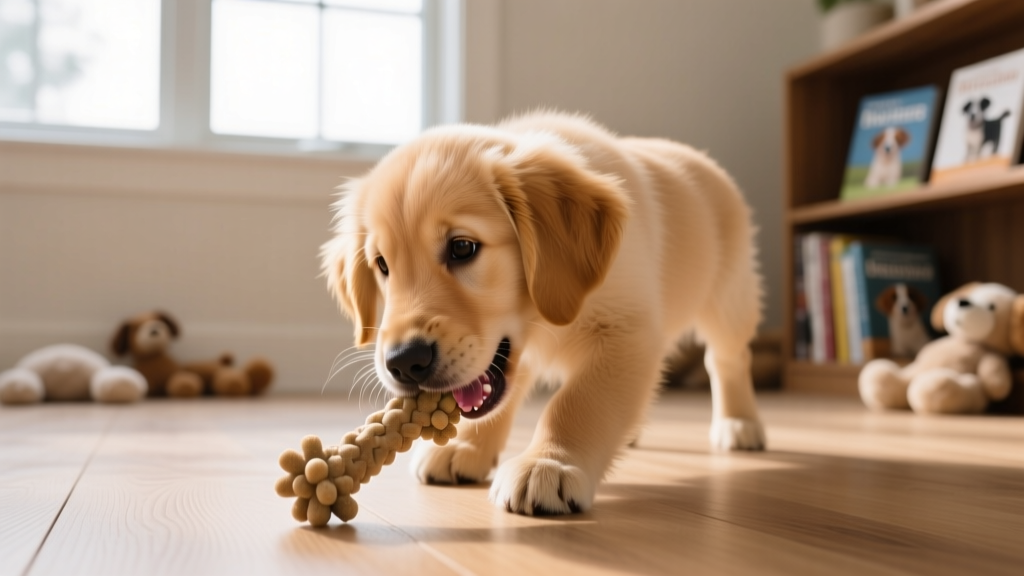
- Rubber chew toys: Kong Classic (size appropriate — Medium for puppies under 30 lb, Large for older puppies), West Paw Zogoflex Hurley, or Nylabone Puppy Chew. Avoid hard nylon bones during active teething, as they can fracture developing teeth.
- Chilled carrots or apple slices: Provide cold crunch without the risk of splintering. Remove apple seeds (they contain trace cyanide). Supervise to prevent choking on large pieces.
- Redirect inappropriate chewing: Keep shoes, remotes, and cords out of reach. When your puppy mouths a forbidden item, trade for an approved chew toy and reward the swap — never punish after the fact.
If your puppy seems to be in significant pain (refusing food for more than one meal, pawing at the mouth excessively, or showing swelling), consult your veterinarian. Retained baby teeth — where the adult tooth erupts alongside the baby tooth — are common in Golden Retrievers and may require veterinary extraction to prevent malocclusion.
Common Golden Retriever Puppy Problems and Solutions
How do I stop puppy biting and nipping? Golden Retrievers are a mouthy breed — they were developed to carry game birds gently, so using their mouths is deeply ingrained. Puppy nipping peaks between 8-16 weeks and gradually decreases with consistent management:
- Bite inhibition training: When teeth contact skin, say "ouch" in a calm, firm tone and immediately withdraw attention for 10-15 seconds (stand up, cross arms, look away). Resume play when the puppy is calm. This mimics how littermates teach each other.
- Redirect to toys: Always have an appropriate chew toy within arm's reach during play sessions. When the puppy mouths you, offer the toy instead and praise enthusiastically when they bite the toy.
- Manage arousal levels: Nipping intensifies when puppies are overtired or overstimulated. If your Golden puppy becomes a "land shark," they likely need a nap — enforce a crate rest with a chew toy.
- Avoid hands-as-toys: Never wrestle with your puppy using bare hands. This teaches that human skin is an acceptable chew target. Use tug toys for interactive play.
Whining and crying in the crate: Distinguish between protest whining (which you should largely ignore) and distress signals (which indicate the puppy needs to eliminate or is genuinely panicked). A puppy who has just been taken outside, fed, and exercised, then placed in the crate with a stuffed Kong, is likely protesting — wait for a pause in vocalization before opening the crate. A puppy who has been crated for 4+ hours and is suddenly whining urgently likely needs to potty.
Destructive chewing beyond teething: Adolescent Goldens (6-12 months) may chew furniture, baseboards, and shoes out of boredom. Solutions include increasing physical exercise (aim for 5 minutes of structured exercise per month of age, twice daily), providing mental stimulation through food puzzles and scent work, and puppy-proofing rooms with bitter apple spray on tempting surfaces.
First-Year Cost Breakdown for a Golden Retriever Puppy
Budgeting realistically prevents surrender to shelters. Here's what Golden Retriever ownership actually costs in the first 12 months (US averages, 2025-2026 pricing):
| Category | Low Estimate | Mid Estimate | High Estimate | Notes |
|---|---|---|---|---|
| Puppy purchase (responsible breeder) | $1,500 | $2,500 | $4,000+ | Health-tested parents, AKC registration, take-back clause; adoption from rescue: $200-$600 |
| Veterinary care (wellness visits, vaccines, spay/neuter) | $600 | $1,200 | $2,000 | Includes 3-4 puppy visits, fecal tests, heartworm prevention, spay/neuter at 6-12 months |
| Food (large-breed puppy formula) | $400 | $600 | $900 | Based on premium kibble at $50-80 per 30 lb bag; raw diets cost significantly more |
| Supplies (crate, bed, leash, collar, bowls, toys, gate) | $250 | $450 | $700 | Initial setup; expect to replace chewed toys and beds multiple times |
| Training (puppy class, basic obedience) | $150 | $400 | $1,200 | Group classes: $150-$300 for 6-8 weeks; private sessions: $80-$150/hour |
| Preventive medications (heartworm, flea/tick) | $200 | $350 | $500 | Monthly preventives; year-round in most US regions |
| Pet insurance (optional but recommended) | $400 | $600 | $900 | $35-$75/month; Golden Retrievers have higher-than-average claim rates due to hip/elbow dysplasia and cancer predisposition |
| Grooming | $100 | $300 | $600 | Goldens need brushing 3-4x/week; professional grooming every 8-12 weeks for baths and nail trims |
| Total first year | $3,600 | $6,400 | $10,800+ | Excludes emergency veterinary care (budget $1,000-$3,000 emergency fund) |
Golden Retrievers are predisposed to hip dysplasia, elbow dysplasia, certain cardiac conditions (subvalvular aortic stenosis), and several cancers (hemangiosarcoma, lymphoma). Pet insurance purchased during puppyhood — before any conditions are documented — ensures pre-existing condition exclusions don't apply to future claims. Companies like Trupanian, Healthy Paws, and Nationwide offer breed-appropriate plans; compare based on reimbursement percentage, annual limits, and whether they cover hereditary conditions.
Frequently Asked Questions About Golden Retriever Puppies
Are Golden Retrievers good first dogs?
Yes, with caveats. Golden Retrievers are forgiving of beginner training mistakes and rarely show true aggression. However, their high energy, mouthiness, exercise needs (60+ minutes daily as adults), heavy shedding, and 10-12 year lifespan commitment make them a bigger responsibility than many first-time owners anticipate. Puppy classes and a structured routine are essential — Goldens left alone 10 hours daily with no stimulation will develop destructive behaviors.
How big will my Golden Retriever puppy get?
Adult male Golden Retrievers typically weigh 65-75 lb (29-34 kg) and stand 23-24 inches at the shoulder. Females weigh 55-65 lb (25-29 kg) and stand 21.5-22.5 inches, per the AKC breed standard. English-type ("British") Goldens from show lines tend to be stockier; field-line Goldens are leaner and more athletic. You can estimate adult weight by doubling the puppy's weight at 16 weeks, though this is approximate.
When should I start training my Golden Retriever puppy?
Training begins the day you bring your puppy home. At 8 weeks, Golden Retriever puppies can learn "sit," "come," and their name using positive reinforcement (food rewards, praise, play). Keep sessions to 3-5 minutes, 2-3 times daily. Formal group puppy classes can begin after the first DHPP vaccine, typically around 10-12 weeks — the socialization benefits of class outweigh the minimal disease risk in a controlled environment with vaccinated puppies.
My Golden puppy is biting my children — is this normal?
Nipping is normal puppy behavior, but children under 8 should never be left unsupervised with any puppy. Teach children to stand still like a "tree" (arms crossed, no eye contact) when the puppy gets mouthy, and to redirect to a toy. If nipping breaks skin or intensifies rather than decreases by 16 weeks, consult a certified professional dog trainer (CPDT-KA or IAABC credentialed) for guidance.
Do Golden Retrievers shed a lot as puppies?
Golden puppy coat is soft and relatively short. The adult double coat — with its dense, water-resistant undercoat — develops between 8-18 months. Once the adult coat comes in, expect year-round moderate shedding with heavy "blowing" of the undercoat twice annually (spring and fall). Invest in an undercoat rake and a high-quality vacuum. Daily brushing during coat blows will keep fur off your furniture.
Raising a Golden Retriever puppy is demanding but deeply rewarding. Their intelligence, eagerness to work with you, and emotional sensitivity make them one of the most trainable breeds available. Stick to a consistent schedule through the first year, invest in early socialization, and maintain regular veterinary wellness visits — and you'll have a well-mannered adult dog for the next decade.
Robin Maitland
All our authors care for dogs every day — read more of their work on the authors page.